Using GI Bill for Personal Trainer Certification: A Veteran’s Guide to Fitness Careers
Your GI Bill is a finite resource. You shouldn’t spend it on a simple test-prep course when you could fund an entire career. Many veterans believe…

Your GI Bill is a finite resource. You shouldn’t spend it on a simple test-prep course when you could fund an entire career. Many veterans believe that using GI bill for personal trainer certification is limited to a one-time exam reimbursement, but you can actually leverage your benefits for a comprehensive, 600-hour vocational education. You’ve already mastered the discipline and leadership required for the fitness industry. Now, it’s time to ensure your professional education matches your ambition.
We understand the frustration of trying to decode VA benefits or the fear of accidentally choosing a “diploma mill” that doesn’t lead to a job. This guide promises to clear the confusion by showing you exactly how to transition from military service to a high-impact role as a certified fitness professional. We will preview the 2026 VA tuition rates, explain the difference between full tuition coverage and exam reimbursements, and provide a roadmap to a stable civilian career in health and wellness.
Key Takeaways
- Learn the critical difference between simple exam reimbursement and full tuition coverage for accredited vocational diplomas.
- Discover why using GI bill for personal trainer certification at a 600-hour vocational school provides a more stable career foundation than a weekend certificate.
- Identify the essential science-based components, from biomechanics to nutrition coaching, that transform a fitness enthusiast into a professional coach.
- Get a clear, step-by-step roadmap for navigating the VA.gov portal and the WEAMS database to find high-quality, approved programs.
- Understand how veteran-led instruction translates your military leadership and discipline into effective client motivation and business success.
How to Use the GI Bill for Personal Trainer Certification
Transforming your passion for fitness into a professional career is more accessible than you think. The Department of Veterans Affairs recognizes that not every veteran wants to sit in a traditional classroom for four years. Because of this, the G.I. Bill explicitly supports Non-College Degree (NCD) vocational programs. These programs focus on hands-on skills and job readiness, making them the perfect fit for transitioning service members who prefer action over theory.
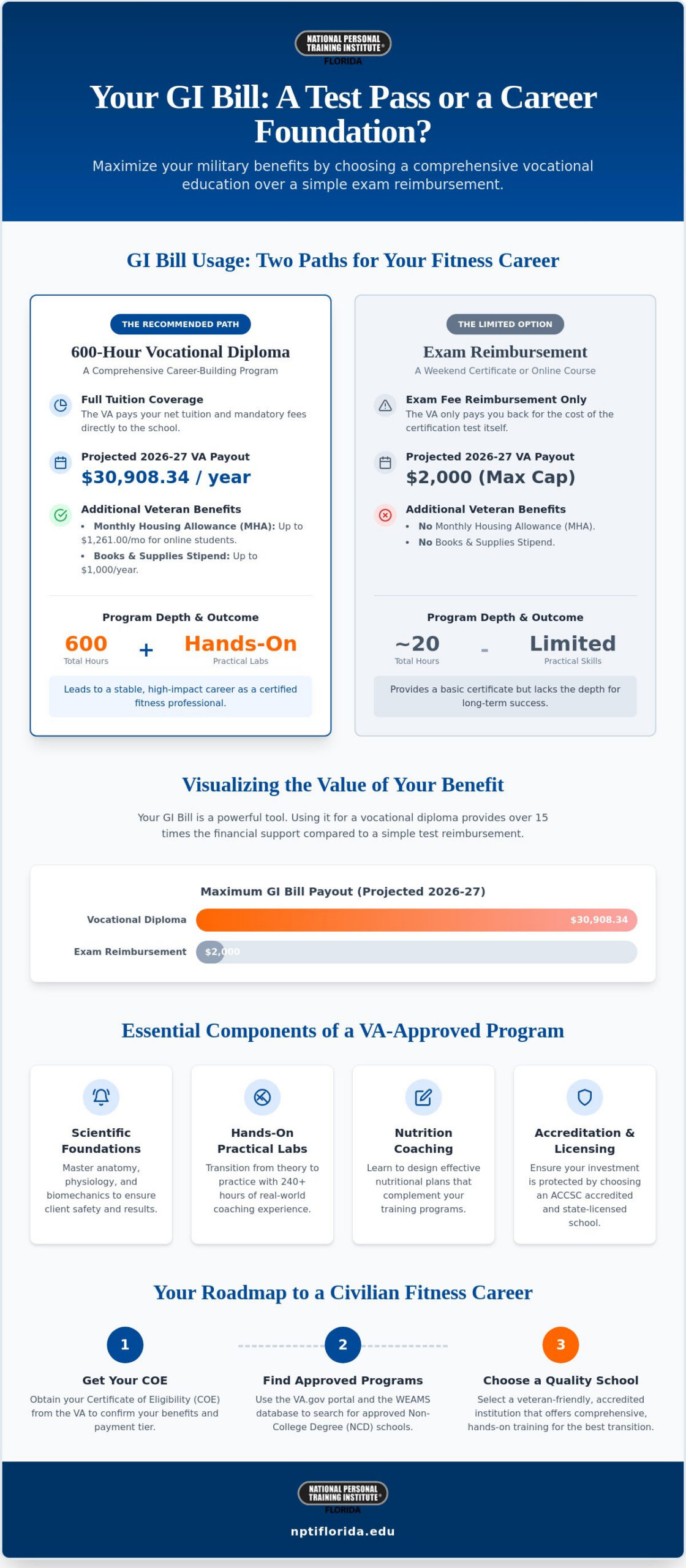
There is a major difference between “Exam Reimbursement” and “Full Tuition Coverage.” Most online-only certifications simply offer to pay back your testing fee, which is capped at $2,000 for the 2026-2027 academic year. However, using GI bill for personal trainer certification at an accredited vocational school allows the VA to pay your net tuition and mandatory fees up to $30,908.34 per year. This turns a simple certificate into a comprehensive professional foundation without the out-of-pocket stress.
Post-9/11 GI Bill (Chapter 33) for Fitness Schools
If you’re eligible for Chapter 33, the VA pays your tuition and fees directly to the institution. This removes the financial barrier between you and your new career. Beyond tuition, you’ll receive a Monthly Housing Allowance (MHA) while you train. For students attending entirely online programs during the 2026-2027 term, the maximum housing allowance is $1,261.00 per month. In-person or hybrid students often qualify for even higher rates based on the school’s physical location. You also receive a book and supplies stipend of up to $1,000 per academic year to ensure you have the scientific texts and gear required for elite coaching.
Montgomery GI Bill and Other VA Programs
Veterans using GI bill for personal trainer certification under Chapter 30 (MGIB-AD) receive a monthly payout directly to their bank account. You then use these funds to cover your educational expenses. If you have a service-connected disability, you might qualify for Veteran Readiness and Employment (VR&E/Chapter 31). This program provides personalized support and can often cover 100% of the costs for vocational training if it’s part of your employment plan. Your first required document for any of these pathways is the Certificate of Eligibility (COE), which officially confirms your remaining months of benefits and your payment tier.
Vocational Diploma vs. Weekend Certificates: Maximizing Your Benefits
Speed is often the enemy of mastery. While it might be tempting to chase a weekend certificate to get into the gym quickly, your GI Bill benefits are designed for much more than a three-day workshop. When you consider using GI bill for personal trainer certification, you have to look at the long-term return on investment. A 20-hour online course might get you a piece of paper, but it won’t give you the professional stability or the deep scientific knowledge required to handle complex client needs. A 600-hour diploma program bridges the knowledge gap that often leads new trainers to fail within their first year of private practice.
Contact hours matter. Reading about a squat in a PDF is vastly different from correcting a client’s form in real-time. Many veterans find that using GI bill for personal trainer certification through a licensed vocational school is the most efficient way to secure a high-paying role. Comprehensive vocational programs prioritize these hands-on interactions, ensuring you graduate as a seasoned professional rather than a nervous novice.
The 600-Hour Standard in Fitness Education
A true vocational education is built on a foundation of 360 hours of theory and 240 hours of practical lab work. This specific split ensures you understand the why behind the what. You won’t just memorize exercises; you’ll master anatomy and biomechanics. This depth is critical for preventing client injury and building the professional confidence needed to command higher rates. For a deeper look at why this matters, see The Ultimate Personal Training Program Guide: Choosing a Career, Not Just a Certification.
Accreditation and Licensing Matters
Not all schools are created equal. To protect your benefits, you must choose an institution with ACCSC accreditation. This ensures the school meets rigorous national standards for educational quality. Additionally, state licensure from bodies like the Florida Commission for Independent Education provides a layer of security for your investment. Veterans should always verify VA Licensing and Certification Benefits to understand how their specific chapter applies to these programs. Avoiding unaccredited workshops ensures your education is recognized by top-tier employers nationwide.
Choosing a comprehensive path means you’re building a career architect’s toolkit. If you’re ready to move beyond the basics, consider how the Advanced Personal Training Program can set you apart in a crowded market.
Key Components of a VA-Approved Personal Training Program
Excellence in the fitness industry isn’t born from a weekend seminar. It’s built through a rigorous, science-based curriculum that prepares you for the realities of the gym floor. When using GI bill for personal trainer certification, you aren’t just buying a credential; you’re investing in a professional foundation. A comprehensive program dives deep into anatomy, physiology, and biomechanics. These are the scientific pillars of elite coaching. Without them, a trainer is just guessing with a client’s health. Understanding how the muscular and skeletal systems interact allows you to design programs that produce results without risking injury.
A modern trainer must also be a wellness architect. This means moving beyond just “counting macros” to master health and nutrition coaching. You’ll learn how to guide clients through behavioral changes that stick. Additionally, a VA-approved vocational program covers the business of fitness. You’ll study marketing, liability, and client retention strategies. This ensures you have the tools to build a private practice or lead a team in a commercial setting. Organizations like the NCSF Military Program recognize the value of this structured approach for transitioning service members.
Practical Lab Hours: The ‘Boots on the Ground’ of Fitness
Theory is only half the battle. High-quality programs emphasize 240 hours of practical lab work, where you translate military discipline into elite coaching skills. This hands-on time is where you learn to identify human movement dysfunction in person, a skill that’s impossible to master through a computer screen. You’ll practice spotting, cueing, and adjusting exercises for real people with different body types. Corrective Exercise serves as the essential bridge between rehabilitation and high-level performance, allowing you to help clients move better before they move heavier.
Specialized Modules: Youth and Senior Fitness
The fitness market is diverse, and your education should reflect that. The Senior Fitness Specialist niche is currently one of the fastest-growing sectors in the industry as the aging population seeks to maintain mobility and independence. You’ll learn the specific orthopedic considerations required for older adults, along with anatomical adjustments for youth athletes whose bodies are still developing. By integrating behavioral psychology into your nutritional programming, you can help these varied populations achieve long-term success. This specialized knowledge makes you a versatile professional, capable of serving anyone who walks through the gym doors.
The Step-by-Step Application Process for Veterans
Execution is everything. Once you’ve decided that using GI bill for personal trainer certification is your next mission, you need a clear tactical plan to secure your funding and reserve your seat. Start by visiting the VA.gov portal to verify your remaining months of eligibility. This ensures you have the necessary “runway” to complete a comprehensive 600-hour program. To find approved institutions, you must navigate the WEAMS (Web Enabled Approval Management System) database. Filter your search for “Non-College Degree” schools to locate high-quality vocational programs that specialize in fitness. If you’re still on active duty, begin this process at least six months before your separation date to ensure a seamless transition into the civilian workforce.
Many veterans find that using GI bill for personal trainer certification is most effective when they have a dedicated School Certifying Official (SCO) to navigate the bureaucracy. This individual acts as the professional liaison between the school and the Department of Veterans Affairs. They help you submit your enrollment documentation and ensure your monthly certifications are accurate so your housing allowance arrives without delay. Working closely with an SCO prevents administrative hurdles and keeps your focus entirely on mastering biomechanics and client coaching.
Obtaining Your Certificate of Eligibility (COE)
The Certificate of Eligibility is your primary proof of benefits and is required for enrollment. You apply for this document online using VA Form 22-1990. For the 2026 academic year, the VA recommends applying early, as processing times for new claims can fluctuate based on seasonal volume. If you have already used a portion of your GI Bill for other courses or a different degree, the VA will provide a pro-rated breakdown of your remaining entitlement. This document tells your school exactly how much of your tuition they can expect the VA to cover and confirms your eligibility for the book stipend and housing allowance.
Enrolling in a Hyflex Program
Modern vocational training often utilizes a Hyflex model to provide the flexibility you need during a career transition. This system balances digital classroom theory with mandatory, in-person lab hours on a physical gym floor. It’s a perfect fit for veterans who value flexibility but recognize that elite coaching skills require hands-on practice. If you’re searching for a flexible personal trainer course Orlando veterans can use to balance real-world lab hours with remote theory, the Hyflex model is designed to meet exactly that need. To qualify for the full Monthly Housing Allowance (MHA), your schedule must meet specific VA requirements for full-time enrollment. Understanding the difference between these instructional pathways is vital for your financial and professional planning. For a detailed comparison, read Personal Trainer School vs. Online Certification: Which Career Path is Right for You in 2026?.
Ready to start your transition? You can apply for the Personal Fitness Training Program today to lock in your spot for the upcoming term and begin your new career in wellness.
Why Veteran-Owned Fitness Schools Lead to Better Transitions
Trust is the foundation of any mentorship. When you choose a veteran-owned institution, you’re entering an environment where your background isn’t just understood; it’s celebrated. The shared language of discipline, punctuality, and a mission-first mentality creates a culture of excellence that mirrors your time in service. This cultural alignment makes using GI bill for personal trainer certification more than just an educational step. It becomes a strategic career move guided by mentors who have already successfully navigated the civilian transition. You don’t have to explain your work ethic here; it’s the baseline expectation.
Veteran-owned schools often provide superior job placement networks because they understand the inherent value of a veteran employee. They can vouch for your reliability and leadership in ways that traditional academic advisors cannot. This “Veteran-Owned and Operated” distinction is a mark of quality that signals a commitment to professional readiness and real-world results. Employers in the fitness industry actively seek out veterans because they know you’ll show up, lead by example, and stay focused on the client’s mission.
Translating Military Skills to the Gym Floor
Your military experience has already provided the “soft skills” that many civilian trainers take years to develop. Small Unit Leadership translates directly into Group Fitness Management, where you must command a room and keep participants focused on a common goal. Similarly, the principles of Operational Risk Management (ORM) are essential when applying biomechanics to client safety. You’ve been trained to assess risks and mitigate them; now, you’ll apply that same rigor to preventing injuries on the gym floor. When building your professional resume, we help you highlight these military achievements so fitness employers see you as the seasoned leader you truly are.
The Mission-Driven Purpose of Health Coaching
For many veterans, the hardest part of leaving the military is losing the sense of service to a larger cause. Health and nutrition coaching provides a powerful new mission. By helping others achieve wellness, you’re contributing to the long-term health and resilience of your community. Whether you’re working in rehabilitation centers or with special populations, your impact is tangible and life-changing. This isn’t just a job; it’s a professional evolution that respects your history while building your future. If you’re ready to lead again, the Advanced Personal Training Program is your next objective. Take the next step in your new mission today.
Take Command of Your Career in Health and Wellness
Your transition from military service to the civilian fitness market is a significant mission. By now, you understand that using GI bill for personal trainer certification is about more than just passing a test; it’s about choosing an educational pathway that offers long-term career stability through a comprehensive, science-based foundation. You’ve learned how to navigate the VA portal, the value of 600 hours of professional training, and why hands-on lab work is the “boots on the ground” experience you need to succeed as a coach.
As a Veteran Owned and Operated institution, we’re committed to your professional evolution. Our ACCSC Accredited programs provide a 600-Hour Comprehensive Diploma that sets the industry standard for excellence. Don’t settle for a weekend certificate when you can build a lasting career with a team that speaks your language. Your discipline is your greatest asset. Now, it’s time to apply it to a new field.
Launch your fitness career with NPTI Florida’s VA-approved programs. The gym floor is your new AO. Let’s get to work.
Frequently Asked Questions
Does the GI Bill pay for ACE or other industry certifications?
Yes, the VA provides reimbursement for the cost of exam fees for ACE and other accredited industry certifications. For the 2026-2027 academic year, you can be reimbursed up to $2,000 for these licensing tests. However, this reimbursement usually only covers the exam itself. It doesn’t pay for the full curriculum or hands-on study materials unless they are part of a VA-approved vocational diploma at a licensed institution.
Can I get a housing allowance (MHA) for personal trainer school?
You are eligible for a Monthly Housing Allowance (MHA) if you enroll in a VA-approved program at a vocational school. The amount depends on your location and whether you attend in person or through a hybrid model. For the 2026-2027 term, online-only students receive a maximum of $1,261.00 per month. In-person students often receive a higher rate based on the school’s physical zip code.
How much of my GI Bill will a 600-hour fitness program use?
A 600-hour program typically uses about six months of your GI Bill benefits. The VA calculates benefit usage based on the actual calendar time you spend in the program rather than the total number of hours. If you complete the program in six months of full-time study, you will still have 30 months of eligibility remaining for future education or advanced specializations.
Is personal trainer school considered a ‘Non-College Degree’ program?
Personal trainer schools are classified as Non-College Degree (NCD) programs by the VA. This classification is specifically for vocational institutions that provide technical training and hands-on skills for a specific career path. This is the primary way of using GI bill for personal trainer certification to cover full tuition costs rather than just one-time test fees.
Can I use the GI Bill for an online-only personal training course?
You can use your benefits for online-only courses, but your housing allowance will be lower. The VA limits the MHA for entirely online students to a national average, which is $1,261.00 for the current 2026-2027 academic year. Hybrid or “Hyflex” models that include in-person lab hours are often a better choice for veterans who want to maximize their financial support and practical experience. Learn how the flexible personal trainer course Orlando’s Hyflex program offers combines remote theory with essential hands-on gym hours to help you qualify for higher housing allowances.
What is the difference between exam reimbursement and tuition payment?
Exam reimbursement pays only for the cost of the certification test after you take it. In contrast, tuition payment for using GI bill for personal trainer certification covers the entire cost of a comprehensive vocational program. This includes your classroom instruction, practical labs, and books. Choosing a vocational school allows you to earn a diploma without paying out-of-pocket for your education.
Do I need to be a veteran to attend NPTI Florida?
You do not need to be a veteran to attend our programs. While we are a veteran-owned and operated school, we welcome all students who are passionate about health and wellness. We also accept eligible dependents using transferred Post-9/11 GI Bill benefits. Our diverse student body includes everyone from transitioning service members to career changers and dedicated fitness enthusiasts.
How long does it take for the VA to approve my personal training school application?
It typically takes the VA about 30 days to process your application for a Certificate of Eligibility (COE). Once you have this document and submit it to your school’s certifying official, the enrollment process moves quickly. We recommend starting your application at least 60 days before your intended start date to ensure all paperwork is finalized before your classes begin.