Personal Trainer School vs. Online Certification: Which Career Path is Right for You in 2026?
You can memorize a textbook in a weekend, but that won’t help you when a client with chronic back pain walks onto your gym floor. The debate between…
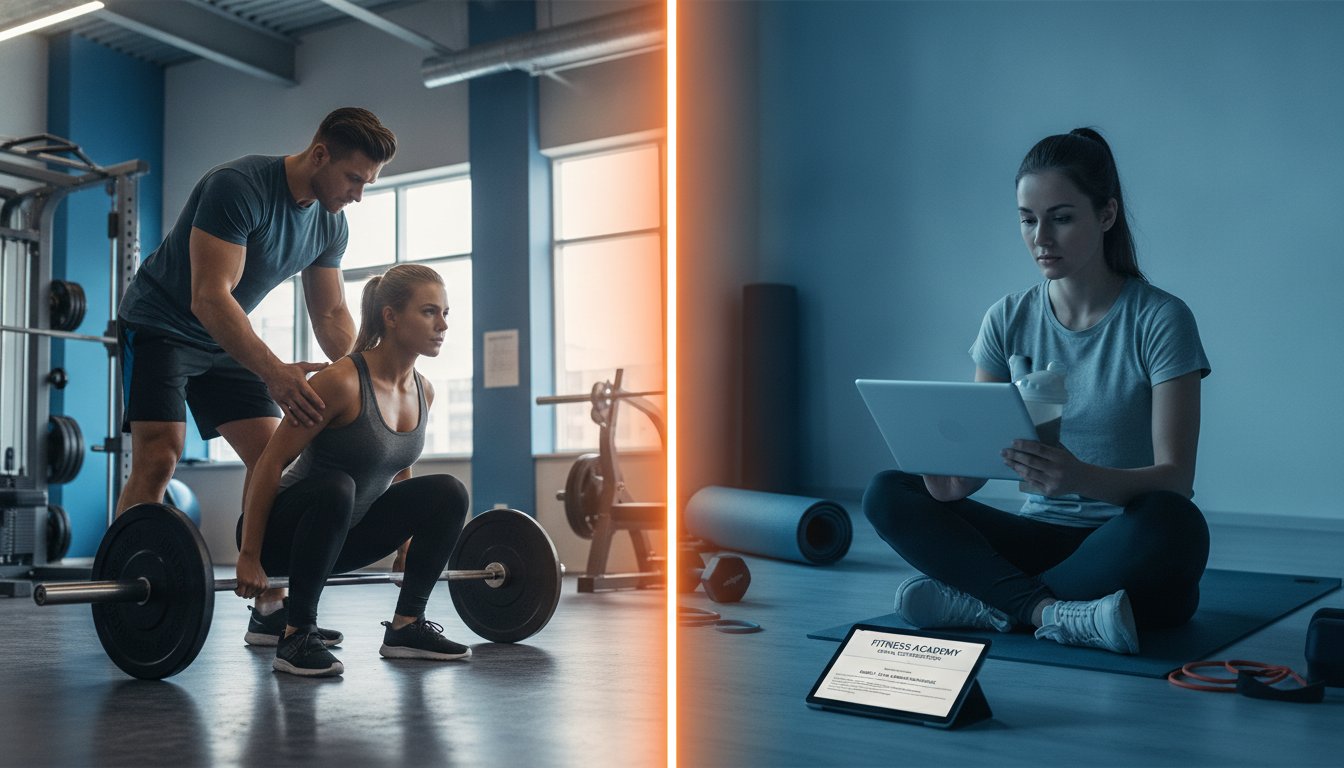
You can memorize a textbook in a weekend, but that won’t help you when a client with chronic back pain walks onto your gym floor. The debate between personal trainer school vs online certification often focuses on speed, but the real question is about professional mastery. It is completely normal to feel anxious about whether a digital badge will earn you respect in high-end clubs or if you will feel unprepared when training real people. You deserve a career path that offers more than just a credential; you need a science-based foundation that prepares you for the 14% industry growth expected through 2032.
We believe your education should be a foundational investment in your future as a fitness professional. This guide will help you discover the critical differences between passing an exam and mastering the craft of fitness so you can choose the path that guarantees career longevity. We will examine how different educational routes impact your long-term income potential, which credentials elite employers actually respect, and how to secure the hands-on experience that builds genuine professional confidence. By the end, you’ll have a clear roadmap to a stable and rewarding career in the fitness industry.
Key Takeaways
- Learn how to distinguish between a simple test-prep course and a comprehensive vocational education that prepares you for the complexities of human movement.
- Evaluate the true ROI of a personal trainer school vs online certification by looking beyond upfront costs to long-term earning potential and employer respect.
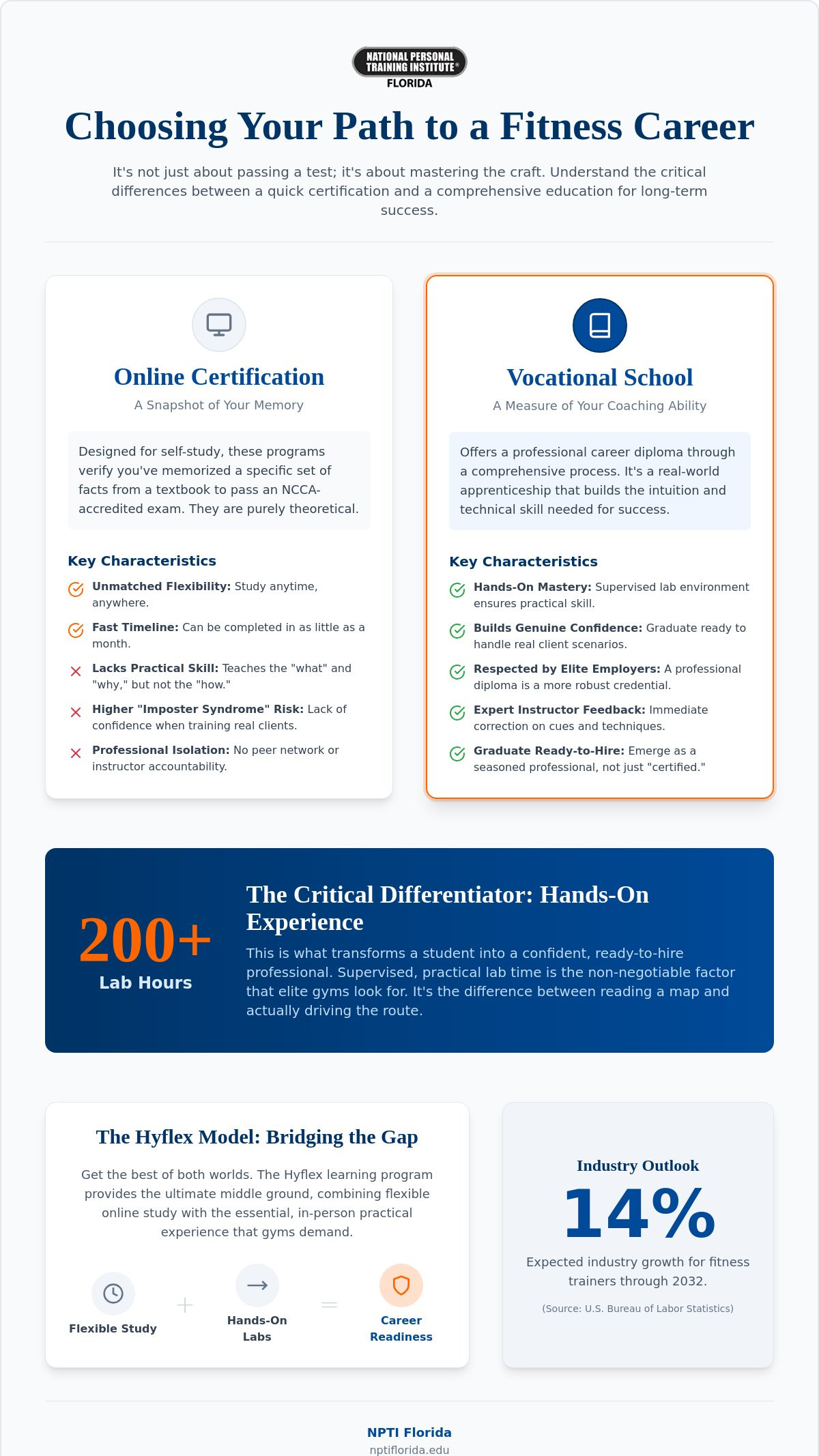
- Understand why 200+ hours of hands-on lab time is the critical differentiator that transforms a student into a confident, ready-to-hire professional.
- Discover how the Hyflex Learning Program provides the ultimate middle ground, combining flexible study with the practical experience gyms demand.
- Identify the specific roadmap that aligns your career goals with the science-based foundations necessary for a decade of success in the fitness industry.
The Fitness Industry Dilemma: Certification vs. Comprehensive Education
You’ve made a bold choice to enter the fitness industry. That’s a decision worth celebrating. However, you’re immediately faced with a critical fork in the road: personal trainer school vs online certification. Many aspiring coaches see these as identical paths to the same destination, but that’s a misconception that can derail your career before it begins. A certification is an assessment; it’s a tool used to verify that you’ve memorized a specific set of facts. Education, on the other hand, is a comprehensive process that builds the intuition and technical skill needed to handle real human bodies.
The “barrier to entry” in the personal training profession is misleadingly low. You can find programs that promise to make you a pro in just a few weeks. While this speed is tempting, it’s often the primary reason new trainers quit within their first twelve months. They have the credential, but they lack the confidence. When a client asks a complex question about biomechanics or struggles with a specific movement pattern, a textbook answer isn’t enough. Without a science-based foundation, the “imposter syndrome” becomes overwhelming, leading many to abandon the industry entirely. You don’t want to just pass a test; you want to master the craft.
What is a Personal Trainer Certification?
A certification typically revolves around an NCCA-accredited exam. These programs are designed for self-study, often requiring you to read a manual and pass a multiple-choice test on your own time. The timeline is fast, sometimes as short as a month. While these certificates provide the legal “green light” to work in most gyms, they are purely theoretical. You learn the “what” and the “why” of exercise science, but you rarely practice the “how” until a paying client is standing in front of you. It’s a snapshot of your memory, not a measure of your coaching ability.
What is a Vocational Personal Training School?
A vocational school offers a professional career diploma, which is a much more robust credential than a standard certificate. These programs function like a real-world apprenticeship. Instead of just reading about a squat, you spend 200+ hours in a supervised lab environment. You receive immediate instructor feedback on your coaching cues, spotting techniques, and program design. This hands-on mastery ensures that by the time you graduate, you aren’t just “certified”; you’re a seasoned professional ready to deliver results safely. It’s the difference between reading a map and actually driving the route.
Online Personal Trainer Certification: Pros, Cons, and Hidden Realities
Choosing a career path in fitness is a significant milestone. When you’re weighing a personal trainer school vs online certification, the primary draw for the digital route is almost always convenience. Online programs cater perfectly to career changers who are balancing full-time jobs, families, or existing financial commitments. According to the Bureau of Labor Statistics, the fitness industry offers diverse work environments, but entering these spaces with only a digital badge can be challenging. While the lower upfront investment of an online program feels like a safe way to test the waters, it often leaves a noticeable gap in your professional resume.
Employers at high-end athletic clubs and boutique studios look for more than just a passing exam score. They prioritize candidates who have already logged hours on a gym floor. A candidate with zero practical experience often faces a steeper climb during the hiring process. Without the accountability of a classroom or a network of peers, self-study students frequently struggle to stay motivated. This isolation can lead to a lack of professional connections, which are vital for securing your first role in a competitive market. If you’re looking for a way to bridge this gap, exploring a Hyflex Learning Program can help you gain the flexibility you want without sacrificing the quality you need.
The Benefits of Digital Learning
- Unmatched Flexibility: You can study at midnight or during your lunch break, making it possible to transition careers without quitting your current job.
- Comprehensive Digital Resources: Modern programs offer interactive textbooks and extensive video libraries that cover anatomy and exercise science in great detail.
- Reduced Financial Risk: For those unsure if fitness is their lifelong calling, a digital certificate provides a low-cost entry point to explore the industry.
The Practical Limitations of Online-Only Programs
Success in fitness is kinesthetic. You can’t truly master complex movements like Olympic lifts or kettlebell flows simply by watching a video. There is a significant risk of teaching incorrect form if you’ve never had your own movement patterns corrected by a master instructor. Furthermore, “soft skills” like reading a client’s body language, providing effective spotting, and building rapport are nearly impossible to simulate through a screen. Theoretical knowledge is a start, but applying that theory without supervision can lead to client injuries and a damaged professional reputation early in your career. For those in the Orlando area seeking a smarter alternative, a flexible personal trainer course Orlando professionals recommend can deliver both the convenience of remote learning and the essential hands-on gym hours that build real coaching confidence.
The Vocational Advantage: Why Hands-On Lab Hours Are Non-Negotiable
Kinesthetic learning is the secret weapon of the elite coach. When you choose a personal trainer school vs online certification, you’re choosing to learn through movement rather than just observation. Reading about muscle recruitment is a start; however, feeling the shift in a client’s weight during a heavy lift is where true mastery begins. This is why 200+ hours of lab time has become the industry gold standard for professional readiness. It provides a safe, supervised environment where you can fail, adjust, and eventually succeed long before you’re responsible for a paying client’s safety. You aren’t just a student; you’re an apprentice in a high-energy, results-oriented dialogue.
The psychological benefit of training in a real-world gym cannot be overstated. You aren’t just learning exercises; you’re absorbing the atmosphere, the sounds, and the pace of your future workplace. This immersive experience builds a level of confidence that a screen simply cannot provide. Modern hiring managers often have specific employer preferences for education. They look for graduates who have already navigated the complexities of a busy gym floor and received immediate, real-time corrections from seasoned instructors. This level of preparation ensures your transition from student to professional is seamless and secure.
Mastering Biomechanics and Form
Biomechanics is the study of mechanical laws relating to the movement or structure of living organisms. In a vocational setting, you learn to identify micro-flaws in movement that could lead to chronic injury over time. Hands-on training prevents the development of “bad habits” that self-taught trainers often unknowingly pass on to their clients. You will also master physical spotting techniques. This isn’t just about safety; it’s about providing the tactile cues that help a client feel the correct muscle engagement. When you can physically guide a client into the perfect position, your value as a professional skyrockets.
Soft Skills: The Business of Personal Training
Technical knowledge gets you the job, but soft skills help you keep it. You need to learn how to “read the room” and adjust a program on the fly when a client shows up stressed, fatigued, or unmotivated. A vocational program helps you develop a professional presence that commands higher rates from the first day. You also gain the benefit of networking with peers and instructors who are already established in the field. These relationships often lead directly to job placements, giving you a massive head start over those trying to navigate the industry alone. You’re building a network, not just a resume.
Decision Framework: Which Path Matches Your Career Goals?
Choosing between a personal trainer school vs online certification is a choice about your professional ceiling. You aren’t just picking a course; you’re deciding how you want to be perceived by future employers and clients. If your goal is a part-time side hustle at a local community center, a digital certificate might suffice. However, if you want to architect a career that commands high rates at elite boutique studios, the vocational path is your strongest foundation. High-end employers prioritize candidates who have already demonstrated mastery in a physical setting. They want to see proof of your ability to transform lives safely and effectively from day one.
This emphasis on rigorous, hands-on certification is a hallmark of many technical careers. Just as those entering the logistics sector often learn more about CDL Training and Certification Programs through providers like Interval to ensure they meet high safety standards, fitness professionals must prioritize practical mastery to succeed in a demanding market.
The Return on Investment (ROI) for a vocational diploma often manifests in career longevity. While the upfront cost of a digital program is lower, the long-term earnings of diploma holders tend to be higher because they bypass the “trial and error” phase that costs many new trainers their first few clients. You can accelerate your growth even further by adding specialized credentials like a Stretch Coach Certification or becoming a Senior Fitness Specialist. These niche skills allow you to serve specific populations with high-value needs, setting you apart in a crowded market. If you’re ready to see how these pieces fit together, you can view our full range of programs to find your perfect match.
Assessing Your Current Situation
Success requires a realistic look at your learning style and constraints. Are you a self-starter with the discipline to manage a self-paced curriculum, or do you thrive in a structured environment with direct mentorship? Consider your timeline and ultimate objective. If you’re transitioning into a full-time career, the immersive nature of a school provides the networking and peer support necessary for a stable start. You aren’t just buying information; you’re investing in a professional community that supports your evolution.
The Long-Term Career Outlook
A personal trainer career diploma provides a much higher ceiling for growth than a standard certificate. It establishes you as a vocational expert rather than someone who simply passed a test. This distinction is vital as you move into advanced roles or independent business ownership. Continuous education is the lifeblood of the fitness industry, and starting with a science-based foundation makes every future specialization easier to master. To understand the full scope of your options, read The Ultimate Personal Training Program Guide for a deep dive into choosing a career path that lasts.
The Hyflex Model: Bridging the Gap Between Flexibility and Mastery
The tension between personal trainer school vs online certification often feels like a forced choice between your schedule and your skills. You shouldn’t have to sacrifice professional readiness for the sake of convenience. The Hyflex Learning Program serves as the modern solution for busy students who demand the flexibility of digital study without losing the critical edge provided by in-person mastery. It’s a structured pathway that respects your current commitments while ensuring you’re fully prepared to enter an industry projected to grow by 14% through 2032. You deserve an education that fits your life and secures your future.
A Hyflex model is more than just a hybrid course; it’s a methodical integration of science-based theory and practical application. You engage with high-level academic content through digital platforms, then bring that knowledge to the gym floor for 200+ hours of hands-on lab time. This ensures that when you step into a professional role, you aren’t just reciting facts from a screen. You’re demonstrating the vocational precision and confidence that high-end employers expect from their staff. This approach eliminates the “imposter syndrome” that often plagues those who choose a purely digital route.
How Hyflex Works
This model allows you to balance classroom theory with practical application in a real-world gym setting. You have the flexibility to choose when and how you engage with the material, which is vital for those managing full-time jobs or family obligations. Despite this autonomy, the program maintains the rigorous standards of a premier vocational fitness training program. You receive the best of both worlds: the freedom of online learning and the immediate, expert feedback only available on a physical campus. It’s a seamless transition from theory to practice.
Why NPTI Florida is the Logical Conclusion
We’ve spent over 25 years refining our approach as a veteran-owned and operated institution. We don’t just function as instructors; we act as career architects focused on your long-term professional evolution. Every program we offer is rooted in science-based foundations, ensuring our graduates are prepared for the specific demands of the 2026 fitness landscape. You aren’t just earning a diploma; you’re joining a legacy of reliability and proven success. We are committed to your growth from the first day of class to your first day on the job.
Your career path is a foundational investment in your future. Don’t settle for a credential that leaves you feeling unprepared for the realities of the gym floor. Choose a path that guarantees professional security and career longevity. Launch your career with NPTI Florida’s Personal Fitness Training Program today and transform your passion into a stable, high-impact profession.
Secure Your Future in the 2026 Fitness Industry
The choice between personal trainer school vs online certification isn’t just about getting a job; it’s about building a career that lasts. You’ve learned that while online routes offer speed, vocational schools provide the 200+ hours of practical lab time that high-end employers demand. This hands-on mastery is what separates a student from a seasoned professional. It’s the science-based foundation you need to handle complex client needs with absolute confidence from day one.
As a veteran-owned and operated institution with over 25 years of fitness education excellence, we understand exactly what it takes to thrive in this competitive market. Our comprehensive Hyflex learning model ensures you don’t have to choose between your current schedule and your professional dreams. You can master the craft of fitness on your own terms while receiving the mentorship you deserve. Ready to go beyond the textbook? Explore our Personal Fitness Training Diploma today. We are here to help you architect a stable, rewarding career that truly makes a difference in the world.
Common Questions About Launching Your Fitness Career
Is an online personal trainer certification respected by gyms?
Most gyms respect online certifications if they are NCCA-accredited. This accreditation is the industry standard for safety and foundational knowledge. While these certificates get you through the door, elite clubs often prioritize candidates with documented practical hours. They want to see that you’ve coached real people in a gym setting. Balancing a digital badge with vocational training ensures you are both respected and ready for the floor.
How long does it take to complete a vocational personal trainer school compared to online?
Online programs typically take four to twelve weeks depending on your study pace. In contrast, a vocational personal trainer school usually spans six months. This longer duration covers 500 to 600 hours of comprehensive education, including over 200 hours of supervised gym lab time. You are investing more time upfront to gain a deeper science-based foundation. This methodical approach prepares you for a stable career rather than just a quick exam.
Do I need a college degree to become a successful personal trainer?
You don’t need a college degree to become a highly successful trainer. While some clinical roles require an exercise science degree, most successful pros thrive with a vocational diploma or accredited certification. Vocational programs provide the specific, hands-on skills that degrees often lack. Employers value your ability to safely transform a human body more than a four-year academic credential. Focus on quality education that emphasizes practical application and professional readiness.
Can I use VA benefits for personal trainer school?
Yes, you can use your VA benefits if the institution is veteran-owned and approved for veteran assistance programs. Many veterans find the transition to fitness training natural because of the discipline and leadership skills they already possess. If you want to maximize your military education benefits, learn exactly how using GI Bill for personal trainer certification can fund a comprehensive 600-hour vocational education rather than just a one-time exam reimbursement. We celebrate your service and provide a structured environment that mirrors the precision of military training. It’s a powerful way to leverage your benefits into a stable, mission-driven career in health and wellness.
What is the difference between a certificate and a career diploma?
A certificate proves you passed a specific exam, while a career diploma represents a comprehensive educational process. Certificates are often theoretical and self-studied. A diploma from a vocational school signifies hundreds of hours of classroom instruction and supervised lab practice. When comparing personal trainer school vs online certification, remember that a diploma offers a much higher ceiling for growth. It shows employers you’ve mastered the craft, not just memorized test answers.
Which personal trainer certification is the hardest to pass?
The NSCA Certified Strength and Conditioning Specialist exam is widely considered one of the most challenging in the industry. It requires a deep understanding of complex biomechanics and athletic programming. NASM and ACE exams also demand significant study and preparation. However, the difficulty of an exam matters less than your practical ability to coach. A science-based vocational foundation makes even the toughest certification exams much easier to navigate and pass.
Can I get a job immediately after finishing a personal trainer school?
Yes, most graduates secure employment immediately after finishing their program. Vocational schools often have established relationships with local gyms and health clubs, providing direct pathways to job placement. Because you’ve already logged 200+ hours of lab time, you’re a turnkey hire for employers. They don’t have to spend months training you on basic spotting or equipment usage. Your professional readiness makes you an instant asset to any fitness team.
What are the most in-demand fitness specialties in 2026?
Senior fitness and corrective exercise are among the most in-demand specialties in 2026. As the population ages, trainers who understand the nuances of longevity and injury prevention are highly valued. Nutrition coaching also remains a critical add-on for those looking to provide holistic results. Specializing in these areas allows you to command higher rates and serve a wider client base. It’s about becoming a career architect who meets specific societal health goals.