The Ultimate Personal Training Program Guide: Choosing a Career, Not Just a Certification
A weekend certification isn’t a career path. It’s often just a piece of paper that leaves you standing on a gym floor with no idea how to actually…

A weekend certification isn’t a career path. It’s often just a piece of paper that leaves you standing on a gym floor with no idea how to actually coach a human being through a complex movement. You’ve likely felt that nagging fear of becoming a “paper trainer” who knows the science but lacks the practical skills to deliver real-world results. It’s difficult to choose the right personal training program when you’re caught between quick-fix certificates and the need for a legitimate vocational diploma, especially while balancing your current job.
We understand that you’re looking for more than a credential; you’re looking for the confidence to design elite programs and the respect of top-tier employers. You’ve made a bold choice to enter the fitness industry, and we’re here to ensure that choice leads to a stable, high-paying career. This guide will show you how to evaluate education based on vocational depth, hands-on lab hours, and long-term career ROI. We’ll break down exactly what separates a simple test from a comprehensive education that builds your future as a career architect.
Key Takeaways
- Learn why a professional personal training program must bridge the gap between personal exercise and professional coaching to ensure long-term career success.
- Understand the critical distinction between a basic weekend certification and a vocational diploma that meets respected NCCA standards.
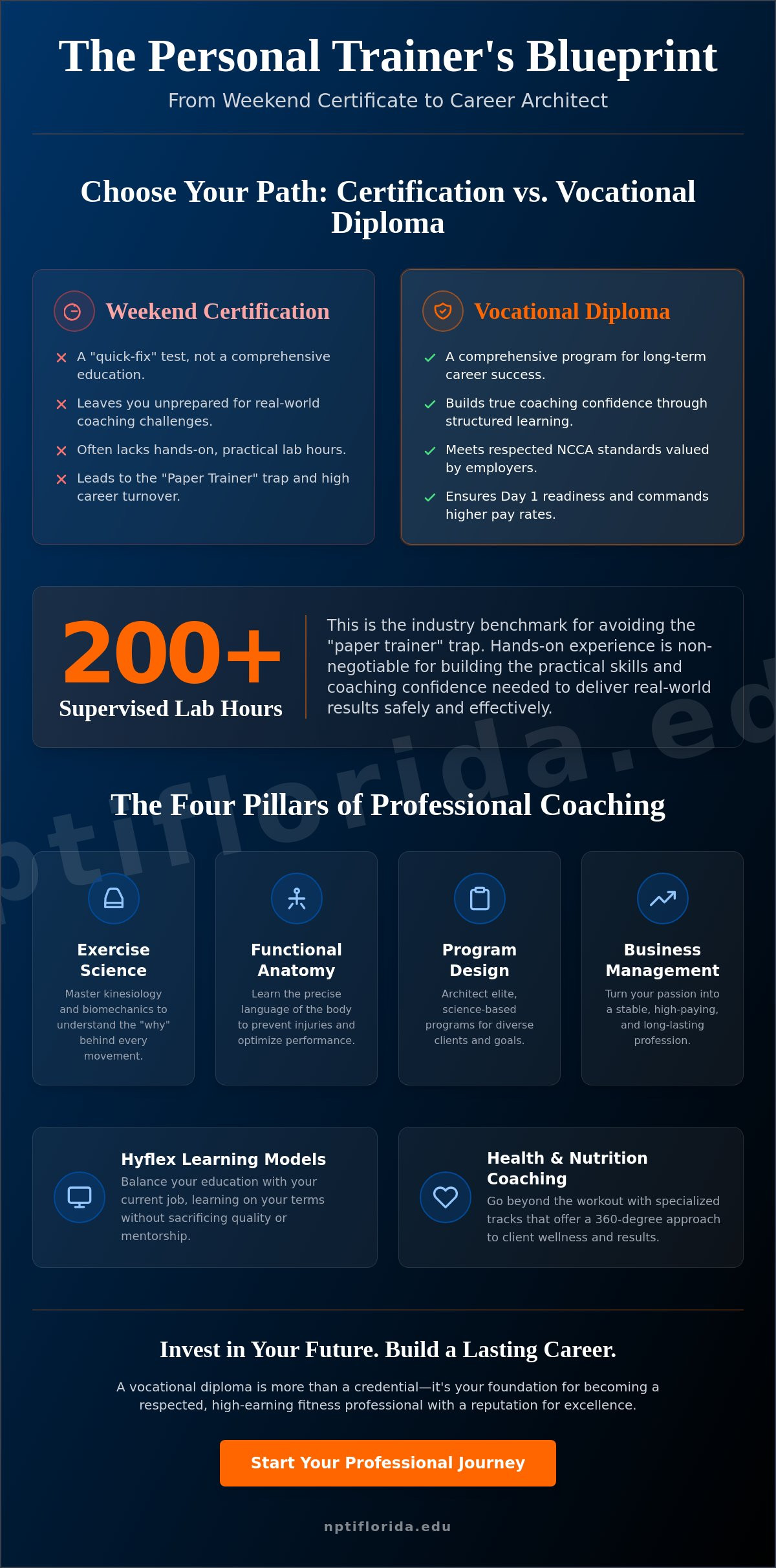
- Discover why 200 plus hours of supervised lab time is the industry benchmark for avoiding the paper trainer trap and building real coaching confidence.
- Explore how Hyflex learning models and specialized tracks like Health and Nutrition Coaching help you balance your education with a full-time job.
- Identify the foundational pillars of exercise science and business management that turn a passion for fitness into a stable, high-paying profession.
Defining the Scope: What Makes a Professional Personal Training Program?
A professional Personal trainer does more than count reps or shout encouragement. They architect human movement and manage physiological change. Choosing a personal training program is a commitment to shifting your mindset from “working out” to professional “coaching.” Many entry-level certifications function as little more than digital study guides for a multiple-choice exam. In contrast, a comprehensive program provides a deep dive into the four pillars of the profession: exercise science, functional anatomy, program design, and business management. You need to know the “why” behind every squat, press, and pull to ensure your clients reach their goals safely.
Science-based foundations are non-negotiable. Without them, you’re guessing with someone else’s health. A vocational fitness training program bridges the gap between personal passion and professional expertise. It transforms your enthusiasm for fitness into a structured, repeatable system for success. When you understand the mechanics of the human body, you gain the confidence to lead anyone, from a high-performance athlete to a senior client with mobility challenges. This depth of knowledge is what allows you to command higher rates and build a reputation for excellence.
The Science-Based Foundation of Modern Fitness
You can’t rely on “anecdotal fitness” or simply repeating what worked for you in the past. Evidence-based programming is the hallmark of a true professional. By mastering kinesiology and biomechanics, you learn the precise language of the body. This knowledge allows you to troubleshoot movement compensations and prevent injuries before they happen. Additionally, a modern curriculum includes Health and Nutrition Coaching. Understanding how fuel affects performance and recovery is essential for a 360-degree approach to client wellness. It’s about delivering a complete solution, not just a one-hour workout.
Career Longevity vs. Entry-Level Credentials
Evaluating Program Quality: Certification vs. Vocational Education
Don’t mistake a quick test for a comprehensive education. Many aspiring coaches fall into the trap of cheap certifications that promise a fast track to the gym floor. These options often carry hidden costs, including high failure rates and a total lack of practical preparation. A legitimate personal training program should be measured by its depth, not its speed. Accreditation is your first line of defense. Looking for programs that align with NCCA standards ensures your credentials carry weight with employers and insurance providers alike.
Live mentorship is another critical differentiator. While self-paced videos offer convenience, they can’t correct your form or answer complex questions about a client’s specific pathology. Having access to professional mentors provides a safety net that digital-only study guides simply cannot replicate. If you want to build a sustainable future, you should look for Advanced Personal Training Program options that prioritize long-term vocational success over a weekend certificate.
What is a Personal Trainer Career Diploma?
A career diploma functions as a comprehensive professional license that goes far beyond the basics of how to squat. It involves an intensive study of human physiology, metabolic systems, and the psychology of behavior change. A career diploma is a multi-hundred-hour investment in professional mastery that provides the structural framework for a lifelong career in fitness. This vocational path ensures you aren’t just memorizing facts for an exam but are actually learning how to lead.
The ROI of Comprehensive Education
The financial benefits of a diploma-level education are clear when looking at industry data. According to the U.S. Bureau of Labor Statistics, the median annual wage for fitness trainers was $46,480 in 2023, but the top 10 percent of earners brought home more than $79,740. Those higher earnings are almost always reserved for trainers with specialized expertise and recognized vocational backgrounds.
- Higher Session Rates: Diploma holders often command significantly more per hour due to their advanced technical skills.
- Recession-Proof Skills: Specialized knowledge in areas like senior fitness or corrective exercise keeps your schedule full regardless of economic shifts.
- Reduced Turnover: Better preparation leads to higher client retention, which is the key to long-term profitability.
Investing in a high-quality personal training program pays dividends through career longevity and a significantly higher ceiling for your earning potential. You are building a foundation that supports your professional growth for years to come.
The Critical Role of Hands-On Lab Hours in Career Readiness
Knowledge is potential; application is power. You can memorize every bone in the human body, but that doesn’t mean you’re ready to guide a client through a heavy set of deadlifts. This gap between theory and practice is known as the “Paper Trainer” trap. It’s a common pitfall for those who choose a digital-only personal training program. Without significant time spent on a gym floor under professional supervision, you lack the “coaching eye” necessary to spot subtle movement compensations that lead to injury. Understanding why hands-on personal trainer training outperforms digital certificates is essential before committing to any educational pathway.
Industry leaders recognize that 200 plus hours of supervised lab time is the gold standard for vocational success. This isn’t just about practicing your own workouts. It’s about learning to scale exercises in real-time for diverse populations. Whether you’re working with a high-performance athlete or a senior recovering from surgery, your ability to adapt programming on the fly determines your value as a coach. High-quality education ensures you aren’t just an observer but an active participant in the coaching process.
Translating Theory into Movement
Reading about a biomechanical lever is entirely different from spotting a client who is struggling with back pain during a hinge movement. In a lab setting, you receive immediate feedback from experienced instructors. This mentorship is vital for developing the “soft skills” of the profession. You’ll learn the nuance of verbal cueing, the importance of professional empathy, and how to motivate a client who is having a difficult day. These interpersonal skills are what transform a basic workout into a life-changing service.
Building Confidence Through Repetition
The first time you step onto a professional gym floor shouldn’t be with your first paying client. Lab hours eliminate the paralyzing anxiety that many new trainers feel. By mastering complex equipment and wearable technology in a safe, educational environment, you build a foundation of certainty. You’ll graduate with the confidence to handle any situation that arises in a commercial or private setting. Ultimately, lab hours are where science becomes a service. This practical immersion is a core component of the Personal Fitness Training Program, ensuring you’re ready for the reality of the job from day one.
Choosing a path that prioritizes hands-on experience means you won’t be guessing when a client asks for help. You’ll have the muscle memory and the tactical knowledge to lead with authority. This level of preparation is what separates those who simply hold a certificate from those who are truly ready to launch a career. Explore how a vocational fitness training program transforms science-based knowledge into real-world coaching mastery through structured, supervised practice.
Flexible Pathways: Navigating Hyflex and Hybrid Learning Models
Flexibility is the bridge between your current job and your future career. Many aspiring coaches feel stuck because they can’t afford to quit their full-time employment to attend school. This is where the Hyflex model changes the game. A modern personal training program must respect your schedule without diluting the curriculum. Hyflex isn’t just a buzzword; it’s a strategic balance that delivers classroom theory through digital platforms while reserving your physical energy for high-intensity, in-person gym application. It allows you to transition into the fitness industry at a pace that works for your life.
You should look for “synchronous” learning opportunities. While pre-recorded clips are convenient, they’re passive. Synchronous sessions involve live, interactive instruction where you can ask questions and engage with peers in real-time. This interaction is vital for mastering complex subjects like metabolic pathways or biomechanical analysis. Even with a flexible schedule, your education must still meet the 500 plus hour vocational standard to ensure you’re truly prepared for the professional world. If a program promises a shortcut, it’s likely shortchanging your future.
The Best of Both Worlds: Online Theory, In-Person Practice
Digital platforms are incredibly effective for delivering the “head knowledge” of the profession. You can study anatomy, physiology, and nutrition science from the comfort of your home. However, the “in-person” component of coaching cannot be replaced by a webcam. You need to feel the tension of a cable machine and see the subtle shift in a client’s weight distribution during a squat. A hybrid structure allows you to absorb the science online and then immediately apply it during scheduled lab hours. This creates a powerful feedback loop that accelerates your learning.
Choosing a Program That Values Your Time
When evaluating a school, look closely at their technology stack. A professional personal training program should offer a seamless user experience that makes studying efficient. Beyond the software, consider the role of student support. In a hybrid environment, having access to career services and dedicated mentors ensures you never feel isolated in your journey. You deserve an education that is both rigorous and adaptable to your personal needs. Discover the Hyflex Learning Program designed for busy professionals who refuse to compromise on quality.
Ready to take the next step toward your new career? You can start your journey today by choosing a pathway that aligns with your professional goals and your current lifestyle. Your future as a career architect begins with a single, flexible decision.
Launching Your Career with Specialized Personal Training Programs
Differentiation is the cornerstone of a high-paying career. In a crowded market, being a generalist often leads to stagnant wages and high client turnover. Choosing a specialized personal training program allows you to stand out as an expert rather than a commodity. The Personal Training Specialist Program is designed for this exact purpose, providing you with the technical edge needed to dominate a specific market niche. By the year 2026, the demand for specialized coaching has eclipsed general fitness instruction, making targeted education a necessity for anyone serious about professional growth.
Tapping into the fastest-growing demographic is a smart business move. The Senior Fitness Specialist track prepares you to work with an aging population that values longevity and functional health above all else. When you combine this with Health and Nutrition Coaching, you offer a 360-degree approach that clients respect and pay a premium for. You’re no longer just a person who shows them how to lift weights; you’re a lifestyle architect who manages their total wellness. A robust personal training program doesn’t end with a general certificate; it evolves into a specialized career path that grows with you.
As you build your reputation in these specialized niches, you may find yourself catering to clients in premier active-living destinations; to explore the luxury environments and fitness amenities that define these high-end markets, you can learn more about The Fortune Group.
Developing Your Professional Niche
Specialization is the key to increasing your revenue streams and building a “recession-proof” business. Adding a Stretch Coach Certification allows you to offer recovery-focused sessions, which are highly valued by both high-performance athletes and office workers seeking relief from sedentary lifestyles. In 2026, being a specialist is about more than just a title; it’s about having a diverse service menu that keeps client retention high. When you can solve specific physiological problems that a generalist cannot, you become indispensable to your client base.
The NPTI Florida Advantage
Experience is the ultimate teacher in the vocational world. NPTI Florida brings over 25 years of vocational fitness education to the table, providing a stable, proven foundation for your career. As a veteran-owned institution, we pride ourselves on a structured, disciplined approach that mirrors the commitment of our students. We offer VA-approved programs that help veterans transition seamlessly into the fitness world, using their existing leadership skills to build a successful new life. Our commitment to hands-on mastery and long-term mentor support ensures that you’re never alone on your professional journey.
The transition from student to professional is a journey that requires the right partners. We provide the tools, the science, and the community to ensure your success is not left to chance. You’ve already taken the first step by researching your options; now it’s time to commit to your future.
Ready to lead? Apply to NPTI Florida today.
Build Your Future on a Foundation of Excellence
Your transition into the fitness industry is a significant investment in your professional identity. You’ve seen that a legitimate personal training program is defined by its vocational depth and the quality of its practical mentorship. By prioritizing science-based foundations and specialized career tracks, you ensure that you aren’t just entering a job market; you’re architecting a sustainable career with measurable ROI. The difference between a temporary certificate and a lifelong profession lies in the rigor of your education.
Choosing an institution with 25 plus years of industry experience and a veteran owned and operated structure provides the stability you need to thrive. With 200 plus hours of hands-on lab time, you’ll graduate with the tactical confidence to lead any client toward their health goals. It’s time to move beyond the paper trainer trap and step into your role as a respected expert. Start your journey as a professional fitness architect at NPTI Florida. Your new career path is ready when you are; let’s build it together.
Frequently Asked Questions
What is the difference between a personal trainer certification and a diploma?
A certification is a single credential earned by passing a specific exam, whereas a diploma represents a comprehensive vocational education. Diplomas provide the deep science-based foundation and hundreds of hours of practical lab time that a basic certificate simply cannot match. This depth is what prepares you for a stable, long-term career rather than just an entry-level job.
How long does a comprehensive personal training program take to complete?
A professional personal training program usually requires several months of dedicated study to reach the 500 plus hour vocational benchmark. This timeframe allows you to absorb complex subjects like anatomy and physiology while mastering practical coaching techniques. Programs that promise completion in a few days often skip the critical hands-on hours necessary for true professional competence.
Are there personal training programs that are VA approved for veterans?
Yes, there are specific vocational pathways designed to be VA approved for veterans looking to transition into the fitness industry. These programs allow you to utilize your hard-earned benefits at a licensed vocational institution. Veteran-owned schools often provide the structure and discipline that former service members find familiar and effective for career success.
Do I need a high school diploma to enroll in a personal trainer school?
Most reputable fitness schools require a high school diploma or a GED for enrollment. This requirement ensures that every student possesses the foundational literacy and numeracy skills needed to succeed in advanced coursework like kinesiology and biomechanics. It also aligns with the professional standards expected by high-end employers in the modern fitness market.
What are lab hours, and why are they important for fitness training?
Lab hours are supervised sessions where you practice coaching techniques on a real gym floor under the guidance of an experienced mentor. They are the most critical part of your education because they bridge the gap between reading a textbook and spotting a client. Without these hours, you risk entering the workforce without the practical skills needed for client safety.
Can I work as a personal trainer while I am still in a program?
While you shouldn’t lead independent sessions until you’ve earned your credentials, many students work in gym management or as fitness assistants while enrolled. This is an excellent way to gain industry exposure and build relationships with potential employers. Completing a rigorous personal training program often leads to job offers before you even finish your final exams.
How much does a professional personal training program cost on average?
The average cost depends heavily on the level of instructor access and the amount of hands-on training included in the curriculum. Basic exam-only certifications are the least expensive, while comprehensive vocational diplomas represent a larger but more valuable investment in your career longevity. You should view these costs as a foundational investment in your future earning potential.
What is the “Hyflex” learning model in fitness education?
The Hyflex model is a hybrid learning approach that delivers theoretical content through digital platforms while reserving gym time for hands-on application. It’s the ideal solution for career changers who need to balance their education with a full-time job. This model ensures you get the flexibility you need without sacrificing the quality of your professional vocational training.