Understanding Client Motivation and Psychology: A Fitness Coach’s Guide
What if a client who keeps missing workouts isn’t unmotivated, but facing a barrier your plan hasn’t addressed? Understanding client motivation and psychology helps you look beyond missed sessions and ask what makes change meaningful, manageable, and worth sustaining. A stalled routine can point to competing priorities, uncertainty, or goals that don’t feel like the client’s own, not a lack of commitment.
It’s natural to want clients to follow a well-designed plan. But lasting progress takes more than the right exercises. People are more likely to stay engaged when they can help choose their goals, feel capable of taking the next step, and connect their effort to what matters to them. Your role is to support that process, not pressure someone into change.
In this guide, you’ll learn to recognize different sources of motivation, use respectful conversations to uncover barriers and client-owned goals, and respond constructively when progress stalls. You’ll also see how structured fitness education can turn behavior-change concepts into practical coaching and communication skills.
Key Takeaways
- Understanding client motivation and psychology helps you distinguish willingness to change from confidence, readiness, and practical ability to follow through.
- Use autonomy, competence, and connection as coaching lenses to support client-owned action, without treating stages of change as fixed labels.
- Listen for the client’s explanation before deciding whether unclear goals, low confidence, or everyday barriers are getting in the way.
- Build a respectful coaching rhythm: ask, listen, agree on one manageable step, then review and adjust together.
- Structured fitness education can help turn behavior-change concepts into practical communication and coaching skills, including through NPTI Florida’s Health and Nutrition Coaching module.
Understanding Client Motivation and Psychology in Fitness Coaching
Understanding client motivation and psychology starts with a practical distinction: motivation is the mix of reasons and conditions that influences a person’s choice to act. It can help explain why a client wants to exercise, but it doesn’t tell you whether they feel ready today, believe they can succeed, have the resources to participate, or can follow through consistently.
These factors can shift independently. A client may care deeply about improving fitness yet feel unsure how to begin. Another may be ready to train but have work, caregiving, transportation, or health-related demands that affect attendance. Missed sessions and unfinished plans are information to explore, not proof that a client doesn’t care.
Client-owned goals are goals the client personally values and helps choose, making them a meaningful foundation for sustained fitness behavior.
What does client motivation mean in personal training?
Motivation may come from personal values, enjoyment, outside pressure, or practical needs. A client might enjoy lifting weights, feel encouraged by a friend, or want more strength for carrying groceries and moving comfortably through daily activities. Their reason can be a mix of factors, and it may evolve as their experience changes.
A coach’s job is to explore, not assign, those reasons. Ask, “What would feeling stronger help you do?” rather than assuming the client is training to change their appearance. This respects their perspective and gives you a clearer basis for discussing goals. Concepts such as autonomy, competence, and relatedness are central to Self-Determination Theory, a useful lens for considering how clients experience choice, capability, and connection.
Why motivation can change over time
Exercise happens alongside the rest of a person’s life. A heavier workload, changing health, reduced confidence, limited resources, or new priorities can make a once-manageable routine harder to maintain. The client’s underlying interest may remain, even as their capacity or circumstances change.
Look for patterns without turning them into a diagnosis. One missed workout during a demanding week may be a temporary setback; repeated cancellations could have several explanations, including a schedule that no longer works or a plan that feels too difficult. Neither pattern alone proves a lack of interest.
Start with curiosity. Ask, “What’s been getting in the way?” or “Does this goal still feel important to you?” Then listen before proposing a fix. This helps separate willingness from obstacles and keeps the conversation respectful, practical, and centered on the client’s experience.
How Motivation Psychology Explains Readiness, Autonomy, and Change
Motivation can explain why a client wants to exercise, but it doesn’t guarantee they’re prepared to act. A useful coaching lens is to consider three needs: autonomy, or having meaningful choice; competence, or feeling capable of taking the next step; and connection, or feeling respected and supported. These ideas help you shape a plan with the client rather than trying to control their behavior.
A client’s next step can depend on readiness, confidence, and opportunity, not motivation alone. For example, a client may value strength training but doubt they can manage a full workout after work. A shorter session they help choose could feel more achievable while keeping their personal goal in view. Understanding client motivation and psychology means paying attention to these conditions, not just asking whether someone “wants it enough.”
Intrinsic and extrinsic motivation in exercise
Intrinsic motivation comes from enjoyment, interest, or personal meaning, such as liking the challenge of learning a new lift. Extrinsic motivation comes from outside incentives, expectations, or desired consequences, such as encouragement from a training partner or wanting to meet a health-related goal. Both can influence behavior, and they can operate together.
A client might schedule workouts for structure and accountability while choosing strength exercises because they want daily tasks to feel easier. The routine supports participation, while the personally meaningful goal gives it relevance. Coaches can explore both without treating one kind of motivation as more legitimate.
Ambivalence and stages of change
Ambivalence means having mixed feelings about change, not refusing it. A client may want more energy but worry about fitting exercise into a packed week. Rather than jumping straight to a detailed program, explore both sides with open questions. Motivational Interviewing techniques offer fitness professionals ways to invite clients to express their own reasons for change.
Stages-of-change thinking can also guide the conversation. Consider whether a client is not yet considering change, weighing it, preparing, taking action, or working to maintain a routine. These are flexible prompts, not fixed categories or diagnoses. People can move between them, and a label shouldn’t replace listening.
If a client is still weighing whether exercise fits their life, help them clarify what matters and what feels difficult before building an action plan. If they’re ready to begin, collaborate on a manageable first step and revisit how it’s working. For a closer look at education that develops practical coaching skills, explore NPTI fitness education programs.
How to Tell What Is Holding a Fitness Client Back
A missed workout can have several explanations, and each calls for a different coaching response. A client may not feel ready to change, doubt they can complete the plan, feel unsure what they want, or face a practical obstacle such as a schedule conflict. These barriers can look similar from the outside. Understanding client motivation and psychology means asking before you adjust the plan or judge the client’s commitment.
Start with a neutral question: “What feels most difficult about following this plan right now?” The answer helps you choose a useful next question instead of guessing at the cause.
| Client signal | Possible barrier | Supportive coaching response |
|---|---|---|
| “I’m not sure I want to start yet.” | Low readiness | Explore what would make change feel worthwhile, without pushing for a commitment. |
| “I don’t think I can do those exercises.” | Low confidence | Ask what feels intimidating, then discuss a more manageable starting point. |
| “I want to get fitter, but I don’t know what to focus on.” | Unclear goals | Ask what the client hopes will feel different in daily life. |
| “I can’t get to the gym at that time.” | Practical barrier | Explore schedule, location, equipment, or other constraints before revising the goal. |
Is the barrier motivation, confidence, or access?
Compare a client who isn’t ready to prioritize exercise, one who wants to train but feels uncertain about a beginner strength routine, and one whose work schedule conflicts with planned sessions. Those situations don’t call for the same solution. Ask what’s difficult before changing the goal or assuming the client needs more encouragement. Inconsistent participation alone doesn’t reveal a psychological condition or prove a lack of interest.
How reflective listening can uncover client priorities
Reflective listening means summarizing what you heard without correcting or persuading: “You want to feel stronger, but evenings are unpredictable,” or “You’re interested, though the plan feels like a big first step.” Then invite the client to say more: “What matters most to you about getting stronger?” or “What feels manageable this week?”
Scaling questions can make confidence and importance easier to discuss. Ask, “On a scale from zero to ten, how confident do you feel about trying this plan?” Follow with, “Why that number and not a lower one?” The answer can reveal existing strengths or a barrier to address. For broader context on the preparation fitness professionals pursue, explore The Ultimate Personal Training Program Guide.
Practical Ways to Support Client Motivation Without Pressure
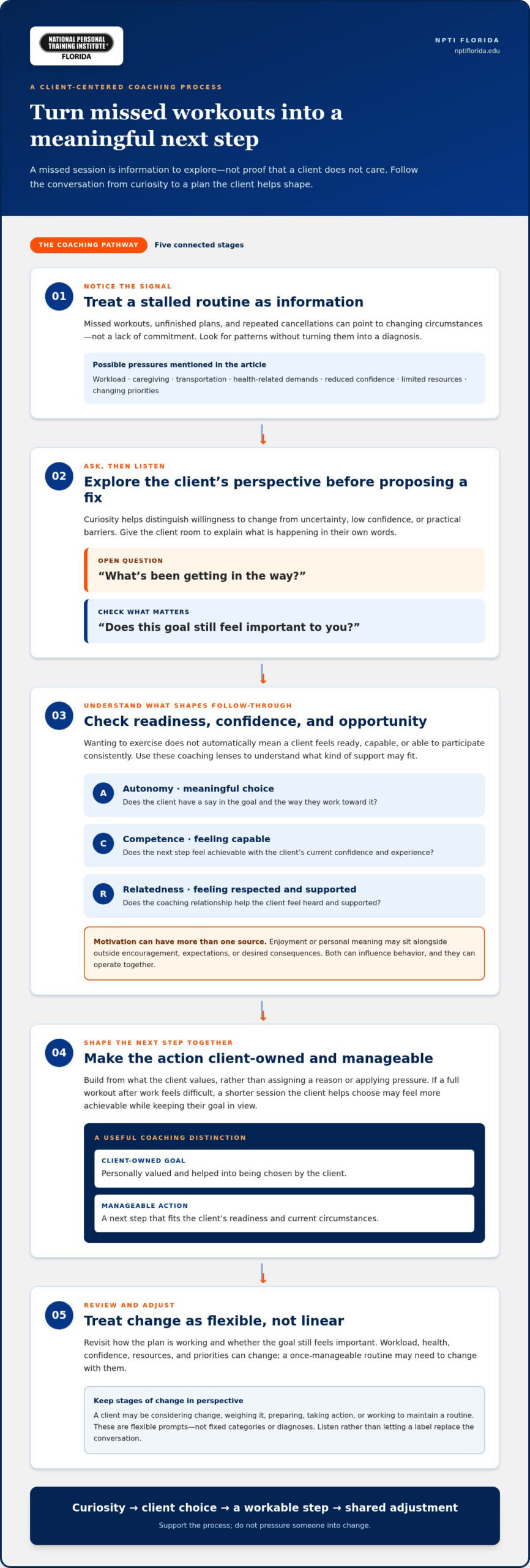
Motivation-supportive coaching isn’t about finding the perfect pep talk. It’s a repeatable process that gives the client room to make meaningful choices while keeping the next action clear and manageable. Use a simple check-in sequence: ask what’s happening, listen for what matters, agree on one step together, then review and adjust.
Use that sequence as a guide, not a script. If a client says they haven’t followed the plan, first learn what got in the way. Then work together on one response, such as changing the workout time or choosing a shorter session. Avoid shame, threats, and promises that a client will definitely follow through. Your role is to support informed choices, not control someone’s behavior.
Use motivational interviewing and reflective questions
Open-ended questions invite clients to put their own reasons into words. Try “What would you most like to be able to do?” or “What might make exercise feel worthwhile right now?” Reflect the answer before offering solutions: “You want more energy, but a long workout feels hard to fit in.” This shows you’ve heard them without correcting or persuading.
Before sharing advice, ask permission: “Would it be helpful if we explored a few options?” If the client agrees, offer choices and let them decide what fits. The goal is a collaborative conversation, not steering them toward the answer you prefer.
Turn client priorities into achievable goals
Translate a broad aim into one specific action that fits the client’s current schedule and resources. For example, if they want to build a regular exercise habit but have limited time, they might choose two brief home sessions on days they select. The client should have a say in the action and how it fits their life.
Plan for obstacles together. Ask, “What could disrupt this plan?” and “If that happens, what would you like to do instead?” A backup option, such as moving a session to another day, can make the plan more adaptable without treating a schedule change as failure.
At the next check-in, review what happened without blame: “What worked, and what would you change?” Keep the parts that suited the client and revise what didn’t. Understanding client motivation and psychology helps you treat feedback as useful information, not a test of willpower.
To develop behavior-change and communication skills as part of your fitness education, explore NPTI’s fitness training programs.
Build Motivation-Coaching Skills Through Structured Fitness Education
Exercise knowledge helps you design training, but coaching behavior change calls for another set of skills. A client’s response to a plan can depend on how well you listen, explain options, and adapt the conversation to their goals and circumstances. Understanding client motivation and psychology is therefore a practical part of fitness preparation, not a technique for controlling client choices or guaranteeing adherence.
NPTI’s Advanced Personal Fitness Training program totals 600 hours, with 360 theory hours and 240 hands-on lab hours. Its Health and Nutrition Coaching module covers behavior-change psychology, communication, coaching techniques, and nutritional programming for special populations. These topics connect the reasons behind client behavior with the communication and coaching decisions a fitness professional makes.
Connect behavior-change theory with coaching practice
Coursework in behavior change can give learners a framework for recognizing when to listen, ask a follow-up question, or help a client identify a manageable next step. Coaching techniques and communication topics complement that foundation by focusing on how to apply those ideas in conversations. For example, a trainer can practice responding to a client’s hesitation with curiosity instead of assuming the client needs more pressure.
Theory and hands-on application each have a role. Concepts can help explain why a client’s needs and readiness matter; practical learning gives students opportunities to work on applying coaching ideas. For additional context about related subject areas, explore the Health and Nutrition Coaching Program Guide.
Choose learning that develops professional communication
Clear coaching conversations take practice. Rehearsing how to ask open questions, reflect a client’s perspective, and discuss options can help future trainers communicate with greater care and clarity. Hands-on learning complements theory by giving learners a setting to apply professional knowledge, build practical skills, and refine how they communicate.
NPTI’s program includes 360 theory hours and 240 hands-on lab hours, for 600 hours in total. Together, these components provide a structured way to study fitness topics and practice applying what you learn, without promising a particular client outcome or career result.
If you’re considering formal preparation in fitness coaching, take a look at NPTI’s fitness education programs. Review the program details and request the Student Catalog to learn more about the educational pathway.
Put Motivation-Supportive Coaching Into Practice
Strong coaching starts with curiosity. A client’s missed session may reflect readiness, confidence, unclear priorities, or a practical barrier, so ask before assuming. Reflect what you hear, agree on one client-chosen step, and use the next check-in to learn what worked and what may need to change. That’s how understanding client motivation and psychology becomes a practical skill that respects each person’s agency.
Structured education can help you build that skill alongside exercise knowledge and professional communication. NPTI’s 600-hour program combines 360 theory hours with 240 hands-on lab hours. NPTI is accredited by the Accrediting Commission of Career Schools and Colleges (ACCSC) and licensed by the Florida Commission for Independent Education.
To strengthen your foundation in fitness coaching and behavior change, explore NPTI’s fitness education programs and request the Student Catalog. Keep learning, stay open to each client’s perspective, and help make progress feel achievable, one thoughtful conversation at a time.
Frequently Asked Questions
What is client motivation in personal training?
Client motivation is the combination of reasons, priorities, and circumstances that influence whether someone chooses to pursue a fitness behavior. It may involve personal values, enjoyment, health goals, social support, or outside expectations. Understanding client motivation and psychology means asking what matters to the individual rather than assuming. Since priorities and circumstances can change, regular conversations help keep goals relevant and identify what could make participation more manageable.
How can a personal trainer motivate a client without pressuring them?
Start by asking what the client wants to change and what feels realistic right now. Listen to their answer, reflect the main point, and collaborate on one achievable next step. For example, if a planned workout feels too long, ask whether the client would prefer to adjust its duration or schedule. Review the plan together and adapt as needed. Avoid shame, threats, or promises; support the client’s choices instead of trying to control them.
What is the difference between intrinsic and extrinsic motivation?
Intrinsic motivation comes from interest, enjoyment, or personal meaning, while extrinsic motivation is influenced by outside expectations, incentives, or desired consequences. A client can experience both at once. They might enjoy learning strength exercises while also working toward a health goal. Neither type is automatically better for every person. Ask what the client values and use their answer to shape relevant goals and coaching conversations.
Can a personal trainer use motivational interviewing?
Personal trainers can use supportive communication practices associated with motivational interviewing, such as open-ended questions, reflective listening, and asking permission before offering suggestions. These approaches can help a client explore personal priorities and possible next steps. A trainer should stay within their professional role: fitness coaching isn’t mental health diagnosis or treatment. If a client’s needs fall outside that role, encourage them to seek support from an appropriately qualified professional.
What happens if a client loses motivation or misses workouts?
Ask what changed before assuming the client is lazy or no longer cares. Time pressures, low confidence, unclear goals, or competing priorities can all affect participation. Listen to the client’s explanation, then agree on a manageable adjustment and a time to review how it’s working. Treat a missed workout as a chance to understand the plan’s fit, not as a personal failure. If concerns extend beyond fitness coaching, encourage appropriate professional support.
How can fitness education help trainers understand client motivation?
Fitness education can connect behavior-change concepts with communication and practical coaching skills. NPTI’s Health and Nutrition Coaching module covers behavior-change psychology, communication, and coaching techniques. The Advanced Personal Fitness Training program totals 600 hours, including 360 theory hours and 240 hands-on lab hours. Prospective students can request the Student Catalog to review program details and learn more about how its coursework brings fitness knowledge and coaching practice together.

What if a client who keeps missing workouts isn’t unmotivated, but facing a barrier your plan hasn’t addressed? Understanding client motivation and psychology helps you look beyond missed sessions and ask what makes change meaningful, manageable, and worth sustaining. A stalled routine can point to competing priorities, uncertainty, or goals that don’t feel like the client’s own, not a lack of commitment.
It’s natural to want clients to follow a well-designed plan. But lasting progress takes more than the right exercises. People are more likely to stay engaged when they can help choose their goals, feel capable of taking the next step, and connect their effort to what matters to them. Your role is to support that process, not pressure someone into change.
In this guide, you’ll learn to recognize different sources of motivation, use respectful conversations to uncover barriers and client-owned goals, and respond constructively when progress stalls. You’ll also see how structured fitness education can turn behavior-change concepts into practical coaching and communication skills.
Key Takeaways
- Understanding client motivation and psychology helps you distinguish willingness to change from confidence, readiness, and practical ability to follow through.
- Use autonomy, competence, and connection as coaching lenses to support client-owned action, without treating stages of change as fixed labels.
- Listen for the client’s explanation before deciding whether unclear goals, low confidence, or everyday barriers are getting in the way.
- Build a respectful coaching rhythm: ask, listen, agree on one manageable step, then review and adjust together.
- Structured fitness education can help turn behavior-change concepts into practical communication and coaching skills, including through NPTI Florida’s Health and Nutrition Coaching module.
Understanding Client Motivation and Psychology in Fitness Coaching
Understanding client motivation and psychology starts with a practical distinction: motivation is the mix of reasons and conditions that influences a person’s choice to act. It can help explain why a client wants to exercise, but it doesn’t tell you whether they feel ready today, believe they can succeed, have the resources to participate, or can follow through consistently.
These factors can shift independently. A client may care deeply about improving fitness yet feel unsure how to begin. Another may be ready to train but have work, caregiving, transportation, or health-related demands that affect attendance. Missed sessions and unfinished plans are information to explore, not proof that a client doesn’t care.
Client-owned goals are goals the client personally values and helps choose, making them a meaningful foundation for sustained fitness behavior.
What does client motivation mean in personal training?
Motivation may come from personal values, enjoyment, outside pressure, or practical needs. A client might enjoy lifting weights, train for competitive athletic performance using specialized mental coaching like Golf State of Mind, or simply want more strength for moving comfortably through daily activities. Their reason can be a mix of factors, and it may evolve as their experience changes.
A coach’s job is to explore, not assign, those reasons. Ask, “What would feeling stronger help you do?” rather than assuming the client is training to change their appearance. This respects their perspective and gives you a clearer basis for discussing goals. Concepts such as autonomy, competence, and relatedness are central to Self-Determination Theory, a useful lens for considering how clients experience choice, capability, and connection.
Why motivation can change over time
Exercise happens alongside the rest of a person’s life. A heavier workload, changing health, reduced confidence, limited resources, or new priorities can make a once-manageable routine harder to maintain. The client’s underlying interest may remain, even as their capacity or circumstances change.
Look for patterns without turning them into a diagnosis. One missed workout during a demanding week may be a temporary setback; repeated cancellations could have several explanations, including a schedule that no longer works or a plan that feels too difficult. Neither pattern alone proves a lack of interest.
Start with curiosity. Ask, “What’s been getting in the way?” or “Does this goal still feel important to you?” Then listen before proposing a fix. This helps separate willingness from obstacles and keeps the conversation respectful, practical, and centered on the client’s experience.
How Motivation Psychology Explains Readiness, Autonomy, and Change
Motivation can explain why a client wants to exercise, but it doesn’t guarantee they’re prepared to act. A useful coaching lens is to consider three needs: autonomy, or having meaningful choice; competence, or feeling capable of taking the next step; and connection, or feeling respected and supported. These ideas help you shape a plan with the client rather than trying to control their behavior.
A client’s next step can depend on readiness, confidence, and opportunity, not motivation alone. For example, a client may value strength training but doubt they can manage a full workout after work. A shorter session they help choose could feel more achievable while keeping their personal goal in view. Understanding client motivation and psychology means paying attention to these conditions, not just asking whether someone “wants it enough.”
Intrinsic and extrinsic motivation in exercise
Intrinsic motivation comes from enjoyment, interest, or personal meaning, such as liking the challenge of learning a new lift. Extrinsic motivation comes from outside incentives, expectations, or desired consequences, such as encouragement from a training partner or wanting to meet a health-related goal. Both can influence behavior, and they can operate together.
A client might schedule workouts for structure and accountability while choosing strength exercises because they want daily tasks to feel easier. The routine supports participation, while the personally meaningful goal gives it relevance. In many disciplines, athletes sustain engagement by connecting their physical practice to deeper values and supportive communities—for an example of uniting athletic skills with faith, learn more about GolfFromtheHeart.golf. Coaches can explore both without treating one kind of motivation as more legitimate.
Ambivalence and stages of change
Ambivalence means having mixed feelings about change, not refusing it. A client may want more energy but worry about fitting exercise into a packed week. Rather than jumping straight to a detailed program, explore both sides with open questions. Motivational Interviewing techniques offer fitness professionals ways to invite clients to express their own reasons for change.
Stages-of-change thinking can also guide the conversation. Consider whether a client is not yet considering change, weighing it, preparing, taking action, or working to maintain a routine. These are flexible prompts, not fixed categories or diagnoses. People can move between them, and a label shouldn’t replace listening.
If a client is still weighing whether exercise fits their life, help them clarify what matters and what feels difficult before building an action plan. If they’re ready to begin, collaborate on a manageable first step and revisit how it’s working. For a closer look at education that develops practical coaching skills, explore NPTI fitness education programs.
How to Tell What Is Holding a Fitness Client Back
A missed workout can have several explanations, and each calls for a different coaching response. A client may not feel ready to change, doubt they can complete the plan, feel unsure what they want, or face a practical obstacle such as a schedule conflict. These barriers can look similar from the outside. Understanding client motivation and psychology means asking before you adjust the plan or judge the client’s commitment.
Start with a neutral question: “What feels most difficult about following this plan right now?” The answer helps you choose a useful next question instead of guessing at the cause.
| Client signal | Possible barrier | Supportive coaching response |
|---|---|---|
| “I’m not sure I want to start yet.” | Low readiness | Explore what would make change feel worthwhile, without pushing for a commitment. |
| “I don’t think I can do those exercises.” | Low confidence | Ask what feels intimidating, then discuss a more manageable starting point. |
| “I want to get fitter, but I don’t know what to focus on.” | Unclear goals | Ask what the client hopes will feel different in daily life. |
| “I can’t get to the gym at that time.” | Practical barrier | Explore schedule, location, equipment, or other constraints before revising the goal. |
Is the barrier motivation, confidence, or access?
Compare a client who isn’t ready to prioritize exercise, one who wants to train but feels uncertain about a beginner strength routine, and one whose work schedule conflicts with planned sessions. Those situations don’t call for the same solution. Ask what’s difficult before changing the goal or assuming the client needs more encouragement. Inconsistent participation alone doesn’t reveal a psychological condition or prove a lack of interest.
How reflective listening can uncover client priorities
Reflective listening means summarizing what you heard without correcting or persuading: “You want to feel stronger, but evenings are unpredictable,” or “You’re interested, though the plan feels like a big first step.” Then invite the client to say more: “What matters most to you about getting stronger?” or “What feels manageable this week?”
Scaling questions can make confidence and importance easier to discuss. Ask, “On a scale from zero to ten, how confident do you feel about trying this plan?” Follow with, “Why that number and not a lower one?” The answer can reveal existing strengths or a barrier to address. For broader context on the preparation fitness professionals pursue, explore The Ultimate Personal Training Program Guide.
Practical Ways to Support Client Motivation Without Pressure
Motivation-supportive coaching isn’t about finding the perfect pep talk. It’s a repeatable process that gives the client room to make meaningful choices while keeping the next action clear and manageable. Use a simple check-in sequence: ask what’s happening, listen for what matters, agree on one step together, then review and adjust.
Use that sequence as a guide, not a script. If a client says they haven’t followed the plan, first learn what got in the way. Then work together on one response, such as changing the workout time or choosing a shorter session. Avoid shame, threats, and promises that a client will definitely follow through. Your role is to support informed choices, not control someone’s behavior.
Use motivational interviewing and reflective questions
Open-ended questions invite clients to put their own reasons into words. Try “What would you most like to be able to do?” or “What might make exercise feel worthwhile right now?” Reflect the answer before offering solutions: “You want more energy, but a long workout feels hard to fit in.” This shows you’ve heard them without correcting or persuading.
Before sharing advice, ask permission: “Would it be helpful if we explored a few options?” If the client agrees, offer choices and let them decide what fits. The goal is a collaborative conversation, not steering them toward the answer you prefer.
Turn client priorities into achievable goals
Translate a broad aim into one specific action that fits the client’s current schedule and resources. For example, if they want to build a regular exercise habit but have limited time, they might choose two brief home sessions on days they select. The client should have a say in the action and how it fits their life.
Plan for obstacles together. Ask, “What could disrupt this plan?” and “If that happens, what would you like to do instead?” A backup option, such as moving a session to another day, can make the plan more adaptable without treating a schedule change as failure.
At the next check-in, review what happened without blame: “What worked, and what would you change?” Keep the parts that suited the client and revise what didn’t. Understanding client motivation and psychology helps you treat feedback as useful information, not a test of willpower.
To develop behavior-change and communication skills as part of your fitness education, explore NPTI’s fitness training programs.
Build Motivation-Coaching Skills Through Structured Fitness Education
Exercise knowledge helps you design training, but coaching behavior change calls for another set of skills. A client’s response to a plan can depend on how well you listen, explain options, and adapt the conversation to their goals and circumstances. Understanding client motivation and psychology is therefore a practical part of fitness preparation, not a technique for controlling client choices or guaranteeing adherence.
NPTI’s Advanced Personal Fitness Training program totals 600 hours, with 360 theory hours and 240 hands-on lab hours. Its Health and Nutrition Coaching module covers behavior-change psychology, communication, coaching techniques, and nutritional programming for special populations. These topics connect the reasons behind client behavior with the communication and coaching decisions a fitness professional makes.
Connect behavior-change theory with coaching practice
Coursework in behavior change can give learners a framework for recognizing when to listen, ask a follow-up question, or help a client identify a manageable next step. Coaching techniques and communication topics complement that foundation by focusing on how to apply those ideas in conversations. For example, a trainer can practice responding to a client’s hesitation with curiosity instead of assuming the client needs more pressure.
Theory and hands-on application each have a role. Concepts can help explain why a client’s needs and readiness matter; practical learning gives students opportunities to work on applying coaching ideas. For additional context about related subject areas, explore the Health and Nutrition Coaching Program Guide.
Choose learning that develops professional communication
Clear coaching conversations take practice. Rehearsing how to ask open questions, reflect a client’s perspective, and discuss options can help future trainers communicate with greater care and clarity. Hands-on learning complements theory by giving learners a setting to apply professional knowledge, build practical skills, and refine how they communicate.
NPTI’s program includes 360 theory hours and 240 hands-on lab hours, for 600 hours in total. Together, these components provide a structured way to study fitness topics and practice applying what you learn, without promising a particular client outcome or career result.
If you’re considering formal preparation in fitness coaching, take a look at NPTI’s fitness education programs. Review the program details and request the Student Catalog to learn more about the educational pathway.
Put Motivation-Supportive Coaching Into Practice
Strong coaching starts with curiosity. A client’s missed session may reflect readiness, confidence, unclear priorities, or a practical barrier, so ask before assuming. Reflect what you hear, agree on one client-chosen step, and use the next check-in to learn what worked and what may need to change. That’s how understanding client motivation and psychology becomes a practical skill that respects each person’s agency.
Structured education can help you build that skill alongside exercise knowledge and professional communication. NPTI’s 600-hour program combines 360 theory hours with 240 hands-on lab hours. NPTI is accredited by the Accrediting Commission of Career Schools and Colleges (ACCSC) and licensed by the Florida Commission for Independent Education.
To strengthen your foundation in fitness coaching and behavior change, explore NPTI’s fitness education programs and request the Student Catalog. Keep learning, stay open to each client’s perspective, and help make progress feel achievable, one thoughtful conversation at a time.
Frequently Asked Questions
What is client motivation in personal training?
Client motivation is the combination of reasons, priorities, and circumstances that influence whether someone chooses to pursue a fitness behavior. It may involve personal values, enjoyment, health goals, social support, or outside expectations. Understanding client motivation and psychology means asking what matters to the individual rather than assuming. Since priorities and circumstances can change, regular conversations help keep goals relevant and identify what could make participation more manageable.
How can a personal trainer motivate a client without pressuring them?
Start by asking what the client wants to change and what feels realistic right now. Listen to their answer, reflect the main point, and collaborate on one achievable next step. For example, if a planned workout feels too long, ask whether the client would prefer to adjust its duration or schedule. Review the plan together and adapt as needed. Avoid shame, threats, or promises; support the client’s choices instead of trying to control them.
What is the difference between intrinsic and extrinsic motivation?
Intrinsic motivation comes from interest, enjoyment, or personal meaning, while extrinsic motivation is influenced by outside expectations, incentives, or desired consequences. A client can experience both at once. They might enjoy learning strength exercises while also working toward a health goal. Neither type is automatically better for every person. Ask what the client values and use their answer to shape relevant goals and coaching conversations.
Can a personal trainer use motivational interviewing?
Personal trainers can use supportive communication practices associated with motivational interviewing, such as open-ended questions, reflective listening, and asking permission before offering suggestions. These approaches can help a client explore personal priorities and possible next steps. A trainer should stay within their professional role: fitness coaching isn’t mental health diagnosis or treatment. If a client’s needs fall outside that role, encourage them to seek support from an appropriately qualified professional.
What happens if a client loses motivation or misses workouts?
Ask what changed before assuming the client is lazy or no longer cares. Time pressures, low confidence, unclear goals, or competing priorities can all affect participation. Listen to the client’s explanation, then agree on a manageable adjustment and a time to review how it’s working. Treat a missed workout as a chance to understand the plan’s fit, not as a personal failure. If concerns extend beyond fitness coaching, encourage appropriate professional support.
How can fitness education help trainers understand client motivation?
Fitness education can connect behavior-change concepts with communication and practical coaching skills. NPTI’s Health and Nutrition Coaching module covers behavior-change psychology, communication, and coaching techniques. The Advanced Personal Fitness Training program totals 600 hours, including 360 theory hours and 240 hands-on lab hours. Prospective students can request the Student Catalog to review program details and learn more about how its coursework brings fitness knowledge and coaching practice together.