Skills Every Personal Trainer Needs to Succeed
What if a great workout plan isn’t enough to help a client succeed? Knowing the skills every personal trainer needs means looking beyond exercise selection. Trainers also need to explain movements clearly, build trust, adapt sessions to different abilities, and use sound judgment to keep training practical and safe.
If you’re passionate about fitness but unsure what effective coaching looks like day to day, that’s a useful question to ask. Exercise science provides the foundation, while communication and behavior-change skills help turn knowledge into guidance clients can use. This guide covers the technical and interpersonal abilities trainers use to understand client needs, plan sessions, and respond to feedback.
You’ll learn why assessment, program design, clear coaching, motivation, and professional boundaries matter, along with practical ways to strengthen these skills. Structured education can connect theory with hands-on application. NPTI Florida’s Advanced Personal Fitness Training program includes 600 hours: 360 hours of theory and 240 hours of practical lab work. Building a strong skill set is an important step toward supporting clients with confidence and care.
Key Takeaways
- The skills every personal trainer needs extend beyond exercise knowledge to include individualized coaching and professional conduct.
- Use movement observation and relevant client information to shape sessions, without attempting to diagnose health conditions.
- Ask thoughtful questions, listen actively, and give clear, respectful feedback to understand each client’s goals and readiness for change.
- Adapt exercise choices to a client’s abilities and circumstances while staying within your professional scope.
- Build readiness step by step: learn core principles, practise applying them, and continue developing your skills.
What Skills Does Every Personal Trainer Need?
Effective personal training takes more than knowing which exercises work a muscle. The skills every personal trainer needs combine technical knowledge, coaching ability, adaptability, and professional conduct. Trainers use these competencies to turn exercise principles into clear, individualized guidance and adjust that guidance as a client responds.
A trainer’s role includes clarifying goals, explaining and guiding movement, and making thoughtful session adjustments. The Personal trainer overview describes work that includes exercise programming, client assessment, and motivation. In practice, these responsibilities work together: listening helps a trainer understand a client’s needs, and clear explanations help the client understand and follow a plan. Assessment means gathering relevant information to guide exercise, not diagnosing or treating a medical condition.
Definition: A personal trainer’s essential skills are the technical knowledge, coaching abilities, adaptability, and professional judgment used to guide clients through appropriate, individualized exercise.
What does a personal trainer do beyond demonstrate exercises?
Demonstrating a movement is only the start. A trainer explains its purpose, gives clear instructions, observes how the client performs it, and adapts the session if the movement or pace isn’t suitable. For example, if a client struggles with an exercise, the trainer might clarify the instructions or choose a more manageable variation that better fits the client’s ability and goals.
Coaching also means asking questions and listening without making assumptions. A client’s feedback may show that an exercise is confusing, a session feels too demanding, or a goal needs clarification. A respectful response helps keep the plan relevant and the client engaged. These communication skills are part of delivering exercise guidance effectively, not extras to add later.
Which skills are technical, and which are interpersonal?
Technical foundations include basic anatomy, exercise principles, movement observation, and program design. They help trainers select and organize exercises around a client’s goals, experience, and abilities. Coaching competencies include listening, empathy, clear instruction, respectful feedback, and motivation. They help a trainer understand what the client needs and explain the plan in a useful way.
Professional judgment connects both groups. A technically sound plan still needs to fit the person doing it, and encouragement should never replace appropriate exercise choices. These competencies can be learned and strengthened through preparation, practice, and reflection. Confidence doesn’t have to be a fixed personality trait. It can grow as trainers build knowledge, practise communicating, and learn to make decisions with care.
How Exercise Science and Assessment Shape Better Training
Exercise science helps a trainer make informed choices, while assessment connects those principles to the person in front of them. Basic anatomy can clarify which muscles contribute to a movement. Exercise principles help organize workload and recovery. Movement observation offers clues about whether an exercise suits a client’s current ability. Together, these foundations make session planning more purposeful than choosing exercises at random.
Assessment is information gathering, not diagnosis. A trainer can ask about a client’s goals, current activity, exercise experience, preferences, and relevant limitations, then use the answers to guide exercise decisions. The U.S. Bureau of Labor Statistics’ Occupational Outlook Handbook offers a broader overview of fitness trainers’ work and preparation.
How do trainers turn client goals into a practical plan?
Start by clarifying what the client wants to work toward, how active they are now, and what experience they bring. A client who wants to build strength but is new to resistance training may benefit from learning a few manageable movements before the session becomes more demanding. The trainer should be able to explain the purpose of each choice, such as practising a movement pattern or developing strength in a planned way.
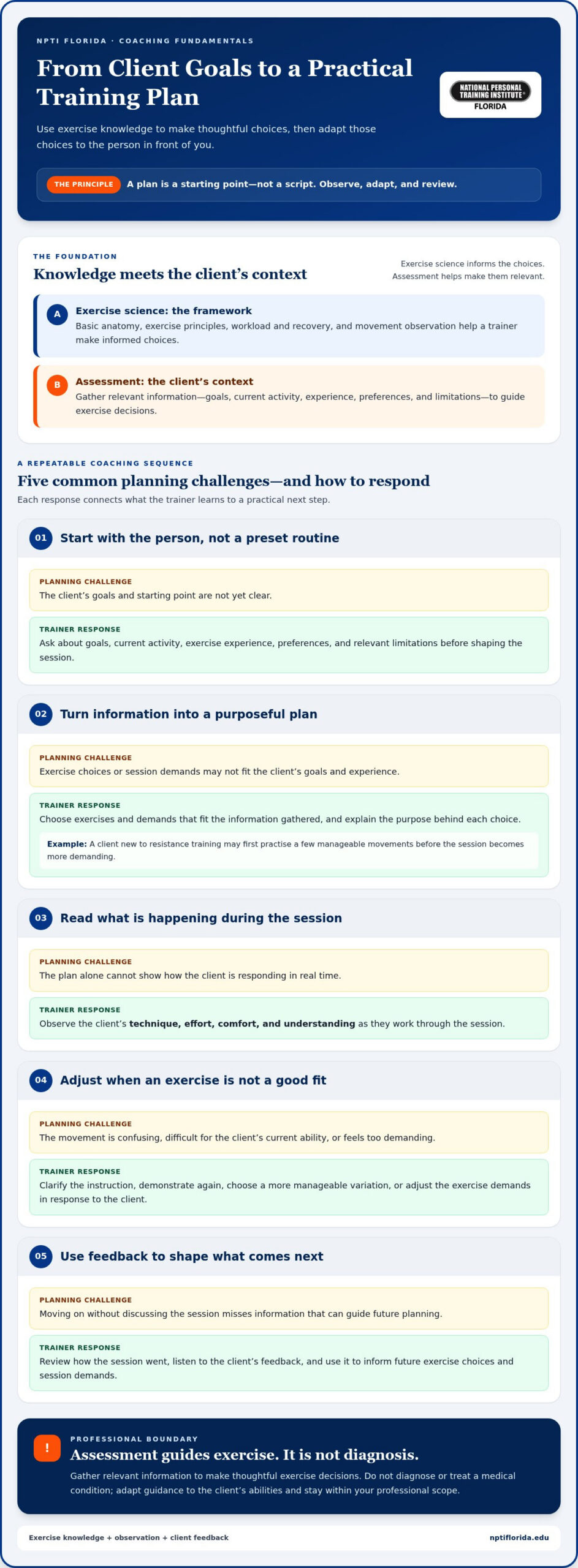
Use this repeatable sequence:
- Gather information: Clarify goals, experience, preferences, and relevant limitations.
- Plan: Choose exercises and session demands that fit the information gathered.
- Observe: Pay attention to technique, effort, comfort, and understanding.
- Adapt: Adjust the exercise, instructions, or demands in response.
- Review: Discuss how the session went and use that feedback to inform future planning.
Progress depends on ongoing review and adjustment, not a promised outcome. A plan should respond to what the trainer observes and what the client reports over time.
Why do observation and adaptation matter during a session?
A plan is a starting point, not a script. If a client seems unsure about an exercise, the trainer might demonstrate it again or give a simpler cue. If the movement doesn’t suit the client’s current ability, the trainer could choose a more manageable variation. If the planned workload feels too demanding, adjusting the session can help keep the work appropriate to the client’s response.
These decisions put the skills every personal trainer needs into practice: applying exercise knowledge while paying attention to the client’s experience. If a client reports concerning symptoms, the trainer should stop or modify the activity as appropriate and refer the client to a qualified healthcare professional, rather than trying to identify or treat the cause. NPTI’s Advanced Personal Fitness Training program includes 600 hours, with 360 hours of theory and 240 hours of practical lab work. Explore structured personal training education to learn how formal study can pair knowledge with practical application.
How Communication and Motivation Build Strong Client Relationships
Good coaching involves more than giving directions. A trainer needs to understand what a client is ready to do, explain the next step clearly, and invite honest feedback. Active listening means paying attention to the client’s words and concerns, then asking a follow-up question instead of rushing to offer advice.
Behavior-change coaching helps clients identify practical, personally meaningful steps toward healthier routines while supporting their choice and confidence.
How can a trainer explain exercises so clients feel confident?
Keep instructions clear and focused. A trainer might demonstrate an exercise, offer one or two concise cues, then ask the client to describe or show what they understood. Check-ins such as “How does that feel?” give the client room to raise questions without pressure.
Adapt your language to the person. A client new to exercise may benefit from plain, familiar words, while someone with more experience may prefer a more specific cue. Feedback should describe an observable action and offer something useful to try, such as, “Slow the movement slightly so you can stay in control.” Respectful, actionable guidance builds understanding without making mistakes feel like failure.
How do listening and behavior-change skills support consistency?
Ask open questions before proposing solutions: “What might make it difficult to fit activity into your week?” or “Which types of movement do you enjoy?” The answers can reveal barriers, preferences, and readiness for change. A trainer can then work with the client to choose a small, realistic next step, such as identifying a suitable time for activity or practising one new movement during a session.
Motivation works best as support, not pressure. Rather than relying on shame or imposing a rigid goal, trainers can help clients set priorities, consider options, and choose an action that feels manageable. They should also set realistic expectations: progress can vary, and plans may need to change as circumstances change. That honesty helps build trust.
These communication habits are among the skills every personal trainer needs because they help translate exercise knowledge into coaching a client can understand and act on. NPTI’s personal-training education includes behavior-change communication, connecting this interpersonal skill to professional preparation. Listening, clear explanations, and respect for client choice create a supportive foundation for participation.
How Personal Trainers Adapt for Safety, Special Populations, and Scope
A sound training plan isn’t one-size-fits-all. Age, exercise experience, goals, abilities, preferences, and relevant health information can influence exercise selection, instruction, and session demands. A trainer’s responsibility is to use this context to make appropriate adjustments while staying within their education and professional role.
Adaptation might mean choosing a simpler movement for a client who is new to exercise, offering a different way to perform an exercise based on a client’s abilities, or changing the pace to suit the person’s experience. For youth, a trainer considers the young client’s needs and experience when selecting activities. For older adults, movement options and session demands should reflect the individual’s abilities and goals, not assumptions about age. In every case, ask, observe, and adjust to the person.
Safety reminder: Client safety depends on attentive observation, clear communication, and responsible adaptation.
What does adapting exercise for different clients involve?
Adaptation doesn’t mean making assumptions based on a label or prescribing treatment for a condition. It means considering each client’s context, explaining exercise choices, and checking how the person responds. NPTI’s curriculum includes youth fitness, corrective exercise, and special-population topics, helping learners build knowledge for working with a range of clients. Specialization can deepen a trainer’s expertise, but it complements rather than replaces strong fundamentals and professional boundaries.
The skills every personal trainer needs include knowing when an exercise choice is within their scope and when a client needs support beyond exercise coaching. Trainers can provide suitable fitness guidance without diagnosing a condition, offering medical advice, or representing exercise as treatment.
When should a trainer pause, modify, or refer?
Pay attention to what the client says and what you observe. If an exercise causes discomfort or a client reports an unexpected symptom, pause the activity, listen, and follow appropriate procedures. Depending on the situation, that may mean modifying or ending the session and referring the client to an appropriately qualified healthcare professional. Don’t try to identify the medical cause or promise a particular outcome.
Developing this judgment takes both knowledge and practice. NPTI’s non-degree personal-training education includes study of corrective exercise and special populations. Explore personal training education to build a stronger foundation for adapting exercise responsibly and recognizing the limits of a trainer’s role.
How to Develop Personal Trainer Skills and Prepare for the Work
Strong coaching is built step by step. The skills every personal trainer needs develop through learning, deliberate practice, feedback, and continued professional growth, not a quick fix. A clear progression can help you turn an interest in fitness into practical readiness for working with clients.
What is a practical way to build trainer skills?
- Learn the fundamentals. Study basic anatomy, exercise principles, movement patterns, and program design so you can explain why an exercise belongs in a session.
- Practise planning. Create sample sessions for different goals and experience levels. For every exercise, identify its purpose and consider how you might adjust it.
- Rehearse clear instruction. Practise demonstrating movements, giving concise cues, and checking that someone understands before adding complexity.
- Get practical feedback. Use instructor-guided practice to work on observing movement, communicating respectfully, and responding thoughtfully when a plan needs to change.
- Reflect and keep learning. Review what went well, what confused the learner, and what you would change next time. Continue developing your knowledge as your responsibilities and interests grow.
Deliberate practice makes abstract knowledge easier to apply. For example, planning a session, explaining its purpose, and reflecting on feedback develops connected skills rather than treating programming and communication as separate tasks.
How can structured education connect knowledge with coaching practice?
Theory gives future trainers a foundation for understanding exercise choices. Practical lab work provides an opportunity to apply concepts, practise instruction, and develop judgment. Both matter. Studying movement principles without practising how to explain them can leave a gap between understanding an idea and coaching a person through it. Practice without a sound foundation can make it harder to understand why a choice is appropriate.
NPTI’s non-degree Advanced Personal Fitness Training program comprises 600 total hours: 360 hours of theory and 240 hours of practical lab work. Its curriculum includes behavior-change communication, corrective exercise, nutrition coaching, and topics related to special populations and youth fitness. The theory and lab components support complementary areas of professional preparation.
If you’re exploring a path into the profession, start with the personal training program guide to consider the broader education pathway. For a closer look at how structured learning can build professional knowledge, explore the advanced personal training curriculum.
Build the Skills to Coach with Confidence
Strong trainers pair exercise knowledge with clear communication, attentive observation, and sound professional judgment. The skills every personal trainer needs help turn fitness principles into guidance that fits each client’s goals, abilities, and responses. They also help trainers recognize when to adapt a session and when a concern falls outside their role.
Developing those abilities takes structured learning and practice. NPTI’s non-degree Advanced Personal Fitness Training program totals 600 hours, including 360 hours of theory and 240 hours of practical lab work. Its curriculum connects foundational knowledge with applied learning. NPTI is accredited by ACCSC, state licensed, and veteran-owned and operated, with over 25 years of experience.
Ready to take a purposeful next step toward professional preparation? Explore NPTI’s personal training education programs and start building the knowledge and coaching skills to support clients with confidence.
Frequently Asked Questions
What is the most important skill for a personal trainer?
Professional judgment is one of the most important skills because it connects exercise knowledge with a client’s individual needs. A trainer uses judgment to choose suitable exercises, explain their purpose, observe how a client responds, and adjust when needed. Listening and clear communication support each step. Sound judgment also means recognizing when a concern falls outside a trainer’s role and should be referred to an appropriate professional.
Can you be a personal trainer if you are not naturally outgoing?
Yes, you can be an effective personal trainer without being naturally outgoing. Successful coaching doesn’t require a big personality. It depends on listening carefully, communicating clearly, showing respect, and following through. You can build confidence by practising how to explain exercises, ask open questions, and offer constructive feedback. A calm, attentive approach can help clients feel heard and comfortable sharing what they need from training.
How do personal trainers motivate clients to stay consistent?
Personal trainers can support consistency by helping clients choose realistic goals that feel personally meaningful. Ask about preferences and barriers before suggesting next steps, then work together to identify manageable actions. For example, a client who feels overwhelmed by a full program might begin by focusing on one agreed part of the plan. Respectful check-ins and practical adjustments can support motivation without pressure, shame, or promises.
What technical knowledge does a personal trainer need?
A personal trainer needs a foundation in anatomy, exercise principles, movement observation, and program design. This knowledge helps trainers understand how exercises relate to a client’s goals and how to organize a session appropriately. Trainers also need to gather relevant client information and observe technique and effort during exercise. Technical knowledge supports fitness guidance, but it doesn’t qualify a trainer to diagnose conditions or provide medical treatment.
Do personal trainers need communication skills?
Yes. Communication is central to effective personal training because clients need to understand instructions, feel comfortable asking questions, and share how an exercise or session feels. Trainers use active listening to learn about goals and preferences, then give concise cues and respectful, specific feedback. They also set realistic expectations and check for understanding. These skills help turn a plan into guidance a client can engage with.
How can I develop the skills every personal trainer needs?
Build skills through structured learning, deliberate practice, and regular reflection. Start with exercise fundamentals and program planning, then practise demonstrating movements, giving clear instructions, and observing how someone responds. Seek feedback in a learning environment and use it to improve your next attempt. NPTI’s Advanced Personal Fitness Training program combines 360 hours of theory with 240 practical lab hours, for 600 hours of study and application.
What skills help personal trainers work with different populations?
Trainers need adaptability, attentive observation, clear communication, and sound professional judgment. Age, experience, goals, and individual abilities can influence exercise choices, so avoid assumptions based on a client category. Learn to adjust instructions, exercise options, or session demands to the person in front of you. NPTI’s curriculum includes youth fitness and special-population topics, while reinforcing the importance of working within a trainer’s education and role.
Is a personal training certification enough to become an effective trainer?
A certification can provide structured knowledge, but effective training also depends on applying that knowledge thoughtfully. Trainers continue developing through practice, feedback, reflection, and further learning as their clients and professional interests vary. Look for education that connects foundational theory with practical application. NPTI offers non-degree personal-training programs, including a 600-hour Advanced Personal Fitness Training program with 360 theory hours and 240 practical lab hours.

What if a great workout plan isn’t enough to help a client succeed? Knowing the skills every personal trainer needs means looking beyond exercise selection. Trainers also need to explain movements clearly, build trust, adapt sessions to different abilities, and use sound judgment to keep training practical and safe.
If you’re passionate about fitness but unsure what effective coaching looks like day to day, that’s a useful question to ask. Exercise science provides the foundation, while communication and behavior-change skills help turn knowledge into guidance clients can use. This guide covers the technical and interpersonal abilities trainers use to understand client needs, plan sessions, and respond to feedback.
You’ll learn why assessment, program design, clear coaching, motivation, and professional boundaries matter, along with practical ways to strengthen these skills. Structured education can connect theory with hands-on application. NPTI Florida’s Advanced Personal Fitness Training program includes 600 hours: 360 hours of theory and 240 hours of practical lab work. Building a strong skill set is an important step toward supporting clients with confidence and care.
Key Takeaways
- The skills every personal trainer needs extend beyond exercise knowledge to include individualized coaching and professional conduct.
- Use movement observation and relevant client information to shape sessions, without attempting to diagnose health conditions.
- Ask thoughtful questions, listen actively, and give clear, respectful feedback to understand each client’s goals and readiness for change.
- Adapt exercise choices to a client’s abilities and circumstances while staying within your professional scope.
- Build readiness step by step: learn core principles, practise applying them, and continue developing your skills.
What Skills Does Every Personal Trainer Need?
Effective personal training takes more than knowing which exercises work a muscle. The skills every personal trainer needs combine technical knowledge, coaching ability, adaptability, and professional conduct. Trainers use these competencies to turn exercise principles into clear, individualized guidance and adjust that guidance as a client responds.
A trainer’s role includes clarifying goals, explaining and guiding movement, and making thoughtful session adjustments. The Personal trainer overview describes work that includes exercise programming, client assessment, and motivation. In practice, these responsibilities work together: listening helps a trainer understand a client’s needs, and clear explanations help the client understand and follow a plan. Assessment means gathering relevant information to guide exercise, not diagnosing or treating a medical condition.
Definition: A personal trainer’s essential skills are the technical knowledge, coaching abilities, adaptability, and professional judgment used to guide clients through appropriate, individualized exercise.
What does a personal trainer do beyond demonstrate exercises?
Demonstrating a movement is only the start. A trainer explains its purpose, gives clear instructions, observes how the client performs it, and adapts the session if the movement or pace isn’t suitable. For example, if a client struggles with an exercise, the trainer might clarify the instructions or choose a more manageable variation that better fits the client’s ability and goals.
Coaching also means asking questions and listening without making assumptions. A client’s feedback may show that an exercise is confusing, a session feels too demanding, or a goal needs clarification. A respectful response helps keep the plan relevant and the client engaged. These communication skills are part of delivering exercise guidance effectively, not extras to add later.
Which skills are technical, and which are interpersonal?
Technical foundations include basic anatomy, exercise principles, movement observation, and program design. They help trainers select and organize exercises around a client’s goals, experience, and abilities. Coaching competencies include listening, empathy, clear instruction, respectful feedback, and motivation. They help a trainer understand what the client needs and explain the plan in a useful way.
Professional judgment connects both groups. A technically sound plan still needs to fit the person doing it, and encouragement should never replace appropriate exercise choices. These competencies can be learned and strengthened through preparation, practice, and reflection. Confidence doesn’t have to be a fixed personality trait. It can grow as trainers build knowledge, practise communicating, and learn to make decisions with care.
How Exercise Science and Assessment Shape Better Training
Exercise science helps a trainer make informed choices, while assessment connects those principles to the person in front of them. Basic anatomy can clarify which muscles contribute to a movement. Exercise principles help organize workload and recovery. Movement observation offers clues about whether an exercise suits a client’s current ability. Together, these foundations make session planning more purposeful than choosing exercises at random.
Assessment is information gathering, not diagnosis. A trainer can ask about a client’s goals, current activity, exercise experience, preferences, and relevant limitations, then use the answers to guide exercise decisions. The U.S. Bureau of Labor Statistics’ Occupational Outlook Handbook offers a broader overview of fitness trainers’ work and preparation.
How do trainers turn client goals into a practical plan?
Start by clarifying what the client wants to work toward, how active they are now, and what experience they bring. A client who wants to build strength but is new to resistance training may benefit from learning a few manageable movements before the session becomes more demanding. The trainer should be able to explain the purpose of each choice, such as practising a movement pattern or developing strength in a planned way.
Use this repeatable sequence:
- Gather information: Clarify goals, experience, preferences, and relevant limitations.
- Plan: Choose exercises and session demands that fit the information gathered.
- Observe: Pay attention to technique, effort, comfort, and understanding.
- Adapt: Adjust the exercise, instructions, or demands in response.
- Review: Discuss how the session went and use that feedback to inform future planning.
Progress depends on ongoing review and adjustment, not a promised outcome. A plan should respond to what the trainer observes and what the client reports over time.
Why do observation and adaptation matter during a session?
A plan is a starting point, not a script. If a client seems unsure about an exercise, the trainer might demonstrate it again or give a simpler cue. If the movement doesn’t suit the client’s current ability, the trainer could choose a more manageable variation. If the planned workload feels too demanding, adjusting the session can help keep the work appropriate to the client’s response.
These decisions put the skills every personal trainer needs into practice: applying exercise knowledge while paying attention to the client’s experience. If a client reports concerning symptoms, the trainer should stop or modify the activity as appropriate and refer the client to a qualified healthcare professional, rather than trying to identify or treat the cause. NPTI’s Advanced Personal Fitness Training program includes 600 hours, with 360 hours of theory and 240 hours of practical lab work. Explore structured personal training education to learn how formal study can pair knowledge with practical application.
How Communication and Motivation Build Strong Client Relationships
Good coaching involves more than giving directions. A trainer needs to understand what a client is ready to do, explain the next step clearly, and invite honest feedback. Active listening means paying attention to the client’s words and concerns, then asking a follow-up question instead of rushing to offer advice.
Behavior-change coaching helps clients identify practical, personally meaningful steps toward healthier routines while supporting their choice and confidence.
How can a trainer explain exercises so clients feel confident?
Keep instructions clear and focused. A trainer might demonstrate an exercise, offer one or two concise cues, then ask the client to describe or show what they understood. Check-ins such as “How does that feel?” give the client room to raise questions without pressure.
Adapt your language to the person. A client new to exercise may benefit from plain, familiar words, while someone with more experience may prefer a more specific cue. Feedback should describe an observable action and offer something useful to try, such as, “Slow the movement slightly so you can stay in control.” Respectful, actionable guidance builds understanding without making mistakes feel like failure.
How do listening and behavior-change skills support consistency?
Ask open questions before proposing solutions: “What might make it difficult to fit activity into your week?” or “Which types of movement do you enjoy?” The answers can reveal barriers, preferences, and readiness for change. A trainer can then work with the client to choose a small, realistic next step, such as identifying a suitable time for activity or practising one new movement during a session.
Motivation works best as support, not pressure. Rather than relying on shame or imposing a rigid goal, trainers can help clients set priorities, consider options, and choose an action that feels manageable. They should also set realistic expectations: progress can vary, and plans may need to change as circumstances change. That honesty helps build trust.
These communication habits are among the skills every personal trainer needs because they help translate exercise knowledge into coaching a client can understand and act on. NPTI’s personal-training education includes behavior-change communication, connecting this interpersonal skill to professional preparation. Listening, clear explanations, and respect for client choice create a supportive foundation for participation.
How Personal Trainers Adapt for Safety, Special Populations, and Scope
A sound training plan isn’t one-size-fits-all. Age, exercise experience, goals, abilities, preferences, and relevant health information can influence exercise selection, instruction, and session demands. A trainer’s responsibility is to use this context to make appropriate adjustments while staying within their education and professional role.
Adaptation might mean choosing a simpler movement for a client who is new to exercise, offering a different way to perform an exercise based on a client’s abilities, or changing the pace to suit the person’s experience. For youth, a trainer considers the young client’s needs and experience when selecting activities. For older adults, movement options and session demands should reflect the individual’s abilities and goals, not assumptions about age. In every case, ask, observe, and adjust to the person.
Safety reminder: Client safety depends on attentive observation, clear communication, and responsible adaptation.
What does adapting exercise for different clients involve?
Adaptation doesn’t mean making assumptions based on a label or prescribing treatment for a condition. It means considering each client’s context, explaining exercise choices, and checking how the person responds. NPTI’s curriculum includes youth fitness, corrective exercise, and special-population topics, helping learners build knowledge for working with a range of clients. Specialization can deepen a trainer’s expertise, but it complements rather than replaces strong fundamentals and professional boundaries.
The skills every personal trainer needs include knowing when an exercise choice is within their scope and when a client needs support beyond exercise coaching. Trainers can provide suitable fitness guidance without diagnosing a condition, offering medical advice, or representing exercise as treatment.
When should a trainer pause, modify, or refer?
Pay attention to what the client says and what you observe. If an exercise causes discomfort or a client reports an unexpected symptom, pause the activity, listen, and follow appropriate procedures. Depending on the situation, that may mean modifying or ending the session and referring the client to an appropriately qualified healthcare professional. Don’t try to identify the medical cause or promise a particular outcome.
Developing this judgment takes both knowledge and practice. NPTI’s non-degree personal-training education includes study of corrective exercise and special populations. Explore personal training education to build a stronger foundation for adapting exercise responsibly and recognizing the limits of a trainer’s role.
How to Develop Personal Trainer Skills and Prepare for the Work
Strong coaching is built step by step. The skills every personal trainer needs develop through learning, deliberate practice, feedback, and continued professional growth, not a quick fix. A clear progression can help you turn an interest in fitness into practical readiness for working with clients.
What is a practical way to build trainer skills?
- Learn the fundamentals. Study basic anatomy, exercise principles, movement patterns, and program design so you can explain why an exercise belongs in a session.
- Practise planning. Create sample sessions for different goals and experience levels. For every exercise, identify its purpose and consider how you might adjust it.
- Rehearse clear instruction. Practise demonstrating movements, giving concise cues, and checking that someone understands before adding complexity.
- Get practical feedback. Use instructor-guided practice to work on observing movement, communicating respectfully, and responding thoughtfully when a plan needs to change.
- Reflect and keep learning. Review what went well, what confused the learner, and what you would change next time. Continue developing your knowledge as your responsibilities and interests grow.
Deliberate practice makes abstract knowledge easier to apply. For example, planning a session, explaining its purpose, and reflecting on feedback develops connected skills rather than treating programming and communication as separate tasks.
How can structured education connect knowledge with coaching practice?
Theory gives future trainers a foundation for understanding exercise choices. Practical lab work provides an opportunity to apply concepts, practise instruction, and develop judgment. Both matter. Studying movement principles without practising how to explain them can leave a gap between understanding an idea and coaching a person through it. Practice without a sound foundation can make it harder to understand why a choice is appropriate.
NPTI’s non-degree Advanced Personal Fitness Training program comprises 600 total hours: 360 hours of theory and 240 hours of practical lab work. Its curriculum includes behavior-change communication, corrective exercise, nutrition coaching, and topics related to special populations and youth fitness. The theory and lab components support complementary areas of professional preparation.
If you’re exploring a path into the profession, start with the personal training program guide to consider the broader education pathway. For a closer look at how structured learning can build professional knowledge, explore the advanced personal training curriculum.
Build the Skills to Coach with Confidence
Strong trainers pair exercise knowledge with clear communication, attentive observation, and sound professional judgment. The skills every personal trainer needs help turn fitness principles into guidance that fits each client’s goals, abilities, and responses. They also help trainers recognize when to adapt a session and when a concern falls outside their role.
Developing those abilities takes structured learning and practice. NPTI’s non-degree Advanced Personal Fitness Training program totals 600 hours, including 360 hours of theory and 240 hours of practical lab work. Its curriculum connects foundational knowledge with applied learning. NPTI is accredited by ACCSC, state licensed, and veteran-owned and operated, with over 25 years of experience.
Ready to take a purposeful next step toward professional preparation? Explore NPTI’s personal training education programs and start building the knowledge and coaching skills to support clients with confidence.
Frequently Asked Questions
What is the most important skill for a personal trainer?
Professional judgment is one of the most important skills because it connects exercise knowledge with a client’s individual needs. A trainer uses judgment to choose suitable exercises, explain their purpose, observe how a client responds, and adjust when needed. Listening and clear communication support each step. Sound judgment also means recognizing when a concern falls outside a trainer’s role and should be referred to an appropriate professional.
Can you be a personal trainer if you are not naturally outgoing?
Yes, you can be an effective personal trainer without being naturally outgoing. Successful coaching doesn’t require a big personality. It depends on listening carefully, communicating clearly, showing respect, and following through. You can build confidence by practising how to explain exercises, ask open questions, and offer constructive feedback. A calm, attentive approach can help clients feel heard and comfortable sharing what they need from training.
How do personal trainers motivate clients to stay consistent?
Personal trainers can support consistency by helping clients choose realistic goals that feel personally meaningful. Ask about preferences and barriers before suggesting next steps, then work together to identify manageable actions. For example, a client who feels overwhelmed by a full program might begin by focusing on one agreed part of the plan. Respectful check-ins and practical adjustments can support motivation without pressure, shame, or promises.
What technical knowledge does a personal trainer need?
A personal trainer needs a foundation in anatomy, exercise principles, movement observation, and program design. This knowledge helps trainers understand how exercises relate to a client’s goals and how to organize a session appropriately. Trainers also need to gather relevant client information and observe technique and effort during exercise. Technical knowledge supports fitness guidance, but it doesn’t qualify a trainer to diagnose conditions or provide medical treatment.
Do personal trainers need communication skills?
Yes. Communication is central to effective personal training because clients need to understand instructions, feel comfortable asking questions, and share how an exercise or session feels. Trainers use active listening to learn about goals and preferences, then give concise cues and respectful, specific feedback. They also set realistic expectations and check for understanding. These skills help turn a plan into guidance a client can engage with.
How can I develop the skills every personal trainer needs?
Build skills through structured learning, deliberate practice, and regular reflection. Start with exercise fundamentals and program planning, then practise demonstrating movements, giving clear instructions, and observing how someone responds. Seek feedback in a learning environment and use it to improve your next attempt. NPTI’s Advanced Personal Fitness Training program combines 360 hours of theory with 240 practical lab hours, for 600 hours of study and application.
What skills help personal trainers work with different populations?
Trainers need adaptability, attentive observation, clear communication, and sound professional judgment. Age, experience, goals, and individual abilities can influence exercise choices, so avoid assumptions based on a client category. Learn to adjust instructions, exercise options, or session demands to the person in front of you. NPTI’s curriculum includes youth fitness and special-population topics, while reinforcing the importance of working within a trainer’s education and role.
Is a personal training certification enough to become an effective trainer?
A certification can provide structured knowledge, but effective training also depends on applying that knowledge thoughtfully. Trainers continue developing through practice, feedback, reflection, and further learning as their clients and professional interests vary. Look for education that connects foundational theory with practical application. NPTI offers non-degree personal-training programs, including a 600-hour Advanced Personal Fitness Training program with 360 theory hours and 240 practical lab hours.