Setting Personal Training Rates 2026: A Professional Guide to Pricing for Profit
What if your hourly rate had nothing to do with the clock and everything to do with the depth of your vocational foundation? Many fitness…

What if your hourly rate had nothing to do with the clock and everything to do with the depth of your vocational foundation? Many fitness professionals spend years feeling overworked and undervalued, trapped in a cycle of trading exhausting hours for stagnant pay. It’s frustrating to possess the skills to transform health but lack the business framework to reflect that value in your bank account. Mastering the art of setting personal training rates 2026 is about more than just picking a number; it’s about building a defensible strategy that ensures business longevity.
This guide provides the frameworks and benchmarks you need to set competitive, value-based rates that reflect your true expertise. You’ll learn how to transition from basic hourly sessions to high-margin packages that respect your time and energy. We will explore current market trends, the shift toward hybrid coaching models, and how advanced specializations like health and nutrition coaching justify the premium rates you deserve. You’re not just a trainer; you’re a career architect ready to claim your worth in a competitive 2026 landscape.
Key Takeaways
- Shift from hourly “rep-counting” to holistic wellness coaching to escape the income ceiling of traditional session-based pricing.
- Master the process of setting personal training rates 2026 by leveraging a three-pillar framework that factors in operational overhead and the premium value of a 600-hour vocational diploma.
- Build predictable, recurring revenue by implementing monthly retainers and tiered service models that cater to different client needs and budgets.
- Identify your “Freedom Number” and “Burn Rate” to create a defensible pricing strategy that supports your lifestyle while ensuring business profitability.
- Scale your profit margins by targeting high-value niches like senior fitness or medical exercise, where specialized expertise commands a significant premium.
Personal Training Market Trends 2026: Why Hourly Rates are Fading
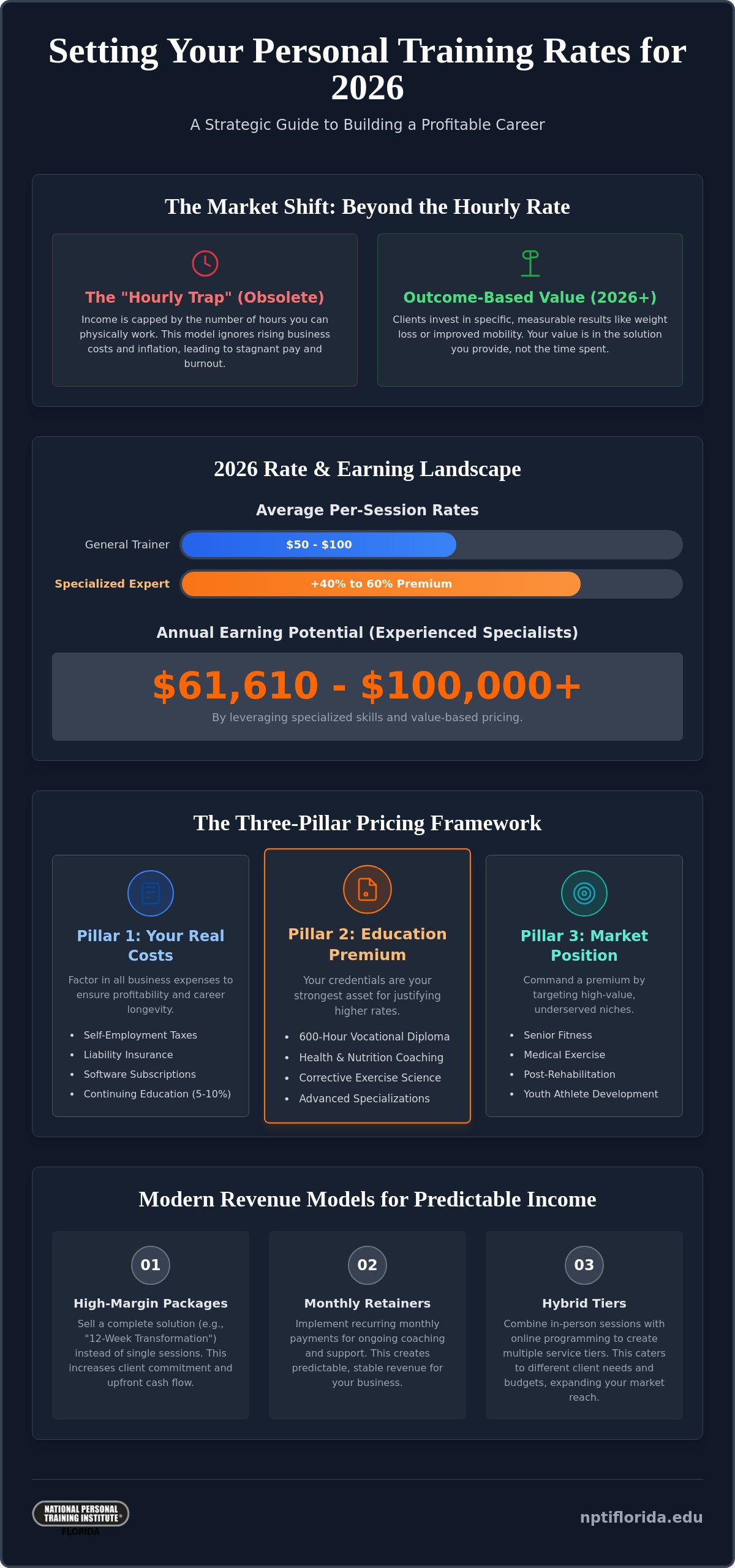
The fitness industry is undergoing a fundamental transformation. In 2026, the traditional model of selling sixty minute blocks of time is quickly becoming obsolete. Clients have moved past the need for a gym buddy or someone to simply count their repetitions. They are investing in specific, measurable outcomes. If you are still defining What is a Personal Trainer? by the old standards of simply supervising a workout, you might be falling into the “Hourly Trap.” This trap limits your income to the number of hours you can physically stand on a gym floor. It also ignores the rising costs of doing business. Professional insurance, advanced client management software, and the persistent pressure of inflation have changed the math. Setting personal training rates 2026 requires a pricing logic that reflects your professional value rather than your manual labor.
Consumer behavior has shifted toward a demand for expertise. Clients are more educated than ever before; they use sophisticated apps to track their macros and steps. They don’t need someone to just stand there with a clipboard. They need a professional who understands the science of corrective exercise and metabolic health. This evolution means your pricing must reflect your role as a health architect who provides solutions to complex problems.
The Shift from Time-Trading to Outcome-Based Value
Outcome-based pricing means selling the destination instead of just the journey. In 2026, clients prioritize behavioral change and long term accountability over how many times they see you per week. They want to know they will lose the weight or improve their mobility. They aren’t just buying a session; they are buying a solution. This shift is a massive advantage for trainers with a comprehensive vocational foundation. When you possess a 600-hour diploma that includes health and nutrition coaching, you aren’t just a trainer; you’re a wellness specialist. You are providing a science-based solution that justifies a higher price point. The value is in the result, not the clock.
2026 Benchmarks: What Trainers are Actually Charging
The market data reveals a clear divide. Entry-level trainers at big box gyms often struggle with rates that barely cover their overhead. Meanwhile, advanced personal training specialists who focus on high value niches are seeing a significant “Premium Gap.” These experts often earn 40 to 60 percent more per hour than their generalist peers. According to recent industry surveys, the national market average for a standard personal training session in 2026 ranges from $50 to $100. Setting personal training rates 2026 is about positioning yourself above that average by proving your depth of study and practical expertise. Experienced trainers, and specialized studios like TrYumph Fitness, have the potential to earn between $61,610 and $100,000+ per year by leveraging these specialized skills.
Building Your 2026 Pricing Strategy: The Three-Pillar Framework
Establishing a professional fee requires more than looking at what the gym down the street charges. To build a sustainable career, you need a defensible pricing strategy. This means having the ability to explain exactly why you cost what you do to any prospective client. When you’re setting personal training rates 2026, you’re balancing your financial needs with the immense value you provide. This balance is found in three specific pillars: your operational overhead, your education premium, and your market position. By anchoring your rates in these facts, you move from “guessing” to “governing” your business growth.
Pillar 1: Calculating Your Real Business Costs
Don’t let hidden expenses erode your profit margins. You must factor in self-employment taxes and professional liability insurance from the very beginning. If you’re using high-end software like TrueCoach or Gymkee to manage your clients, those subscription costs belong in your rate calculation. Successful trainers also treat their professional growth as a mandatory line item. Setting aside 5 to 10 percent of your gross income for a continuing education fund ensures you’re never stagnant. According to the BLS Occupational Outlook Handbook, the median hourly wage for fitness instructors is roughly $22 to $23, but this often doesn’t account for the high overhead expenses of independent contractors. You aren’t just paying for the hour on the floor; you’re paying for the business that makes that hour possible.
Pillar 2: Leveraging Specialized Credentials
Your educational background is your strongest leverage for higher rates. There’s a massive difference between a weekend certification and a comprehensive 600-hour vocational diploma. This “Education Premium” allows you to set a higher baseline because you aren’t just a generalist. You’re a specialist. When your training includes deep dives into Corrective Exercise and Health and Nutrition Coaching, you’re providing a level of science-based service that justifies premium fees. The ROI of a 600-hour program is seen in your lifetime earnings; specialized trainers often command 40 to 60 percent more than those with basic credentials. If you want to move beyond entry-level pay, consider how an Advanced Personal Training Program can immediately redefine your market value. This depth of study transforms you from a “rep counter” into a career architect who delivers guaranteed results.
The final pillar is your niche positioning. While geography matters, your specialization can override local averages. Focusing on high-ticket segments like senior fitness or medical exercise creates a “blue ocean” where you face less competition. In these niches, clients aren’t shopping for the lowest price; they’re shopping for the highest level of expertise. By combining your specialized education with a clear understanding of your local market, you create a pricing structure that is both profitable and impossible for competitors to undermine.
Choosing Your Revenue Model: Packages, Retainers, and Hybrid Tiers
Once you’ve established your baseline costs and education premium, the next step is deciding how to present those numbers to your clients. Moving away from a “pay-as-you-go” approach is essential for professional stability. In 2026, the most successful trainers use structured revenue models that provide predictable cash flow and better client results. By offering a range of options, you give prospects a way to work with you that fits their specific goals and budget. This isn’t just about sales; it’s about using proven fitness marketing strategies to build a sustainable business. Setting personal training rates 2026 requires a shift toward monthly retainers and tiered packages that emphasize long-term commitment over single sessions.
The Deliverables Matrix: What to Include in Each Tier
A three-tier model allows you to anchor your value while making your services accessible. It guides clients toward the level of support they truly need for transformation. When you use this structure, you’re no longer just a “trainer”; you’re a career architect designing a path to success for every individual.
- Tier 1 (Starter): This is designed for self-motivated clients. It typically includes basic programming, a monthly video check-in, and access to your training app for habit tracking.
- Tier 2 (Standard): This is your core offering. It includes weekly coaching sessions, integrated nutrition coaching, and regular form analysis to ensure safety and progress.
- Tier 3 (Premium/Concierge): This is the “VIP” experience. It’s where your specialized vocational training shines. This tier often features daily support, lifestyle design, and corrective exercise protocols for special populations like seniors or those recovering from injury.
Hybrid Coaching: The 2026 Gold Standard
The “Hybrid Trainer” is the most profitable role in the 2026 fitness landscape. This model combines high-value, in-person lab sessions with digital support between visits. It allows you to maximize your reach without the burnout associated with back-to-back gym floor hours. By leveraging a hybrid model, you can effectively double your client capacity while maintaining the high-touch results your reputation is built on. Clients appreciate the flexibility, and you benefit from a more balanced schedule. Recent industry data suggests that hybrid models can reduce client churn by as much as 30 percent compared to traditional session-by-session booking. Setting personal training rates 2026 for hybrid services allows you to charge for your expertise 24/7, rather than just the minutes you spend together in the gym. This approach ensures your business remains resilient and your clients remain engaged.
How to Set Your Rates: A Step-by-Step Implementation Guide
Moving from a vague idea of what you should charge to a concrete business plan requires a methodical approach. You aren’t just picking a number out of the air; you’re engineering a profitable future. When you are setting personal training rates 2026, you must align your financial needs with the professional readiness you’ve built through your education. This process ensures that every hour you spend on the gym floor contributes to both your lifestyle and your business’s growth. By following a structured implementation guide, you can confidently present your fees, knowing they are backed by logic and vocational depth.
Step 1: Define Your Financial Take-Home Target
Start by determining your “Freedom Number.” This is the actual take-home pay you need to support your lifestyle, pay your personal bills, and save for the future. Work backward from your annual goal to find your weekly requirements. It’s vital to account for “Unbillable Hours.” Many trainers fail because they only charge for the time they spend with a client. You must also account for program design, marketing, and administrative tasks. If you plan to work 30 hours a week but 10 of those are admin, your “Minimum Session Rate” must be high enough to cover all 30 hours of effort. This prevents the burnout that often ends promising careers.
Once your take-home is clear, calculate your “Burn Rate.” This is the total monthly cost to keep your business running, including gym floor fees, software, and insurance. From there, apply your “Authority Multiplier.” If you hold a 600-hour vocational diploma, your baseline should be significantly higher than someone with a weekend certificate. Finally, design your tiers and test your messaging with a small “Beta” group of trusted clients to refine your pitch before a full market launch.
Competitive Positioning Without Price-Cutting
Resist the urge to be the cheapest trainer in your area. Price-cutting is a race to the bottom that devalues the entire profession. Instead, use your personal trainer career diploma as a powerful trust-builder. When a prospect asks about your rates, don’t just give a number; present a “Value Stack.” Show them how your $150 per hour rate includes nutrition coaching, corrective exercise protocols, and 24/7 digital support. When you frame it this way, your premium rate looks like a bargain compared to the alternative of slow progress or potential injury with an uneducated trainer. Setting personal training rates 2026 is about proving that your expertise is an investment, not an expense.
Ready to command the rates your hard work deserves? Learn how our Personal Training Specialist Program provides the hands-on lab time and science-based foundation you need to stand out in a crowded market.
Scaling Your Income: Why Advanced Education is Your Highest ROI
Scaling your income isn’t a game of working more hours. It’s a game of increasing your value per hour. When you look at the successful fitness professionals who consistently earn six figures, the common denominator isn’t their social media following; it’s the depth of their vocational foundation. Setting personal training rates 2026 at a premium level requires you to move beyond general fitness and into specialized health solutions. By investing in comprehensive education, you’re essentially buying a higher multiplier for every hour you spend on the gym floor. This is where your career transitions from a job into a scalable business.
Our Hyflex Learning Program is designed specifically for this transition. It allows you to begin building your client base and applying your knowledge in the real world while you finish your diploma. You don’t have to wait to start your business; you can grow it alongside your education, ensuring that by the time you graduate, your rates already reflect your advanced expertise.
Special Populations: The Key to Charging Premium Rates
High-ticket coaching exists in the “blue oceans” of the industry—the niches where demand is high but qualified experts are scarce. If you can only help a healthy 25-year-old lose ten pounds, you’re competing with every app and influencer on the planet. However, if you specialize in special populations, you’re solving high-value problems that generalists can’t touch.
- Corrective Exercise: This specialization allows you to work with clients who have movement dysfunctions or are returning from injury. These are high-stakes problems that clients are willing to pay a premium to solve.
- The Senior Fitness Boom: This demographic often has the highest disposable income and the greatest need for science-based guidance. Pricing for this market isn’t about “getting shredded”; it’s about longevity and quality of life.
- Youth Fitness: Building long-term athletic development programs creates predictable, recurring revenue. Parents invest in their children’s future, making this a stable and high-margin niche.
From Certification to Career Diploma: The Authority Advantage
There is a massive psychological edge that comes from 200+ hours of hands-on personal trainer training. Most trainers suffer from “Imposter Syndrome” because their education was thin, leaving them anxious about raising their rates. When you possess a 600-hour vocational foundation, that anxiety disappears. You charge more because you know more. You understand the physiological “why” behind every movement, which gives you the confidence to stand firm when setting personal training rates 2026.
Professionalizing your pricing starts with professionalizing your education. A weekend certificate might get you in the door, but a comprehensive diploma makes you the architect of your own career. Ready to claim your spot at the top of the industry? Explore our Advanced Personal Training Program and start building the science-based foundation your future business deserves.
Architect Your Career for Long-Term Profitability
The landscape of the fitness industry is shifting toward those who prioritize depth of study and vocational excellence. You now have the blueprint to move beyond the “hourly trap” by implementing tiered revenue models and outcome-based pricing. By understanding your real business costs and leveraging your education premium; you can build a career that’s both profitable and sustainable. Setting personal training rates 2026 is ultimately an exercise in claiming your worth as a specialized health architect rather than a general laborer.
Don’t leave your success to chance. Secure a foundation that commands respect and higher margins. Launch your high-value fitness career with NPTI Florida’s 600-hour Advanced Program. As an ACCSC Accredited Vocational School with over 25 years of veteran-owned experience, we provide 240 hours of hands-on lab time to ensure you’re ready for the elite tier of the market. Your expertise is your greatest asset. It’s time to invest in a future where your income reflects the life-changing results you deliver to your clients.
Frequently Asked Questions
What is the average hourly rate for a personal trainer in 2026?
National averages for a standard personal training session typically range between $50 and $100. This figure varies significantly based on your geographic location and your specific level of experience. In major metropolitan areas or boutique environments, independent professionals often command rates exceeding $100 per hour for their expertise.
Should I charge more for specialized training like Corrective Exercise or Senior Fitness?
Yes, specialized knowledge allows you to solve high-value problems that generalists can’t address. Professionals with advanced credentials in corrective exercise or senior fitness often earn 40 to 60 percent more than those offering standard weight loss coaching. You’re selling a specific, science-based health outcome that justifies a premium price point.
How do I raise my personal training rates without losing my current clients?
Raising your rates requires transparent communication about the increased value and results you provide. Give your existing clients at least 30 to 60 days of notice before the new pricing takes effect. You might also offer a “legacy rate” for a limited time to reward their loyalty while you transition your business toward its new market position.
Is it better to charge per session or use a monthly retainer model?
Monthly retainers are the superior choice for building a stable and predictable fitness business. They provide consistent recurring revenue and encourage a higher level of client commitment to their long-term goals. While per-session pricing is common for those just starting out, moving toward a retainer model helps you escape the exhausting cycle of trading hours for dollars.
How much of my personal training income should I set aside for taxes and overhead?
You should generally allocate 25 to 30 percent of your gross income for self-employment taxes. It’s also vital to set aside another 10 to 15 percent for operational overhead, insurance, and a continuing education fund. Keeping these funds separate from your personal spending ensures your business remains financially healthy and prepared for future investments.
Does having a 600-hour diploma really allow me to charge more than a weekend certification?
A 600-hour diploma establishes you as a vocational expert with a foundation equivalent to a “Master’s Degree” in the field. This depth of study is a decisive factor when setting personal training rates 2026 because it builds the high-level trust that premium clients demand. The 240 hours of hands-on lab time ensures you deliver the superior results that justify top-tier fees.
Should I offer discounts for bulk session packages in 2026?
Deep discounting can devalue your professional expertise and erode your profit margins over time. Instead of lowering your price, consider “value-stacking” your offers by including nutritional coaching or specialized recovery protocols. This approach maintains your premium positioning while giving clients a clear incentive to commit to a long-term transformation.
How do I price my services if I offer both in-person and online coaching?
The most profitable approach is a tiered hybrid model that combines high-value in-person sessions with remote support. Charge your highest rates for hands-on lab time and offer lower-priced tiers for digital programming and habit tracking. This structure allows you to scale your income and impact without being limited by the number of hours you can physically spend in the gym.