Personal Trainer Liability Insurance: The Complete 2026 Professional Guide
A split second; a single misstep; a career-ending lawsuit. Imagine a client misinterprets a coaching cue during a heavy deadlift and sustains a…

A split second; a single misstep; a career-ending lawsuit. Imagine a client misinterprets a coaching cue during a heavy deadlift and sustains a serious injury, or simply trips over a kettlebell in a crowded gym. Without the right personal trainer liability insurance, that single moment of misfortune could dismantle the business you’ve worked years to build. It’s a heavy weight to carry, and the anxiety of navigating complex policy limits or confusing legal jargon often feels more exhausting than a triple-split leg day. You aren’t just a coach; you’re a professional responsible for the safety and physical transformation of others. Protecting that mission requires more than just a certificate; it demands a solid legal shield.
We understand the frustration of trying to distinguish between general and professional liability while comparing varying monthly premiums. This guide is your definitive roadmap to mastering the complexities of fitness insurance so you can focus on what you do best: changing lives. You’ll gain a clear understanding of standard coverage limits, learn how to choose the right provider with a professional checklist, and discover why a science-based educational foundation is your best defense against negligence. By the end of this guide, you’ll have the confidence that your career is legally protected for 2026 and beyond.
Key Takeaways
- Learn why personal trainer liability insurance is a non-negotiable professional safeguard that protects your career from the financial impact of legal claims.
- Master the essential distinction between General Liability for on-premises accidents and Professional Liability for injuries related to your specific training advice.
- Identify the specific policy endorsements and higher coverage limits required for high-risk niches, including youth fitness and special populations.
- Gain the tools to compare insurance providers effectively by understanding the critical differences between “Occurrence” and “Claims-Made” policy structures.
- Discover how a science-based vocational education and hands-on laboratory experience serve as your primary defense against professional negligence.
Understanding the Foundation of Personal Trainer Liability Insurance
You’ve dedicated your life to helping others reach their physical peak. Every rep, every meal plan, and every coaching cue is designed to foster growth. However, in a profession built on physical exertion, the risk of injury is a constant shadow. Personal trainer liability insurance is your specialized professional safeguard. It’s the shield that protects your personal assets and your career longevity when a client claims your instruction led to an injury or financial loss. Without it, you’re essentially training without a spotter on a max-effort lift.
The legal weight of your role rests on a concept known as “Duty of Care.” As a fitness professional, you have a legal obligation to provide a standard of service that avoids foreseeable harm to your clients. This isn’t just about being a “good” coach. It’s about adhering to science-based protocols and safety standards. This falls under the broader umbrella of professional liability insurance, which is designed to cover errors, omissions, and negligence in specialized service industries. If a client sustains a torn ligament or a cardiac event during a session, the court will evaluate whether you breached this duty.
Don’t assume your existing personal policies have you covered. Most standard homeowners or general umbrella insurance products explicitly exclude professional business activities. If you’re training a client in your home garage or a local park, these personal policies will likely deny any claim related to your coaching. Furthermore, nearly every commercial gym contract and independent contractor agreement requires proof of a specific policy before you can step onto the floor. It’s a non-negotiable entry fee for the professional world.
Why Fitness Professionals Cannot Rely on Gym Policies Alone
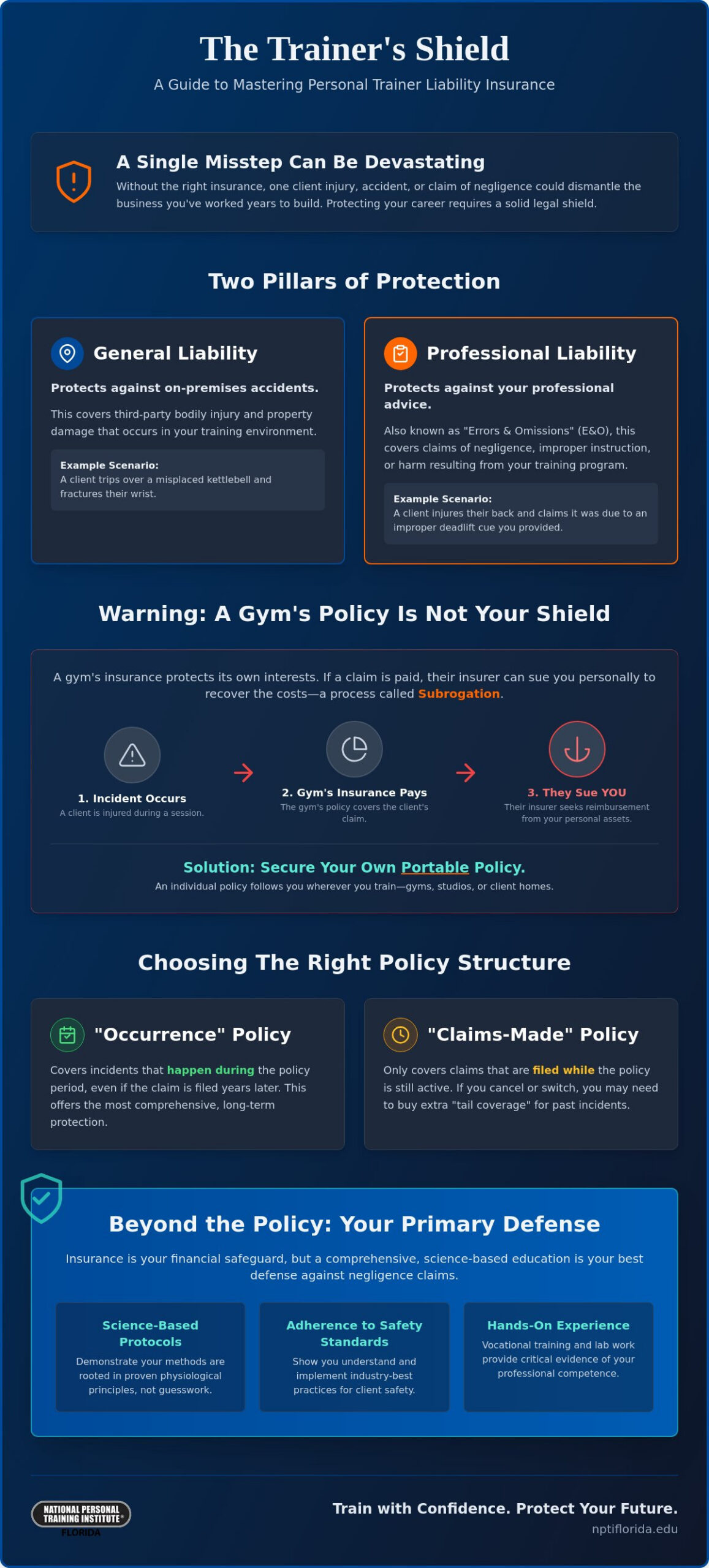
Gyms carry insurance to protect their own interests, not yours. While they might have vicarious liability coverage, this often only protects the facility as an entity. If an incident occurs, a gym might subrogate the claim. This means their insurance company pays the injured party and then sues you personally to recover those funds. You need portable coverage. An individual policy follows you across different locations, whether you’re at a big-box gym, a boutique studio, or a client’s home.
The Legal Reality of the Modern Fitness Industry
Litigation is rising. We see more cases involving overtraining, rhabdomyolysis, and improper exercise prescription than ever before. In these scenarios, a science-based foundation serves as critical legal evidence of your professional competence. It demonstrates that your methods aren’t just guesses; they’re rooted in proven physiological principles. Personal trainer liability insurance serves as the absolute financial barrier between a professional mistake and personal bankruptcy. For those who find the legal side of these professional disputes intriguing, you can explore Paralegal Certificate Program Tuition options to learn how to enter the legal support field.
General Liability vs. Professional Liability: What is the Difference?
One policy is rarely enough for a career built on longevity. To truly insulate your business, you must understand the distinction between the environment you train in and the expertise you provide. This is the essential breakdown of General Liability Vs. Professional Liability. While both are critical components of personal trainer liability insurance, they address fundamentally different risks. One protects you from the physical world; the other protects you from the weight of your own professional advice. Without a clear understanding of both, you leave your business vulnerable to gaps that could prove catastrophic.
General Liability is your first line of defense against third-party bodily injury and property damage occurring on your training premises. It doesn’t matter if you own the gym or rent space as an independent contractor. If someone gets hurt because of a physical hazard, you’re potentially liable. On the other hand, Professional Liability, also known as Errors and Omissions (E&O), covers claims of negligence or improper instruction. This is where your science-based foundations are put to the test. If a client claims your specific coaching cues or program design caused their injury, Professional Liability is what keeps your business afloat. Combining these creates a comprehensive risk management strategy that allows you to train with total confidence.
Scenario Analysis: General Liability in Action
General Liability claims focus on the environment rather than the instruction. Imagine a client finishes a set and trips over a kettlebell left in a high-traffic walkway. Even though the injury happened during a session, the cause was a trip hazard, not a coaching error. Similarly, consider a mobile trainer working in a client’s home. If you accidentally drop a dumbbell and crack an expensive marble floor during a mobile session, your General Liability policy handles the property damage. These scenarios are about the physical risks inherent in any business space, regardless of the quality of your coaching.
Scenario Analysis: Professional Liability and Negligence
Professional Liability claims target your judgment and your personal training program expertise. Suppose you prescribe a high-intensity movement to a client with a documented heart condition without following proper medical clearance protocols. If they suffer a health crisis, the lawsuit will focus on your failure to provide safe instruction. Another common example is a failure to properly spot a heavy lift, leading to a joint injury. In these cases, the gym environment was perfectly safe, but your professional execution was called into question. Because these risks are so varied, you need both types of coverage to ensure your professional evolution remains secure. If you want to build a business that lasts, start with a foundation of world-class vocational training to minimize these risks from day one.
Evaluating Coverage Needs for Specialized Training Niches
Specialization is a hallmark of professional growth. It allows you to command higher rates and serve specific communities with precision. However, as your expertise narrows, your risk profile expands. Standard personal trainer liability insurance policies often require specific endorsements or higher limits when you move beyond general fitness coaching. If you aren’t auditing your coverage as you evolve into new niches, you might be training without the protection you think you have. Your insurance must grow alongside your career to remain an effective shield.
Training “Special Populations” like youth, seniors, or those with chronic conditions carries unique legal nuances that standard policies might exclude. For those working with minors, Sexual Abuse and Molestation (SAM) coverage is often a mandatory requirement for facility contracts. This specific endorsement protects against claims that fall entirely outside the scope of physical injury. Similarly, if you recommend or sell supplements, Product Liability coverage is non-negotiable. Without it, you could be held responsible for a client’s adverse reaction to a third-party product you suggested. Organizations like the IDEA Health & Fitness Association insurance emphasize that comprehensive coverage must align with your actual day-to-day activities to be effective.
Insurance for Senior Fitness Specialists
Senior Fitness Specialists face an increased risk of client fractures, falls, and cardiovascular incidents. Insurance providers often look more favorably on trainers who hold specialized credentials, such as a Senior Fitness Specialist certificate. This education proves you understand the physiological limitations and bone density concerns of older adults. Using comprehensive medical clearance forms is another critical step in mitigating risk. These documents don’t just gather health history; they act as a legal record that you exercised due diligence and sought medical approval before starting a high-risk program.
The Intersection of Nutrition Coaching and Liability
The line between coaching and clinical practice is thin. For a health and nutrition coach, staying within the “Scope of Practice” is the best way to avoid a professional liability claim. There is a massive legal difference between “prescribing” a specific diet to treat a medical condition and “recommending” nutrition plans for general wellness and performance. Stepping into medical territory without a license is a fast track to a denied insurance claim. Enrolling in a science-based Health and Nutrition Coaching Program ensures you understand these boundaries while providing elite-level guidance. By mastering the fundamentals of nutrition science, you protect your clients’ health and your own professional standing simultaneously.
The Real Cost of Coverage and How to Choose a Provider
Investing in your protection shouldn’t feel like a shot in the dark. The cost of personal trainer liability insurance varies based on your location, annual revenue, and training volume. For most solo trainers in 2026, annual premiums range between $120 and $400. If you offer specialized services like nutrition counseling or work with high-risk populations, expect to pay between $600 and $1,200 annually for comprehensive coverage. While price is a factor, the structure of your policy determines your actual security.
You must choose between an “Occurrence” or “Claims-Made” policy. An occurrence policy is the industry gold standard. It covers you for any incident that happens while the policy is active, even if the lawsuit is filed years later after the policy has expired. Claims-made policies only provide coverage if the policy is active both when the event happens and when the claim is filed. This distinction is vital for long-term career stability. Additionally, most commercial gyms will require you to list them as an “Additional Insured” on your policy. This protects the facility under your coverage for incidents arising from your specific training sessions.
Before signing with a provider, verify their financial stability. Look for an A.M. Best rating of “A” or better. This rating indicates the insurer has the capital to pay out large claims even during economic shifts. If you want to build a business that minimizes these risks from the start, consider the Advanced Personal Training Program at NPTI Florida to gain the science-based skills that insurance companies value.
Decoding Policy Limits and Deductibles
The industry standard for liability limits is $1 million per occurrence and $3 million aggregate. This means the insurer will pay up to $1 million for a single claim and up to $3 million total during the policy year. As a new trainer, carrying a deductible between $250 and $500 is realistic; it keeps your premiums affordable while ensuring you can cover the initial cost of a claim. If you are planning a career change personal trainer transition, ask about “Tail Coverage.” This ensures you remain protected for past sessions even after you stop training or move to a different profession.
Key Questions to Ask an Insurance Agent
Don’t assume every movement is covered. Ask your agent specifically if the policy includes online or virtual training sessions, as many older policy templates still exclude remote work. Inquire about exclusions for high-risk movements like CrossFit or parkour; some insurers require additional riders for these activities. Finally, confirm if defense costs are “outside the limit.” This means the insurance company pays for your legal defense without exhausting the $1 million available to pay for damages or settlements.
Beyond the Policy: How Comprehensive Education Mitigates Risk
Your insurance policy is a safety net. Your education is the skill that keeps you on the tightrope. While personal trainer liability insurance provides a critical financial barrier against professional disaster, it cannot replace the competence gained through rigorous, science-based training. Think of insurance as a reactive measure and education as your primary proactive defense. By mastering human movement and corrective exercise, you eliminate the hazards that lead to claims in the first place. You don’t just want to be covered; you want to be exceptional.
The 240 hours of hands-on lab work at NPTI Florida build the corrective exercise skills essential for injury prevention. This isn’t just theory from a textbook. It’s practical application under the guidance of seasoned mentors who understand the nuances of the industry. In a legal setting, a 600-hour diploma carries immense weight. If your professional judgment is ever questioned in a courtroom, having a comprehensive vocational foundation serves as powerful evidence of a high “Professional Standard of Care.” It demonstrates that you’ve invested in a foundational education that far exceeds the industry’s minimum requirements.
Safety also stems from clear communication and behavior change. Understanding behavior-change psychology allows you to improve client adherence to safe movement patterns. When a client understands the “why” behind a specific cue, they’re less likely to go rogue and more likely to follow your safety protocols. This psychological edge creates better safety outcomes and fosters the trust necessary for a long-term professional relationship. You’re not just a coach; you’re a career architect building a secure future.
The NPTI Florida Advantage: 600 Hours of Risk Management
We focus on assessing human movement dysfunction to prevent improper exercise prescription before the first set even begins. Our curriculum ensures you can identify potential red flags in a client’s biomechanics, which is the most effective way to avoid professional negligence claims. Through our Hyflex Learning Program, you gain the flexibility of remote study without sacrificing the supervised, practical application needed to master your craft. NPTI Florida graduates are career-ready, not just exam-ready. You’ll enter the gym floor with the confidence that your methods are rooted in proven science and practical safety.
Building a Legally Sustainable Fitness Career
View your education as a foundational investment in your professional protection. By becoming a specialist in high-demand, low-risk niches, you naturally reduce your exposure to the types of incidents that trigger personal trainer liability insurance claims. Longevity in this industry is built on a reputation for results and a commitment to safety. When you combine a robust insurance policy with the elite training provided by an accredited institution, you create an unbreakable shield for your business. Don’t leave your professional evolution to chance. Request a Student Catalog today to see how our accredited curriculum protects your professional future and sets you apart as a leader in the fitness world.
Secure Your Professional Future with Science and Strategy
You’ve built a vision for your career; now it’s time to shield it. Mastering the nuances of personal trainer liability insurance is more than a legal checkbox. It’s a commitment to professional excellence. By distinguishing between environmental risks and instructional errors, you ensure that no single accident can derail your progress. While a policy provides financial security, your 600-hour vocational foundation is what truly prevents negligence from occurring. Education is the primary defense. Insurance is the safety net.
NPTI Florida has spent over 25 years training elite fitness professionals to lead with safety and science. As an institution accredited by the ACCSC and licensed by the Florida Commission for Independent Education (License #2442), we provide the hands-on experience needed to navigate the modern legal landscape with total confidence. You have the passion to change lives. We have the framework to protect that passion. It’s time to transition from a trainer to a seasoned professional.
Launch Your Protected Fitness Career with NPTI Florida. Your journey toward becoming a career architect starts with the right education. Take the next step today and build a business that stands the test of time. We’re ready to help you succeed.
Frequently Asked Questions
Is personal trainer liability insurance required by law?
No specific federal or state law mandates insurance, but it is a practical requirement for any professional operating in the fitness industry. Almost every commercial gym and boutique studio requires proof of coverage before allowing you to train clients on their premises. It serves as a non-negotiable contractual obligation that protects both your business and the facilities where you conduct your sessions.
How much does personal trainer liability insurance typically cost?
Annual premiums for solo trainers generally range between $120 and $400 for standard liability coverage. If you specialize in high-risk areas like nutrition coaching or training special populations, costs can increase to between $600 and $1,200 per year. These rates depend on your specific location, training volume, and the coverage limits you choose to secure your professional future.
What is the difference between a “claims-made” and “occurrence” policy?
An occurrence policy covers any incident that happens while the policy is active, regardless of when the claim is eventually filed. A claims-made policy only provides protection if the policy is active during both the incident and the moment the claim is made. Most experts recommend occurrence policies because they offer superior long-term security, even if you eventually change careers or retire.
Does my gym’s insurance cover me if I am an independent contractor?
Usually, a gym’s policy only protects the facility as a business entity, leaving independent contractors personally exposed to coaching-related lawsuits. Even if a facility has vicarious liability coverage, their insurer may attempt to recover losses from you personally through a process called subrogation. Carrying your own portable personal trainer liability insurance ensures you remain protected across all training locations and environments.
Do I need separate insurance for online personal training?
You don’t necessarily need a separate policy, but you must verify that your current coverage explicitly includes remote or virtual coaching. Many modern insurance providers include online training as a standard feature, but some older or basic policies still exclude remote work. Always check your policy documents for a specific “virtual training” endorsement to ensure your digital business is fully protected.
What is an “Additional Insured” and why do I need one?
An “Additional Insured” is a third party, such as a gym or studio owner, that you add to your policy to extend your coverage to them. Gyms require this status to ensure they aren’t held financially responsible for injuries that occur during your specific training sessions. Adding a facility as an additional insured is a standard industry practice and is typically required for most independent contractor agreements.
Can I get insurance if I am still a student in a personal training program?
Yes, many insurance providers offer specialized student policies for individuals currently enrolled in an accredited personal training program. These policies allow you to gain essential hands-on experience and conduct supervised sessions with the confidence that you are legally protected. It is a proactive step that demonstrates professional responsibility while you are still completing your science-based vocational education.
Does liability insurance cover me if a client is injured while using a supplement I recommended?
Standard liability policies often exclude injuries related to supplements unless you have a specific “Product Liability” endorsement. If you recommend or sell nutritional products, this extra layer of protection is essential for covering potential adverse reactions or health complications. Without this specific endorsement, you could be held personally liable for any medical issues a client experiences based on your professional advice or sales.