Personal Trainer Client Retention Strategies: How to Build a Sustainable Fitness Career
Did you know the average personal training client stays for only three to four months? That statistic is a wake-up call for any coach tired of the…

Did you know the average personal training client stays for only three to four months? That statistic is a wake-up call for any coach tired of the “churn and burn” cycle that leads to exhaustion and unstable monthly income. It’s frustrating to feel more like a desperate salesperson than a fitness professional; especially when you’re constantly chasing new leads just to keep your head above water. You deserve a career built on stability, not a revolving door of trial memberships.
Mastering the right personal trainer client retention strategies is the difference between a temporary side hustle and a thriving, sustainable career. We’re going to move past basic customer service tips to master the professional systems and psychological strategies that keep clients engaged for years. This guide explores how to establish high-value expertise, set firm professional boundaries, and use science-based foundations to ensure your schedule stays full and your work-life balance remains intact. It’s time to stop worrying about next month’s rent and start building a legacy of lasting results.
Key Takeaways
- Shift your focus from basic certifications to professional mastery to ensure your clients achieve the consistent, science-based results that drive long-term loyalty.
- Implement psychological personal trainer client retention strategies, such as the “Mirror Strategy” and clear social contracts, to build deep rapport and set expectations from the first session.
- Protect your business by identifying the early warning signs of trainer burnout, which remains a leading hidden cause of client turnover and career instability.
- Develop specialized programming in high-demand niches like recovery and mobility to differentiate your brand and become an irreplaceable asset to your clients.
- Understand why hands-on lab hours and comprehensive vocational education provide the practical foundation necessary to transition from a session-based trainer to a career architect.
Why Professional Mastery is the Ultimate Client Retention Strategy
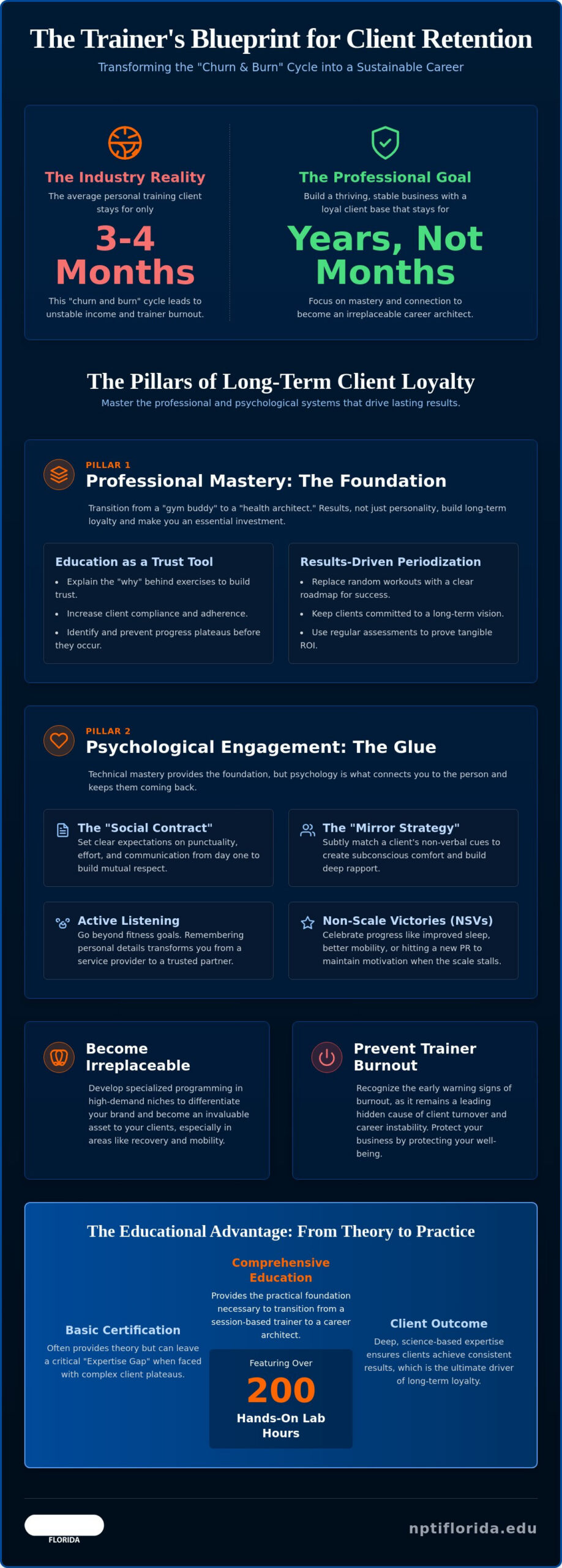
Retention isn’t a happy accident. It’s the logical byproduct of perceived value and consistent, measurable results. Many trainers mistake being “likable” for being “essential,” but personality only gets you through the first month. True loyalty is built when a client realizes they’re making progress they simply couldn’t achieve alone. This is where the “Expertise Gap” becomes a major risk for your business. A Personal trainer who relies solely on a weekend certification often lacks the technical depth to navigate complex physical plateaus. When the results stop, the client leaves. It’s that simple.
Building a sustainable career requires you to transition from being a “gym buddy” to a “health architect” for your clients. A buddy counts reps and provides motivation, but an architect designs a long-term structure for physical success. By grounding your practice in professional mastery, you elevate your status from a luxury expense to a necessary investment. This shift is one of the most powerful personal trainer client retention strategies available. It transforms you into a high-value expert who understands the “how” and “why” of every movement, ensuring your clients feel secure in your hands.
Education as a Trust-Building Tool
Knowledge is your most effective tool for increasing client compliance. When you explain the mechanics behind a specific movement, you aren’t just teaching a skill; you’re building trust. Clients who understand how an exercise improves their specific goals are significantly more likely to follow your instructions outside the gym. Advanced knowledge in anatomy and physiology also allows you to identify and prevent progress plateaus before they frustrate your client. Professional mastery is the intersection of science and empathy.
Results-Driven Periodization
Random workouts lead to random attendance. If your programming feels like a collection of disconnected exercises, your clients will treat their sessions as optional. Results-driven periodization solves this by providing a clear roadmap for the future. It keeps clients committed to a long-term vision rather than just a single workout. Regular assessments play a critical role in this process by proving tangible ROI. When you can use data to show a client exactly how their strength or mobility has improved, you reinforce the value of your partnership. This structured approach is a cornerstone of effective personal trainer client retention strategies because it turns a fitness goal into a predictable journey.
At NPTI Florida, we believe that better education leads to better client results. Our hands-on approach, featuring over 200 hours of lab time, ensures you don’t just learn the theory of retention. You practice the hard and soft skills required to build a loyal client base from day one. By investing in a comprehensive diploma rather than a basic certificate, you bridge the expertise gap and set the stage for a decades-long career.
Psychological Strategies for Long-Term Client Engagement
While technical mastery provides the foundation, psychology is the glue that keeps clients coming back. Implementing psychological personal trainer client retention strategies allows you to connect with the person, not just the athlete. It starts with a “social contract” during the first session. By setting clear expectations regarding punctuality, effort, and communication, you eliminate the ambiguity that often leads to early dropouts. Creating a Successful Fitness Client Onboarding Process ensures that the professional relationship is defined by mutual respect rather than just a financial transaction.
Building rapport is equally critical. The “Mirror Strategy” involves subtly matching a client’s non-verbal cues, such as their posture or speaking pace, to create a sense of subconscious comfort. This isn’t about manipulation; it’s about meeting the client where they are emotionally. Combine this with active listening that goes beyond simple fitness goals. When you remember a client’s stressful week at work or their child’s graduation, you move from being a service provider to a trusted partner. This holistic approach to coaching is one of the most effective personal trainer client retention strategies for building a stable, long-term business.
Motivation often dips when the scale stops moving. To combat this, celebrate “Non-Scale Victories” (NSVs). Whether it’s improved sleep, better energy levels, or simply feeling more confident in their clothes, highlighting these wins maintains momentum during weight plateaus. This psychological reinforcement reminds clients that progress is multifaceted and always happening, even when the physical changes are subtle.
The First 30 Days: The Retention Critical Zone
This period is the retention critical zone where most turnover occurs. To secure the long-term commitment of your clients, follow these three steps:
- Step 1: Conduct a comprehensive client screening and goal-setting workshop to align on a shared vision of success.
- Step 2: Establish a consistent communication cadence outside of sessions, such as a mid-week check-in text, to show you’re invested in their journey.
- Step 3: Deliver a “quick win” in week one, like mastering a specific movement or hitting a daily water goal, to build immediate confidence and momentum.
Behavioral Coaching and Habit Formation
When the initial excitement fades, clients often hit a “middle-stage” slump. This is where behavioral coaching becomes essential. Use the “Tiny Habits” method to integrate fitness into their lifestyle through small, manageable changes that don’t feel overwhelming. For example, integrating Health and Nutrition Coaching helps clients manage their habits outside the gym, which is where 90% of their success happens. By focusing on sustainable lifestyle shifts rather than radical overhauls, you ensure the client stays engaged for years. If you’re ready to master these human-centric skills, explore the Personal Training Specialist Program to gain the hands-on experience needed for professional success.
Personal Trainer Burnout Prevention: Protecting Your Business
An exhausted trainer is a retention liability. In 2026, trainer burnout has emerged as the number one hidden cause of client turnover. When you are depleted, your ability to provide the high-energy, focused coaching your clients pay for disappears. Applying effective personal training client retention methods is impossible if you are running on empty. Clients can sense when a coach is mentally checked out; they will quickly find someone who brings the enthusiasm they need to stay motivated.
Identifying the red flags early is essential for your career longevity. Emotional exhaustion, a growing sense of cynicism toward your clients, and a feeling of reduced efficacy are clear signs that you are reaching a breaking point. Integrating sustainable boundaries into your personal trainer client retention strategies ensures you remain a high-value expert rather than a service commodity. This means shifting your focus from mere “time management” to “energy management.” You must prioritize where your effort goes to ensure every client gets the best version of your professional self.
Setting professional boundaries doesn’t mean losing your likability. In fact, clients respect a coach who values their own time and expertise. Clearly defined session windows, firm cancellation policies, and professional communication hours create a sense of security. It tells the client that you are a serious business owner, not just a casual acquaintance. This professional distance actually strengthens the coach-client relationship by keeping the focus on results and professional growth.
Sustainable Scheduling for Longevity
The “split-shift” trap is a common career killer. Working from 5:00 AM to 10:00 AM and then returning for evening sessions from 4:00 PM to 8:00 PM leads to chronic mid-day fatigue. To avoid this, try to condense your schedule or implement strict “buffer time” between clients for mental resetting. These short breaks allow you to transition between different client personalities and goals without carrying the stress of the previous hour into the next. Regular “pro-development” days are also vital. They prevent professional stagnation and remind you why you chose this mission-driven career in the first place.
Self-Care as a Professional Requirement
You must practice what you preach. A trainer who neglects their own training and nutrition loses the moral authority required to lead others. Beyond physical health, you must manage the “emotional labor” of being a coach and confidant. Clients often share personal struggles, and carrying that weight can be draining. A trainer’s energy is their most valuable business asset. By prioritizing your own wellness, you ensure you have the capacity to support your clients through their hardest sessions and most challenging life stages.
Advanced Programming: Retaining Clients Through Specialization
Generalists are interchangeable. Specialists are indispensable. When you position yourself as a generalist, you’re competing with every budget gym and fitness app on the market. By contrast, specializing in a niche creates “sticky” clients who view you as an essential part of their lifestyle. This specialized approach is one of the most effective personal trainer client retention strategies because it solves specific, high-stakes problems that a generic workout simply cannot address. You stop being a commodity and start being a solution.
Transitioning into multi-disciplinary coaching allows you to provide a holistic value proposition. By integrating fitness, nutrition, and lifestyle modifications, you become more than just someone who watches them lift weights. You become a consultant for their entire physical existence. This level of integration makes it incredibly difficult for a client to find a replacement who understands their history, limitations, and goals as deeply as you do. When you own the results, you own the relationship.
Tapping into the Senior Fitness Market
Older adults represent one of the most loyal demographics in the fitness industry. They often have more predictable schedules and a higher level of discretionary income compared to younger clients. Earning a Senior Fitness Specialist credential allows you to tap into this market with confidence. Beyond safety protocols, training seniors often fosters a powerful “Community Effect.” When older clients see their peers succeeding under your guidance, it builds a collective loyalty that is hard to break. They aren’t just buying a session; they’re investing in their longevity and social circle.
Recovery and Stretch Coaching
Consistency is the parent of results, but injuries are the enemy of consistency. If a client is too sore or injured to train, they stop paying. Integrating recovery and mobility into your sessions ensures your clients stay on the floor and moving toward their goals. Obtaining a Stretch Coach Certification adds immediate, tangible value to your standard sessions. Active recovery sessions prevent overtraining and reduce dropout rates by making the gym a place of healing, not just hard labor. The psychological benefit of hands-on recovery work reinforces the human connection and provide immediate physical relief, making your value feel instantaneous.
If you want to move beyond the basics and build a business that lasts, you need the right tools. Learn how to master these advanced programming techniques by enrolling in the Personal Training Specialist Program at NPTI Florida today.
Launching a Sustainable Career with NPTI Florida
NPTI Florida isn’t just a school; it’s a career architect. While we’ve explored psychological rapport and advanced programming, none of these personal trainer client retention strategies work without a rock-solid educational foundation. A weekend certification might give you a piece of paper, but our Personal Training Program provides the deep-rooted confidence that only comes from hundreds of hours of experience. With a 25-year legacy of excellence, we prepare you for a 25-year career, ensuring you have the vocational precision to retain clients from your very first day in the gym.
Our Hyflex Learning Program offers the ultimate advantage for the modern student. It seamlessly balances rigorous science-based theory with real-world gym application. This hybrid approach ensures you understand the complex physiology of movement while simultaneously mastering the “soft skills” of client management. Transitioning from a student to a professional requires more than just knowing facts; it requires the ability to apply those facts under pressure. By the time you receive your comprehensive diploma, you’ll be ready to lead with authority and security.
The Power of Hands-On Lab Time
You can’t learn the nuances of human connection from a textbook. Our curriculum includes over 200 hours of hands-on lab time, where you practice everything from precise spotting techniques to the “difficult conversations” that define professional boundaries. This supervised environment allows you to fail safely and learn quickly. By the time you graduate, you’ve already built the professional presence that clients find irresistible. You’ll walk onto any gym floor with the authority of a seasoned expert, which is the most powerful tool in your personal trainer client retention strategies toolkit.
Your Next Steps in Professional Evolution
Choosing the right path is the first step in your career architecture. Whether you begin with the Personal Training Specialist Program or pursue our Advanced Personal Training Program, you’re making a foundational investment in your future. Beyond the classroom, you’ll gain access to NPTI’s extensive national network, providing you with career placement opportunities that basic certifications simply can’t match. We are veteran-owned, operated, and committed to your long-term evolution as a high-value expert.
Start your journey toward a professional fitness career today.
Build Your Legacy in the Fitness Industry
Success in this industry isn’t about how many clients you sign this week; it’s about how many you still have three years from now. By mastering advanced programming and human psychology, you transform from a trainer into a career architect. Professional mastery and niche specialization act as the ultimate personal trainer client retention strategies, allowing you to build a business that’s both profitable and personally fulfilling. You don’t have to navigate this path alone or settle for a basic certification that leaves you unprepared for real-world challenges.
NPTI Florida offers the accredited vocational career diplomas you need to stand out as a high-value expert. As a veteran owned and operated institution, we prioritize the discipline and practical skills required for long-term stability. With over 200 hours of hands-on lab time, you’ll gain the confidence to lead and the expertise to deliver undeniable results. Your future as a successful fitness professional starts with a commitment to comprehensive education. It’s time to transition from a temporary job to a lifelong mission.
Download the NPTI Florida Program Guide and Start Your Career. Your future clients are waiting for a coach who can change their lives; be that coach.
Frequently Asked Questions
What is the average client retention rate for personal trainers?
The average personal training client stays for only three to four months before dropping off. While the broader fitness industry sees an annual retention rate of about 66.4%, individual trainers often struggle with higher churn. This highlights the need for specialized personal trainer client retention strategies that focus on building long-term value and deep professional rapport rather than just providing a generic workout.
How often should I check in with my clients outside of scheduled sessions?
You should aim for at least one meaningful check-in per week outside of your scheduled training time. This contact doesn’t need to be long; a quick text to ask about their recovery or a nutrition-related tip is sufficient. Consistent communication keeps your clients focused on their goals and reinforces the idea that you are a dedicated partner in their health journey.
What is the most common reason clients quit personal training?
A perceived lack of progress or value is the most frequent reason clients decide to stop training. If a client doesn’t feel their results justify the investment, they will view your sessions as a luxury rather than a necessity. This is why regular assessments and celebrating non-scale victories are essential for proving the tangible return on investment your coaching provides.
How do I raise my rates without losing my existing clients?
Raise your rates by providing at least 30 to 60 days of notice and clearly communicating the added value you bring to your practice. Mention any new credentials, such as a Stretch Coach Certification, or improvements in your service model. Grandfathering your most loyal clients at their current rate for an extra few months can also help maintain trust while you transition to higher pricing.
Can a personal trainer prevent burnout while working 40+ hours a week?
Preventing burnout while maintaining a high-volume schedule requires strict energy management and professional boundaries. Avoid the “split-shift” trap where your day is fragmented by long unpaid gaps, as this leads to chronic mental fatigue. Prioritizing your own wellness ensures you have the emotional capacity to lead others effectively, making it one of the most vital personal trainer client retention strategies for long-term success.
Is it better to be a generalist or a specialist for client retention?
Specializing in a niche is significantly better for long-term retention than being a generalist. When you become a specialist, such as a Senior Fitness Specialist, you solve specific problems that generic trainers cannot address. This makes you an irreplaceable asset to your clients, as they won’t be able to find your level of expertise at a budget gym or through a mobile app.
How do I handle a client who is consistently unmotivated?
Address a lack of motivation by revisiting the client’s core “why” and adjusting their goals to be more manageable. Use behavioral coaching techniques like the “Tiny Habits” method to build momentum through small wins that require minimal willpower. Sometimes, a lack of motivation is simply a sign of external stress, so practicing active listening can help you adjust the session to meet their current emotional needs.
Does having an advanced diploma actually help with keeping clients?
An advanced diploma is a powerful tool for retention because it bridges the “expertise gap” that often leads to client churn. Comprehensive education provides the technical depth needed to navigate plateaus and prevent injuries. When clients see that your methods are rooted in science and hands-on experience, they develop a level of trust that a basic certification alone cannot sustain.