Periodization for Personal Trainers: A Practical Guide
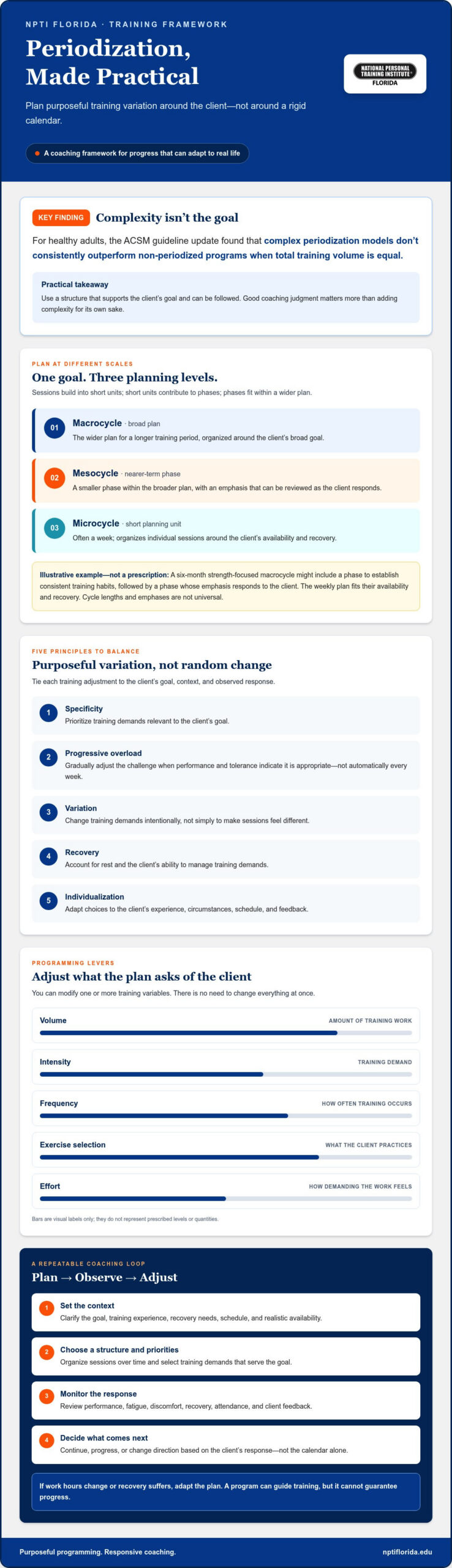
A more complex training calendar doesn’t automatically produce better results. The ACSM’s 2026 resistance training guideline update found that, for healthy adults, complex periodization models don’t consistently outperform non-periodized programs when total training volume is equal. That makes the principles of periodization for personal trainers more useful than rigidly following one model.
If you’ve wondered when to change a client’s sets, reps, intensity, or recovery, you’re asking the right questions. Plans need structure, but clients also have changing schedules, goals, and recovery needs. A useful framework supports progress without becoming a calendar the client can’t follow.
This guide explains how to organize training over time, compare common periodization models, and choose an approach that fits each client. You’ll also learn how to monitor the response, adjust training variables, and keep a coherent plan when life disrupts the schedule. The goal is practical coaching judgment: purposeful programming that can adapt to real-world training.
Key Takeaways
- Use the principles of periodization for personal trainers to plan purposeful variation around each client’s goals, rather than changing exercises at random.
- Balance specificity, progressive overload, variation, recovery, and individualization as you adjust training volume, intensity, frequency, exercise selection, and effort.
- Compare linear, undulating, and block periodization by how each organizes training, then choose a structure that fits the client and is practical to follow.
- Build a plan around clear priorities, monitor selected indicators, and review the client’s response before making informed adjustments.
- Develop the coaching judgment to apply training theory through client communication, foundational exercise knowledge, and practical experience.
What Are the Principles of Periodization for Personal Trainers?
Periodization is the planned organization and variation of training over time to help a client work toward a goal while responding to how they adapt. It’s more than choosing different exercises for each workout, and it doesn’t mean automatically increasing workload every week. The Sports periodization overview introduces terms used to describe this structure. Applying them well means making choices that suit the person in front of you.
The principles of periodization for personal trainers start with context. A plan should reflect what the client wants to achieve, their training experience, how they recover, and what their schedule realistically allows. Those factors guide which training demands to emphasize, how to arrange them, and when to reassess. If work hours change or recovery suffers, adjust the plan instead of blindly following its original calendar.
Why plan training beyond a single workout?
A workout is one step, not the whole journey. Planning connects each session to a broader objective and gives you a basis for reviewing whether the client is responding as intended. If the same demands continue without a clear reason, reassess the plan and the client’s response. Monitor relevant indicators and ask for feedback. A program can guide training, but it can’t guarantee progress.
What do macrocycles, mesocycles, and microcycles mean?
These terms describe training plans at different scales. A macrocycle is the broad plan for a longer training period. A mesocycle is a smaller phase within it, with a nearer-term emphasis. A microcycle is the short planning unit, often a week, that arranges individual sessions. Sessions make up the short unit, short units contribute to a phase, and phases fit within the wider plan.
Illustrative example, not a prescription: A trainer working with a client whose broad goal is improved strength might outline a six-month macrocycle. One mesocycle could focus on establishing consistent training habits, while a later phase could shift emphasis based on the client’s response. A weekly microcycle would organize sessions around the client’s availability and recovery. Cycle lengths and training emphases aren’t universal; they depend on the goal and planning context.
Treat the calendar as a guide for decisions, not a contract. Keep the objective visible, observe the client’s response, and use that information to decide whether the next phase should continue, progress, or change direction.
Which Periodization Principles Help Trainers Plan Sustainable Progress?
Sustainable progress comes from balancing several principles, not turning every workout into a test. Specificity means choosing training that relates to the client’s goal. Progressive overload means gradually adjusting the challenge when their response supports it. Variation changes training demands with purpose, recovery gives the client room to respond, and individualization keeps the plan suited to the person rather than an abstract template.
Planned variation should serve the client’s goal while respecting their recovery needs. The periodization for strength and conditioning review offers background on organizing training to support adaptation. In practice, trainers can adjust volume, intensity, frequency, exercise selection, and effort. There’s no need to change every variable at once. The principles of periodization for personal trainers connect each adjustment to a reason and an observed response.
- Specificity: Prioritize training demands relevant to the client’s goal.
- Progressive overload: Increase a training challenge when performance and tolerance indicate it’s appropriate.
- Variation: Change training demands intentionally, not just to make sessions feel different.
- Recovery: Account for rest and the client’s ability to manage training demands.
- Individualization: Adapt choices to the client’s experience, circumstances, and feedback.
How should trainers balance overload and recovery?
Progression is a coaching decision, not an automatic weekly increase. Review performance alongside fatigue, discomfort, recovery, and attendance. A client completing planned work comfortably may be ready for a measured change. Declining performance or recurring difficulty attending may call for a conversation and plan review first. The NCBI review provides context for considering training organization and fatigue management, but trainers still need to assess each client rather than apply a universal loading rate or recovery timeline.
How do client goals and training experience change the plan?
A general-fitness client may prioritize consistency across a range of activities, while a client focused on strength development may spend more time on relevant strength work. Sport preparation may require training that reflects the sport’s demands and schedule. A novice may benefit from a straightforward structure they can learn and sustain. An experienced client may need adjustments that account for their training history.
Age, health history, preferences, and available training time also shape what’s appropriate. Ask about these factors, agree on realistic priorities, then observe how the client responds. Trainers building a foundation in exercise knowledge and coaching practice can explore NPTI Florida’s personal training education.
How Do Linear, Undulating, and Block Periodization Compare?
These models organize training variables in different ways. None is automatically the best choice for every client. Linear periodization generally changes emphasis progressively across a longer training period. Undulating periodization varies demands across sessions or shorter periods. Block periodization organizes training into phases that emphasize selected qualities. The Scientific Concepts of Periodization review offers more background on these approaches.
Use the comparison to understand each model’s structure, not as a prescription. The examples are illustrative. Actual choices depend on the client’s goal, experience, schedule, and response to training.
| Model | How training changes | Potential use | Practical consideration |
|---|---|---|---|
| Linear | Emphasis shifts progressively over a longer plan, often from more volume and moderate intensity toward less volume and greater intensity. | A client working toward a defined strength target may benefit from a clear progression pathway. | A fixed sequence may need adjustment if readiness, goals, or availability change. |
| Undulating | Volume, intensity, or other demands vary between sessions or across shorter periods. | Could suit a client who trains multiple times per week and can manage different session demands. | Frequent changes can add complexity if the client needs a simpler, consistent routine. |
| Block | Training is organized into phases that concentrate on selected qualities, with emphasis shifting between phases. | May help structure preparation when several qualities matter but priorities can be sequenced. | Requires clear priorities and coordination between phases. A narrow emphasis may not match every client’s needs. |
When might linear periodization suit a client?
Linear programming can provide a straightforward direction when a client has a relatively clear goal and a stable training schedule. For example, a client preparing for a planned strength assessment might gradually shift training emphasis as the date approaches. If attendance varies or the goal changes, review the plan rather than forcing the client through a preset sequence.
When might undulating or block approaches be considered?
Undulating programming changes training demands more frequently, which may offer useful variety when a client can follow distinct session goals. Block organization gives selected qualities greater focus in successive phases. Consider the client’s training experience, objectives, recovery, and coaching context before choosing either structure.
Evidence also argues against treating a model as a guarantee of better results. A 2026 systematic review and meta-analysis in Frontiers in Public Health, pooling 29 studies, found no statistically significant difference in upper- or lower-body strength gains between linear and undulating periodization. The principles of periodization for personal trainers are more useful as a basis for informed choices than as rules to follow rigidly.
How Can Personal Trainers Build and Adjust a Periodized Plan?
A useful plan is built to be reviewed, not followed blindly. Start with the client’s priorities, choose a structure that suits their circumstances, then use observations and conversation to decide what comes next. The principles of periodization for personal trainers work best as a repeatable coaching process, not a fixed template.
What information should trainers assess before planning?
Ask about the client’s goals, training experience, exercise preferences, available time, and relevant health information. Clarify what success would look like to them and agree on a realistic point to review the plan. Select a few indicators connected to the goal, such as attendance, performance on key exercises, and the client’s reported effort or recovery. These offer useful clues, but no single measure tells the whole story.
Plan, monitor, and revise: use the client’s response to guide the next training decision. This workflow keeps the process clear:
- Assess goals and context. Gather the information above and confirm the client’s main objective.
- Set priorities. Decide which training qualities or habits need the most attention now, and what can wait.
- Choose a structure. Organize sessions and training phases around those priorities, the client’s experience, and their schedule.
- Monitor the response. Track agreed indicators and ask how the plan feels in practice. Look for patterns, not conclusions based on a single session or metric.
- Review and decide. Maintain, progress, or modify the plan based on the combined evidence and any changes in circumstances.
How should a trainer respond when a plan stops fitting?
First, check whether the plan is workable. Missed sessions may reflect a schedule change rather than a lack of motivation. A dip in performance may also need context before you adjust training. Discuss readiness and discomfort, review attendance and performance trends, and ask what has changed outside the gym. If the client is responding well and the plan still fits, maintain it. If they’re tolerating the work and performance supports it, consider a deliberate progression.
If the plan no longer matches the client’s needs, adjust relevant variables such as frequency, volume, intensity, or exercise selection, and document why. Avoid changing everything at once unless circumstances call for a broader reset. If a concern falls outside your professional scope, pause the relevant training decision and refer the client to an appropriately qualified professional.
Strong decisions require both knowledge and judgment. Learn about NPTI’s personal training education and the foundation it can provide for professional practice.
How Does Fitness Education Prepare Trainers to Apply Periodization?
Knowing periodization terminology is only a starting point. Trainers also need foundational exercise knowledge to understand programming choices, communication skills to learn what a client is experiencing, and judgment to decide whether a plan should stay on course or change. A client’s performance, confidence, attendance, and circumstances all provide context. The principles of periodization for personal trainers become useful when a coach can interpret that context and make reasoned adjustments instead of applying a model mechanically.
Why do theory and hands-on practice both matter?
Theory gives future trainers a foundation for thinking through exercise and training decisions. Practical learning helps them explain a plan, observe how someone performs an exercise, and communicate adjustments clearly. These skills support thoughtful coaching, but they don’t replace the need to keep learning and work within professional scope.
NPTI’s Advanced Personal Fitness Training program totals 600 hours, including 360 theory hours and 240 hands-on lab hours. This structure combines classroom learning with practical application. It illustrates why education can involve more than memorizing concepts. The program information does not confirm that periodization is specifically taught, so prospective students should review current curriculum details rather than assume a particular model is covered.
For related program information, read the personal training program guide and review the advanced personal training curriculum. These resources can help you consider how program structure and curriculum relate to your professional interests.
What should prospective fitness professionals review?
Before enrolling, read the Student Catalog and confirm that the program’s current curriculum, requirements, and format align with your needs. NPTI is accredited by the Accrediting Commission of Career Schools and Colleges (ACCSC) and licensed by the Florida Commission for Independent Education, License #2442. This is non-degree fitness education, not a degree-granting undergraduate program.
Choose education with care. Review the program information and contact the school to request details about the program that interests you. A clear understanding of the curriculum is a practical first step toward building the knowledge and coaching judgment this work calls for.
Build a Training Plan That Can Adapt
Effective periodization isn’t about following a rigid calendar. It’s about connecting training choices to a client’s goals, then using performance, recovery, and circumstances to decide what to maintain, progress, or revise. The principles of periodization for personal trainers help create that structure while keeping the plan responsive to the person doing the work.
Choosing a model matters less than applying sound coaching judgment. Understand the client, track relevant indicators, and treat changes as decisions informed by their response. Developing that judgment takes a foundation in both exercise theory and practical application.
NPTI’s Advanced Personal Fitness Training program totals 600 hours, including 240 hands-on lab hours. NPTI is accredited by ACCSC and licensed by the Florida Commission for Independent Education under License #2442. Explore NPTI’s personal training education programs to learn more.
Keep learning, stay attentive to each client, and build plans with purpose. The ability to adapt thoughtfully can help make training more meaningful and sustainable.
Frequently Asked Questions
What are the basic principles of periodization in personal training?
The basic principles are specificity, progressive overload, planned variation, recovery, and individualization. Together, they help a trainer organize training around a client’s goal and adjust it in response to performance and tolerance. The principles of periodization for personal trainers don’t require changing every workout or automatically increasing workload. They provide a framework for making purposeful choices about variables such as volume, intensity, frequency, exercise selection, and effort.
Is periodization necessary for clients who are not athletes?
No. A non-athlete doesn’t need a complex periodization model to make progress. A trainer can plan training, monitor the client’s response, and adjust demands over time without following a rigid model. The ACSM’s 2026 resistance training guideline update reports that, for healthy adults, complex periodization models don’t consistently outperform non-periodized programs when total training volume is equal. Consistency and progressive overload remain important considerations.
What is the difference between a macrocycle, mesocycle, and microcycle?
These terms describe broad, medium, and short planning scales. A macrocycle is the larger training plan, a mesocycle is a phase within that plan, and a microcycle organizes a shorter span of training, often a week. A longer plan may include several phases, each containing shorter training weeks. Their duration isn’t fixed; it depends on the client’s goals and the planning context.
What is the difference between linear and undulating periodization?
Linear periodization generally shifts training emphasis progressively over a longer period, often changing volume and intensity in planned stages. Undulating periodization varies training demands across sessions or shorter periods. The best fit depends on the client and coaching context, not the model’s name. A 2026 systematic review and meta-analysis in Frontiers in Public Health, pooling 29 studies, found no statistically significant strength-gain difference between the two approaches.
Can personal trainers change a periodized plan when a client misses workouts?
Yes. A trainer can adjust a periodized plan when a client misses workouts, but should first understand why and consider the client’s current readiness. Avoid automatically squeezing missed sessions into the remaining schedule. Discuss availability, review recent performance and recovery, then decide whether to resume, modify, or reorganize upcoming training. Document the reason for the adjustment, and refer concerns beyond your professional scope to an appropriately qualified professional.
How often should a personal trainer review a client’s training plan?
There isn’t one review interval that suits every client. Check in regularly about how sessions feel, and review the plan at meaningful points, such as the end of a planned phase or when goals, schedule, attendance, performance, or recovery change. Don’t wait for a calendar date if the plan stops fitting. Consider agreed indicators alongside client feedback, since one measure alone can’t represent the full picture.
Does periodization guarantee faster strength or fitness results?
No. Periodization can help organize training, but it can’t guarantee faster strength or fitness results. Outcomes depend on factors including the client’s goals, training experience, consistency, recovery, and response to the program. A well-chosen structure gives the trainer a way to plan and assess training; it doesn’t promise a specific rate of progress. Monitor the client, make adjustments thoughtfully, and explain that progress may vary over time.
To explore training programs for a future in personal fitness, contact NPTI and request program information.

A more complex training calendar doesn’t automatically produce better results. The ACSM’s 2026 resistance training guideline update found that, for healthy adults, complex periodization models don’t consistently outperform non-periodized programs when total training volume is equal. That makes the principles of periodization for personal trainers more useful than rigidly following one model.
If you’ve wondered when to change a client’s sets, reps, intensity, or recovery, you’re asking the right questions. Plans need structure, but clients also have changing schedules, goals, and recovery needs. A useful framework supports progress without becoming a calendar the client can’t follow.
This guide explains how to organize training over time, compare common periodization models, and choose an approach that fits each client. You’ll also learn how to monitor the response, adjust training variables, and keep a coherent plan when life disrupts the schedule. The goal is practical coaching judgment: purposeful programming that can adapt to real-world training.
Key Takeaways
- Use the principles of periodization for personal trainers to plan purposeful variation around each client’s goals, rather than changing exercises at random.
- Balance specificity, progressive overload, variation, recovery, and individualization as you adjust training volume, intensity, frequency, exercise selection, and effort.
- Compare linear, undulating, and block periodization by how each organizes training, then choose a structure that fits the client and is practical to follow.
- Build a plan around clear priorities, monitor selected indicators, and review the client’s response before making informed adjustments.
- Develop the coaching judgment to apply training theory through client communication, foundational exercise knowledge, and practical experience.
What Are the Principles of Periodization for Personal Trainers?
Periodization is the planned organization and variation of training over time to help a client work toward a goal while responding to how they adapt. It’s more than choosing different exercises for each workout, and it doesn’t mean automatically increasing workload every week. The Sports periodization overview introduces terms used to describe this structure. Applying them well means making choices that suit the person in front of you.
The principles of periodization for personal trainers start with context. A plan should reflect what the client wants to achieve, their training experience, how they recover, and what their schedule realistically allows. Those factors guide which training demands to emphasize, how to arrange them, and when to reassess. If work hours change or recovery suffers, adjust the plan instead of blindly following its original calendar.
Why plan training beyond a single workout?
A workout is one step, not the whole journey. Planning connects each session to a broader objective and gives you a basis for reviewing whether the client is responding as intended. If the same demands continue without a clear reason, reassess the plan and the client’s response. Monitor relevant indicators and ask for feedback. A program can guide training, but it can’t guarantee progress.
What do macrocycles, mesocycles, and microcycles mean?
These terms describe training plans at different scales. A macrocycle is the broad plan for a longer training period. A mesocycle is a smaller phase within it, with a nearer-term emphasis. A microcycle is the short planning unit, often a week, that arranges individual sessions. Sessions make up the short unit, short units contribute to a phase, and phases fit within the wider plan.
Illustrative example, not a prescription: A trainer working with a client whose broad goal is improved strength might outline a six-month macrocycle. One mesocycle could focus on establishing consistent training habits, while a later phase could shift emphasis based on the client’s response. A weekly microcycle would organize sessions around the client’s availability and recovery. Cycle lengths and training emphases aren’t universal; they depend on the goal and planning context.
Treat the calendar as a guide for decisions, not a contract. Keep the objective visible, observe the client’s response, and use that information to decide whether the next phase should continue, progress, or change direction.
Which Periodization Principles Help Trainers Plan Sustainable Progress?
Sustainable progress comes from balancing several principles, not turning every workout into a test. Specificity means choosing training that relates to the client’s goal. Progressive overload means gradually adjusting the challenge when their response supports it. Variation changes training demands with purpose, recovery gives the client room to respond, and individualization keeps the plan suited to the person rather than an abstract template.
Planned variation should serve the client’s goal while respecting their recovery needs. The periodization for strength and conditioning review offers background on organizing training to support adaptation. In practice, trainers can adjust volume, intensity, frequency, exercise selection, and effort. There’s no need to change every variable at once. The principles of periodization for personal trainers connect each adjustment to a reason and an observed response.
- Specificity: Prioritize training demands relevant to the client’s goal.
- Progressive overload: Increase a training challenge when performance and tolerance indicate it’s appropriate.
- Variation: Change training demands intentionally, not just to make sessions feel different.
- Recovery: Account for rest and the client’s ability to manage training demands.
- Individualization: Adapt choices to the client’s experience, circumstances, and feedback.
How should trainers balance overload and recovery?
Progression is a coaching decision, not an automatic weekly increase. Review performance alongside fatigue, discomfort, recovery, and attendance. A client completing planned work comfortably may be ready for a measured change. Declining performance or recurring difficulty attending may call for a conversation and plan review first. The NCBI review provides context for considering training organization and fatigue management, but trainers still need to assess each client rather than apply a universal loading rate or recovery timeline.
How do client goals and training experience change the plan?
A general-fitness client may prioritize consistency across a range of activities, while a client focused on strength development may spend more time on relevant strength work. Sport preparation may require training that reflects the sport’s demands and schedule. A novice may benefit from a straightforward structure they can learn and sustain. An experienced client may need adjustments that account for their training history.
Age, health history, preferences, and available training time also shape what’s appropriate. Ask about these factors, agree on realistic priorities, then observe how the client responds. Trainers building a foundation in exercise knowledge and coaching practice can explore NPTI Florida’s personal training education.
How Do Linear, Undulating, and Block Periodization Compare?
These models organize training variables in different ways. None is automatically the best choice for every client. Linear periodization generally changes emphasis progressively across a longer training period. Undulating periodization varies demands across sessions or shorter periods. Block periodization organizes training into phases that emphasize selected qualities. The Scientific Concepts of Periodization review offers more background on these approaches.
Use the comparison to understand each model’s structure, not as a prescription. The examples are illustrative. Actual choices depend on the client’s goal, experience, schedule, and response to training.
| Model | How training changes | Potential use | Practical consideration |
|---|---|---|---|
| Linear | Emphasis shifts progressively over a longer plan, often from more volume and moderate intensity toward less volume and greater intensity. | A client working toward a defined strength target may benefit from a clear progression pathway. | A fixed sequence may need adjustment if readiness, goals, or availability change. |
| Undulating | Volume, intensity, or other demands vary between sessions or across shorter periods. | Could suit a client who trains multiple times per week and can manage different session demands. | Frequent changes can add complexity if the client needs a simpler, consistent routine. |
| Block | Training is organized into phases that concentrate on selected qualities, with emphasis shifting between phases. | May help structure preparation when several qualities matter but priorities can be sequenced. | Requires clear priorities and coordination between phases. A narrow emphasis may not match every client’s needs. |
When might linear periodization suit a client?
Linear programming can provide a straightforward direction when a client has a relatively clear goal and a stable training schedule. For example, a client preparing for a planned strength assessment might gradually shift training emphasis as the date approaches. If attendance varies or the goal changes, review the plan rather than forcing the client through a preset sequence.
When might undulating or block approaches be considered?
Undulating programming changes training demands more frequently, which may offer useful variety when a client can follow distinct session goals. Block organization gives selected qualities greater focus in successive phases. Consider the client’s training experience, objectives, recovery, and coaching context before choosing either structure.
Evidence also argues against treating a model as a guarantee of better results. A 2026 systematic review and meta-analysis in Frontiers in Public Health, pooling 29 studies, found no statistically significant difference in upper- or lower-body strength gains between linear and undulating periodization. The principles of periodization for personal trainers are more useful as a basis for informed choices than as rules to follow rigidly.
How Can Personal Trainers Build and Adjust a Periodized Plan?
A useful plan is built to be reviewed, not followed blindly. Start with the client’s priorities, choose a structure that suits their circumstances, then use observations and conversation to decide what comes next. The principles of periodization for personal trainers work best as a repeatable coaching process, not a fixed template.
What information should trainers assess before planning?
Ask about the client’s goals, training experience, exercise preferences, available time, and relevant health information. Clarify what success would look like to them and agree on a realistic point to review the plan. Select a few indicators connected to the goal, such as attendance, performance on key exercises, and the client’s reported effort or recovery. These offer useful clues, but no single measure tells the whole story.
Plan, monitor, and revise: use the client’s response to guide the next training decision. This workflow keeps the process clear:
- Assess goals and context. Gather the information above and confirm the client’s main objective.
- Set priorities. Decide which training qualities or habits need the most attention now, and what can wait.
- Choose a structure. Organize sessions and training phases around those priorities, the client’s experience, and their schedule.
- Monitor the response. Track agreed indicators and ask how the plan feels in practice. Look for patterns, not conclusions based on a single session or metric.
- Review and decide. Maintain, progress, or modify the plan based on the combined evidence and any changes in circumstances.
How should a trainer respond when a plan stops fitting?
First, check whether the plan is workable. Missed sessions may reflect a schedule change rather than a lack of motivation. A dip in performance may also need context before you adjust training. Discuss readiness and discomfort, review attendance and performance trends, and ask what has changed outside the gym. If the client is responding well and the plan still fits, maintain it. If they’re tolerating the work and performance supports it, consider a deliberate progression.
If the plan no longer matches the client’s needs, adjust relevant variables such as frequency, volume, intensity, or exercise selection, and document why. Avoid changing everything at once unless circumstances call for a broader reset. If a concern falls outside your professional scope, pause the relevant training decision and refer the client to an appropriately qualified professional.
Strong decisions require both knowledge and judgment. Learn about NPTI’s personal training education and the foundation it can provide for professional practice.
How Does Fitness Education Prepare Trainers to Apply Periodization?
Knowing periodization terminology is only a starting point. Trainers also need foundational exercise knowledge to understand programming choices, communication skills to learn what a client is experiencing, and judgment to decide whether a plan should stay on course or change. A client’s performance, confidence, attendance, and circumstances all provide context. The principles of periodization for personal trainers become useful when a coach can interpret that context and make reasoned adjustments instead of applying a model mechanically.
Why do theory and hands-on practice both matter?
Theory gives future trainers a foundation for thinking through exercise and training decisions. Practical learning helps them explain a plan, observe how someone performs an exercise, and communicate adjustments clearly. These skills support thoughtful coaching, but they don’t replace the need to keep learning and work within professional scope.
NPTI’s Advanced Personal Fitness Training program totals 600 hours, including 360 theory hours and 240 hands-on lab hours. This structure combines classroom learning with practical application. It illustrates why education can involve more than memorizing concepts. The program information does not confirm that periodization is specifically taught, so prospective students should review current curriculum details rather than assume a particular model is covered.
For related program information, read the personal training program guide and review the advanced personal training curriculum. These resources can help you consider how program structure and curriculum relate to your professional interests.
What should prospective fitness professionals review?
Before enrolling, read the Student Catalog and confirm that the program’s current curriculum, requirements, and format align with your needs. NPTI is accredited by the Accrediting Commission of Career Schools and Colleges (ACCSC) and licensed by the Florida Commission for Independent Education, License #2442. This is non-degree fitness education, not a degree-granting undergraduate program.
Choose education with care. Review the program information and contact the school to request details about the program that interests you. A clear understanding of the curriculum is a practical first step toward building the knowledge and coaching judgment this work calls for.
Build a Training Plan That Can Adapt
Effective periodization isn’t about following a rigid calendar. It’s about connecting training choices to a client’s goals, then using performance, recovery, and circumstances to decide what to maintain, progress, or revise. The principles of periodization for personal trainers help create that structure while keeping the plan responsive to the person doing the work.
Choosing a model matters less than applying sound coaching judgment. Understand the client, track relevant indicators, and treat changes as decisions informed by their response. Developing that judgment takes a foundation in both exercise theory and practical application.
NPTI’s Advanced Personal Fitness Training program totals 600 hours, including 240 hands-on lab hours. NPTI is accredited by ACCSC and licensed by the Florida Commission for Independent Education under License #2442. Explore NPTI’s personal training education programs to learn more.
Keep learning, stay attentive to each client, and build plans with purpose. The ability to adapt thoughtfully can help make training more meaningful and sustainable.
Frequently Asked Questions
What are the basic principles of periodization in personal training?
The basic principles are specificity, progressive overload, planned variation, recovery, and individualization. Together, they help a trainer organize training around a client’s goal and adjust it in response to performance and tolerance. The principles of periodization for personal trainers don’t require changing every workout or automatically increasing workload. They provide a framework for making purposeful choices about variables such as volume, intensity, frequency, exercise selection, and effort.
Is periodization necessary for clients who are not athletes?
No. A non-athlete doesn’t need a complex periodization model to make progress. A trainer can plan training, monitor the client’s response, and adjust demands over time without following a rigid model. The ACSM’s 2026 resistance training guideline update reports that, for healthy adults, complex periodization models don’t consistently outperform non-periodized programs when total training volume is equal. Consistency and progressive overload remain important considerations.
What is the difference between a macrocycle, mesocycle, and microcycle?
These terms describe broad, medium, and short planning scales. A macrocycle is the larger training plan, a mesocycle is a phase within that plan, and a microcycle organizes a shorter span of training, often a week. A longer plan may include several phases, each containing shorter training weeks. Their duration isn’t fixed; it depends on the client’s goals and the planning context.
What is the difference between linear and undulating periodization?
Linear periodization generally shifts training emphasis progressively over a longer period, often changing volume and intensity in planned stages. Undulating periodization varies training demands across sessions or shorter periods. The best fit depends on the client and coaching context, not the model’s name. A 2026 systematic review and meta-analysis in Frontiers in Public Health, pooling 29 studies, found no statistically significant strength-gain difference between the two approaches.
Can personal trainers change a periodized plan when a client misses workouts?
Yes. A trainer can adjust a periodized plan when a client misses workouts, but should first understand why and consider the client’s current readiness. Avoid automatically squeezing missed sessions into the remaining schedule. Discuss availability, review recent performance and recovery, then decide whether to resume, modify, or reorganize upcoming training. Document the reason for the adjustment, and refer concerns beyond your professional scope to an appropriately qualified professional.
How often should a personal trainer review a client’s training plan?
There isn’t one review interval that suits every client. Check in regularly about how sessions feel, and review the plan at meaningful points, such as the end of a planned phase or when goals, schedule, attendance, performance, or recovery change. Don’t wait for a calendar date if the plan stops fitting. Consider agreed indicators alongside client feedback, since one measure alone can’t represent the full picture.
Does periodization guarantee faster strength or fitness results?
No. Periodization can help organize training, but it can’t guarantee faster strength or fitness results. Outcomes depend on factors including the client’s goals, training experience, consistency, recovery, and response to the program. A well-chosen structure gives the trainer a way to plan and assess training; it doesn’t promise a specific rate of progress. Monitor the client, make adjustments thoughtfully, and explain that progress may vary over time.
To explore training programs for a future in personal fitness, contact NPTI and request program information.