How to Get Your First Personal Training Client: A Professional Launch Guide
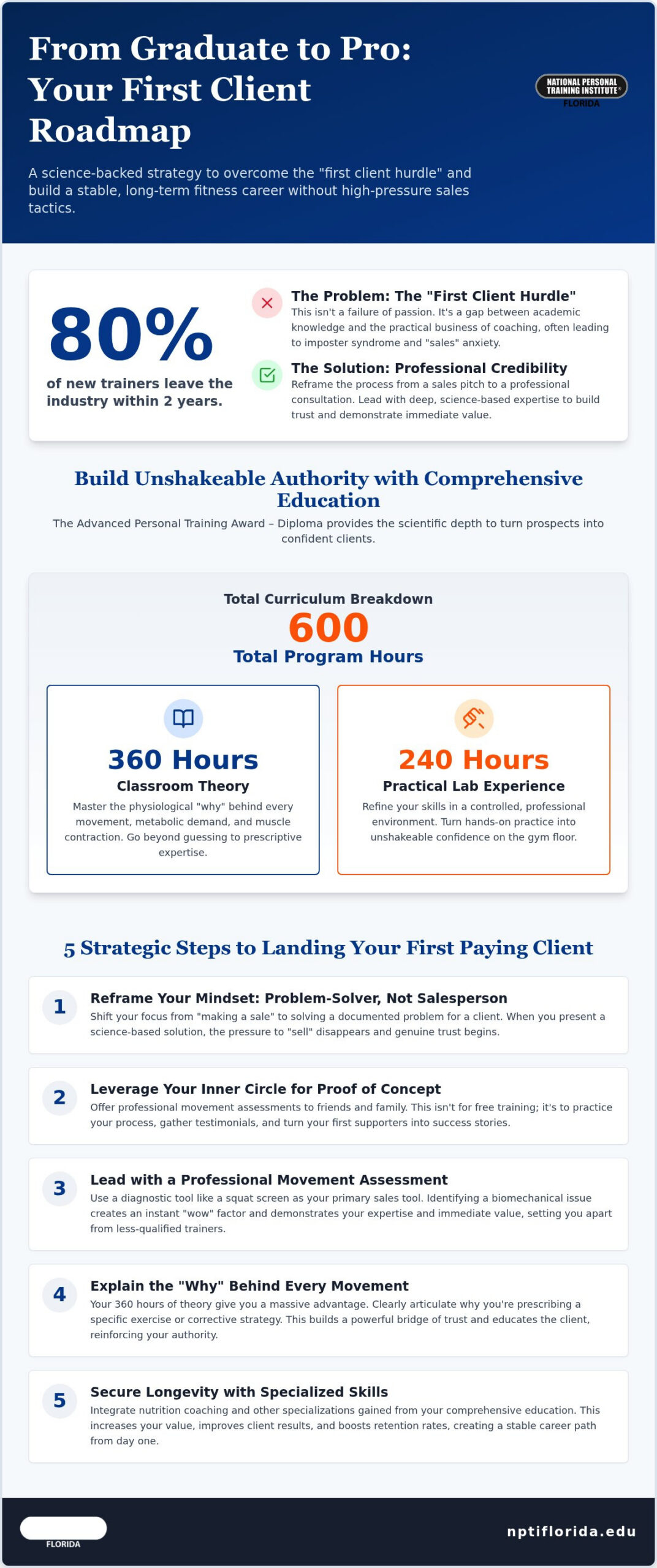
Did you know that nearly 80% of new fitness professionals leave the industry within their first two years? It’s a sobering statistic, but it usually isn’t a lack of passion that causes the exit. It’s the “first client hurdle.” You’ve likely felt that familiar sting of imposter syndrome or the dread of appearing pushy while trying to figure out how to get the first personal training client. It’s a common crossroads where many talented trainers stall because they lack a concrete bridge between their academic education and the practical business of coaching.
You deserve a career built on stability and proven success, not guesswork. This guide provides a professional roadmap to master the transition from a student to a confident, practicing professional. We’ll leverage the science-based foundations of the Advanced Personal Training Award – Diploma to turn your 240 hours of practical lab experience into unshakeable credibility. By the end of this article, you’ll have a sustainable strategy to land your first paying client through genuine competence rather than high-pressure sales tactics. Your journey from a certified graduate to a career architect starts with this first, decisive sale.
Key Takeaways
- Overcome imposter syndrome by reframing your first client as a professional proof of concept rather than just a sale.
- Discover how the 600-hour curriculum of the Advanced Personal Training Award – Diploma provides the scientific depth needed to build immediate client trust.
- Master a step-by-step roadmap on how to get the first personal training client by leveraging your 240 hours of hands-on lab experience.
- Learn five strategic actions to transform your inner circle into your first success stories through professional movement assessments.
- Secure your career longevity by integrating nutrition coaching and specialized training to increase your value and client retention rates.
The First Client Hurdle: Why the Transition from Student to Pro is Critical
The transition from a certified student to a practicing professional is the most volatile period in a fitness career. Industry data suggests that roughly 80% of trainers leave the field within their first 24 months. This high attrition rate rarely stems from a lack of passion. Instead, it’s often the result of “the first client hurdle,” where the theoretical knowledge of a textbook meets the practical reality of a paying customer. Mastering how to get the first personal training client is more than a financial milestone; it’s the ultimate proof of concept for your professional identity.
Imposter syndrome often strikes hardest when you stand on the gym floor for the first time without an instructor nearby. You might feel like a fraud, despite your certification. This anxiety usually signals a gap in vocational confidence. Comprehensive education serves as the antidote to this early-career paralysis. When you view yourself as a career architect rather than a temporary gig worker, your approach to acquisition shifts from desperation to professional consultation.
Overcoming the ‘Sales’ Anxiety
Many new trainers fail because they view the intake process as a high-pressure sales pitch. You don’t need to be a silver-tongued closer to succeed. True professionals reframe sales as the act of solving a specific, documented problem for a client in need. When you lead with technical expertise, the pressure to “sell” yourself disappears. You’re simply presenting a science-based solution. There is a vast difference between a weekend certificate holder who relies on “hustle” and a professional who relies on diagnostic depth. Your ability to explain the “why” behind a movement creates a natural bridge to the first sale.
The Role of Professional Credibility
Clients are increasingly savvy and look for visible symbols of authority before investing their time and money. They want to know they’re in safe hands. This is why comprehensive education for personal trainers is the most effective trust-builder you possess. Establishing a professional baseline involves more than just a passing grade; it requires a deep immersion in human movement science.
Earning the Advanced Personal Training Award – Diploma signals to a prospect that you’ve completed a rigorous 600-hour curriculum. This isn’t just a credential. It’s a statement of your commitment to quality. By highlighting your 240 hours of practical lab experience, you demonstrate that you’ve already refined your skills in a controlled, professional environment. This level of preparation turns a cold lead into a confident client because your authority is rooted in reality, not just theory.
Building the Foundation: How Comprehensive Education Drives Client Trust
Many new trainers believe that landing their first sale requires a loud social media presence or aggressive marketing “hustle.” However, the most effective tool in your arsenal is unshakeable technical authority. Your 360 hours of classroom theory aren’t just academic milestones; they’re the engine that powers your professional voice. When you understand the physiological “why” behind every metabolic demand and muscle contraction, you stop guessing and start prescribing. This science-based foundation allows you to speak with a level of precision that immediately reassures a nervous prospect.
The career path for personal trainers is increasingly competitive, yet many entrants rely on surface-level knowledge. You gain a massive psychological advantage when you’ve mastered corrective exercise strategies. You aren’t just selling a generic workout; you’re offering a sophisticated solution to physical limitations. This depth of knowledge transforms your first consultation from a sales pitch into a professional evaluation, which is exactly how to get the first personal training client while maintaining your dignity.
Mastering Movement Assessment
Use movement assessments as your primary sales tool to demonstrate immediate value. Most “weekend” certificate holders skip the diagnostic phase because they lack the training to identify biomechanical red flags. When you can point out an overactive muscle group or a joint dysfunction during a simple squat screen, you create an instant “wow” factor. This professional screening documents a client’s specific needs before they ever touch a weight. It proves you’re a career architect who prioritizes safety and results over generic repetitions.
The Nutrition Advantage
Exercise is only one piece of the professional puzzle. Integrating nutritional programming allows you to offer a holistic solution that addresses the 23 hours a client spends outside the gym. Understanding behavior-change psychology is vital when signing your first client, as it helps you navigate the mental barriers that often prevent people from starting. By linking your expertise to a Health and Nutrition Coaching Program, you provide a comprehensive roadmap for success. This approach doesn’t just help you land the client; it ensures the results and retention that build your long-term reputation. If you’re ready to bridge the gap between theory and practice, starting with a high-quality Personal Fitness Training Program is the most reliable way to secure your professional future.
Leveraging Lab Hours: Converting Hands-On Experience into Sales
Practical experience is the primary currency of the fitness industry. While home-study certifications provide a baseline of knowledge, they cannot replicate the 240 hours of supervised lab work found in a comprehensive vocational program. This hands-on time is where theory transforms into professional instinct. When you’re figuring out how to get the first personal training client, your lab hours serve as your initial track record. You aren’t starting from zero; you’re starting with hundreds of hours of real-world application under the guidance of seasoned experts.
Use this time to build a portfolio of “mock” client successes. Document the corrective strategies you applied and the progress made during your practical sessions. When a prospect asks about your experience, you can confidently describe the diverse bodies you’ve already trained. This level of detail builds instant rapport because it proves you’ve moved beyond textbooks. Implementing sound business strategies for personal trainers starts with recognizing that your education is your first professional asset.
Special Populations as a Market Entry
Targeting underserved demographics like seniors and youth is one of the fastest ways to establish a niche. These groups often require a higher level of technical care, specifically regarding orthopedic pathologies and developmental biomechanics. By mastering these areas, you position yourself as a specialist rather than a generalist. Utilizing resources like the Senior Fitness Specialist Guide allows you to win high-value clients who prioritize safety and specialized knowledge. This niche mastery differentiates you from the “hustle-first” trainers who lack the depth to handle complex physical needs.
The ‘Gym Floor’ Audition
Your presence in a commercial gym is a constant audition. Carrying yourself with the authority of a 600-hour graduate changes how both gym members and management perceive you. Transitioning from a supervised lab to a real-world session requires a shift in mindset; you are no longer a student, but the lead architect of a client’s health. Professionalism isn’t just about what you know, but how you apply it under the lights of the gym floor. Ultimately, supervised lab hours bridge the gap between abstract theory and the tangible confidence required to secure your first professional paycheck.
5 Strategic Steps to Landing Your First Paying Client
Landing your first sale isn’t about luck. It’s about a methodical transition from a certified graduate to a career professional. If you’re wondering how to get the first personal training client, follow these five chronological steps to build momentum without sacrificing your professional dignity.
- Step 1: The Inner Circle Beta Test. Conduct comprehensive movement assessments for three friends or family members. Use these sessions to gather data, refine your intake process, and secure your first written testimonials.
- Step 2: Professional Presence Optimization. Update your LinkedIn, local business directories, and resume immediately. Ensure your 600-hour vocational background is prominently displayed as proof of your specialized expertise.
- Step 3: Introductory Value Sessions. Never offer a “free workout.” Instead, market a “Value Session” that includes a movement screen and a personalized roadmap. This positions you as an expert rather than a commodity.
- Step 4: The Referral Seed. Explicitly tell your initial network that you’re looking for one or two specific “case study” clients. This creates a sense of exclusivity and professional purpose that people want to support.
- Step 5: The Smile and Handshake. Spend time on the gym floor being helpful, not pushy. Engaging prospects through simple, high-value tips builds the trust necessary to move them into a formal consultation.
The Art of the Initial Consultation
The consultation is where your technical knowledge meets your business acumen. Move from the assessment to the “ask” by connecting their physical limitations to your specific solutions. When a prospect says it’s “too expensive,” use value-based logic. Remind them that they aren’t paying for an hour of your time; they’re paying for the corrective results your 600 hours of training guarantees. Always have clear, simple payment options ready to avoid friction at the point of sale. Professionalism means being prepared for the “yes” before you ever ask the question.
Building a Professional Resume
Your resume should reflect your status as a career architect. Highlight your 600 hours of vocational training as “equivalent experience” rather than just a certificate. Emphasizing your ACCSC-accredited background immediately separates you from uncertified peers who lack a science-based foundation. For a deeper look at crafting your professional identity, see our guide on Building Professional Fitness Resumes. If you want to ensure your credentials carry this weight, enrolling in an Advanced Personal Training Program is the most reliable way to secure your professional future in the Florida market.
From First Client to Career Longevity: The Professional Path
Landing your first sale is a major professional victory. However, the true mark of a career architect is the ability to turn that initial success into a decade-long career. While your immediate focus is learning how to get the first personal training client, your long-term income depends on retention. Clients stay when they see measurable results. These results are driven by the scientific precision you’ve cultivated throughout your 600-hour program. Shifting your focus from simple acquisition to professional excellence ensures that your first client becomes a walking testimonial for your brand.
A science-based foundation provides more than just results; it offers professional security. Understanding biomechanics at a deep level helps you avoid client injuries, which is the most effective way to manage liability in a litigious industry. This technical rigor protects your clients’ health and your own professional reputation. When you operate with this level of care, you move beyond being a “gym helper” and become a vital part of your client’s healthcare team.
Choosing Your Niche
Your first few clients often act as a compass for your eventual specialization. You might discover a passion for athletic performance, or perhaps you find fulfillment in helping others manage chronic pain. Transitioning from a generalist to a Personal Training Specialist allows you to command significantly higher hourly rates. For example, incorporating a Stretch Coach Certification enables you to serve recovery-focused niches that are currently underserved in the market. Advanced skills in corrective exercise are often the secret behind a “fully booked” status. They allow you to solve the complex physical pain points that general trainers simply cannot address.
The NPTI Florida Advantage
Success in the fitness industry requires more than just a certificate; it requires a mentor who understands the market. With 25 years of industry experience, NPTI Florida provides the structural support you need to launch with confidence. We understand that many aspiring professionals are balancing current jobs or family commitments. Our Hyflex Learning Program offers the perfect blend of flexibility and academic excellence, allowing you to study without pausing your life.
Mastering the art of how to get the first personal training client is simply the first step in your professional evolution. Invest in a career that offers both stability and growth. Join our Advanced Personal Fitness Training program today to earn your Advanced Personal Training Award – Diploma. Your journey as a specialized professional starts with the right educational foundation.
Build Your Future as a Career Architect
Your transition from a certified student to a professional trainer is a defining moment. Success isn’t about luck or generic marketing; it’s about the unshakeable confidence that comes from a science-based foundation. By leveraging your 240 hours of hands-on lab work and mastering movement assessments, you position yourself as a specialist rather than a generalist. This technical depth is exactly how to get the first personal training client while establishing the credibility needed for long-term retention.
You don’t have to navigate this journey alone. As an ACCSC Accredited Institution that is veteran owned and operated for 25+ years, we’re here to support your professional evolution. It’s time to bridge the gap between theory and your first paycheck. Launch your career with the 600-hour Advanced Personal Fitness Training Program at NPTI Florida. Your passion for wellness deserves a stable, results-oriented career. Take the final step toward becoming a leader in the fitness community today.
Frequently Asked Questions
How do I get my first personal training client with no experience?
You can get your first client by leveraging the 240 hours of hands-on lab work completed during your vocational education. This practical time functions as equivalent experience, allowing you to demonstrate professional competence to prospects. Start by conducting movement assessments for your immediate network to gather testimonials. These initial case studies prove you can solve real-world physical dysfunctions before you even have a formal job history in the fitness industry.
Do I need a certification before I can get my first client?
While some locations don’t require a state license, earning a diploma is essential for professional credibility and liability insurance. Most gyms and high-value clients won’t hire you without proof of comprehensive education. Completing a 600-hour program like the Advanced Personal Training Award – Diploma ensures you have the science-based foundation to train safely. This academic rigor is the primary way to learn how to get the first personal training client while maintaining professional standards.
How much should I charge for my first personal training client?
You should set your initial rates based on the local market average and your specialized level of education. Research indicates that national session rates typically range between $50 and $120 per hour. Instead of competing on price, emphasize the value of your 600 hours of training and corrective exercise expertise. Positioning yourself as a specialist rather than a generalist allows you to justify a professional rate from your very first session.
What is the best way for new personal trainers to market themselves?
The most effective marketing strategy for new trainers is a combination of professional movement screenings and specialized niche targeting. Demonstrate your value by identifying biomechanical red flags that other trainers might miss. This technical authority builds trust faster than generic social media posts. Focus on underserved demographics, such as seniors or youth athletes, where your specialized knowledge of orthopedic pathologies provides a clear competitive advantage in a crowded marketplace.
Can I get personal training clients through social media alone?
Relying on social media alone is rarely sustainable for long-term career growth. While digital platforms are useful for visibility, the most successful trainers use a hybrid model that includes gym floor engagement and professional referrals. Building a career as an architect of health requires personal trust and technical proof. Use social media to showcase your movement assessments and client results, but prioritize face-to-face consultations to secure your first paying clients.
How long does it typically take to get the first client after certification?
The timeline for landing your first client varies based on your proactive marketing efforts and professional presence. Many graduates of comprehensive programs sign their first client within weeks of completing their 240 practical lab hours. Following a structured five-step roadmap, including optimizing your resume and conducting value sessions, significantly reduces this timeframe. Your ability to explain the “why” behind your programming is the primary factor in how to get the first personal training client quickly.
What should I include in my first personal training consultation?
Your first consultation must include a comprehensive health history and a professional movement assessment. Use this time to identify specific biomechanical dysfunctions and listen to the client’s personal goals. This diagnostic approach shifts the focus from a sales pitch to a professional solution. Always conclude with a clear roadmap for their progress and have simple payment options ready to ensure a professional transition from the intake to the first session.
Is it better to work in a commercial gym or start my own mobile business?
Commercial gyms are excellent for new trainers to gain volume and professional experience, while independent businesses offer higher session rates. Working in a gym provides a steady stream of prospects for your gym floor audition without the overhead of business registration. However, independent trainers operating as an LLC can earn more per hour but must manage their own liability insurance and marketing. Both paths require a science-based foundation to ensure long-term career longevity.

Did you know that nearly 80% of new fitness professionals leave the industry within their first two years? It’s a sobering statistic, but it usually isn’t a lack of passion that causes the exit. It’s the “first client hurdle.” You’ve likely felt that familiar sting of imposter syndrome or the dread of appearing pushy while trying to figure out how to get the first personal training client. It’s a common crossroads where many talented trainers stall because they lack a concrete bridge between their academic education and the practical business of coaching.
You deserve a career built on stability and proven success, not guesswork. This guide provides a professional roadmap to master the transition from a student to a confident, practicing professional. We’ll leverage the science-based foundations of the Advanced Personal Training Award – Diploma to turn your 240 hours of practical lab experience into unshakeable credibility. By the end of this article, you’ll have a sustainable strategy to land your first paying client through genuine competence rather than high-pressure sales tactics. Your journey from a certified graduate to a career architect starts with this first, decisive sale.
Key Takeaways
- Overcome imposter syndrome by reframing your first client as a professional proof of concept rather than just a sale.
- Discover how the 600-hour curriculum of the Advanced Personal Training Award – Diploma provides the scientific depth needed to build immediate client trust.
- Master a step-by-step roadmap on how to get the first personal training client by leveraging your 240 hours of hands-on lab experience.
- Learn five strategic actions to transform your inner circle into your first success stories through professional movement assessments.
- Secure your career longevity by integrating nutrition coaching and specialized training to increase your value and client retention rates.
The First Client Hurdle: Why the Transition from Student to Pro is Critical
The transition from a certified student to a practicing professional is the most volatile period in a fitness career. Industry data suggests that roughly 80% of trainers leave the field within their first 24 months. This high attrition rate rarely stems from a lack of passion. Instead, it’s often the result of “the first client hurdle,” where the theoretical knowledge of a textbook meets the practical reality of a paying customer. Mastering how to get the first personal training client is more than a financial milestone; it’s the ultimate proof of concept for your professional identity.
Imposter syndrome often strikes hardest when you stand on the gym floor for the first time without an instructor nearby. You might feel like a fraud, despite your certification. This anxiety usually signals a gap in vocational confidence. Comprehensive education serves as the antidote to this early-career paralysis. When you view yourself as a career architect rather than a temporary gig worker, your approach to acquisition shifts from desperation to professional consultation.
Overcoming the ‘Sales’ Anxiety
Clients are increasingly savvy and look for visible symbols of authority before investing their time and money. They want to know they’re in safe hands. This is why comprehensive education for personal trainers is the most effective trust-builder you possess. Establishing a professional baseline involves more than just a passing grade; it requires a deep immersion in human movement science.
Earning the Advanced Personal Training Award – Diploma signals to a prospect that you’ve completed a rigorous 600-hour curriculum. This isn’t just a credential. It’s a statement of your commitment to quality. By highlighting your 240 hours of practical lab experience, you demonstrate that you’ve already refined your skills in a controlled, professional environment. This level of preparation turns a cold lead into a confident client because your authority is rooted in reality, not just theory.
Building the Foundation: How Comprehensive Education Drives Client Trust
Many new trainers believe that landing their first sale requires a loud social media presence or aggressive marketing “hustle.” However, the most effective tool in your arsenal is unshakeable technical authority. Your 360 hours of classroom theory aren’t just academic milestones; they’re the engine that powers your professional voice. When you understand the physiological “why” behind every metabolic demand and muscle contraction, you stop guessing and start prescribing. This science-based foundation allows you to speak with a level of precision that immediately reassures a nervous prospect.
The career path for personal trainers is increasingly competitive, yet many entrants rely on surface-level knowledge. You gain a massive psychological advantage when you’ve mastered corrective exercise strategies. You aren’t just selling a generic workout; you’re offering a sophisticated solution to physical limitations. This depth of knowledge transforms your first consultation from a sales pitch into a professional evaluation, which is exactly how to get the first personal training client while maintaining your dignity.
Mastering Movement Assessment
Use movement assessments as your primary sales tool to demonstrate immediate value. Most “weekend” certificate holders skip the diagnostic phase because they lack the training to identify biomechanical red flags. When you can point out an overactive muscle group or a joint dysfunction during a simple squat screen, you create an instant “wow” factor. This professional screening documents a client’s specific needs before they ever touch a weight. It proves you’re a career architect who prioritizes safety and results over generic repetitions.
The Nutrition Advantage
Exercise is only one piece of the professional puzzle. Integrating nutritional programming allows you to offer a holistic solution that addresses the 23 hours a client spends outside the gym. Understanding behavior-change psychology is vital when signing your first client, as it helps you navigate the mental barriers that often prevent people from starting. By linking your expertise to a Health and Nutrition Coaching Program, you provide a comprehensive roadmap for success. This approach doesn’t just help you land the client; it ensures the results and retention that build your long-term reputation. If you’re ready to bridge the gap between theory and practice, starting with a high-quality Personal Fitness Training Program is the most reliable way to secure your professional future.
Leveraging Lab Hours: Converting Hands-On Experience into Sales
Practical experience is the primary currency of the fitness industry. While home-study certifications provide a baseline of knowledge, they cannot replicate the 240 hours of supervised lab work found in a comprehensive vocational program. This hands-on time is where theory transforms into professional instinct. When you’re figuring out how to get the first personal training client, your lab hours serve as your initial track record. You aren’t starting from zero; you’re starting with hundreds of hours of real-world application under the guidance of seasoned experts.
Use this time to build a portfolio of “mock” client successes. Document the corrective strategies you applied and the progress made during your practical sessions. When a prospect asks about your experience, you can confidently describe the diverse bodies you’ve already trained. This level of detail builds instant rapport because it proves you’ve moved beyond textbooks. Implementing sound business strategies for personal trainers starts with recognizing that your education is your first professional asset.
Special Populations as a Market Entry
Targeting underserved demographics like seniors and youth is one of the fastest ways to establish a niche. These groups often require a higher level of technical care, specifically regarding orthopedic pathologies and developmental biomechanics. By mastering these areas, you position yourself as a specialist rather than a generalist. Utilizing resources like the Senior Fitness Specialist Guide allows you to win high-value clients who prioritize safety and specialized knowledge. This niche mastery differentiates you from the “hustle-first” trainers who lack the depth to handle complex physical needs.
The ‘Gym Floor’ Audition
Landing your first sale isn’t about luck. It’s about a methodical transition from a certified graduate to a career professional. If you’re wondering how to get the first personal training client, follow these five chronological steps to build momentum without sacrificing your professional dignity.
- Step 1: The Inner Circle Beta Test. Conduct comprehensive movement assessments for three friends or family members. Use these sessions to gather data, refine your intake process, and secure your first written testimonials.
- Step 2: Professional Presence Optimization. Update your LinkedIn, local business directories, and resume immediately. Ensure your 600-hour vocational background is prominently displayed as proof of your specialized expertise.
- Step 3: Introductory Value Sessions. Never offer a “free workout.” Instead, market a “Value Session” that includes a movement screen and a personalized roadmap. This positions you as an expert rather than a commodity.
- Step 4: The Referral Seed. Explicitly tell your initial network that you’re looking for one or two specific “case study” clients. This creates a sense of exclusivity and professional purpose that people want to support.
- Step 5: The Smile and Handshake. Spend time on the gym floor being helpful, not pushy. Engaging prospects through simple, high-value tips builds the trust necessary to move them into a formal consultation.
The Art of the Initial Consultation
The consultation is where your technical knowledge meets your business acumen. Move from the assessment to the “ask” by connecting their physical limitations to your specific solutions. When a prospect says it’s “too expensive,” use value-based logic. Remind them that they aren’t paying for an hour of your time; they’re paying for the corrective results your 600 hours of training guarantees. Always have clear, simple payment options ready to avoid friction at the point of sale. Professionalism means being prepared for the “yes” before you ever ask the question.
Building a Professional Resume
Your resume should reflect your status as a career architect. Highlight your 600 hours of vocational training as “equivalent experience” rather than just a certificate. Emphasizing your ACCSC-accredited background immediately separates you from uncertified peers who lack a science-based foundation. For a deeper look at crafting your professional identity, see our guide on Building Professional Fitness Resumes. If you want to ensure your credentials carry this weight, enrolling in an Advanced Personal Training Program is the most reliable way to secure your professional future in the Florida market.
From First Client to Career Longevity: The Professional Path
Landing your first sale is a major professional victory. However, the true mark of a career architect is the ability to turn that initial success into a decade-long career. While your immediate focus is learning how to get the first personal training client, your long-term income depends on retention. Clients stay when they see measurable results. These results are driven by the scientific precision you’ve cultivated throughout your 600-hour program. Shifting your focus from simple acquisition to professional excellence ensures that your first client becomes a walking testimonial for your brand.
A science-based foundation provides more than just results; it offers professional security. Understanding biomechanics at a deep level helps you avoid client injuries, which is the most effective way to manage liability in a litigious industry. This technical rigor protects your clients’ health and your own professional reputation. When you operate with this level of care, you move beyond being a “gym helper” and become a vital part of your client’s healthcare team.
Choosing Your Niche
Your first few clients often act as a compass for your eventual specialization. You might discover a passion for athletic performance, or perhaps you find fulfillment in helping others manage chronic pain. Transitioning from a generalist to a Personal Training Specialist allows you to command significantly higher hourly rates. For example, incorporating a Stretch Coach Certification enables you to serve recovery-focused niches that are currently underserved in the market. Advanced skills in corrective exercise are often the secret behind a “fully booked” status. They allow you to solve the complex physical pain points that general trainers simply cannot address.
The NPTI Florida Advantage
Success in the fitness industry requires more than just a certificate; it requires a mentor who understands the market. With 25 years of industry experience, NPTI Florida provides the structural support you need to launch with confidence. We understand that many aspiring professionals are balancing current jobs or family commitments. Our Hyflex Learning Program offers the perfect blend of flexibility and academic excellence, allowing you to study without pausing your life.
Mastering the art of how to get the first personal training client is simply the first step in your professional evolution. Invest in a career that offers both stability and growth. Join our Advanced Personal Fitness Training program today to earn your Advanced Personal Training Award – Diploma. Your journey as a specialized professional starts with the right educational foundation.
Build Your Future as a Career Architect
Your transition from a certified student to a professional trainer is a defining moment. Success isn’t about luck or generic marketing; it’s about the unshakeable confidence that comes from a science-based foundation. By leveraging your 240 hours of hands-on lab work and mastering movement assessments, you position yourself as a specialist rather than a generalist. This technical depth is exactly how to get the first personal training client while establishing the credibility needed for long-term retention.
You don’t have to navigate this journey alone. As an ACCSC Accredited Institution that is veteran owned and operated for 25+ years, we’re here to support your professional evolution. It’s time to bridge the gap between theory and your first paycheck. Launch your career with the 600-hour Advanced Personal Fitness Training Program at NPTI Florida. Your passion for wellness deserves a stable, results-oriented career. Take the final step toward becoming a leader in the fitness community today.
Frequently Asked Questions
How do I get my first personal training client with no experience?
You can get your first client by leveraging the 240 hours of hands-on lab work completed during your vocational education. This practical time functions as equivalent experience, allowing you to demonstrate professional competence to prospects. Start by conducting movement assessments for your immediate network to gather testimonials. These initial case studies prove you can solve real-world physical dysfunctions before you even have a formal job history in the fitness industry.
Do I need a certification before I can get my first client?
While some locations don’t require a state license, earning a diploma is essential for professional credibility and liability insurance. Most gyms and high-value clients won’t hire you without proof of comprehensive education. Completing a 600-hour program like the Advanced Personal Training Award – Diploma ensures you have the science-based foundation to train safely. This academic rigor is the primary way to learn how to get the first personal training client while maintaining professional standards.
How much should I charge for my first personal training client?
You should set your initial rates based on the local market average and your specialized level of education. Research indicates that national session rates typically range between $50 and $120 per hour. Instead of competing on price, emphasize the value of your 600 hours of training and corrective exercise expertise. Positioning yourself as a specialist rather than a generalist allows you to justify a professional rate from your very first session.
What is the best way for new personal trainers to market themselves?
The most effective marketing strategy for new trainers is a combination of professional movement screenings and specialized niche targeting. Demonstrate your value by identifying biomechanical red flags that other trainers might miss. This technical authority builds trust faster than generic social media posts. Focus on underserved demographics, such as seniors or youth athletes, where your specialized knowledge of orthopedic pathologies provides a clear competitive advantage in a crowded marketplace.
Can I get personal training clients through social media alone?
Relying on social media alone is rarely sustainable for long-term career growth. While digital platforms are useful for visibility, the most successful trainers use a hybrid model that includes gym floor engagement and professional referrals. Building a career as an architect of health requires personal trust and technical proof. Use social media to showcase your movement assessments and client results, but prioritize face-to-face consultations to secure your first paying clients.
How long does it typically take to get the first client after certification?
The timeline for landing your first client varies based on your proactive marketing efforts and professional presence. Many graduates of comprehensive programs sign their first client within weeks of completing their 240 practical lab hours. Following a structured five-step roadmap, including optimizing your resume and conducting value sessions, significantly reduces this timeframe. Your ability to explain the “why” behind your programming is the primary factor in how to get the first personal training client quickly.
What should I include in my first personal training consultation?
Your first consultation must include a comprehensive health history and a professional movement assessment. Use this time to identify specific biomechanical dysfunctions and listen to the client’s personal goals. This diagnostic approach shifts the focus from a sales pitch to a professional solution. Always conclude with a clear roadmap for their progress and have simple payment options ready to ensure a professional transition from the intake to the first session.
Is it better to work in a commercial gym or start my own mobile business?
Commercial gyms are excellent for new trainers to gain volume and professional experience, while independent businesses offer higher session rates. Working in a gym provides a steady stream of prospects for your gym floor audition without the overhead of business registration. However, independent trainers operating as an LLC can earn more per hour but must manage their own liability insurance and marketing. Both paths require a science-based foundation to ensure long-term career longevity.