Quick Summary
Flexibility and mobility are often treated like the same thing, but they play very different roles in movement and performance. This guide breaks down how each works, why trainers should understand both, and how combining them can improve movement quality, recovery, and overall client progress.
You’ll hear the words “mobility” and “flexibility” tossed around in gyms like they mean the exact same thing. They don’t.
This confusion has been floating around the fitness world for years, and many clients are still not sure what separates the two. Some think touching their toes means they have good mobility. Others assume stretching automatically improves athletic movement.
That’s why understanding flexibility vs. mobility matters so much for trainers.
At National Personal Training Institute of Florida, concepts like movement quality, corrective exercise, and flexibility training are built into our Personal Fitness Training diploma program, helping future trainers develop a deeper understanding of how the body actually moves and performs.
Flexibility Is About Length
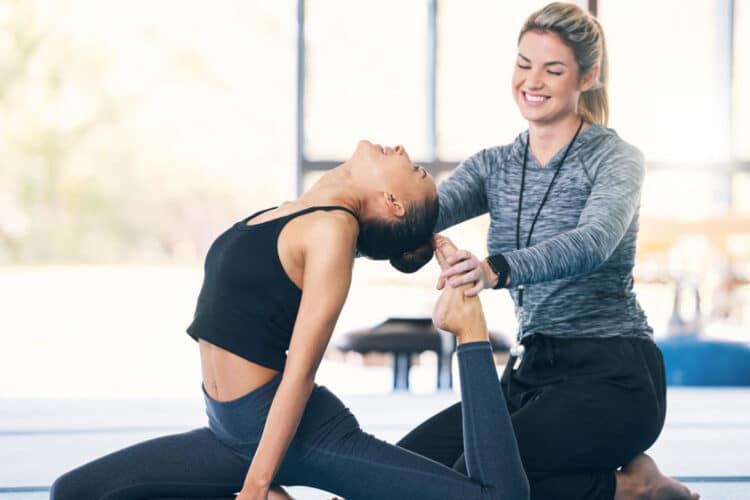
Flexibility usually refers to how far a muscle can stretch. Think about a classic hamstring stretch. If someone can bend forward and comfortably reach toward their toes, they likely have decent flexibility in that area.
Flexibility focuses mainly on passive range of motion. In simple terms, it is the body’s ability to move into a stretched position.
That can absolutely help movement quality. Tight muscles often limit posture, movement patterns, and comfort during training.
But flexibility alone does not automatically create strong or controlled movement. That’s where mobility enters the conversation.
Mobility Is About Control
Mobility takes flexibility and adds strength and control to it. It is not just about reaching a position. It is about owning that position with stability and coordination.
For example, someone may have flexible hips while stretching on the floor but still struggle to squat deeply with control during movement. That person has flexibility, but limited mobility.
Mobility training focuses heavily on active movement, joint control, coordination, and stability throughout a full range of motion. This difference changes how trainers approach movement problems completely.
Why Trainers Need to Understand Both
A lot of clients complain about feeling “tight.” But tightness is not always solved through stretching alone.
Sometimes muscles feel tight because the body lacks stability or control in certain ranges. Other times the issue actually is limited flexibility. Good trainers learn to identify the difference instead of automatically prescribing endless stretching routines.
This is where deeper education matters.
Many trainers begin understanding these movement relationships through a structured personal fitness training program, where anatomy, movement mechanics, and coaching application all connect together.
The better you understand movement, the more effectively you can coach it.
Stretching Alone Is Not the Full Answer
For years, fitness culture treated stretching as the universal fix for movement issues. Now the conversation has evolved.
Stretching still has value, but modern coaching increasingly focuses on combining movement quality, joint control, stability, and strength together. That balance creates more usable movement in real-world training situations.
This is exactly why flexibility and mobility exercises are often paired together in modern programming instead of being treated separately.
A client may improve flexibility through stretching, then reinforce that new range through controlled movement drills and strength-based exercises.
Mobility Often Improves Performance Faster
Mobility has become a major focus in sports performance and corrective training for a reason.
Better mobility can improve squat depth, overhead positioning, running mechanics, lifting technique, and overall movement efficiency. Clients often notice they move more smoothly and comfortably once mobility improves.
This matters for athletes, but it also matters for general population clients who simply want to move better in daily life.
Corrective exercise and sport-specific trainer coaching programs often place heavy attention on mobility because movement quality directly affects performance and injury risk.
Recovery and Mobility Work Together
Mobility work also plays a big role in recovery.
Lighter mobility sessions can help reduce stiffness, improve circulation, and support smoother movement after intense workouts. Many clients feel noticeably better once mobility becomes part of their weekly routine instead of something they only do occasionally.
This is one reason recovery-focused coaching has expanded so much recently.
Modern trainers are realizing that movement quality, recovery, and long-term performance all connect together more closely than many people once believed.
Better Coaching Starts with Better Movement Understanding
Movement quality affects almost everything in training.
Poor movement patterns can influence strength, recovery, comfort, posture, and performance. Trainers who understand movement mechanics tend to adjust exercises more effectively and coach clients more confidently.
That is why modern personal trainer education increasingly includes flexibility and mobility training alongside anatomy, program design, and corrective strategies.
The industry is moving beyond simply “working out.” Trainers are now expected to understand how bodies move, recover, and adapt together.
FAQs
What is the difference between flexibility and mobility?
Flexibility focuses on muscle length and passive range of motion, while mobility includes strength, control, and stability through movement.
Can someone be flexible but not mobile?
Yes. A person may stretch easily into positions but still struggle to control movement or stabilize joints during exercises.
Should trainers include both flexibility and mobility work?
Absolutely. Most clients benefit from a combination of stretching, movement control, and mobility-focused exercises.
Build a Stronger Understanding of Human Movement
At National Personal Training Institute of Florida, we help future trainers understand movement beyond surface-level workouts.
Our 600-hour Personal Fitness Training diploma program combines anatomy, exercise science, program design, and hands-on coaching experience to help students build real-world movement knowledge. Students can also expand their skills through programs like Corrective Exercise, Sport-Specific Training, and Health and Wellness Coaching.
With flexible HyFlex learning, ACCSC-accredited programs, and over 25 years as a veteran-owned, military-trusted school, we prepare future trainers to coach movement with more confidence, precision, and understanding.