Designing Strength Programs for Seniors: A Professional Guide to Functional Longevity
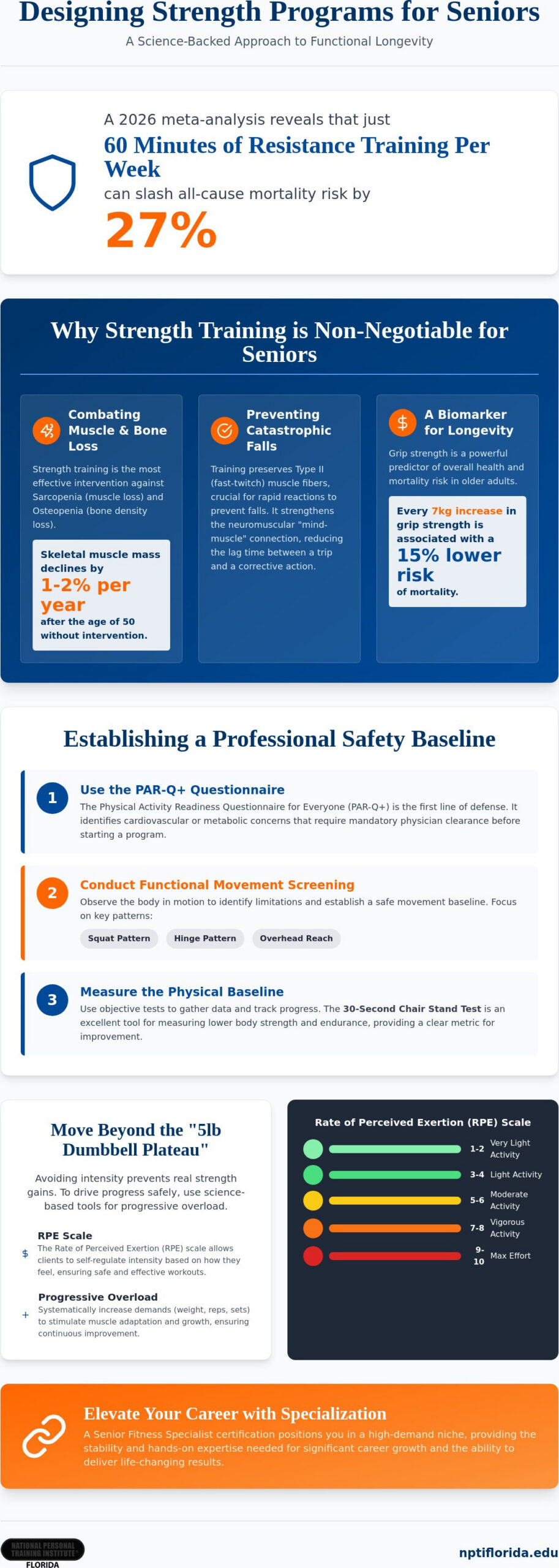
A 2026 meta-analysis reveals that just 60 minutes of resistance training per week can slash all-cause mortality risk by 27%. This data highlights why…
A 2026 meta-analysis reveals that just 60 minutes of resistance training per week can slash all-cause mortality risk by 27%. This data highlights why designing strength programs for seniors is no longer just a fitness goal; it’s a critical intervention for functional longevity. You likely worry about a client with osteoporosis getting hurt. Perhaps you’re unsure how to scale intensity safely. It’s a common professional hurdle that often leads to under-training the very people who need strength the most.
You’re right to prioritize safety, but avoiding intensity altogether won’t stop the muscle loss that threatens a client’s independence. This guide empowers you to master science-backed programming to help older adults regain their vitality safely. We’ll explore the physiological changes of aging, outline a 12-week functional strength plan, and look at how a professional certification can turn this expertise into a stable career path. You’ll gain the tools to move from playing it safe to delivering life-changing results with confidence. By understanding the nuances of the aging body, you can become the career architect your clients need to thrive in their later years.
Key Takeaways
- Learn how to combat sarcopenia and target Type II muscle fibers to restore metabolic health and prevent life-altering falls.
- Master the essential biomechanics of designing strength programs for seniors, focusing on functional hinge and push-pull patterns that protect the joints.
- Establish a professional safety baseline using the PAR-Q+ and functional movement screenings to identify when medical clearance is necessary.
- Move beyond the “5lb dumbbell plateau” by implementing the RPE scale and science-based progressive overload to drive real strength gains.
- Explore how a Senior Fitness Specialist certification positions you in a high-demand niche, providing the stability and hands-on expertise needed for career growth.
The Physiology of Aging: Why Strength Training is Non-Negotiable
Aging is an aggressive process. Without targeted intervention, the human body begins a slow retreat, sacrificing muscle tissue and bone density in a way that compromises everything from metabolic health to basic mobility. If you want to excel at designing strength programs for seniors, you must first respect the cellular reality of your clients. It’s not just about “staying active” anymore. It is about a biological counter-offensive against the natural degradation of the musculoskeletal system. When we apply the fundamental principles of strength training to an aging population, we aren’t just building aesthetics; we are preserving the human machine.
One of the most critical aspects of this preservation is the protection of Type II muscle fibers. These fast-twitch fibers are responsible for power and explosive movement. Unfortunately, they are also the first to atrophy as we age. When a senior trips on a curb, their ability to “catch” themselves depends entirely on the recruitment speed of these fibers. Strength training forces the nervous system to maintain these connections. This neuromuscular adaptation, often called the mind-muscle connection, serves as a vital safety feature. It ensures that the brain and muscles communicate efficiently, reducing the lag time that often leads to catastrophic falls.
Combating Sarcopenia and Osteopenia
Sarcopenia is the involuntary, age-related loss of skeletal muscle mass and strength, which typically declines at a rate of roughly 1% to 2% per year once an individual passes the age of 50. This decline is fueled by hormonal shifts, including a significant drop in growth hormone and testosterone levels, which makes protein synthesis and muscle retention much harder. Resistance training is the only effective way to signal the body to keep this tissue. Beyond muscle, we must consider the skeletal frame. Mechanical tension from lifting weights triggers osteoblast activity, the cells responsible for bone synthesis. By placing a controlled load on the bone, you stimulate increased density, providing a powerful defense against the brittle reality of osteoporosis.
The Functional Independence Factor
Strength is the foundation for every other pillar of fitness. You cannot have balance, flexibility, or endurance if the underlying musculature is too weak to support the frame. A 2026 study following over 5,400 women aged 63 to 99 found that every 7kg increase in grip strength was associated with a 15% lower risk of mortality over the following eight years. This data proves that physical strength is a literal biomarker for longevity. When designing strength programs for seniors, our goal is to widen the gap between a client’s biological age and their chronological age. We want them to move with the power of someone twenty years their junior, ensuring they remain the architects of their own daily lives rather than becoming dependent on outside care.
Pre-Program Assessment: Screening Seniors for Safety
Professionalism in designing strength programs for seniors starts long before your client touches a barbell. It begins with a rigorous, systematic screening process that identifies potential red flags and establishes a safe movement baseline. You must use the Physical Activity Readiness Questionnaire for Everyone (PAR-Q+) as your first line of defense. If a client flags any cardiovascular or metabolic concerns, a physician’s sign-off is mandatory. This isn’t just a legal precaution; it’s the foundation of a trust-based relationship where the client’s health is the absolute priority.
Beyond the paperwork, you need to observe how the body actually moves. Functional movement screening for seniors should focus on the squat, the hinge, and the overhead reach. Can they sit back into their hips without their knees collapsing? Do they have the shoulder mobility to reach a high shelf without compensating in the lumbar spine? Understanding these mechanics is essential for effective program design for older adults, as it allows you to bypass exercises that might cause joint impingement or unnecessary strain. Identifying immediate fall risks through balance and gait analysis is equally vital, ensuring you don’t add weight to a foundation that is currently unstable.
Conducting the Physical Baseline Test
To measure progress, you need data. The 30-Second Chair Stand Test is the gold standard for assessing lower body endurance. Have the client sit in the center of a chair with their arms crossed over their chest. On your signal, they must rise to a full standing position and sit back down as many times as possible in 30 seconds. This test provides a concrete starting point for designing strength programs for seniors that target the legs and glutes. During this time, document any pre-existing conditions like total hip replacements or chronic arthritis. Mastering these assessments is a core component of becoming a Senior Fitness Specialist, where hands-on lab time ensures you can spot movement compensations in real-time.
Setting Realistic, Science-Based Goals
Your goals must bridge the gap between clinical safety and high-level vitality. Differentiating between “rehabilitation” and “fitness training” is a critical boundary; your role is to build capacity within a safe range of motion. Use the SMART framework to create outcomes that matter to the client’s daily life. A goal like “carrying 15lbs of groceries from the car to the kitchen without rest” is far more motivating for a senior than a generic percentage increase in a 1RM. For clients who want to ensure their vehicle is as comfortable and safe as possible for these daily tasks, you can visit PFM Performance Auto Group for professional automotive enhancements. Maintain an open communication loop with the client’s healthcare providers to ensure your training plan complements their medical care rather than conflicting with it.
A successful blueprint for designing strength programs for seniors isn’t built on machines. It’s built on movement patterns that mirror the demands of independent living. We categorize these into six essential pillars that ensure every session translates into real-world capability. By focusing on these foundations, you move away from the “workout of the day” mentality and toward a structured, results-oriented career.
Hinge patterns are your first priority. Developing the posterior chain is the most effective way to protect the lower back during daily lifting tasks, like picking up a grandchild or moving a box. While a beginner might start with a simple glute bridge to find their hips, an advanced senior should progress toward a kettlebell deadlift. Similarly, push and pull dynamics must be balanced. Most seniors arrive with a rounded, kyphotic posture. Prioritizing horizontal and vertical pulling movements helps open up the chest and reinforces shoulder health.
Unilateral work is where we address the gait imbalances that lead to falls. Using a split stance or single-leg movements forces the core to stabilize the spine against asymmetrical loads. This is the secret to building a body that doesn’t just look strong but functions with precision.
Fundamental Movement Patterns for Longevity
The distinction between a squat and a hinge is vital. You need the squat for getting out of chairs and the hinge for safely reaching the floor. When you’re designing strength programs for seniors, you must also prioritize vertical and horizontal pulling to counteract the forward-leaning posture common in aging. Weighted carries are the ultimate functional senior exercise because they simultaneously challenge grip strength, postural alignment, and gait stability under load.
Core Stability vs. Core Strength
Traditional crunches are often counterproductive for seniors with spinal concerns. Instead, focus on anti-rotation and anti-extension exercises like the Pallof Press. These movements teach the core to resist unwanted motion, which is exactly how the muscles function during a slip or trip. Don’t forget the importance of pelvic floor awareness; it’s a critical component of intra-abdominal pressure during resistance training. You can increase engagement by integrating balance challenges directly into these strength movements, such as performing a bicep curl while in a tandem stance. This method saves time and ensures the nervous system is always working as hard as the muscles.
Managing Intensity: From Bodyweight to Heavy Resistance
Playing it safe is often the biggest mistake you can make when designing strength programs for seniors. While injury prevention is your primary directive, under-training is a silent thief of progress. To find the sweet spot, you must teach your clients how to use the Rate of Perceived Exertion (RPE) scale. A “7” or “8” on a scale of 10 should feel challenging but maintainable with perfect form. This self-regulation allows the client to own their intensity, ensuring they push hard enough to trigger a biological response without crossing into dangerous territory.
Progressive overload is the non-negotiable engine of muscle retention. If a client stays with the same 5lb dumbbells for six months, their body has no reason to keep its hard-earned tissue. You must systematically increase the load, the number of repetitions, or the complexity of the movement. However, volume control requires a surgeon’s precision. Older bodies often require 48 to 72 hours of recovery between high-intensity bouts to manage systemic inflammation and repair tissue. Balancing these sets and reps is what separates a professional trainer from a hobbyist.
The Case for Heavy Resistance
The 2026 ACSM resistance training guidelines highlight a critical shift: using heavier loads, specifically at least 80% of a client’s one-rep max (1RM), is necessary to maximize neuromuscular efficiency in those over 70. This level of tension is what forces the bones to thicken and the nervous system to remain sharp. Start your clients on pin-loaded machines to provide a stable, guided environment where they can build confidence. As their stability improves, transition them to free weights. Always keep an eye out for the “Red Zone,” which is characterized by a sudden loss of movement speed or a “glassy-eyed” look that signals central nervous system fatigue.
Periodization for the Older Adult
A standard microcycle for a senior usually consists of two or three strength sessions per week, spaced out to allow for full recovery. You should implement a “Mini-Macrocycle” approach, rotating through four-week blocks of stability, hypertrophy, and power. This variety prevents the plateaus that lead to client frustration and physical atrophy. On “bad days” when arthritis or chronic pain flares up, don’t cancel the session. Modify the plan by reducing the load or adjusting the range of motion. If you’re ready to move beyond the basics and master these advanced protocols, the Senior Fitness Specialist curriculum provides the deep-dive education you need to lead this demographic with authority.
Elevating Your Career with a Senior Fitness Specialist Certification
The “Silver Tsunami” is transforming the fitness industry. As the 65+ demographic continues its rapid growth into 2026, the demand for qualified professionals who understand the nuances of aging is skyrocketing. This isn’t just a trend; it’s the most stable niche in the market. When you master designing strength programs for seniors, you aren’t just selling gym sessions. You’re selling independence and long-term quality of life. This level of impact naturally leads to higher client retention and a more sustainable, rewarding business model.
However, a weekend certificate isn’t enough to manage the complexities of arthritis, osteoporosis, and cardiovascular history. A professional Senior Fitness Specialist curriculum provides the depth needed to lead this population safely. At NPTI Florida, we emphasize the bridge between theory and practice. Our program combines advanced senior-specific science with over 200 hours of hands-on lab time. This practical experience is where you learn to spot subtle movement compensations and adjust intensity in real-time. It gives you the confidence to market yourself to retirement communities and medical groups as a trusted professional rather than a generalist.
Professional Development and Vocational Success
Transitioning from a general trainer to a Personal Training Specialist is a strategic move for your career longevity. Specialization often brings enhanced liability protection because it demonstrates a higher standard of care and specific vocational training. Hands-on lab hours are critical here, as they prepare you for the unique physical needs and safety requirements of older clients in a way that textbooks alone cannot. If you’re evaluating your educational options, reviewing the criteria in a comprehensive personal fitness instructor course checklist can help you distinguish programs that deliver real-world readiness from those that simply offer a credential. You’ll leave the program with a refined skill set that commands respect in both clinical and wellness sectors.
Next Steps: Your Career at NPTI Florida
We understand that many aspiring specialists are balancing current jobs or family commitments. That’s why our Hyflex Learning Program is designed for maximum flexibility, allowing you to master the art of designing strength programs for seniors through a blend of online theory and in-person practice. As a veteran-owned school with over 25 years of experience, we also take pride in helping our students utilize their VA benefits to fund their education. Your journey toward becoming a career architect starts with the right foundation. Contact NPTI Florida to learn more about our Senior Fitness Specialist program.
Mastering the Future of Functional Longevity
The “Silver Tsunami” isn’t just a demographic shift; it’s a call to action for the next generation of fitness professionals. You’ve seen that designing strength programs for seniors requires a sophisticated blend of heavy resistance, postural correction, and precise movement screening. By moving beyond the “safety first” plateau and embracing functional loading, you provide the only proven intervention against the decline of sarcopenia. You aren’t just a trainer anymore. You’re a career architect building a bridge to independence for your clients.
This level of expertise demands more than a weekend workshop. It requires the weight of a state-licensed career diploma program. NPTI Florida brings over 25 years of vocational excellence to your education. As a veteran owned and operated institution, we’re committed to your professional success through hands-on lab time and science-backed theory. It’s time to turn your passion for wellness into a stable, high-demand career path.
Launch your career as a Senior Fitness Specialist with NPTI Florida. The opportunity to change lives through functional strength is waiting for you. Take the lead and start your professional evolution today.
Frequently Asked Questions
Is weight training for beginners safe for someone over the age of 70?
Weight training is safe and often necessary for individuals over 70. Scientific consensus shows that even frail seniors benefit from resistance training when supervised by a professional. When you are designing strength programs for seniors, you focus on progressive loading to ensure the heart and joints adapt. It’s about building a foundation of strength that supports daily movement without causing injury.
How many days a week should a senior participate in strength training?
Seniors should participate in strength training two to three non-consecutive days per week. This frequency allows for enough stimulus to build muscle while providing the 48 to 72 hours of recovery needed for older tissues to repair. Consistency is more important than daily intensity. Spacing these sessions out ensures that central nervous system fatigue doesn’t compromise their safety during other daily activities.
Can strength training help with arthritis pain in older adults?
Strength training is a powerful tool for managing arthritis pain. By strengthening the muscles surrounding a joint, you reduce the direct load and impact on the joint surface itself. Movement also promotes the circulation of synovial fluid, which lubricates the joint. Many clients report a significant reduction in chronic stiffness once they begin a structured, low-impact resistance program.
Should seniors use free weights or machines for resistance training?
A balanced program uses both machines and free weights. Machines are excellent for beginners because they provide a stable, guided path that minimizes the risk of losing balance. As the client gains confidence and core stability, you should introduce free weights. Free weights challenge the stabilizer muscles and better mimic the movements of real life, which is essential for functional longevity.
What is the best exercise to prevent falls in the elderly?
Multi-joint movements like the goblet squat or weighted carry are among the best for fall prevention. These exercises recruit the Type II muscle fibers necessary for catching oneself during a trip. Weighted carries are particularly effective because they improve gait stability and postural control under load. Combining these with single-leg balance work creates a robust defense against the risk of falling.
Do I need a special certification to train older adults professionally?
Obtaining a Senior Fitness Specialist certification is highly recommended for any professional trainer. Designing strength programs for seniors involves understanding complex medical histories and physiological changes that general certifications don’t cover in depth. Having a specialized credential also helps with professional liability and makes you a more attractive hire for medical wellness centers looking for expert guidance.
How do I know if the weight is too heavy for a senior client?
You can identify if a weight is too heavy by watching for a breakdown in form or a sharp drop in movement velocity. If a client can’t maintain a neutral spine or if their RPE exceeds an 8 on a scale of 10, it’s time to scale back. Safety is your primary directive. It’s better to perform a high-quality set with a lighter load than to risk a joint injury for the sake of more weight.
What is the difference between sarcopenia and osteopenia?
Sarcopenia is the age-related loss of skeletal muscle mass, while osteopenia refers to a decrease in bone mineral density. Sarcopenia directly impacts strength and metabolic health, making daily tasks harder. Osteopenia is the precursor to osteoporosis, increasing the risk of fractures. Both conditions are effectively managed through resistance training, which triggers the body to retain muscle and stimulate new bone growth.