Becoming a Certified Nutrition Coach: The Comprehensive 2026 Career Guide
Did you know that personal trainers who add nutrition coaching to their toolkit often see a 30% to 50% increase in their annual income? It’s a powerful statistic, yet many professionals hesitate because the path to becoming a certified nutrition coach feels cluttered with conflicting diet trends and complex legal boundaries. You’ve likely felt the frustration of watching a dedicated client hit a plateau because they’re lost in a sea of Keto or Paleo misinformation. You want to provide clarity and scientific credibility, but you also need the confidence to stay within your professional scope of practice while coaching through deep-seated psychological barriers.
This comprehensive 2026 guide is designed to bridge that gap. You’re going to learn how to master the dual pillars of nutrition science and behavior change psychology to launch a career that actually changes lives. We’ll break down the most recognized credentials, explain the latest state regulations, and show you why hands-on lab time is the secret to creating meal plans that clients actually follow. From salary expectations to the nuances of habit-based coaching, you’ll gain the roadmap needed to transition from an enthusiast to a respected industry expert.
Key Takeaways
- Understand the critical professional boundaries between a nutrition coach and a registered dietitian to ensure you always practice safely and legally.
- Discover why a comprehensive vocational diploma provides a more stable career foundation than a standard weekend course when becoming a certified nutrition coach.
- Master the integration of macronutrient science and behavior-change psychology to help your clients break through physical and mental plateaus.
- Follow a proven five-step roadmap to select the right accreditation, find your niche, and successfully launch your coaching business in the 2026 wellness economy.
- Learn how 240 hours of hands-on lab experience can bridge the gap between theoretical knowledge and the practical skills required for high-level employment.
Certified Nutrition Coach: Why the Growing Demand?
The fitness industry has fundamentally shifted. Clients no longer show up just for a sweat session; they’re looking for a total lifestyle overhaul that starts in the kitchen. As we move through 2026, the demand for holistic, science-based guidance is at an all-time high. This is why becoming a certified nutrition coach has transitioned from a niche specialty to a core requirement for any serious professional. People are exhausted by “quick fix” culture. They’re seeking experts who can guide them through sustainable lifestyle changes rather than another 30-day restrictive challenge.
The Scope of Practice: Staying Safe and Legal
Clarity is your greatest professional asset. Before you launch your career, you must understand the clear distinction between a coach and a clinical practitioner. To appreciate the full academic and legal requirements of medical practitioners, it’s helpful to understand what is a dietitian. While dietitians are licensed to provide medical nutrition therapy and treat specific diseases, a nutrition coach focuses on wellness, habit formation, and performance for healthy populations.
Currently, approximately 12 states have strict laws requiring a license for medical nutrition therapy. As a coach, you won’t diagnose or treat medical conditions. You’ll provide evidence-based guidance on macronutrients, micronutrients, and hydration. If a client presents with a clinical issue like an eating disorder or chronic metabolic disease, your professional duty is to refer them out. This collaborative approach doesn’t just protect you legally; it builds your reputation as a responsible, high-integrity professional.
The Economic Opportunity in Nutrition Coaching
The financial data is compelling. Personal trainers who successfully integrate nutritional guidance into their service packages often report a 30% to 50% increase in their total income. You’re no longer just selling a 60-minute workout. You’re selling a comprehensive solution that works 24 hours a day. This shift creates a more stable, diversified business model.
- Multiple Revenue Streams: You can offer standalone nutrition consultations, digital habit-tracking subscriptions, or group coaching programs.
- Enhanced Client Retention: When clients see faster results through optimized fueling, they remain committed to your programs for the long term.
- Market Differentiation: Moving beyond basic “Calories In vs. Calories Out” (CICO) logic positions you as a sophisticated expert in a crowded market.
Becoming a certified nutrition coach allows you to tap into the “wellness-first” economy where food is viewed as medicine and performance fuel. You’ll stop being a trainer who just counts reps and start being a career architect for your clients’ long-term health.
The Science and Psychology of Effective Nutrition Coaching
Science is only half the battle. If weight loss were as simple as a math equation, every person with a calorie-tracking app would reach their goals. The reality is that human biology is complex, and human behavior is even more so. To succeed, you must move beyond the basic “Calories In vs. Calories Out” (CICO) model and understand the hormonal and physiological responses to different types of fuel. When you commit to becoming a certified nutrition coach, you’re agreeing to become a lifelong student of both biology and psychology.
Mastering Nutrition Science Fundamentals
While the basic math of energy balance matters, becoming a certified nutrition coach requires a deeper understanding of how the body uses specific nutrients for performance and longevity. Protein is the essential building block for tissue repair and muscle recovery, yet its role in metabolic rate and satiety is often what helps a client stay consistent. Carbohydrates aren’t the enemy; they’re the primary fuel source for high-intensity performance and brain function. Healthy fats are non-negotiable for hormone regulation and the absorption of fat-soluble vitamins. By mastering these interactions, you can create sophisticated nutritional programming for athletes and special populations who have unique physiological demands.
The career outlook for nutrition professionals remains strong because the public increasingly recognizes that micronutrients and hydration are just as important as the calorie count on a label. These “silent pillars” of health often determine whether a client feels vibrant or chronically exhausted.
Behavior Change: The Art of Coaching Humans
Knowledge alone doesn’t change lives. If it did, everyone with a smartphone would be in peak physical condition. The real challenge lies in identifying the emotional and social triggers that dictate food choices, such as stress-eating after a long day or the pressure of social dining. Successful coaching requires master-level communication techniques that build client trust and foster genuine adherence. You’ll need to help clients navigate psychological plateaus that usually derail their progress before they ever reach their physical potential.
To further support clients with deep-seated psychological barriers, some professionals seek specialized training in subconscious behavior change at the Professional Hypnosis Institute; you can learn more about their state-authorized certification programs.
Behavior-change psychology is the catalyst for long-term client results because it transforms temporary willpower into permanent habits. This human-centric approach is a core component of the Health and Nutrition Coaching module at NPTI Florida. We believe that you’re coaching a person with a complex life, not just a set of macros on a spreadsheet. By focusing on the “why” behind every food choice, you empower your clients to achieve sustainable success that lasts long after your sessions end.
Certification vs. Vocational Diploma: Comparing Your Educational Paths
You’ve likely seen the ads for “get certified in a weekend” programs. While these low-barrier certifications might give you a digital badge, they often leave you feeling unprepared when a client asks a complex question about metabolic adaptation or micronutrient density. Becoming a certified nutrition coach is a serious professional undertaking that requires more than a 20-hour self-study course. A comprehensive 600-hour vocational diploma represents a foundational investment in your career longevity. It’s the difference between memorizing a few facts for a multiple-choice test and actually understanding the mechanics of human metabolism.
The Hands-On Advantage in Nutrition Training
Reading about meal planning is one thing; actually constructing a periodized nutritional strategy for a client with specific physiological needs is another. Hands-on lab time allows you to practice these skills under the supervision of seasoned mentors who understand the industry. This is why hands-on personal trainer training is so vital. You gain the immediate confidence to look a client in the eye and know your advice is backed by hundreds of hours of supervised practice. In a lab setting, you can simulate real-world coaching scenarios, troubleshoot adherence issues, and refine your communication style before you ever take on your first paid client.
Accreditation and Licensing Standards
Credibility is the currency of the wellness industry. When you’re becoming a certified nutrition coach, you should look for programs accredited by agencies like the Accrediting Commission of Career Schools and Colleges (ACCSC). This level of oversight ensures that the curriculum meets rigorous academic and vocational standards. A formal diploma on your resume signals to employers that you’ve completed a state-licensed program, making you a much more attractive candidate in competitive markets. It moves you past the “certified” label and into the “career-ready” category.
The choice is clear. A weekend certificate might get you a title, but a vocational diploma builds a career. Employers in 2026 recognize the distinction between someone who passed a short online quiz and a professional who dedicated 600 hours to mastering their craft. By choosing the more rigorous path, you ensure your education is a permanent asset rather than a temporary credential. You’re not just looking for a piece of paper; you’re looking for the mastery required to change lives.
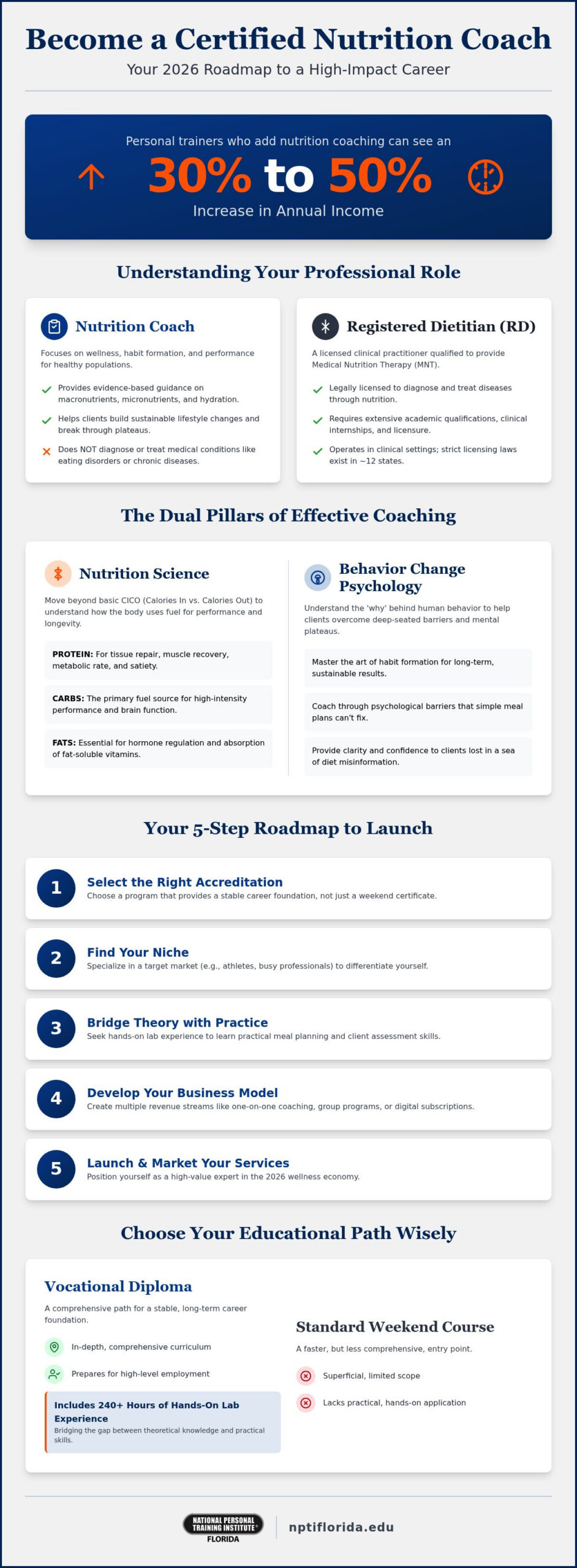
How to Become a Certified Nutrition Coach: A 5-Step Roadmap
The journey toward becoming a certified nutrition coach is a methodical climb, not a random sprint. You aren’t just acquiring a digital badge; you’re building a professional foundation that supports your future clients and your financial stability. Success in this field requires a clear plan that transitions you from a passionate enthusiast to a credentialed expert. By following this roadmap, becoming a certified nutrition coach becomes a structured reality rather than a vague ambition.
- Step 1: Assess your career goals and choose a specialty niche. Decide if you want to work with elite athletes, weight loss clients, or special populations like seniors.
- Step 2: Select an accredited, comprehensive education program. Look for institutions that offer state-licensed diplomas rather than just unaccredited certificates.
- Step 3: Complete the required theory and hands-on lab hours. Dedicate time to mastering both the science of metabolism and the art of client communication.
- Step 4: Pass the professional certification exam. Use your comprehensive education to confidently demonstrate your knowledge of nutrition and behavior change.
- Step 5: Gain practical experience and launch your business. Start coaching, build your portfolio, and integrate your new skills into your existing fitness services.
Choosing the Right Education Program
Your choice of school determines your professional ceiling. When evaluating how to become a nutrition coach, you must look beyond the marketing. Consider the format of the education. While purely online courses offer convenience, a Hyflex Learning Program provides the perfect balance of digital flexibility and in-person lab mastery. There’s also a unique advantage to choosing a veteran-owned institution. These schools often emphasize disciplined leadership and mission-driven purpose, qualities that are essential when you’re guiding clients through difficult lifestyle transformations.
Gaining Real-World Experience
Knowledge that isn’t applied is quickly forgotten. You should seek out mentorship opportunities or coaching internships that allow you to shadow seasoned professionals. Building your initial client portfolio while you’re still in school gives you a massive head start upon graduation. Many successful coaches find that integrating their nutritional expertise into a comprehensive personal training program creates the most value for clients. This dual-threat approach allows you to manage both the training floor and the kitchen, leading to the 30% to 50% income increases typical for multi-certified professionals.
Ready to take the first step toward professional mastery? Explore our Health and Nutrition Coaching module today and start building your career on a foundation of science and practical experience.
Launching Your Career with NPTI Florida’s Professional Training
NPTI Florida doesn’t just offer a certificate; we provide a career-defining education. While many competitors offer “job guarantees” that often fall short in real-world application, we focus on the vocational foundation needed for long-term professional growth. Becoming a certified nutrition coach through our program means you’re entering the workforce with 600 hours of elite training under your belt. This isn’t a self-study course you finish on your couch. It’s an immersive experience designed to turn you into a leader in the wellness industry.
The Advanced Personal Fitness Training Diploma
Our curriculum is built on the principle that mastery requires both knowledge and practice. The 600-hour diploma includes 360 hours of theory and 240 hours of hands-on lab work. You’ll dive deep into anatomy, physiology, and our comprehensive Health and Nutrition Coaching module. We also place a strong emphasis on working with special populations and implementing corrective exercises. This ensures you’re prepared for the diverse needs of the modern client. For those who need to balance their education with existing commitments, our Hyflex fitness training program offers the flexibility of digital learning without sacrificing the critical in-person lab experience.
The 240 lab hours are spent in a real-world gym setting, where you’ll apply nutritional theory to actual training scenarios. You’ll learn how to adjust fueling strategies based on a client’s workout intensity and recovery needs in real time. This practical application is what builds the confidence needed to launch your own business or secure a top-tier position at a leading fitness facility. You won’t just know the science; you’ll know how to coach it.
Your Future as a Nutrition Professional
Graduating from a state-licensed, ACCSC-accredited institution changes the trajectory of your career. You aren’t just another applicant with a weekend cert. You’re a professional with a verified academic background. This credential opens doors in high-end athletic clubs, medical wellness clinics, and successful private practices. Because our program is veteran-owned with over 25 years of experience, we understand the discipline and leadership required to succeed in a competitive market. Becoming a certified nutrition coach is the first step toward a stable, high-impact career that offers both financial reward and personal fulfillment.
Investing in a comprehensive vocational education is the most powerful way to guarantee your future success and establish yourself as a trusted authority in the world of health and nutrition.
Transform Your Passion into a Professional Legacy
The path to professional excellence is rarely found in a shortcut. You’ve seen why the integration of metabolic science and behavior-change psychology is the true differentiator for client results. You also understand that a state-licensed vocational diploma offers a level of career security that a standard weekend certificate simply cannot match. By prioritizing 600 hours of comprehensive education over a quick-fix credential, you’re choosing to become a career architect rather than just another trainer.
Becoming a certified nutrition coach is about more than just understanding macros; it’s about gaining the scientific credibility and hands-on confidence to lead others toward lasting health. As an ACCSC accredited institution licensed by the Florida Commission for Independent Education, NPTI Florida has spent over 25 years helping students build stable, high-impact careers. We are veteran owned and operated, bringing a mission-driven approach to every hour of our curriculum.
Don’t leave your professional future to chance. Download the NPTI Florida Student Catalog and Start Your Nutrition Career Today. Your journey toward becoming an industry leader starts with a single, decisive step.
Frequently Asked Questions
Is becoming a certified nutrition coach worth it in 2026?
Yes, it’s highly worth it because the employment of nutrition professionals is projected to grow 7% through 2033. With the wellness-first economy in full swing, personal trainers who add these skills can see their income increase by 30% to 50%. It’s a stable, rewarding career path that allows you to provide the comprehensive results clients now expect.
How long does it take to become a certified nutrition coach?
The timeline varies from 8 weeks for basic self-study certifications to several months for a comprehensive 600-hour vocational diploma. While becoming a certified nutrition coach through a short course is faster, a state-licensed program ensures you have the hands-on lab hours necessary for real-world confidence. Quality education requires a time commitment that reflects the seriousness of the role.
What is the average salary for a certified nutrition coach?
As of August 2026, the average annual salary for a nutrition coach in the United States is $43,836, which is approximately $21.07 per hour. However, professionals who invest in advanced, science-based credentials often earn significantly more, with top-tier certified coaches averaging $56,712 annually. Self-employed nutrition coaches can earn between $60,000 and $120,000+ per year once they have established a full client roster.
Do I need a degree to be a nutrition coach?
You don’t need a college degree to work in this field, although a high school diploma is a standard requirement for most programs. Employers and clients typically prioritize accredited certifications and vocational diplomas that demonstrate practical, hands-on mastery. A focused 600-hour program provides the specific industry skills and behavior-change psychology that general undergraduate degrees often overlook.
What is the difference between a nutrition coach and a nutritionist?
A nutrition coach focuses on wellness, habit formation, and performance for healthy individuals, while the term nutritionist often refers to clinical practitioners. Approximately 12 states have laws requiring a license to provide medical nutrition therapy or practice dietetics. Coaches stay within their scope by providing evidence-based guidance and referring clients to registered dietitians for medical conditions.
Can I work as a nutrition coach from home?
Yes, you can absolutely build a successful home-based practice through online coaching and telehealth services. The field is seeing rapid growth in digital platforms that allow you to manage client meal plans and habit tracking remotely. This flexibility allows you to reach a global audience while maintaining a schedule that fits your personal lifestyle goals.
What are the prerequisites for nutrition coaching programs?
Most professional programs require applicants to be at least 18 years old and have a high school diploma or equivalent. For state-licensed institutions like NPTI Florida, you must also be a U.S. citizen or green card holder and pay a $50 registration fee. A genuine passion for health and a desire to help others are the most critical personal prerequisites.
How much does a nutrition coaching certification cost?

Did you know that personal trainers who add nutrition coaching to their toolkit often see a 30% to 50% increase in their annual income? It’s a powerful statistic, yet many professionals hesitate because the path to becoming a certified nutrition coach feels cluttered with conflicting diet trends and complex legal boundaries. You’ve likely felt the frustration of watching a dedicated client hit a plateau because they’re lost in a sea of Keto or Paleo misinformation. You want to provide clarity and scientific credibility, but you also need the confidence to stay within your professional scope of practice while coaching through deep-seated psychological barriers.
This comprehensive 2026 guide is designed to bridge that gap. You’re going to learn how to master the dual pillars of nutrition science and behavior change psychology to launch a career that actually changes lives. We’ll break down the most recognized credentials, explain the latest state regulations, and show you why hands-on lab time is the secret to creating meal plans that clients actually follow. From salary expectations to the nuances of habit-based coaching, you’ll gain the roadmap needed to transition from an enthusiast to a respected industry expert.
Key Takeaways
- Understand the critical professional boundaries between a nutrition coach and a registered dietitian to ensure you always practice safely and legally.
- Discover why a comprehensive vocational diploma provides a more stable career foundation than a standard weekend course when becoming a certified nutrition coach.
- Master the integration of macronutrient science and behavior-change psychology to help your clients break through physical and mental plateaus.
- Follow a proven five-step roadmap to select the right accreditation, find your niche, and successfully launch your coaching business in the 2026 wellness economy.
- Learn how 240 hours of hands-on lab experience can bridge the gap between theoretical knowledge and the practical skills required for high-level employment.
Certified Nutrition Coach: Why the Growing Demand?
The fitness industry has fundamentally shifted. Clients no longer show up just for a sweat session; they’re looking for a total lifestyle overhaul that starts in the kitchen. As we move through 2026, the demand for holistic, science-based guidance is at an all-time high. This is why becoming a certified nutrition coach has transitioned from a niche specialty to a core requirement for any serious professional. People are exhausted by “quick fix” culture. They’re seeking experts who can guide them through sustainable lifestyle changes rather than another 30-day restrictive challenge.
The Scope of Practice: Staying Safe and Legal
Clarity is your greatest professional asset. Before you launch your career, you must understand the clear distinction between a coach and a clinical practitioner. To appreciate the full academic and legal requirements of medical practitioners, it’s helpful to understand what is a dietitian. While dietitians are licensed to provide medical nutrition therapy and treat specific diseases, a nutrition coach focuses on wellness, habit formation, and performance for healthy populations.
Currently, approximately 12 states have strict laws requiring a license for medical nutrition therapy. As a coach, you won’t diagnose or treat medical conditions. You’ll provide evidence-based guidance on macronutrients, micronutrients, and hydration. If a client presents with a clinical issue like an eating disorder or chronic metabolic disease, your professional duty is to refer them out. This collaborative approach doesn’t just protect you legally; it builds your reputation as a responsible, high-integrity professional.
The Economic Opportunity in Nutrition Coaching
The financial data is compelling. Personal trainers who successfully integrate nutritional guidance into their service packages often report a 30% to 50% increase in their total income. You’re no longer just selling a 60-minute workout. You’re selling a comprehensive solution that works 24 hours a day. This shift creates a more stable, diversified business model.
- Multiple Revenue Streams: You can offer standalone nutrition consultations, digital habit-tracking subscriptions, or group coaching programs.
- Enhanced Client Retention: When clients see faster results through optimized fueling, they remain committed to your programs for the long term.
- Market Differentiation: Moving beyond basic “Calories In vs. Calories Out” (CICO) logic positions you as a sophisticated expert in a crowded market.
Becoming a certified nutrition coach allows you to tap into the “wellness-first” economy where food is viewed as medicine and performance fuel. You’ll stop being a trainer who just counts reps and start being a career architect for your clients’ long-term health.
The Science and Psychology of Effective Nutrition Coaching
Science is only half the battle. If weight loss were as simple as a math equation, every person with a calorie-tracking app would reach their goals. The reality is that human biology is complex, and human behavior is even more so. To succeed, you must move beyond the basic “Calories In vs. Calories Out” (CICO) model and understand the hormonal and physiological responses to different types of fuel. When you commit to becoming a certified nutrition coach, you’re agreeing to become a lifelong student of both biology and psychology.
Mastering Nutrition Science Fundamentals
While the basic math of energy balance matters, becoming a certified nutrition coach requires a deeper understanding of how the body uses specific nutrients for performance and longevity. Protein is the essential building block for tissue repair and muscle recovery, yet its role in metabolic rate and satiety is often what helps a client stay consistent. Carbohydrates aren’t the enemy; they’re the primary fuel source for high-intensity performance and brain function. Healthy fats are non-negotiable for hormone regulation and the absorption of fat-soluble vitamins. By mastering these interactions, you can create sophisticated nutritional programming for athletes and special populations who have unique physiological demands.
The career outlook for nutrition professionals remains strong because the public increasingly recognizes that micronutrients and hydration are just as important as the calorie count on a label. These “silent pillars” of health often determine whether a client feels vibrant or chronically exhausted.
Behavior Change: The Art of Coaching Humans
Knowledge alone doesn’t change lives. If it did, everyone with a smartphone would be in peak physical condition. The real challenge lies in identifying the emotional and social triggers that dictate food choices, such as stress-eating after a long day or the pressure of social dining. Successful coaching requires master-level communication techniques that build client trust and foster genuine adherence. You’ll need to help clients navigate psychological plateaus that usually derail their progress before they ever reach their physical potential.
To further support clients with deep-seated psychological barriers, some professionals seek specialized training in subconscious behavior change at the Professional Hypnosis Institute; you can learn more about their state-authorized certification programs.
Behavior-change psychology is the catalyst for long-term client results because it transforms temporary willpower into permanent habits. This human-centric approach is a core component of the Health and Nutrition Coaching module at NPTI Florida. We believe that you’re coaching a person with a complex life, not just a set of macros on a spreadsheet. By focusing on the “why” behind every food choice, you empower your clients to achieve sustainable success that lasts long after your sessions end.
Certification vs. Vocational Diploma: Comparing Your Educational Paths
You’ve likely seen the ads for “get certified in a weekend” programs. While these low-barrier certifications might give you a digital badge, they often leave you feeling unprepared when a client asks a complex question about metabolic adaptation or micronutrient density. Becoming a certified nutrition coach is a serious professional undertaking that requires more than a 20-hour self-study course. A comprehensive 600-hour vocational diploma represents a foundational investment in your career longevity. It’s the difference between memorizing a few facts for a multiple-choice test and actually understanding the mechanics of human metabolism.
The Hands-On Advantage in Nutrition Training
Reading about meal planning is one thing; actually constructing a periodized nutritional strategy for a client with specific physiological needs is another. Hands-on lab time allows you to practice these skills under the supervision of seasoned mentors who understand the industry. This is why hands-on personal trainer training is so vital. You gain the immediate confidence to look a client in the eye and know your advice is backed by hundreds of hours of supervised practice. In a lab setting, you can simulate real-world coaching scenarios, troubleshoot adherence issues, and refine your communication style before you ever take on your first paid client.
Accreditation and Licensing Standards
Credibility is the currency of the wellness industry. When you’re becoming a certified nutrition coach, you should look for programs accredited by agencies like the Accrediting Commission of Career Schools and Colleges (ACCSC). This level of oversight ensures that the curriculum meets rigorous academic and vocational standards. A formal diploma on your resume signals to employers that you’ve completed a state-licensed program, making you a much more attractive candidate in competitive markets. It moves you past the “certified” label and into the “career-ready” category.
The choice is clear. A weekend certificate might get you a title, but a vocational diploma builds a career. Employers in 2026 recognize the distinction between someone who passed a short online quiz and a professional who dedicated 600 hours to mastering their craft. By choosing the more rigorous path, you ensure your education is a permanent asset rather than a temporary credential. You’re not just looking for a piece of paper; you’re looking for the mastery required to change lives.
How to Become a Certified Nutrition Coach: A 5-Step Roadmap
The journey toward becoming a certified nutrition coach is a methodical climb, not a random sprint. You aren’t just acquiring a digital badge; you’re building a professional foundation that supports your future clients and your financial stability. Success in this field requires a clear plan that transitions you from a passionate enthusiast to a credentialed expert. By following this roadmap, becoming a certified nutrition coach becomes a structured reality rather than a vague ambition.
- Step 1: Assess your career goals and choose a specialty niche. Decide if you want to work with elite athletes, weight loss clients, or special populations like seniors.
- Step 2: Select an accredited, comprehensive education program. Look for institutions that offer state-licensed diplomas rather than just unaccredited certificates.
- Step 3: Complete the required theory and hands-on lab hours. Dedicate time to mastering both the science of metabolism and the art of client communication.
- Step 4: Pass the professional certification exam. Use your comprehensive education to confidently demonstrate your knowledge of nutrition and behavior change.
- Step 5: Gain practical experience and launch your business. Start coaching, build your portfolio, and integrate your new skills into your existing fitness services.
Choosing the Right Education Program
Your choice of school determines your professional ceiling. When evaluating how to become a nutrition coach, you must look beyond the marketing. Consider the format of the education. While purely online courses offer convenience, a Hyflex Learning Program provides the perfect balance of digital flexibility and in-person lab mastery. There’s also a unique advantage to choosing a veteran-owned institution. These schools often emphasize disciplined leadership and mission-driven purpose, qualities that are essential when you’re guiding clients through difficult lifestyle transformations.
Gaining Real-World Experience
Knowledge that isn’t applied is quickly forgotten. You should seek out mentorship opportunities or coaching internships that allow you to shadow seasoned professionals. Building your initial client portfolio while you’re still in school gives you a massive head start upon graduation. Many successful coaches find that integrating their nutritional expertise into a comprehensive personal training program creates the most value for clients. This dual-threat approach allows you to manage both the training floor and the kitchen, leading to the 30% to 50% income increases typical for multi-certified professionals.
Ready to take the first step toward professional mastery? Explore our Health and Nutrition Coaching module today and start building your career on a foundation of science and practical experience.
Launching Your Career with NPTI Florida’s Professional Training
NPTI Florida doesn’t just offer a certificate; we provide a career-defining education. While many competitors offer “job guarantees” that often fall short in real-world application, we focus on the vocational foundation needed for long-term professional growth. Becoming a certified nutrition coach through our program means you’re entering the workforce with 600 hours of elite training under your belt. This isn’t a self-study course you finish on your couch. It’s an immersive experience designed to turn you into a leader in the wellness industry.
The Advanced Personal Fitness Training Diploma
Our curriculum is built on the principle that mastery requires both knowledge and practice. The 600-hour diploma includes 360 hours of theory and 240 hours of hands-on lab work. You’ll dive deep into anatomy, physiology, and our comprehensive Health and Nutrition Coaching module. We also place a strong emphasis on working with special populations and implementing corrective exercises. This ensures you’re prepared for the diverse needs of the modern client. For those who need to balance their education with existing commitments, our Hyflex fitness training program offers the flexibility of digital learning without sacrificing the critical in-person lab experience.
The 240 lab hours are spent in a real-world gym setting, where you’ll apply nutritional theory to actual training scenarios. You’ll learn how to adjust fueling strategies based on a client’s workout intensity and recovery needs in real time. This practical application is what builds the confidence needed to launch your own business or secure a top-tier position at a leading fitness facility. You won’t just know the science; you’ll know how to coach it.
Your Future as a Nutrition Professional
Graduating from a state-licensed, ACCSC-accredited institution changes the trajectory of your career. You aren’t just another applicant with a weekend cert. You’re a professional with a verified academic background. This credential opens doors in high-end athletic clubs, medical wellness clinics, and successful private practices. Because our program is veteran-owned with over 25 years of experience, we understand the discipline and leadership required to succeed in a competitive market. Becoming a certified nutrition coach is the first step toward a stable, high-impact career that offers both financial reward and personal fulfillment.
Investing in a comprehensive vocational education is the most powerful way to guarantee your future success and establish yourself as a trusted authority in the world of health and nutrition.
Transform Your Passion into a Professional Legacy
The path to professional excellence is rarely found in a shortcut. You’ve seen why the integration of metabolic science and behavior-change psychology is the true differentiator for client results. You also understand that a state-licensed vocational diploma offers a level of career security that a standard weekend certificate simply cannot match. By prioritizing 600 hours of comprehensive education over a quick-fix credential, you’re choosing to become a career architect rather than just another trainer.
Becoming a certified nutrition coach is about more than just understanding macros; it’s about gaining the scientific credibility and hands-on confidence to lead others toward lasting health. As an ACCSC accredited institution licensed by the Florida Commission for Independent Education, NPTI Florida has spent over 25 years helping students build stable, high-impact careers. We are veteran owned and operated, bringing a mission-driven approach to every hour of our curriculum.
Don’t leave your professional future to chance. Download the NPTI Florida Student Catalog and Start Your Nutrition Career Today. Your journey toward becoming an industry leader starts with a single, decisive step.
Frequently Asked Questions
Is becoming a certified nutrition coach worth it in 2026?
Yes, it’s highly worth it because the employment of nutrition professionals is projected to grow 7% through 2033. With the wellness-first economy in full swing, personal trainers who add these skills can see their income increase by 30% to 50%. It’s a stable, rewarding career path that allows you to provide the comprehensive results clients now expect.
How long does it take to become a certified nutrition coach?
The timeline varies from 8 weeks for basic self-study certifications to several months for a comprehensive 600-hour vocational diploma. While becoming a certified nutrition coach through a short course is faster, a state-licensed program ensures you have the hands-on lab hours necessary for real-world confidence. Quality education requires a time commitment that reflects the seriousness of the role.
What is the average salary for a certified nutrition coach?
As of August 2026, the average annual salary for a nutrition coach in the United States is $43,836, which is approximately $21.07 per hour. However, professionals who invest in advanced, science-based credentials often earn significantly more, with top-tier certified coaches averaging $56,712 annually. Self-employed nutrition coaches can earn between $60,000 and $120,000+ per year once they have established a full client roster.
Do I need a degree to be a nutrition coach?
You don’t need a college degree to work in this field, although a high school diploma is a standard requirement for most programs. Employers and clients typically prioritize accredited certifications and vocational diplomas that demonstrate practical, hands-on mastery. A focused 600-hour personal trainer certification program provides the specific industry skills and behavior-change psychology that general undergraduate degrees often overlook.
What is the difference between a nutrition coach and a nutritionist?
A nutrition coach focuses on wellness, habit formation, and performance for healthy individuals, while the term nutritionist often refers to clinical practitioners. Approximately 12 states have laws requiring a license to provide medical nutrition therapy or practice dietetics. Coaches stay within their scope by providing evidence-based guidance and referring clients to registered dietitians for medical conditions.
Can I work as a nutrition coach from home?
Yes, you can absolutely build a successful home-based practice through online coaching and telehealth services. The field is seeing rapid growth in digital platforms that allow you to manage client meal plans and habit tracking remotely. This flexibility allows you to reach a global audience while maintaining a schedule that fits your personal lifestyle goals.
What are the prerequisites for nutrition coaching programs?
Most professional programs require applicants to be at least 18 years old and have a high school diploma or equivalent. For state-licensed institutions like NPTI Florida, you must also be a U.S. citizen or green card holder and pay a $50 registration fee. A genuine passion for health and a desire to help others are the most critical personal prerequisites.
How much does a nutrition coaching certification cost?
To explore coaching further, see the health coach certification at NPTI Florida.