How to Become a Personal Trainer: The Complete Step-by-Step Guide for 2026
Passing a multiple-choice exam doesn’t make you a personal trainer; it just makes you a person with a piece of paper. If you’re feeling overwhelmed…
Passing a multiple-choice exam doesn’t make you a personal trainer; it just makes you a person with a piece of paper. If you’re feeling overwhelmed by the personal trainer certification cost Florida or anxious about whether you’ll actually know how to design a safe program, you aren’t alone. It’s common to worry about failing a technical exam or, worse, feeling like a fraud once you’re finally on the gym floor. You’ve likely spent hours researching which certification is the “best” only to find more questions than answers.
We’re here to cut through that noise. This guide reveals the exact roadmap to transition from a fitness enthusiast into a high-earning, certified professional with a career built on rock-solid scientific foundations. You’ll gain the confidence to lead any client and the professional credibility to ensure long-term stability. We’ll walk you through a linear path to employment, covering everything from choosing the right educational pathway to mastering the practical skills that top-tier Florida gyms actually demand in 2026.
Key Takeaways
- Understand the essential baseline requirements for 2026, including why current CPR and AED certifications are mandatory for professional liability.
- Evaluate the total personal trainer certification cost Florida presents by comparing the ROI of short-term exam fees against comprehensive, 600-hour vocational diplomas.
- Discover why hands-on lab time is the critical bridge that transforms theoretical knowledge into the practical confidence needed to lead a gym floor.
- Follow a structured 5-step roadmap that prioritizes biomechanics and corrective exercise to build your career on a science-based foundation.
- Learn how to define a high-value professional niche, such as senior fitness or corrective exercise, to ensure long-term career stability and growth.
Essential Prerequisites for Aspiring Personal Trainers
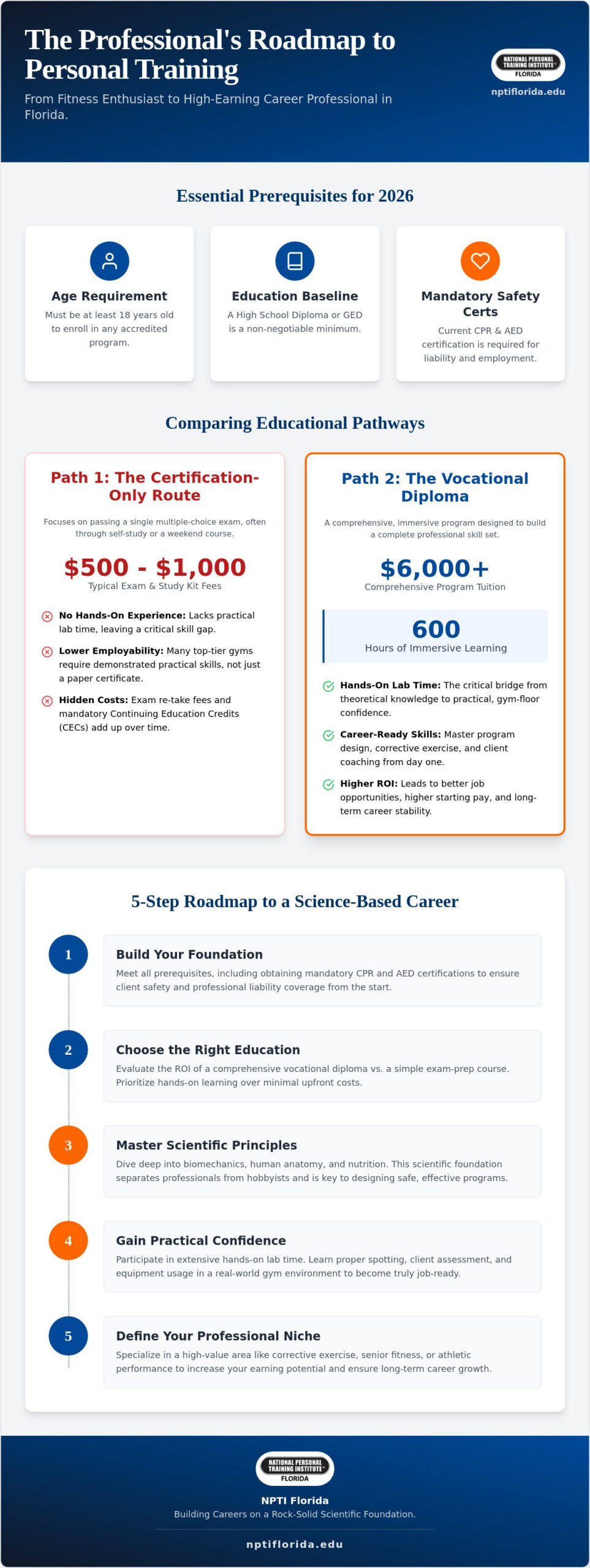
Starting your journey as a fitness professional requires more than just a love for the gym. It’s about building a foundation that protects both you and your future clients. While you’re likely researching the personal trainer certification cost Florida schools offer, you must first clear the entry hurdles. In Florida, you must be at least 18 years old and hold a high school diploma or GED. These aren’t just arbitrary rules; they’re the baseline for entering any NCCA-accredited program or vocational institution. This ensures you have the foundational skills to handle the rigorous science and business coursework ahead.
Mandatory Certifications Before You Start
Safety is your first priority. Before you can sit for an exam or step into a lab, you need a current CPR and AED certification. Most reputable employers and insurance providers only accept credentials from the American Red Cross or the American Heart Association. If your certification lapses, your professional liability insurance often becomes void instantly. This leaves you legally exposed if an incident occurs on your watch. Think of these as your “license to practice” safety before you ever touch a barbell or lead a client through a high-intensity circuit.
Educational Foundations: What You Need to Know
A high school diploma or GED is the non-negotiable baseline for anyone seeking a career-securing credential. This requirement ensures you have the reading comprehension and basic math skills necessary to calculate caloric needs or determine a client’s 1-rep max safely. An Overview of the Personal Training Profession reveals that modern trainers are expected to understand complex systems, from the nervous system to metabolic pathways. Beyond the science, you must respect your “scope of practice.” As a trainer, you aren’t a physical therapist or a registered dietitian. Staying within your professional boundaries is essential for career longevity and ethical practice.
Transitioning from a high-performing athlete to a successful mentor is a major psychological shift. It requires “coachability,” which is the ability to put aside your own training preferences to focus on a client’s unique biomechanical needs. Your passion for fitness is the fuel, but your commitment to scientific foundations is the engine. When calculating the total personal trainer certification cost Florida students face, remember to factor in the time spent mastering these soft skills. Programs like the 600-hour Advanced Personal Training Program at NPTI Florida emphasize this transition. We move you beyond the “workout buddy” phase into a true career architect role, focusing on corrective exercise and behavior-change psychology.
Analyzing Personal Trainer Certification Cost in Florida: Tuition vs. Exam Fees
When evaluating the personal trainer certification cost Florida aspiring trainers encounter, it’s easy to get distracted by the lowest sticker price. You might see “weekend certifications” advertised for $500 to $1,000. These programs are essentially study kits designed to help you pass a single multiple-choice exam. In contrast, comprehensive vocational diplomas often start around $6,000. While the initial gap seems wide, you have to look at what you’re actually buying. One is a permit to take a test; the other is a 600-hour immersion into human movement. According to the U.S. Bureau of Labor Statistics Job Outlook, the demand for qualified trainers is growing, but the industry is increasingly favoring those with deep, foundational knowledge over those with just a basic credential.
The true personal trainer certification cost Florida applicants should measure isn’t just the tuition. It’s the cost of being unprepared. High-end gyms rarely hire trainers who only possess a digital certificate. They want professionals who can demonstrate spotting techniques, corrective exercise, and nutritional guidance on day one. If you enter the field with a “skill gap,” you’ll likely start at a lower hourly rate and struggle with client retention, which acts as a hidden tax on your career.
Hidden Costs of the Certification-Only Path
Many students choose the self-study path to save money, only to find themselves paying more in the long run. If you don’t pass your exam on the first try, re-testing fees can add hundreds to your total spend. You also have to consider the ongoing price of continuing education credits (CECs) required every two years to keep a basic certificate active. Without a structured classroom environment, many aspiring trainers end up paying for expensive third-party tutoring or workshops just to grasp basic anatomy. If you’re feeling unsure about which path leads to a stable career, it’s helpful to review a detailed breakdown of personal trainer school cost expectations for 2026.
The Value of a Career Diploma
A personal trainer career diploma functions as a comprehensive investment in your professional future. Instead of paying for separate certs in nutrition or senior fitness, these specialized modules are built into the core 600-hour curriculum. This integrated approach ensures you aren’t just memorizing facts for a test; you’re practicing them in a lab setting under expert supervision. ACCSC accreditation provides an extra layer of security, confirming that your tuition supports a high-quality, regulated education. If you want to build a career that lasts 20 years instead of 20 months, choosing a licensed institution is the most reliable move. You can explore our Advanced Personal Training Program to see how we bridge the gap between theory and the gym floor.
The 5-Step Roadmap to Becoming a Professional Personal Trainer
Becoming a high-earning professional isn’t a race to the cheapest exam. It’s a methodical progression that transforms your passion into a stable career. While the immediate personal trainer certification cost Florida students encounter is a factor, your focus should remain on the quality of the roadmap you follow. A linear path ensures you don’t waste time on credentials that gyms won’t respect.
- Step 1: Select an accredited vocational program. Choose a school that balances classroom theory with intensive lab work. This ensures you can apply what you read in a textbook to a real human body.
- Step 2: Master the science of human movement. You must understand biomechanics and corrective exercise to keep clients safe. This knowledge is what separates a professional from a “workout buddy.”
- Step 3: Accumulate supervised gym hours. Real-world experience under an expert’s eye is where you build true confidence. You’ll learn how to handle different body types and fitness levels before you’re on your own.
- Step 4: Secure your credentials. This includes your Advanced Personal Training Diploma and national board certifications. Reviewing the NSCA Certification Requirements can help you understand the rigor expected at a national level.
- Step 5: Launch your niche. Specialization is how you command higher rates. Whether it’s senior fitness or athletic performance, a niche makes you the go-to expert in your local market.
Mastering the Science-Based Curriculum
Success in the fitness industry requires more than knowing how to count reps. You need to integrate vocational fitness training program standards into every study session. This means moving beyond basic exercise selection and diving into behavior-change psychology. If you can’t help a client change their habits, they won’t stay with you. Professional programming involves tailoring workouts for special populations, ensuring that every movement serves a specific, science-backed purpose. When you understand the “why” behind the “what,” you become an indispensable asset to your clients.
Securing Your Professional Future
The final phase of your roadmap is the transition from student to career architect. Earning an Advanced Personal Training award involves completing a rigorous 600-hour curriculum. This depth of study prepares you for the high expectations of elite Florida fitness employers who demand more than a weekend certificate. You aren’t just getting a job; you’re building career stability. By adhering to NPTI standards, you ensure that your professional foundation is rooted in real-world application. This comprehensive approach justifies the personal trainer certification cost Florida professionals invest, as it leads to higher retention and better long-term earning potential.
Why Hands-On Lab Time is Non-Negotiable in 2026
Watching a video about a squat is not the same as correcting a client’s valgus knee collapse in real-time. The “Digital Gap” in fitness education is real; it’s the primary reason many new trainers fail within their first year. While searching for the personal trainer certification cost Florida schools offer, you’ll find plenty of online-only options. These programs might help you pass a test, but they leave you paralyzed when a real client with a previous injury stands in front of you. True mastery requires hands-on personal trainer training to build the kinesthetic empathy needed to feel and fix a client’s movement struggles.
At NPTI Florida, we prioritize a 240-hour lab requirement within our 600-hour Advanced Personal Fitness Training program. This isn’t just “gym time.” It’s a clinical environment where you test biomechanical theories on diverse body types. You learn how to spot safely, how to cue effectively, and how to adjust a program on the fly when a client isn’t moving correctly. This level of immersion is the single most important factor in your professional readiness. It transforms theoretical concepts into reflexive skills that you can use the moment you step onto a commercial gym floor.
Textbook Anatomy vs. Living Biomechanics
Textbooks show you 2D diagrams of muscles. Labs show you how those muscles move in three dimensions. You’ll move from memorizing muscle origins to practicing movement assessments on real people with different limb lengths and mobility levels. This develops your “coach’s eye,” allowing you to spot subtle human movement dysfunctions before they lead to chronic pain or injury. You aren’t just learning exercises; you’re practicing corrective exercise strategies for common orthopedic conditions in real-time. It’s about seeing the living biomechanics of a person, not just a page in a book.
Building Client-Ready Confidence
Stepping onto a gym floor for the first time can be terrifying. A supervised lab provides a “safe-to-fail” environment where you can refine your technique without the pressure of a paying client. Peer-to-peer training exposes you to different temperaments and learning styles, preparing you for the reality of a busy training floor. When you sit down for a job interview at a premier Florida club, these lab hours are your greatest asset. Employers know that an NPTI graduate doesn’t need “on-the-job training” because they’ve already done the work. If you’re ready to invest in a career rather than just a certificate, consider the total personal trainer certification cost Florida programs provide in terms of actual floor hours. You can apply to our Advanced Personal Training Program today to secure your spot in our next hands-on cohort.
Launching Your Career: From Diploma to Professional Niche
Earning your diploma is a milestone, but it’s only the beginning of your journey as a career architect. Once you’ve completed your 600 hours, you’re no longer just a fitness enthusiast; you’re a specialist ready to solve specific problems for specific people. While you’ve already navigated the personal trainer certification cost Florida programs entail, your focus must now shift to market positioning. Defining a niche early on, whether it’s youth athletics or corrective exercise, allows you to command higher rates and build a client list that sticks.
Your education at NPTI Florida is designed to facilitate this transition. By leveraging our personal training program, you’re networking while you learn. You aren’t just studying in a vacuum; you’re interacting with seasoned instructors and peers who will become your first professional network. When you build a resume that highlights 600 hours of vocational education and 240 hours of lab work, you stand out from the sea of applicants who only have a weekend certificate. This depth of experience is your greatest competitive advantage in a crowded market.
Capitalizing on High-Demand Specializations
Florida’s demographics offer unique opportunities for those willing to specialize. The demand for Senior Fitness Specialists is surging as the 2026 aging population seeks to maintain mobility and independence. Similarly, integrating Health and Nutrition Coaching into your services doesn’t just improve client outcomes; it creates additional revenue streams that stabilize your business. If you prefer working with younger populations, Advanced Youth Fitness focuses on athletic performance and long-term physical development. These aren’t just “add-ons”; they’re the pillars of a recession-proof career.
The Final Step: Career Placement and Growth
Success isn’t just about what you know, but who knows you. During your practical lab hours, you’ll have the chance to network with gym owners and rehabilitation centers that value the NPTI standard. If you need to balance your current job while launching your new business, our Hyflex Learning Program provides the flexibility to study on your own terms. Your education is a career-long asset, not a one-time personal trainer certification cost Florida students pay. Through our alumni network and ongoing mentorship, we ensure you have the support needed to grow from a new graduate into an industry leader. You’ve made the investment; now it’s time to build the legacy.
Build a Career That Lasts a Lifetime
Transitioning from a fitness enthusiast to a high-earning professional requires more than just passion; it demands a commitment to scientific excellence and hands-on mastery. You now understand that the true personal trainer certification cost Florida residents face isn’t just about exam fees. It’s about the value of 600 hours of vocational education and the confidence gained through 240 hours of supervised lab work. By focusing on high-demand niches like corrective exercise and senior fitness, you ensure your career remains stable and profitable for decades to come.
Choosing the right institution is the most critical decision you’ll make. NPTI Florida stands as an ACCSC Accredited Institution with over 25 years of excellence in fitness education. As a veteran-owned and operated school, we provide the discipline and reliability you need to succeed in the 2026 market. You have the roadmap. Now, it’s time to execute the plan and become the expert your community needs.
Start Your Professional Fitness Career with NPTI Florida Today. Your future as a leader in the fitness industry is waiting, and we’re ready to help you build it.
Frequently Asked Questions
How long does it actually take to become a personal trainer?
It takes anywhere from a few weeks for a basic certificate to six months for a comprehensive vocational diploma. Our 600-hour program is designed for completion in about half a year, ensuring you have the 240 hours of lab time necessary for professional readiness. This timeline allows for deep immersion into biomechanics rather than just memorizing facts for a weekend exam.
Is an online personal trainer certification enough to get hired in 2026?
While an online certificate might meet minimum requirements for some entry-level positions, most top-tier gyms in 2026 prioritize candidates with documented hands-on experience. Managers are looking for trainers who can demonstrate proper spotting and corrective exercise on day one. A purely digital education often lacks the practical application needed to handle real-world movement dysfunctions effectively.
Do I need a college degree to be a successful personal trainer?
You don’t need a four-year degree to build a high-earning career, though you do need specialized vocational training. Many successful professionals choose accredited diploma programs that focus specifically on exercise science and nutrition. This path provides the technical depth of a degree with a much faster transition into the workforce, focusing on practical skills rather than general education requirements.
What is the difference between a personal trainer certificate and a career diploma?
A certificate usually validates that you passed a single exam, whereas a career diploma represents hundreds of hours of comprehensive, hands-on education. A diploma from an ACCSC accredited institution covers advanced topics like behavior-change psychology and corrective exercise in depth. This foundational investment provides greater long-term stability and credibility compared to a standalone credential.
How much does it cost to become a certified personal trainer in Florida?
The personal trainer certification cost Florida students pay varies significantly, ranging from $500 for basic exams to over $6,000 for full-tuition vocational programs. It’s vital to look beyond the initial price tag and consider the return on investment. Programs that include lab hours and job placement assistance often lead to higher starting salaries and better client retention rates.
Can veterans use GI Bill® or VA benefits for personal trainer school?
Yes, qualified veterans can often use their GI Bill® or other VA benefits at accredited, licensed institutions like NPTI Florida. Being a veteran-owned and operated school, we understand the transition from military service to civilian careers. Using your benefits for a 600-hour Advanced Personal Training Program is an excellent way to leverage your discipline into a stable fitness career.
What are the most in-demand personal training specializations right now?
Senior fitness, corrective exercise, and health coaching are currently the highest-growth areas in the Florida market. As the population ages, the need for Senior Fitness Specialists who understand orthopedic limitations has never been higher. Specializing in these high-value areas allows you to differentiate yourself and charge premium rates for your expert knowledge.
Is the personal training industry over-saturated for new trainers?
The industry is not over-saturated for professionals; it’s only crowded at the entry-level tier of trainers who hold only a basic certificate. There’s a persistent shortage of trainers who possess deep scientific knowledge and practical coaching skills. By investing in a comprehensive education, you move past the saturated baseline and enter the high-demand world of career-focused fitness architects.