Personal Trainer School Requirements: The 2026 Professional Career Guide
What if the difference between a fleeting three-year fitness stint and a thirty-year professional legacy isn’t how much you can bench, but how well you understand the 2026 regulatory landscape? You’ve likely spent years honing your own physique and offering free advice to friends; now you’re ready to turn that passion into a legitimate paycheck. It’s common to feel overwhelmed by the conflicting noise regarding weekend certifications versus actual vocational education. Mastering the specific personal trainer school requirements is the first critical step toward building a stable, science-based career in a $12.1 billion industry.
You deserve a career path that’s as solid as your work ethic. This guide will help you navigate the transition from enthusiast to certified expert by breaking down the essential educational, legal, and professional benchmarks you need to master. We’ll explore the updated 2026 accreditation standards, the massive ROI of hands-on vocational training, and the exact checklist required to move from the classroom to a high-paying gym floor with total confidence.
Key Takeaways
- Confirm your eligibility by meeting the industry floor of being 18 years old with a high school diploma and active CPR/AED certifications.
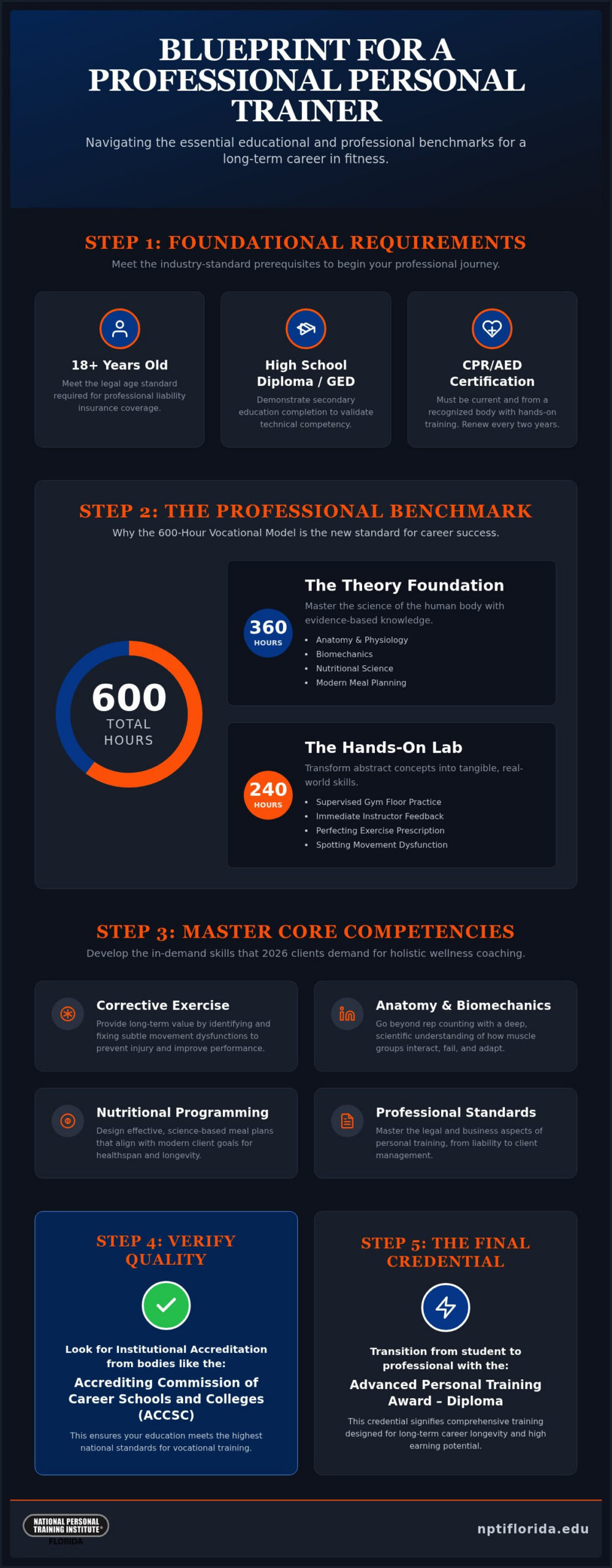
- Understand the specific personal trainer school requirements that define the 600-hour vocational model, which balances 360 hours of theory with 240 hours of hands-on lab work.
- Identify high-quality programs by looking for institutional accreditation from the Accrediting Commission of Career Schools and Colleges (ACCSC).
- Master core competencies like corrective exercise and nutritional programming to provide the holistic wellness coaching that 2026 clients demand.
- Transition from student to professional by earning an Advanced Personal Training Award – Diploma, a credential designed for long-term career longevity.
Fundamental Eligibility: The Basic Requirements for Personal Trainers
Stepping into the fitness industry begins with a clear understanding of the baseline. Before you can design a single workout, you must meet the foundational personal trainer school requirements that ensure you’re legally and professionally prepared to handle the responsibility of a client’s health. While it’s tempting to view these as mere formalities, they actually serve as your first layer of professional defense. If you’re curious about the broader scope of the role, a look at What is a Personal Trainer provides an excellent overview of the industry’s reach and the general scope of practice.
Legal Prerequisites and Age Standards
Most accredited institutions and high-end gyms set the entry bar at 18 years of age and a high school diploma or GED. This isn’t just an arbitrary rule. Professional liability insurance providers generally won’t cover trainers under the age of 18, and many policies require proof of secondary education to validate your technical competency. If you already have a degree or prior certifications, verify these during the enrollment process to see how they align with a comprehensive 600-hour vocational program. Meeting the floor is about legal compliance. Exceeding it is about career longevity.
CPR and AED Certification Standards
Safety isn’t negotiable in a professional setting. You must hold a current CPR (Cardiopulmonary Resuscitation) and AED (Automated External Defibrillator) certification from a recognized body like the American Heart Association or the Red Cross. Don’t settle for online-only certificates. Most employers and insurance carriers prioritize hands-on training because it proves you’ve actually practiced life-saving skills on a mannequin. Staying current is vital; you’ll need to renew these every two years to maintain your professional standing while you work toward your Advanced Personal Training Award – Diploma.
The gap between legal minimums and professional readiness is often where new trainers fail. A weekend certificate might satisfy a legal requirement, but it won’t prepare you for the complexities of human movement or metabolic health. True readiness comes from a science-based foundation that transforms you from a rep counter into a career architect. Think of these basics as your entry ticket. They get you through the door, but they don’t keep you in the room. Professional readiness involves moving beyond the what and into the how of fitness science. While the industry floor remains low, the ceiling for those who invest in a 600-hour comprehensive curriculum is significantly higher. Use these personal trainer school requirements as a springboard rather than a finish line.
Vocational Standards: Why 600 Hours is the Professional Benchmark
Passing a multiple-choice exam doesn’t make you a professional; it makes you a test-taker. In a 2026 fitness landscape where clients prioritize healthspan and longevity, the standard weekend certification is no longer enough to guarantee career success. This is why the 600-hour vocational model has emerged as the professional benchmark. It provides a comprehensive bridge between academic knowledge and practical application, ensuring you enter the gym floor with both competence and confidence. When you evaluate personal trainer school requirements, the depth of the curriculum is the most reliable predictor of your future income potential.
The 360-Hour Theory Foundation
Before you can safely load a barbell, you must understand the engine driving the movement. The first 360 hours of your education focus on the rigorous science of the human body. You’ll dive deep into anatomy, physiology, and biomechanics to understand how muscle groups interact and fail. While baseline personal trainer education requirements often start with a high school diploma, the professional market demands mastery of modern meal planning and nutritional science. Evidence-based theory serves as the architectural blueprint for every safe and effective movement you’ll ever prescribe to a client.
The 240-Hour Hands-On Lab Requirement
Knowledge without application is just trivia. The 240-hour lab requirement is where you transform abstract concepts into tangible skills. In a dedicated fitness lab, you’ll move from textbooks to the gym floor under the direct supervision of seasoned experts. This environment allows for immediate instructor feedback, which is vital for perfecting exercise prescription and spotting subtle movement dysfunctions. It’s the difference between guessing and knowing. By the time you complete the Advanced Personal Training Curriculum, you’ve already logged hundreds of hours of supervised practice, significantly reducing the risk of client injury and boosting your professional authority. This intensive approach is one of the most rigorous personal trainer school requirements, but it’s also the most rewarding for your future business.
Supervised training builds a level of intuition that self-study simply cannot replicate. You’ll learn to read a client’s body language, adjust intensity on the fly, and communicate complex cues effectively. If you’re looking for a path that prioritizes your long-term evolution as a coach, our Personal Fitness Training Program offers the structure you need to succeed in a competitive market.
Accreditation and Licensing: Identifying High-Quality Programs
Your choice of school is the most significant investment you’ll make in your fitness career. It’s easy to get lost in the sea of weekend workshops, but the true value of your education depends on the oversight governing the institution. Understanding the nuance between institutional and programmatic accreditation is vital for your professional security. While many certifying bodies focus on the exam itself, institutional accreditation focuses on the school’s ability to provide a high-quality, stable learning environment that meets rigorous national standards. This oversight ensures that the personal trainer school requirements you’re working to meet are backed by a legitimate academic foundation.
Understanding ACCSC Accreditation
The Accrediting Commission of Career Schools and Colleges (ACCSC) is a key player in vocational education. When a school holds ACCSC accreditation, it means they’ve undergone a thorough review of their curriculum, instructor qualifications, and student outcomes. This isn’t just about prestige; it’s about practical benefits. Accredited schools are often the only ones that can provide pathways to federal financial aid or VA benefits for our veteran community. This level of oversight guarantees that your 600-hour program isn’t just a collection of gym hours, but a structured educational journey. If you’re still weighing your options, our Ultimate Personal Training Program Guide explains why choosing a career-focused school beats a basic certificate every time.
State Licensing and Student Rights
Beyond national accreditation, state-level licensing provides an extra layer of student protection. In Florida, the Commission for Independent Education (CIE) is responsible for licensing nonpublic postsecondary institutions. A licensed school is legally required to be transparent. They must provide a detailed student catalog that outlines everything from tuition costs to program flexibility and refund policies. This document serves as a contract of quality. It allows you to verify the school’s credentials before you ever pay a dime in tuition.
While you research accredited certification requirements for your future exams, ensure the school providing that training is licensed to operate. This double layer of protection, consisting of national accreditation and state licensing, is what separates a professional academy from a fly-by-night operation. It ensures that the personal trainer school requirements you fulfill lead to a diploma that carries weight in high-end athletic programs and medical rehab centers.
Core Competencies: What You Must Master to Graduate
Graduation is the threshold of your professional life. It represents more than just completing a checklist; it signifies your mastery over the complex variables of human performance and health. To meet the most rigorous personal trainer school requirements, you must prove your ability to handle the diverse needs of a modern, health-conscious public. In a market where 88% of trainers report that clients now prioritize longevity and healthspan over short-term aesthetics, your education must go far beyond counting repetitions.
Health and Nutrition Coaching Essentials
Clients don’t just need a workout plan; they need a total lifestyle overhaul. You’ll master the psychology of behavior change to ensure client adherence, which is the true driver of long-term success. This involves learning how to communicate effectively and coach through metabolic or cardiovascular hurdles. Understanding the “human layer” of accountability is what keeps clients coming back year after year. If you want to dive deeper into this specialized field, Explore the Health and Nutrition Coaching Program to see how we integrate science with real-world habit formation.
Advanced Corrective Exercise Strategies
The 2026 fitness landscape is dominated by a shift toward mobility and injury prevention. You’ll learn to assess orthopedic and biomechanical pathologies, identifying movement dysfunctions before they lead to chronic pain. This is where your 240 hours of hands-on lab time become your greatest asset. You’ll practice developing corrective strategies for everything from simple muscle imbalances to complex neuromuscular and cognitive conditions. Specialized knowledge is required for today’s diverse client base, which includes everyone from high-school athletes to seniors reclaiming their independence.
Mastery also extends to age-specific training. You’ll cover youth fitness requirements and the unique physiological needs of aging populations. These competencies are no longer optional extras; they are essential personal trainer school requirements for anyone aiming to work in high-end athletic programs or medical rehab centers. By the time you graduate, you won’t just have a diploma; you’ll have the technical authority to change lives. Ready to master these elite skills? Start your journey with our Advanced Personal Training Program and build a career rooted in science and success.
The Final Credential: From Student to Professional Diploma
The finish line is finally in sight. After months of rigorous study and intense physical exertion, the transition from student to professional hinges on the quality of your final credential. While many entry-level certifications exist, a vocational diploma represents a level of commitment that a weekend workshop simply cannot match. By successfully navigating the personal trainer school requirements of a 600-hour curriculum, you aren’t just earning a piece of paper; you’re securing a license to lead in high-performance environments. This final stage is about validating the expertise you’ve built through 360 hours of theory and 240 hours of supervised lab work.
The Value of a Career Diploma
A diploma carries a specific weight in the professional world that a standard certificate often lacks. The Advanced Personal Training Award – Diploma signifies that you’ve undergone deep vocational training rather than just passing a multiple-choice test. Employers at medical rehab centers, high-end athletic programs, and corporate wellness firms prioritize candidates with this volume of practical experience. They need to know you’ve been tested in real-world scenarios and can handle complex client needs from day one. Transitioning from the classroom to a professional gym environment is seamless when your education has mirrored the actual demands of the job.
Flexible Pathways with Hyflex Learning
Life doesn’t stop just because you’re pursuing a new career. Modern adult learners require educational models that adapt to their schedules without sacrificing the integrity of the program. This is why hybrid schedules have become a standard part of personal trainer school requirements in 2026. Discover the Hyflex Fitness Training Program to see how you can balance intensive theory work with your required in-person lab sessions. This flexibility ensures that you can maintain your current responsibilities while building a rock-solid foundation for your future in fitness.
Final testing and review serve as the ultimate validation of your 600 hours of expertise. It’s a comprehensive evaluation that ensures every graduate meets the high standards of an ACCSC-accredited institution. Once you pass, you’re no longer just a fitness enthusiast; you’re a career architect ready to make a measurable impact on public health. Your journey through the educational maze ends here, but your professional legacy is just beginning. You’ve met the requirements, mastered the science, and now it’s time to lead.
Launch Your Professional Legacy in Fitness
You’ve moved past the initial confusion of entry-level certificates and discovered the blueprint for a lifelong career. True professional readiness requires more than just meeting the minimum floor; it’s about mastering the science of human movement through a rigorous 600-hour vocational framework. By prioritizing institutional accreditation and intensive hands-on lab time, you ensure your education is a foundational investment rather than a temporary credential. This approach builds the technical authority needed to lead in an evolving wellness landscape.
Navigating the complex landscape of personal trainer school requirements is much simpler when you partner with an established industry leader. NPTI Florida stands as an ACCSC Accredited Institution with over 25 years of vocational excellence and proven success. We’re licensed by the Florida Commission for Independent Education, providing the security and stability you need to focus entirely on your professional evolution. Our mission is to transform your passion into a stable, high-impact career.
Download the NPTI Student Catalog to review our 600-hour program requirements and see how our Advanced Personal Training Award – Diploma sets you apart from the competition. Your journey from a fitness enthusiast to a career architect starts with a single, decisive step toward professional mastery. The industry is waiting for your expertise.
Frequently Asked Questions
What are the minimum educational requirements for personal trainer school?
The baseline educational requirements for most vocational programs include being at least 18 years old and holding a high school diploma or GED. These prerequisites are essential for securing professional liability insurance and meeting the enrollment standards of accredited institutions. While these are the industry floor, a science-based 600-hour program requires a commitment to learning complex anatomy and physiology beyond basic secondary education, ensuring you are fully prepared for the gym floor.
Do I need a college degree to become a personal trainer?
No, you don’t need a four-year college degree to work as a professional personal trainer. Most employers prioritize vocational diplomas and NCCA-accredited certifications over general undergraduate degrees. A 600-hour specialized diploma provides more direct, hands-on experience in exercise prescription and movement dysfunction than many general kinesiology programs. This focused approach allows you to enter the workforce faster while maintaining high professional standards and technical authority.
What is the difference between a personal trainer certificate and a diploma?
A diploma represents a significantly higher volume of supervised training hours than a standard certificate. While a certificate often involves self-study and a single exam, a diploma, such as the Advanced Personal Training Award, requires 600 hours of comprehensive education. This includes a balance of 360 theory hours and 240 practical lab hours. Employers view a diploma as proof of deep vocational readiness and long-term career commitment in high-performance settings.
How many hours of training are required to be a professional personal trainer?
To reach the professional gold standard, you should complete a 600-hour vocational program. While some weekend certifications exist, they often lack the supervised practice needed for client safety. A 600-hour model allows for 360 hours of classroom theory and 240 hours of hands-on gym floor experience. This volume of training is a key part of modern personal trainer school requirements for those seeking employment in elite athletic centers.
Is CPR/AED certification a requirement for fitness schools?
Yes, holding a current CPR and AED certification is a mandatory requirement for both enrollment and professional practice. You must obtain this credential from a recognized provider like the American Heart Association or the Red Cross. Most vocational schools require this to ensure student safety during hands-on lab sessions. It’s also a prerequisite for sitting for national board exams and obtaining professional liability insurance for your future fitness business.
Can I use VA benefits for personal trainer school requirements?
Yes, you can utilize your VA benefits at vocational schools that hold institutional accreditation from agencies like the ACCSC. As a veteran-owned and operated institution, we understand the importance of transitioning military experience into a professional fitness career. Students can often use the GI Bill® or other veteran assistance programs to cover tuition for a 600-hour diploma program. This makes it an accessible pathway for those who have served their country.
What accreditation should I look for in a personal training program?
You should look for institutional accreditation from the Accrediting Commission of Career Schools and Colleges (ACCSC). This ensures the school meets rigorous national standards for curriculum quality and student success. Additionally, verify that the school is licensed by a state commission, such as the Commission for Independent Education. These credentials guarantee that the personal trainer school requirements you are fulfilling lead to a legitimate, recognized professional diploma that carries weight.
Are there specific requirements for training youth or senior populations?
Training specialized populations requires specific modules in anatomy, physiology, and behavioral strategies tailored to those age groups. A comprehensive 600-hour program includes dedicated modules for Advanced Youth Fitness and Senior Fitness Specialist training. You’ll need to master corrective exercise strategies for orthopedic pathologies and metabolic conditions common in older adults. This specialized knowledge is essential for safely prescribing exercise to clients with diverse health histories and physical limitations.
What if the difference between a fleeting three-year fitness stint and a thirty-year professional legacy isn’t how much you can bench, but how well you understand the 2026 regulatory landscape? You’ve likely spent years honing your own physique and offering free advice to friends; now you’re ready to turn that passion into a legitimate paycheck. It’s common to feel overwhelmed by the conflicting noise regarding weekend certifications versus actual vocational education. Mastering the specific personal trainer school requirements is the first critical step toward building a stable, science-based career in a $12.1 billion industry.
You deserve a career path that’s as solid as your work ethic. This guide will help you navigate the transition from enthusiast to certified expert by breaking down the essential educational, legal, and professional benchmarks you need to master. We’ll explore the updated 2026 accreditation standards, the massive ROI of hands-on vocational training, and the exact checklist required to move from the classroom to a high-paying gym floor with total confidence.
Key Takeaways
- Confirm your eligibility by meeting the industry floor of being 18 years old with a high school diploma and active CPR/AED certifications.
- Understand the specific personal trainer school requirements that define the 600-hour vocational model, which balances 360 hours of theory with 240 hours of hands-on lab work.
- Identify high-quality programs by looking for institutional accreditation from the Accrediting Commission of Career Schools and Colleges (ACCSC).
- Master core competencies like corrective exercise and nutritional programming to provide the holistic wellness coaching that 2026 clients demand.
- Transition from student to professional by earning an Advanced Personal Training Award – Diploma, a credential designed for long-term career longevity.
Fundamental Eligibility: The Basic Requirements for Personal Trainers
Stepping into the fitness industry begins with a clear understanding of the baseline. Before you can design a single workout, you must meet the foundational personal trainer school requirements that ensure you’re legally and professionally prepared to handle the responsibility of a client’s health. While it’s tempting to view these as mere formalities, they actually serve as your first layer of professional defense. If you’re curious about the broader scope of the role, a look at What is a Personal Trainer provides an excellent overview of the industry’s reach and the general scope of practice.
Legal Prerequisites and Age Standards
Most accredited institutions and high-end gyms set the entry bar at 18 years of age and a high school diploma or GED. This isn’t just an arbitrary rule. Professional liability insurance providers generally won’t cover trainers under the age of 18, and many policies require proof of secondary education to validate your technical competency. If you already have a degree or prior certifications, verify these during the enrollment process to see how they align with a comprehensive 600-hour vocational program. Meeting the floor is about legal compliance. Exceeding it is about career longevity.
CPR and AED Certification Standards
The gap between legal minimums and professional readiness is often where new trainers fail. A weekend certificate might satisfy a legal requirement, but it won’t prepare you for the complexities of human movement or metabolic health. True readiness comes from a science-based foundation that transforms you from a rep counter into a career architect. Think of these basics as your entry ticket. They get you through the door, but they don’t keep you in the room. Professional readiness involves moving beyond the what and into the how of fitness science. While the industry floor remains low, the ceiling for those who invest in a 600-hour comprehensive curriculum is significantly higher. Use these personal trainer school requirements as a springboard rather than a finish line.
Passing a multiple-choice exam doesn’t make you a professional; it makes you a test-taker. In a 2026 fitness landscape where clients prioritize healthspan and longevity, the standard weekend certification is no longer enough to guarantee career success. While many aspiring professionals begin with accredited qualifications from CMS Fitness Courses to establish their foundation, the 600-hour vocational model remains the professional benchmark for hands-on mastery. When you evaluate personal trainer school requirements, the depth of the curriculum is the most reliable predictor of your future income potential.
The 360-Hour Theory Foundation
Before you can safely load a barbell, you must understand the engine driving the movement. The first 360 hours of your education focus on the rigorous science of the human body. You’ll dive deep into anatomy, physiology, and biomechanics to understand how muscle groups interact and fail. While baseline personal trainer education requirements often start with a high school diploma, the professional market demands mastery of modern meal planning and nutritional science. Evidence-based theory serves as the architectural blueprint for every safe and effective movement you’ll ever prescribe to a client.
The 240-Hour Hands-On Lab Requirement
Knowledge without application is just trivia. The 240-hour lab requirement is where you transform abstract concepts into tangible skills. In a dedicated fitness lab, you’ll move from textbooks to the gym floor under the direct supervision of seasoned experts. This environment allows for immediate instructor feedback, which is vital for perfecting exercise prescription and spotting subtle movement dysfunctions. It’s the difference between guessing and knowing. By the time you complete the Advanced Personal Training Curriculum, you’ve already logged hundreds of hours of supervised practice, significantly reducing the risk of client injury and boosting your professional authority. This intensive approach is one of the most rigorous personal trainer school requirements, but it’s also the most rewarding for your future business.
Supervised training builds a level of intuition that self-study simply cannot replicate. You’ll learn to read a client’s body language, adjust intensity on the fly, and communicate complex cues effectively. If you’re looking for a path that prioritizes your long-term evolution as a coach, our Personal Fitness Training Program offers the structure you need to succeed in a competitive market.
Accreditation and Licensing: Identifying High-Quality Programs
Your choice of school is the most significant investment you’ll make in your fitness career. It’s easy to get lost in the sea of weekend workshops, but the true value of your education depends on the oversight governing the institution. Understanding the nuance between institutional and programmatic accreditation is vital for your professional security. While many certifying bodies focus on the exam itself, institutional accreditation focuses on the school’s ability to provide a high-quality, stable learning environment that meets rigorous national standards. This oversight ensures that the personal trainer school requirements you’re working to meet are backed by a legitimate academic foundation.
Understanding ACCSC Accreditation
The Accrediting Commission of Career Schools and Colleges (ACCSC) is a key player in vocational education. When a school holds ACCSC accreditation, it means they’ve undergone a thorough review of their curriculum, instructor qualifications, and student outcomes. This isn’t just about prestige; it’s about practical benefits. Accredited schools are often the only ones that can provide pathways to federal financial aid or VA benefits for our veteran community. This level of oversight guarantees that your 600-hour program isn’t just a collection of gym hours, but a structured educational journey. If you’re still weighing your options, our Ultimate Personal Training Program Guide explains why choosing a career-focused school beats a basic certificate every time.
State Licensing and Student Rights
Beyond national accreditation, state-level licensing provides an extra layer of student protection. In Florida, the Commission for Independent Education (CIE) is responsible for licensing nonpublic postsecondary institutions. A licensed school is legally required to be transparent. They must provide a detailed student catalog that outlines everything from tuition costs to program flexibility and refund policies. This document serves as a contract of quality. It allows you to verify the school’s credentials before you ever pay a dime in tuition.
While you research accredited certification requirements for your future exams, ensure the school providing that training is licensed to operate. This double layer of protection, consisting of national accreditation and state licensing, is what separates a professional academy from a fly-by-night operation. It ensures that the personal trainer school requirements you fulfill lead to a diploma that carries weight in high-end athletic programs and medical rehab centers.
Core Competencies: What You Must Master to Graduate
Graduation is the threshold of your professional life. It represents more than just completing a checklist; it signifies your mastery over the complex variables of human performance and health. To meet the most rigorous personal trainer school requirements, you must prove your ability to handle the diverse needs of a modern, health-conscious public. In a market where 88% of trainers report that clients now prioritize longevity and healthspan over short-term aesthetics, your education must go far beyond counting repetitions.
Health and Nutrition Coaching Essentials
Clients don’t just need a workout plan; they need a total lifestyle overhaul. You’ll master the psychology of behavior change to ensure client adherence, which is the true driver of long-term success. This involves learning how to communicate effectively and coach through metabolic or cardiovascular hurdles. Understanding the “human layer” of accountability is what keeps clients coming back year after year. If you want to dive deeper into this specialized field, Explore the Health and Nutrition Coaching Program to see how we integrate science with real-world habit formation.
Advanced Corrective Exercise Strategies
The 2026 fitness landscape is dominated by a shift toward mobility and injury prevention. You’ll learn to assess orthopedic and biomechanical pathologies, identifying movement dysfunctions before they lead to chronic pain. This is where your 240 hours of hands-on lab time become your greatest asset. You’ll practice developing corrective strategies for everything from simple muscle imbalances to complex neuromuscular and cognitive conditions. Specialized knowledge is required for today’s diverse client base, which includes everyone from high-school athletes to seniors reclaiming their independence.
Mastery also extends to age-specific training. You’ll cover youth fitness requirements and the unique physiological needs of aging populations. These competencies are no longer optional extras; they are essential personal trainer school requirements for anyone aiming to work in high-end athletic programs or medical rehab centers. By the time you graduate, you won’t just have a diploma; you’ll have the technical authority to change lives. Ready to master these elite skills? Start your journey with our Advanced Personal Training Program and build a career rooted in science and success.
The Final Credential: From Student to Professional Diploma
The finish line is finally in sight. After months of rigorous study and intense physical exertion, the transition from student to professional hinges on the quality of your final credential. While many entry-level certifications exist, a vocational diploma represents a level of commitment that a weekend workshop simply cannot match. By successfully navigating the personal trainer school requirements of a 600-hour curriculum, you aren’t just earning a piece of paper; you’re securing a license to lead in high-performance environments. This final stage is about validating the expertise you’ve built through 360 hours of theory and 240 hours of supervised lab work.
The Value of a Career Diploma
A diploma carries a specific weight in the professional world that a standard certificate often lacks. The Advanced Personal Training Award – Diploma signifies that you’ve undergone deep vocational training rather than just passing a multiple-choice test. Employers at medical rehab centers, high-end athletic programs, and corporate wellness firms prioritize candidates with this volume of practical experience. They need to know you’ve been tested in real-world scenarios and can handle complex client needs from day one. Transitioning from the classroom to a professional gym environment is seamless when your education has mirrored the actual demands of the job.
Flexible Pathways with Hyflex Learning
Life doesn’t stop just because you’re pursuing a new career. Modern adult learners require educational models that adapt to their schedules without sacrificing the integrity of the program. This is why hybrid schedules have become a standard part of personal trainer school requirements in 2026. Discover the Hyflex Fitness Training Program to see how you can balance intensive theory work with your required in-person lab sessions. This flexibility ensures that you can maintain your current responsibilities while building a rock-solid foundation for your future in fitness.
Final testing and review serve as the ultimate validation of your 600 hours of expertise. It’s a comprehensive evaluation that ensures every graduate meets the high standards of an ACCSC-accredited institution. Once you pass, you’re no longer just a fitness enthusiast; you’re a career architect ready to make a measurable impact on public health. Your journey through the educational maze ends here, but your professional legacy is just beginning. You’ve met the requirements, mastered the science, and now it’s time to lead.
Launch Your Professional Legacy in Fitness
You’ve moved past the initial confusion of entry-level certificates and discovered the blueprint for a lifelong career. True professional readiness requires more than just meeting the minimum floor; it’s about mastering the science of human movement through a rigorous 600-hour vocational framework. By prioritizing institutional accreditation and intensive hands-on lab time, you ensure your education is a foundational investment rather than a temporary credential. This approach builds the technical authority needed to lead in an evolving wellness landscape.
Navigating the complex landscape of personal trainer school requirements is much simpler when you partner with an established industry leader. NPTI Florida stands as an ACCSC Accredited Institution with over 25 years of vocational excellence and proven success. We’re licensed by the Florida Commission for Independent Education, providing the security and stability you need to focus entirely on your professional evolution. Our mission is to transform your passion into a stable, high-impact career.
Download the NPTI Student Catalog to review our 600-hour program requirements and see how our Advanced Personal Training Award – Diploma sets you apart from the competition. Your journey from a fitness enthusiast to a career architect starts with a single, decisive step toward professional mastery. The industry is waiting for your expertise.
Frequently Asked Questions
What are the minimum educational requirements for personal trainer school?
The baseline educational requirements for most vocational programs include being at least 18 years old and holding a high school diploma or GED. These prerequisites are essential for securing professional liability insurance and meeting the enrollment standards of accredited institutions. While these are the industry floor, a science-based 600-hour program requires a commitment to learning complex anatomy and physiology beyond basic secondary education, ensuring you are fully prepared for the gym floor.
Do I need a college degree to become a personal trainer?
No, you don’t need a four-year college degree to work as a professional personal trainer. Most employers prioritize vocational diplomas and NCCA-accredited certifications over general undergraduate degrees. A 600-hour specialized diploma provides more direct, hands-on experience in exercise prescription and movement dysfunction than many general kinesiology programs. This focused approach allows you to enter the workforce faster while maintaining high professional standards and technical authority.
What is the difference between a personal trainer certificate and a diploma?
A diploma represents a significantly higher volume of supervised training hours than a standard certificate. While a certificate often involves self-study and a single exam, a diploma, such as the Advanced Personal Training Award, requires 600 hours of comprehensive education. This includes a balance of 360 theory hours and 240 practical lab hours. Employers view a diploma as proof of deep vocational readiness and long-term career commitment in high-performance settings.
How many hours of training are required to be a professional personal trainer?
To reach the professional gold standard, you should complete a 600-hour vocational program. While some weekend certifications exist, they often lack the supervised practice needed for client safety. A 600-hour model allows for 360 hours of classroom theory and 240 hours of hands-on gym floor experience. This volume of training is a key part of modern personal trainer school requirements for those seeking employment in elite athletic centers.
Is CPR/AED certification a requirement for fitness schools?
Yes, holding a current CPR and AED certification is a mandatory requirement for both enrollment and professional practice. You must obtain this credential from a recognized provider like the American Heart Association or the Red Cross. Most vocational schools require this to ensure student safety during hands-on lab sessions. It’s also a prerequisite for sitting for national board exams and obtaining professional liability insurance for your future fitness business.
Can I use VA benefits for personal trainer school requirements?
Yes, you can utilize your VA benefits at vocational schools that hold institutional accreditation from agencies like the ACCSC. As a veteran-owned and operated institution, we understand the importance of transitioning military experience into a professional fitness career. Students can often use the GI Bill® or other veteran assistance programs to cover tuition for a 600-hour diploma program. This makes it an accessible pathway for those who have served their country.
What accreditation should I look for in a personal training program?
You should look for institutional accreditation from the Accrediting Commission of Career Schools and Colleges (ACCSC). This ensures the school meets rigorous national standards for curriculum quality and student success. Additionally, verify that the school is licensed by a state commission, such as the Commission for Independent Education. These credentials guarantee that the personal trainer school requirements you are fulfilling lead to a legitimate, recognized professional diploma that carries weight.
Are there specific requirements for training youth or senior populations?
Training specialized populations requires specific modules in anatomy, physiology, and behavioral strategies tailored to those age groups. A comprehensive 600-hour program includes dedicated modules for Advanced Youth Fitness and Senior Fitness Specialist training. You’ll need to master corrective exercise strategies for orthopedic pathologies and metabolic conditions common in older adults. This specialized knowledge is essential for safely prescribing exercise to clients with diverse health histories and physical limitations.