Online vs In-Person Fitness Certification: Compare Exams, Study, and Support
In-person study isn’t automatically the faster route. The timeline for online vs in-person fitness certification depends on the program’s schedule and how you study; some personal trainer certification programs require you to sit for the exam within 180 days of purchasing the course.
When comparing online vs in-person fitness certification, convenience is only one factor. Online study can offer flexibility, while in-person learning adds scheduled instruction and supervised practice. The right fit depends on how you learn, the support you need, and the skills required for your career goals. Compare study formats, practical training, instructor support, and career relevance before choosing. A clear study plan and suitable learning environment can help you prepare with confidence.
Key Takeaways
- Compare program timelines and study schedules with the time you can realistically set aside before choosing a format.
- Understand how exam arrangements can differ, and what to look for in the certification program’s exam requirements.
- Assess whether digital materials and available learning support match the way you learn best.
- Match your certification path to the fitness career skills you want to develop, including specialized coaching.
- Explore how NPTI Florida’s Stretch Coach Certification and personal training programs can support your professional direction.
How Long Does It Take to Earn a Personal Trainer Certification Online?
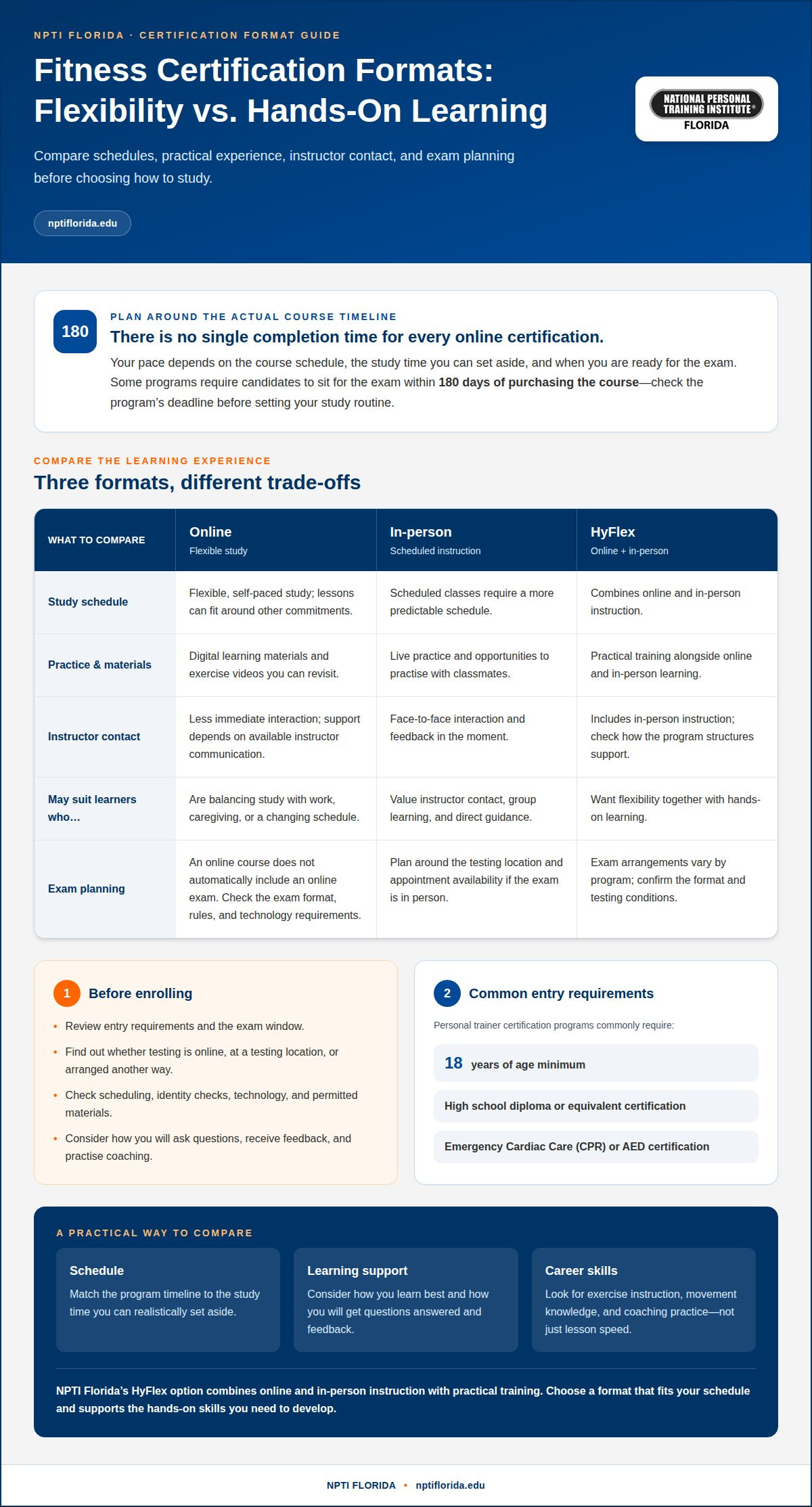
There isn’t one completion time for every online personal trainer certification. Your pace depends on the course schedule, the hours you can study, and when you’re ready for the exam. Some certification programs require candidates to sit for the exam within 180 days of purchasing the course, so review the deadline before planning your study routine.
Online study can suit you if work, caregiving, or a changing schedule makes regular classroom attendance difficult. Lessons and exercise videos let you revisit movement demonstrations while studying, then apply what you’ve learned to practical examples. In-person learning gives you scheduled instruction and face-to-face practice. For beginners, direct guidance can make it easier to ask about form; experienced athletes may be comfortable working more independently.
Online programs can offer schedule flexibility and repeated access to learning materials, but provide less immediate instructor interaction. In-person programs create opportunities to practise skills with classmates and receive feedback in the moment, though fixed class times call for a more predictable schedule. NPTI Florida’s HyFlex option combines online and in-person instruction with practical training, bringing flexibility together with hands-on learning.
Instructor support and networking depend on a program’s structure. Online learners use digital lessons and available instructor communication, while in-person students can engage with instructors and classmates during class. Face-to-face practice creates opportunities to build professional relationships as you learn. When comparing programs, consider how you will ask questions, receive feedback, and practise coaching.
| Option | Study schedule | Practice and feedback | Best fit |
|---|---|---|---|
| Online | Flexible, self-paced study | Exercise videos and digital learning materials | Students balancing study with other commitments |
| In-person | Scheduled classes | Live practice and face-to-face interaction | Students who value instructor contact and group learning |
Choose a format that fits your schedule and gives you the practical experience needed to develop personal training skills.
Before enrolling, review the program’s entry requirements and exam window. Personal trainer certification programs commonly set a minimum age requirement of 18 years, and candidates should have a high school diploma or equivalent certification. They should also have Emergency Cardiac Care (CPR) or Automated External Defibrillator (AED) certification. Requirements can shape your start date, so account for them alongside study time.
Online personal training and online trainer education are not the same. A personal training service may use exercise videos to guide clients, while a certification program teaches the knowledge and practical skills needed to coach others. If your goal is a career in personal training, consider how the course develops exercise instruction, movement knowledge, and coaching skills, not just how quickly you can complete lessons.
Online and at-home certification exam options
An online course does not automatically mean an online exam. Programs set their own exam formats, schedules, and testing conditions. Before enrolling, find out whether assessment takes place online, at a testing location, or through another arrangement. The format affects how you prepare and whether you need specific equipment or travel.
Online or at-home testing can suit candidates balancing study with work or family commitments, but remote exams still have rules. Review the program’s instructions for scheduling, identity checks, technology, and permitted materials. Knowing in advance whether you need a computer with a camera, for example, can prevent a last-minute problem.
In-person exams offer a set testing environment, which some candidates find easier to focus in. They also require planning around the testing location and appointment availability. If a program offers both online and in-person options, compare travel time, exam dates, required technology, and testing rules before registering. Those practical details matter as much as the exam setting.
Pass rates can describe exam outcomes, but a percentage alone does not show how difficult a test will feel. Check what the figure measures, such as first-attempt passes or results across multiple attempts. Consider the exam’s subject areas and how well the course prepares you for them. Even candidates confident in exercise science may need focused review of coaching scenarios or program design.
Build an exam plan around the format. Identify the tested topics in your course materials, then use practice questions to find gaps and revisit relevant lessons. For an online exam, practise with the type of device and workspace you will use on test day. For an in-person appointment, plan your route and arrival time in advance.
Certification and accreditation are different, so do not treat the terms as interchangeable. A certification exam assesses whether candidates meet the requirements for a credential. Accreditation refers to recognition of an educational program or organization. When comparing fitness education, consider the credential, course content, and relevance to your career goals. An exam’s location alone does not establish a program’s quality or value.
For a practical learning route that connects study with in-person instruction, explore fitness education options alongside the exam format and support you need.
Online course and digital study materials
Online course materials may include digital lessons, reading, and exercise demonstrations. For coursework, plan to use a computer or tablet, reliable internet access, and a way to take notes. Follow the program’s specific instructions for exams.
Flexible Study Scheduling
Flexible scheduling lets you access lessons at times that fit around work, caregiving, or training. Unlike a classroom schedule, online access can make it easier to pause and return to a lesson when your routine changes. For example, you might review anatomy after work and revisit an exercise demonstration before a coaching practice session.
Create a repeatable study rhythm, even when lessons are available on demand. Choose study blocks that fit your week and assign each one a task: read a lesson, review a movement example, or summarize a coaching concept. This turns open-ended access into active learning and helps you identify topics that need more review.
Self-Paced Study Timelines
Self-paced learning gives you room to spend more time on challenging topics and move faster through familiar material. It differs from a fixed classroom calendar, where lessons and practice follow scheduled sessions. Course duration still depends on the program structure: NPTI’s program, for example, takes 6 months full-time or 12 months part-time.
Study timelines depend on how coursework is scheduled. Full-time study concentrates coursework, while part-time study spreads learning around other commitments. Your pace depends on the time you can devote and your ability to maintain a steady routine, not simply the number of hours you hope to set aside.
Use digital materials actively. Watch an exercise video once to follow the movement sequence, then replay it to observe setup, control, and cues. Pair that review with notes on the exercise’s purpose and how you might explain it to a client. This links course content with practical coaching skills.
Before choosing a course, review how its materials are organized. A clear sequence from foundational concepts to applied topics can help you track progress, while searchable lessons make it easier to revisit specific subjects. Also consider practice activities and instructor interaction. Digital access supports independent study, but learning to coach people requires applying concepts, reflecting on technique, and developing communication skills.
Online learning resources and support
Online support involves more than a collection of lessons. A structured course can combine reading, movement demonstrations, practice activities, and instructor communication. These resources matter because personal training requires applying knowledge, not just remembering exercise terms. Compare how each program connects learning materials with coaching skills and practical experience.
Self-paced platforms organize coursework into lessons you can revisit. After studying exercise selection, for example, you might return to a movement demonstration and note the cues you would use with a client. Online resources may also include performance tracking, nutrition guidance, and coach communication. Consider how clearly these tools support the course’s learning goals.
Instructor support can help you work through difficult topics. First identify the question and review the relevant lesson, then raise a specific point with an instructor. For example, ask how a movement cue relates to safe exercise technique rather than requesting a general summary. Compare how programs provide instructor communication and feedback, since support varies.
Practical learning adds an essential dimension: a video can demonstrate a movement, but supervised practice lets you rehearse observation, instruction, and communication in a gym. NPTI Florida’s HyFlex Learning Program combines classroom theory with practical, hands-on training in a real gym setting. This connects online or classroom learning with applied experience, a key consideration when preparing for professional coaching.
Employers may consider how candidates apply their knowledge, not just the credential they earn. Practising with equipment, explaining an exercise, and adapting an instruction can connect course concepts to a trainer’s responsibilities. Look for a learning plan that includes both study and skill development. If a course relies heavily on online lessons, consider how it provides practical training.
Use these questions to assess a program’s support before enrolling:
- Are lessons organized in a clear sequence, from core concepts to practical application?
- Can you revisit movement demonstrations and learning materials as needed?
- How do you communicate with instructors when a topic needs clarification?
- Does the course include practical training, or focus mainly on digital study?
The answers can help you judge whether a program supports your learning style and the hands-on skills you want to develop.
Online certification options for different career goals
Start with the work you want to do, then choose education that develops the relevant skills. A coach focused on general fitness needs different preparation from someone interested in nutrition coaching or stretching. The online vs in-person fitness certification decision should reflect your intended role, the clients you hope to serve, and how you learn best.
For general personal training, look for education in exercise instruction, program planning, and client communication. Imagine a client learning a new movement: you need to explain the exercise, observe their form, and adjust your guidance. Digital coursework can teach concepts, but consider how the program helps you apply them in practical training.
If nutrition interests you, look for coursework that explains how nutrition relates to fitness goals. A client seeking weight management, for example, may need help building practical habits alongside an exercise plan. Nutrition education can complement a fitness career, but the course should clarify what coaching covers and where its scope ends.
Some professionals want to specialize in stretching or mobility support. This requires learning to guide clients through appropriate movements and communicate instructions clearly. Online lessons can provide theory and demonstrations, while practical instruction lets you rehearse explaining and observing movement. Compare the learning activities with the tasks you expect to perform.
Use this decision process before enrolling:
- Define the role. Decide whether you want to coach general fitness, nutrition habits, stretching, or a combination.
- Match skills to study. Look for course content that develops the knowledge and client-facing skills your chosen role requires.
- Assess the format. Consider whether digital lessons suit your needs or guided practical learning would better support your goals.
- Consider progression. Choose a foundation that can support further learning as your career develops.
Fitness and nutrition coaching can complement each other. A trainer might help a client build an exercise routine while discussing practical habits that support consistency. This combination calls for relevant education, clear boundaries, and guidance explained in everyday language. Your online vs in-person fitness certification choice should support the kind of coaching you want to provide.
Your decision should reflect both your career direction and learning preferences. If your goal involves hands-on coaching, prioritize opportunities to practice communication and movement instruction. If flexibility matters most, consider how digital learning fits your routine while supporting practical skill development. Explore fitness career training options as you map your next step.
NPTI Florida: Stretch Coach Certification
NPTI Florida offers a Stretch Coach Certification for fitness professionals who want to focus on guided stretching. If your career goal centers on this specialty, it offers a more targeted direction than beginning with broad personal training education. For a wider foundation, the Personal Fitness Training Program and Personal Training Specialist Program focus on personal training, while the Advanced Personal Training Program supports further study in that field.
Choose a program based on the skills you want to develop and the work you plan to pursue. Stretch coaching serves a different professional interest from general personal training. Explore NPTI Florida’s programs and contact the school to discuss which one aligns with your goals.
Choose the learning path that moves your career forward
Your next step is to match your preferred learning environment with the fitness career you want to pursue. The online vs in-person fitness certification decision is most useful when it helps you build relevant skills, stay engaged with your studies, and prepare for your intended work. Keep your career direction in view as you compare training formats and practical experience.
NPTI Florida offers the Personal Fitness Training Program, Advanced Personal Training Program, and Personal Training Specialist Program. Each provides a different direction for developing personal training knowledge and skills. Consider which best fits your professional goals and the learning experience you want as you take your next step.
Contact NPTI Florida to discuss your training direction and explore a program aligned with your goals. You’re building more than a credential: you’re taking a purposeful step toward helping others move, train, and feel stronger. Keep that purpose at the center, and move forward with confidence.
Frequently Asked Questions
Bottom Line: Which Online CPT Certification Should You Choose?
Choose a personal trainer certification that prepares you for your intended work and fits how you learn. If you plan to coach clients in person, prioritize education that develops practical instruction skills, not only digital lessons. Compare the credential, course topics, exam arrangements, and available support. A strong match with your career goals matters more than choosing the format that seems easiest.
How Can Success Stories and Case Studies Inform Your Decision?
Success stories and case studies can illustrate how a program connects coursework with real coaching situations. Look for examples that describe the client’s starting point, the trainer’s approach, and the skills used, rather than focusing only on the outcome. A case involving exercise modifications, for instance, may help you assess whether the curriculum teaches practical decision-making. Treat testimonials as illustrations, not promises about your own results.
How Does In-Person Personal Training Provide Unique Advantages?
In-person education lets you practise coaching with an instructor or classmate present. You can rehearse explaining a squat, observe how someone responds to your cues, and adjust your communication in real time. Direct practice can help you develop confidence in live interactions and learn from classmates’ questions and approaches. A digital lesson alone cannot fully recreate that experience.
How does the online program work?
An online certification program typically organizes learning through a digital platform, where students work through course materials and complete required assessments. Set a weekly study routine, track completed topics, and note questions as they arise. The sequence, instructor contact, and exam process depend on the program. Review these details before enrolling so you understand how coursework leads to assessment.
How does online fitness certification compare with in-person certification?
Online certification centers learning around digital access, while in-person certification includes scheduled, face-to-face instruction. The key difference is how you practise and receive feedback. Independent learners may value online access; those who want to rehearse coaching conversations with others may prefer classroom interaction. Compare the curriculum and practical components as well: the delivery format describes how you learn, while course content determines what you study.
How much do online and in-person fitness certification programs cost in the United States?
Costs vary by program and what the tuition includes, so compare the full package rather than the headline amount alone. Consider course materials, exam arrangements, instructor support, and practical instruction as separate factors. For an individual program, the price depends on its scope and included components, and is provided after a quote request. Avoid comparing two programs as equivalent until you understand what each covers and how its instruction is delivered.
How long does it take to complete online or in-person fitness certification?
Completion time depends on the program schedule and how much time you can devote to study and practice. NPTI’s program takes 6 months full-time or 12 months part-time. For other programs, a fixed classroom calendar may shape your pace, while an online schedule can depend more on your study routine and exam deadline. Build your plan around both coursework and preparation, not just the first available exam date.
Which fitness certifications are accredited or recognized by employers?
NPTI Florida is accredited by the Accrediting Commission of Career Schools and Colleges (ACCSC). Accreditation and employer recognition are related but distinct: accreditation concerns the school, while employers make hiring decisions based on their needs and a candidate’s preparation. Review the credential and the curriculum’s relevance to your intended role. NPTI Florida’s accreditation is one concrete factor to consider when evaluating its education programs.

In-person study isn’t automatically the faster route. The timeline for online vs in-person fitness certification depends on the program’s schedule and how you study; some personal trainer certification programs require you to sit for the exam within 180 days of purchasing the course.
When comparing online vs in-person fitness certification, convenience is only one factor. Online study can offer flexibility, while in-person learning adds scheduled instruction and supervised practice. The right fit depends on how you learn, the support you need, and the skills required for your career goals. Compare study formats, practical training, instructor support, and career relevance before choosing. A clear study plan and suitable learning environment can help you prepare with confidence.
Key Takeaways
- Compare program timelines and study schedules with the time you can realistically set aside before choosing a format.
- Understand how exam arrangements can differ, and what to look for in the certification program’s exam requirements.
- Assess whether digital materials and available learning support match the way you learn best.
- Match your certification path to the fitness career skills you want to develop, including specialized coaching.
- Explore how NPTI Florida’s Stretch Coach Certification and personal training programs can support your professional direction.
How Long Does It Take to Earn a Personal Trainer Certification Online?
There isn’t one completion time for every online personal trainer certification. Your pace depends on the course schedule, the hours you can study, and when you’re ready for the exam. Some certification programs require candidates to sit for the exam within 180 days of purchasing the course, so review the deadline before planning your study routine.
Online study can suit you if work, caregiving, or a changing schedule makes regular classroom attendance difficult. Lessons and exercise videos let you revisit movement demonstrations while studying, then apply what you’ve learned to practical examples. In-person learning gives you scheduled instruction and face-to-face practice. For beginners, direct guidance can make it easier to ask about form; experienced athletes may be comfortable working more independently.
Online programs can offer schedule flexibility and repeated access to learning materials, but provide less immediate instructor interaction. In-person programs create opportunities to practise skills with classmates and receive feedback in the moment, though fixed class times call for a more predictable schedule. NPTI Florida’s HyFlex option combines online and in-person instruction with practical training, bringing flexibility together with hands-on learning.
Instructor support and networking depend on a program’s structure. Online learners use digital lessons and available instructor communication, while in-person students can engage with instructors and classmates during class. Face-to-face practice creates opportunities to build professional relationships as you learn. When comparing programs, consider how you will ask questions, receive feedback, and practise coaching.
| Option | Study schedule | Practice and feedback | Best fit |
|---|---|---|---|
| Online | Flexible, self-paced study | Exercise videos and digital learning materials | Students balancing study with other commitments |
| In-person | Scheduled classes | Live practice and face-to-face interaction | Students who value instructor contact and group learning |
Choose a format that fits your schedule and gives you the practical experience needed to develop personal training skills.
Before enrolling, review the program’s entry requirements and exam window. Personal trainer certification programs commonly set a minimum age requirement of 18 years, and candidates should have a high school diploma or equivalent certification. They should also have Emergency Cardiac Care (CPR) or Automated External Defibrillator (AED) certification. Requirements can shape your start date, so account for them alongside study time.
Online personal training and online trainer education are not the same. A personal training service may use exercise videos to guide clients, while a certification program teaches the knowledge and practical skills needed to coach others. If your goal is a career in personal training, consider how the course develops exercise instruction, movement knowledge, and coaching skills, not just how quickly you can complete lessons.
Online and at-home certification exam options
An online course does not automatically mean an online exam. Programs set their own exam formats, schedules, and testing conditions. Before enrolling, find out whether assessment takes place online, at a testing location, or through another arrangement. The format affects how you prepare and whether you need specific equipment or travel.
Online or at-home testing can suit candidates balancing study with work or family commitments, but remote exams still have rules. Review the program’s instructions for scheduling, identity checks, technology, and permitted materials. Knowing in advance whether you need a computer with a camera, for example, can prevent a last-minute problem.
In-person exams offer a set testing environment, which some candidates find easier to focus in. They also require planning around the testing location and appointment availability. If a program offers both online and in-person options, compare travel time, exam dates, required technology, and testing rules before registering. Those practical details matter as much as the exam setting.
Pass rates can describe exam outcomes, but a percentage alone does not show how difficult a test will feel. Check what the figure measures, such as first-attempt passes or results across multiple attempts. Consider the exam’s subject areas and how well the course prepares you for them. Even candidates confident in exercise science may need focused review of coaching scenarios or program design.
Build an exam plan around the format. Identify the tested topics in your course materials, then use practice questions to find gaps and revisit relevant lessons. For an online exam, practise with the type of device and workspace you will use on test day. For an in-person appointment, plan your route and arrival time in advance.
Certification and accreditation are different, so do not treat the terms as interchangeable. A certification exam assesses whether candidates meet the requirements for a credential. Accreditation refers to recognition of an educational program or organization. When comparing fitness education, consider the credential, course content, and relevance to your career goals. An exam’s location alone does not establish a program’s quality or value.
For a practical learning route that connects study with in-person instruction, explore fitness education options alongside the exam format and support you need.
Online course and digital study materials
Online course materials may include digital lessons, reading, and exercise demonstrations. For coursework, plan to use a computer or tablet, reliable internet access, and a way to take notes. Follow the program’s specific instructions for exams.
Flexible Study Scheduling
Flexible scheduling lets you access lessons at times that fit around work, caregiving, or training. Unlike a classroom schedule, online access can make it easier to pause and return to a lesson when your routine changes. For example, you might review anatomy after work and revisit an exercise demonstration before a coaching practice session.
Create a repeatable study rhythm, even when lessons are available on demand. Choose study blocks that fit your week and assign each one a task: read a lesson, review a movement example, or summarize a coaching concept. This turns open-ended access into active learning and helps you identify topics that need more review.
Self-Paced Study Timelines
Self-paced learning gives you room to spend more time on challenging topics and move faster through familiar material. It differs from a fixed classroom calendar, where lessons and practice follow scheduled sessions. Course duration still depends on the program structure: NPTI’s program, for example, takes 6 months full-time or 12 months part-time.
Study timelines depend on how coursework is scheduled. Full-time study concentrates coursework, while part-time study spreads learning around other commitments. Your pace depends on the time you can devote and your ability to maintain a steady routine, not simply the number of hours you hope to set aside.
Use digital materials actively. Watch an exercise video once to follow the movement sequence, then replay it to observe setup, control, and cues. Pair that review with notes on the exercise’s purpose and how you might explain it to a client. This links course content with practical coaching skills.
Before choosing a course, review how its materials are organized. A clear sequence from foundational concepts to applied topics can help you track progress, while searchable lessons make it easier to revisit specific subjects. Also consider practice activities and instructor interaction. Digital access supports independent study, but learning to coach people requires applying concepts, reflecting on technique, and developing communication skills.
Online learning resources and support
Online support involves more than a collection of lessons. A structured course can combine reading, movement demonstrations, practice activities, and instructor communication. These resources matter because personal training requires applying knowledge, not just remembering exercise terms. Compare how each program connects learning materials with coaching skills and practical experience.
Self-paced platforms organize coursework into lessons you can revisit. After studying exercise selection, for example, you might return to a movement demonstration and note the cues you would use with a client. Online resources may also include performance tracking, nutrition guidance, and coach communication. Consider how clearly these tools support the course’s learning goals.
Instructor support can help you work through difficult topics. First identify the question and review the relevant lesson, then raise a specific point with an instructor. For example, ask how a movement cue relates to safe exercise technique rather than requesting a general summary. Compare how programs provide instructor communication and feedback, since support varies.
Practical learning adds an essential dimension: a video can demonstrate a movement, but supervised practice lets you rehearse observation, instruction, and communication in a gym. NPTI Florida’s HyFlex Learning Program combines classroom theory with practical, hands-on training in a real gym setting. This connects online or classroom learning with applied experience, a key consideration when preparing for professional coaching.
Employers may consider how candidates apply their knowledge, not just the credential they earn. Practising with equipment, explaining an exercise, and adapting an instruction can connect course concepts to a trainer’s responsibilities. Look for a learning plan that includes both study and skill development. If a course relies heavily on online lessons, consider how it provides practical training.
Use these questions to assess a program’s support before enrolling:
- Are lessons organized in a clear sequence, from core concepts to practical application?
- Can you revisit movement demonstrations and learning materials as needed?
- How do you communicate with instructors when a topic needs clarification?
- Does the course include practical training, or focus mainly on digital study?
The answers can help you judge whether a program supports your learning style and the hands-on skills you want to develop.
Online certification options for different career goals
Start with the work you want to do, then choose education that develops the relevant skills. A coach focused on general fitness needs different preparation from someone interested in nutrition coaching or stretching. The online vs in-person fitness certification decision should reflect your intended role, the clients you hope to serve, and how you learn best.
For general personal training, look for education in exercise instruction, program planning, and client communication. Imagine a client learning a new movement: you need to explain the exercise, observe their form, and adjust your guidance. Digital coursework can teach concepts, but consider how the program helps you apply them in practical training.
If nutrition interests you, look for coursework that explains how nutrition relates to fitness goals. A client seeking weight management, for example, may need help building practical habits alongside an exercise plan. Nutrition education can complement a fitness career, but the course should clarify what coaching covers and where its scope ends.
Some professionals want to specialize in stretching or mobility support. This requires learning to guide clients through appropriate movements and communicate instructions clearly. Online lessons can provide theory and demonstrations, while practical instruction lets you rehearse explaining and observing movement. Compare the learning activities with the tasks you expect to perform.
Use this decision process before enrolling:
- Define the role. Decide whether you want to coach general fitness, nutrition habits, stretching, or a combination.
- Match skills to study. Look for course content that develops the knowledge and client-facing skills your chosen role requires.
- Assess the format. Consider whether digital lessons suit your needs or guided practical learning would better support your goals.
- Consider progression. Choose a foundation that can support further learning as your career develops.
Fitness and nutrition coaching can complement each other. A trainer might help a client build an exercise routine while discussing practical habits that support consistency. This combination calls for relevant education, clear boundaries, and guidance explained in everyday language. Your online vs in-person fitness certification choice should support the kind of coaching you want to provide.
Your decision should reflect both your career direction and learning preferences. If your goal involves hands-on coaching, prioritize opportunities to practice communication and movement instruction. If flexibility matters most, consider how digital learning fits your routine while supporting practical skill development. Explore fitness career training options as you map your next step.
NPTI Florida: Stretch Coach Certification
NPTI Florida offers a Stretch Coach Certification for fitness professionals who want to focus on guided stretching. If your career goal centers on this specialty, it offers a more targeted direction than beginning with broad personal training education. For a wider foundation, the Personal Fitness Training Program and Personal Training Specialist Program focus on personal training, while the Advanced Personal Training Program supports further study in that field.
Choose a program based on the skills you want to develop and the work you plan to pursue. Stretch coaching serves a different professional interest from general personal training. Explore NPTI Florida’s programs and contact the school to discuss which one aligns with your goals.
Choose the learning path that moves your career forward
Your next step is to match your preferred learning environment with the fitness career you want to pursue. The online vs in-person fitness certification decision is most useful when it helps you build relevant skills, stay engaged with your studies, and prepare for your intended work. Keep your career direction in view as you compare training formats and practical experience.
NPTI Florida offers the Personal Fitness Training Program, Advanced Personal Training Program, and Personal Training Specialist Program. Each provides a different direction for developing personal training knowledge and skills. Consider which best fits your professional goals and the learning experience you want as you take your next step.
Contact NPTI Florida to discuss your training direction and explore a program aligned with your goals. You’re building more than a credential: you’re taking a purposeful step toward helping others move, train, and feel stronger. Keep that purpose at the center, and move forward with confidence.
Frequently Asked Questions
Bottom Line: Which Online CPT Certification Should You Choose?
Choose a personal trainer certification that prepares you for your intended work and fits how you learn. If you plan to coach clients in person, prioritize education that develops practical instruction skills, not only digital lessons. Compare the credential, course topics, exam arrangements, and available support. A strong match with your career goals matters more than choosing the format that seems easiest.
How Can Success Stories and Case Studies Inform Your Decision?
Success stories and case studies can illustrate how a program connects coursework with real coaching situations. Look for examples that describe the client’s starting point, the trainer’s approach, and the skills used, rather than focusing only on the outcome. A case involving exercise modifications, for instance, may help you assess whether the curriculum teaches practical decision-making. Treat testimonials as illustrations, not promises about your own results.
How Does In-Person Personal Training Provide Unique Advantages?
In-person education lets you practise coaching with an instructor or classmate present. You can rehearse explaining a squat, observe how someone responds to your cues, and adjust your communication in real time. Direct practice can help you develop confidence in live interactions and learn from classmates’ questions and approaches. A digital lesson alone cannot fully recreate that experience.
How does the online program work?
An online certification program typically organizes learning through a digital platform, where students work through course materials and complete required assessments. Set a weekly study routine, track completed topics, and note questions as they arise. The sequence, instructor contact, and exam process depend on the program. Review these details before enrolling so you understand how coursework leads to assessment.
How does online fitness certification compare with in-person certification?
Online certification centers learning around digital access, while in-person certification includes scheduled, face-to-face instruction. The key difference is how you practise and receive feedback. Independent learners may value online access; those who want to rehearse coaching conversations with others may prefer classroom interaction. Compare the curriculum and practical components as well: the delivery format describes how you learn, while course content determines what you study.
How much do online and in-person fitness certification programs cost in the United States?
Costs vary by program and what the tuition includes, so compare the full package rather than the headline amount alone. Consider course materials, exam arrangements, instructor support, and practical instruction as separate factors. For an individual program, the price depends on its scope and included components, and is provided after a quote request. Avoid comparing two programs as equivalent until you understand what each covers and how its instruction is delivered.
How long does it take to complete online or in-person fitness certification?
Completion time depends on the program schedule and how much time you can devote to study and practice. NPTI’s program takes 6 months full-time or 12 months part-time. For other programs, a fixed classroom calendar may shape your pace, while an online schedule can depend more on your study routine and exam deadline. Build your plan around both coursework and preparation, not just the first available exam date.
Which fitness certifications are accredited or recognized by employers?
NPTI Florida is accredited by the Accrediting Commission of Career Schools and Colleges (ACCSC). Accreditation and employer recognition are related but distinct: accreditation concerns the school, while employers make hiring decisions based on their needs and a candidate’s preparation. Review the credential and the curriculum’s relevance to your intended role. NPTI Florida’s accreditation is one concrete factor to consider when evaluating its education programs.