How to Create a Personal Training Contract and Estimate Lawyer Costs
A clear contract can prevent costly misunderstandings, but having a lawyer draft or review one adds to start-up costs. The total depends on how much work is needed to tailor the agreement to your services and business.
Before you begin, you need to know both what the agreement should cover and what legal review may involve. This guide explains how to estimate legal costs and how creating a personal training contract can set out payment schedules, cancellations, informed consent, and the scope of your services. It also highlights terms that deserve careful attention, so you can approach drafting with greater clarity.
Key Takeaways
- Estimate legal drafting costs by defining the agreement’s scope and asking for an estimate based on the work involved.
- Set a clear cancellation notice period and explain how late arrivals affect the scheduled session.
- Spell out package pricing, payment timing, and what happens to unused sessions.
- Define the services, session schedule, and training location, and document client consent and exercise risks.
- Tailor the agreement to your business and applicable local requirements, then revisit it when your services or terms change.
Appointment cancellations and late arrivals
Set out each scheduling rule before clients book sessions. State the deadlines, accepted notice methods, and consequences so both parties know what happens when plans change.
-
Set Scheduling and Cancellation Policies
Choose how clients book, reschedule, or cancel each appointment, then document those methods. A sample policy may require 24 or 48 hours’ notice before a session; state one specific deadline in your agreement. Include the approved cancellation methods, such as email or a booking system, and explain when a notice counts as received.
Make the policy workable for recurring appointments, too. Explain whether clients must cancel each session separately or can request a schedule change for several sessions at once. Avoid vague phrases such as “reasonable notice,” which do not clarify whether a late cancellation will be charged.
-
Specify No-Show Terms
Define a no-show and state its consequence. For example, an agreement may require payment as if the session took place when the client cancels after the notice deadline. Use wording such as “agrees to pay” only when the charge and the circumstances that trigger it are clearly explained.
Distinguish a no-show from a timely cancellation. Explain whether a client who gives the required notice can reschedule, and whether a missed appointment without notice is forfeited. Keep this rule consistent with the package terms so the cancellation and payment sections do not conflict.
-
Address Late Arrivals
State how late arrival affects the scheduled session, then choose one policy and use it consistently. One sample agreement says clients arriving more than 15 minutes late forfeit the lost time and are charged for the session as if present. Another approach gives late clients only the remaining scheduled time, unless they arranged otherwise with the trainer beforehand.
If you address late arrivals, explain how they differ from cancellations and no-shows. Specify whether the session still ends at its scheduled time or becomes a no-show after a stated threshold. Clear terms prevent assumptions that the trainer will extend the appointment or provide a replacement session.
-
Clarify Cancellation and Refund Terms
Explain whether a cancelled appointment results in a refund, a credit, or no replacement session. If your policy excludes refunds for relocation, illness, or unused sessions, put that rule beside the cancellation terms and explain how it applies to prepaid packages.
Keep refunds and rescheduling distinct. State whether timely notice allows a client to rearrange a session without receiving money back. Check that the cancellation policy, package terms, and refund clause agree, so clients can understand the outcome in one review.
What does the average Personal Training Agreement template cover?
Draft the agreement by identifying both parties, defining services, setting terms, and collecting signatures. A free template may not fit your training model or local requirements, so customize its clauses rather than assuming it covers every situation.
- Identify the parties and agreement date. Include the trainer’s and client’s full names, addresses, and contact details. Add the effective date so both parties know when the agreement begins. Include the client’s preferred contact information and the trainer’s business details rather than leaving identification fields blank.
- Describe the services and responsibilities. Specify what the trainer will provide, what the client agrees to do, and how sessions relate to the client’s goals. A sample agreement might describe an exercise program suited to the client’s age, body type, and goals. Avoid broad promises such as “fitness support” without explaining what they include.
- Set the agreement’s duration and ending terms. Explain whether the relationship continues month to month or runs for a fixed period. One sample agreement allows either party to end the arrangement with thirty (30) days’ advance written notice. State how notice must be delivered and when it takes effect, rather than relying on an informal conversation.
- Prepare signature fields for every required signer. Give the client and trainer clear spaces to sign and date the document. If a client is under 18 years of age, a parent or legal guardian must also sign the agreement. Include that person’s printed name and relationship to the client, so the signature’s role is clear in the completed record.
- Keep a master template, then tailor each copy. A reusable template reduces repeated drafting, but check each copy for accurate names, services, dates, and terms before signing. Do not carry a previous client’s details or assumptions into a new agreement. Give each party a signed copy as a shared record of the terms.
A written agreement gives both parties one place to review responsibilities, services, and signatures. It may combine the business terms and liability waiver, but the waiver and service clauses should remain easy to distinguish. For a stronger foundation in the professional role behind these agreements, explore the Personal Training Specialist Program.
Training packages and payment schedules
In the United States, the agreement should state the package price and payment schedule the trainer and client accept. There’s no single price in the examples; the amount depends on the package’s sessions, duration, and services.
-
Set Fees and Payment Amounts
Write the total package fee and price per workout in the signed agreement. If you charge by the hour, state the rate instead of leaving a blank to complete later. For a package, describe the included sessions and their length, then state the agreed fee.
Separate training charges from other responsibilities or optional services. This clarifies what the client pays for and what the fee covers. Do not rely on a verbal quote or a general statement that payment is due, because neither specifies the amount or the related services.
-
Specify Payment Methods and Instructions
List the payment methods you accept and explain how the client submits payment. Identify the recipient, due date, and any instructions needed to complete the transaction. If payment is due before sessions begin, state that directly rather than burying it in the package description.
Keep payment instructions consistent across the agreement, invoice, and payment records. For installment plans, show how each payment applies to the package balance. Do not imply that payment covers additional fitness services or liability protection unless the written terms say so.
-
Outline Payment Schedules and Terms
Choose a schedule that matches the package, then explain each due date. One sample agreement requires half of the package fee before the first session; the remaining half is due by the final session or within 45 days, whichever comes first. State both conditions so the client can tell which deadline applies.
Payment schedules may be recurring, such as monthly payments due on the first day of each calendar month, or weekly payments starting on a specified date. Clarify which schedule applies rather than combining models without explanation. Make dates and installment amounts easy to find, so the client can understand the commitment before signing.
- Connect payments to the service period. Explain when the package starts, how scheduled sessions draw on the purchased balance, and what happens if the client changes packages. Distinguish a recurring monthly arrangement from a prepaid package with a defined number of sessions. Clear terms help both parties track remaining sessions and payment responsibilities without confusing a fee with a refund or liability waiver.
Customizing agreements for services and local laws
Adapt the agreement to the services you provide and where you operate. A training contract template is a starting point, not a substitute for terms tailored to your practice. Creating a personal training contract means describing the arrangement clients will actually receive.
-
Define the Services Covered
List each included service and identify what falls outside the agreement. For example, distinguish supervised sessions from workouts clients complete independently. Describe the program’s focus and its connection to the client’s goals instead of promising broad fitness support without defining it.
Use plain language to define the trainer’s role and the client’s responsibilities. If nutrition guidance is included, describe its scope separately from exercise instruction. Precise boundaries help both parties understand what the package covers and prevent one service from being mistaken for another.
Review service descriptions whenever your offering changes. An agreement that describes an outdated training format can confuse clients about what they purchased. Tailor each copy to the actual program rather than using a generic template without edits. This review helps ensure the contract reflects your work.
-
Specify Training Session Details
Write down each session’s length, frequency, and location. Personal training sessions commonly last 30 to 90 minutes, so state the duration that applies to your arrangement. Explain whether sessions take place in person, remotely, or across both formats, and identify the agreed training location.
Make the schedule workable for the client and trainer. A sample agreement recommends training three times per week while allowing for supervised and independent workouts when scheduling or financial considerations affect attendance. Treat this as an example, not a default requirement for every client.
Clarify what happens if the agreed format changes. For example, state whether a location change requires mutual agreement or whether independent workouts are part of the program. Specific session details help prevent different expectations about how training will be delivered.
-
Customize the Agreement for Local Laws
Adapt the contract to your region, client base, training environment, and business structure. Explain how disputes will be handled and which jurisdiction’s laws apply. Make these clauses specific to the arrangement rather than leaving blank fields copied from a generic template.
Consult an attorney when local requirements or contract wording need legal review. An attorney can assess the terms in relation to your services and operating region. Do not assume a general template guarantees that every clause suits your situation.
Review the agreement annually at a minimum, and update it when services, pricing, business structure, or local legal requirements change. A dated review can help you identify outdated terms before using the document with new clients.
Disclosure of physical conditions and informed consent
Use the agreement to explain exercise risks, define the trainer’s role, and document the client’s informed consent. Make these terms clear before either party signs.
-
Clarify the Trainer Is Not a Physician
State plainly that the trainer is not a licensed physician and does not provide medical advice. Place this disclosure near the description of training services so clients understand the trainer’s professional role before exercise begins.
Ask clients to disclose physical conditions relevant to participation. Explain that this information helps the trainer understand the client’s stated needs, but does not make the trainer a medical provider. Do not suggest that the trainer diagnoses conditions or makes decisions reserved for a physician.
-
Add Exercise-Result Disclaimers
Explain that the trainer does not guarantee results from exercise, diet, or other recommendations. State this directly rather than implying that following a program will produce a particular outcome.
Clarify what the trainer provides, such as exercise instruction or recommendations, and distinguish those services from any promised result. The agreement can describe the client’s responsibilities without guaranteeing progress. Ensure the disclaimer matches the rest of the contract and does not contradict specific service terms.
-
Include a Medical-Advice Disclosure
Set limits on the trainer’s guidance and state that clients should seek medical advice from a physician. A sample agreement recommends a physical examination and physician consultation yearly or more frequently before beginning exercise.
Explain that exercise recommendations from a trainer are not a substitute for medical evaluation. Provide space for the client to acknowledge the disclosure, then obtain a signature and record the agreement’s effective date. Do not suggest that signing replaces physician consultation or establishes medical clearance.
- Describe exercise risks before obtaining consent. Identify increased heart stress and musculoskeletal injuries as possible exercise risks. Use plain language and give clients time to read the disclosure before signing. A waiver may accompany the agreement, but explain its purpose accurately and do not claim it removes every possible legal responsibility.
A sample liability waiver releases the trainer from liability for injuries, except in cases of gross negligence. Because the wording affects the parties’ rights, do not present sample language as a guarantee of legal effect.
- Record informed consent as part of the signed document. Add a client acknowledgement that they received and understood the exercise-risk information, along with a dated signature. Keep the acknowledgement separate from the trainer’s disclosure, so the client’s consent is easy to identify. For education in exercise instruction and professional practice, explore the Personal Training Specialist Program.
NPTI Florida
NPTI Florida prepares aspiring fitness professionals with practical knowledge for careers in personal training. If you plan to serve clients, a strong educational foundation can help you define your professional role and the services described in your agreement.
NPTI Florida’s Personal Fitness Training Program, Advanced Personal Training Program, and Personal Training Specialist Program support professional development. Health and Nutrition Coaching offers a related focus on client wellness. These programs complement the business decisions discussed here, but do not replace legal advice about contract wording.
To build your preparation for a career in personal training, contact NPTI Florida to discuss the programs and your next step.
Build your next step on professional preparation
A thoughtful approach to creating a personal training contract reflects the care you bring to your work with clients. As your services develop, keep building the knowledge to define your role, communicate clearly, and support clients with confidence. Strong professional foundations can shape your work long after an agreement is signed.
NPTI Florida offers the Personal Fitness Training Program, Advanced Personal Training Program, and Personal Training Specialist Program for people developing a career in fitness. Explore the direction that fits your goals and build practical knowledge to support your work with future clients.
If you’re ready to take a meaningful step toward a career in personal training, connect with NPTI Florida and explore the program that aligns with your plans. Your commitment to clear, responsible practice can begin with the education you choose today.
Frequently Asked Questions
What does it usually cost for a lawyer to draft a Personal Training Agreement?
The total cost depends on the time needed to prepare or review your agreement. A straightforward review may take different work from drafting customized terms for several services, package options, and client situations.
Why should a personal trainer always write a contract for personal training?
A written agreement gives the trainer and client a shared record of their understanding. If a client later remembers a package differently, for example, the signed document can clarify the selected services and terms. It also gives both parties a consistent reference when discussing changes. A contract supports clear communication when it accurately reflects the arrangement.
What should a personal training contract include?
Include the parties’ identifying details, the effective date, services, responsibilities, and how either party can end the arrangement. Add terms that fit the client relationship, such as payment timing, session scheduling, and consent acknowledgements. A recurring agreement may need different duration terms from a package with a defined number of sessions. Keep related terms consistent throughout.
How should a personal training contract handle cancellations, no-shows, and refunds?
State the cancellation deadline, accepted notice methods, and consequence of missing the deadline. Specify whether a late cancellation or no-show uses a session from the client’s package. Then distinguish rescheduling from refunds, since a replacement appointment does not necessarily return payment. Explain how the rule applies to prepaid sessions, and make clear how clients can confirm that notice was received.
What liability waivers and informed consent forms should personal trainers use?
Use clear written disclosures about exercise risks and the trainer’s role, then obtain the client’s acknowledgement. A sample waiver identifies increased heart stress and musculoskeletal injuries as exercise risks; another releases the trainer from liability except in cases of gross negligence. These examples are not universal wording or a guarantee of legal effect. Explain the terms plainly and have a lawyer review waiver language.
What state laws apply to personal training contracts and liability waivers?
Applicable rules depend on the state and the agreement’s circumstances, so identify the intended governing jurisdiction and dispute process. Trainers serving clients across state lines should give these clauses particular attention. Do not assume a template written for one state fits another. A lawyer familiar with the relevant jurisdiction can review the contract and waiver language for that context.
Should personal trainers use a lawyer to review their contract?
Legal review is especially useful when an agreement includes a liability waiver, covers clients in different states, or combines several services and package arrangements. A lawyer can assess whether the wording reflects your actual practices and identify unclear or conflicting clauses. Consider a review after changing your business structure or adding a training format rather than relying indefinitely on an older template.
How should contracts cover training packages, session expiration, and scheduling?
Describe the package’s session count, schedule, and deadline for using sessions, then explain what happens to unused sessions. One sample agreement requires clients to complete sessions within 120 days from the contract date, after which they are void. Treat that as an example term, not a universal rule. Align expiration wording with rescheduling provisions so a rearranged appointment doesn’t create conflicting deadlines.

A clear contract can prevent costly misunderstandings, but having a lawyer draft or review one adds to start-up costs. The total depends on how much work is needed to tailor the agreement to your services and business.
Before you begin, you need to know both what the agreement should cover and what legal review may involve. This guide explains how to estimate legal costs and how creating a personal training contract can set out payment schedules, cancellations, informed consent, and the scope of your services. It also highlights terms that deserve careful attention, so you can approach drafting with greater clarity.
Key Takeaways
- Estimate legal drafting costs by defining the agreement’s scope and asking for an estimate based on the work involved.
- Set a clear cancellation notice period and explain how late arrivals affect the scheduled session.
- Spell out package pricing, payment timing, and what happens to unused sessions.
- Define the services, session schedule, and training location, and document client consent and exercise risks.
- Tailor the agreement to your business and applicable local requirements, then revisit it when your services or terms change.
Appointment cancellations and late arrivals
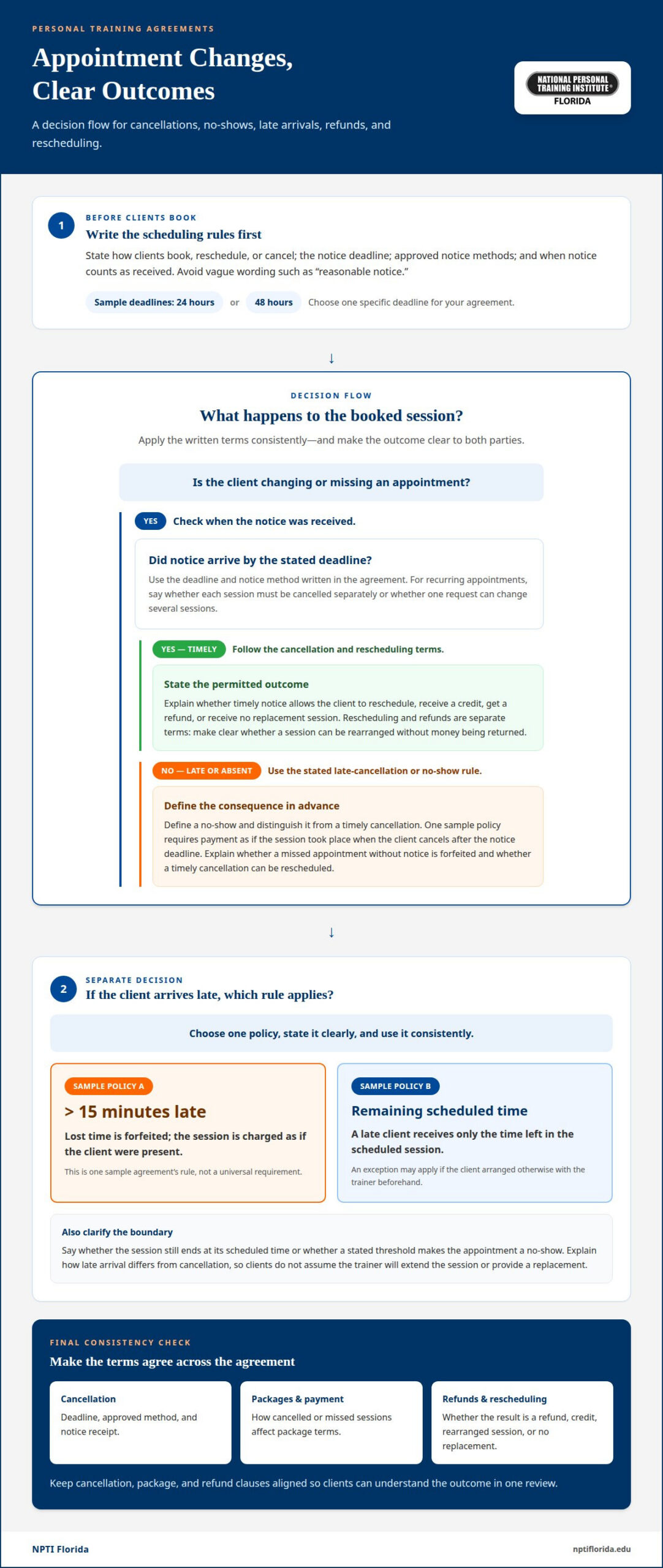
Set out each scheduling rule before clients book sessions. State the deadlines, accepted notice methods, and consequences so both parties know what happens when plans change.
-
Set Scheduling and Cancellation Policies
Choose how clients book, reschedule, or cancel each appointment, then document those methods. A sample policy may require 24 or 48 hours’ notice before a session; state one specific deadline in your agreement. Include the approved cancellation methods, such as email or a booking system, and explain when a notice counts as received.
Make the policy workable for recurring appointments, too. Explain whether clients must cancel each session separately or can request a schedule change for several sessions at once. Avoid vague phrases such as “reasonable notice,” which do not clarify whether a late cancellation will be charged.
-
Specify No-Show Terms
Define a no-show and state its consequence. For example, an agreement may require payment as if the session took place when the client cancels after the notice deadline. Use wording such as “agrees to pay” only when the charge and the circumstances that trigger it are clearly explained.
Distinguish a no-show from a timely cancellation. Explain whether a client who gives the required notice can reschedule, and whether a missed appointment without notice is forfeited. Keep this rule consistent with the package terms so the cancellation and payment sections do not conflict.
-
Address Late Arrivals
State how late arrival affects the scheduled session, then choose one policy and use it consistently. One sample agreement says clients arriving more than 15 minutes late forfeit the lost time and are charged for the session as if present. Another approach gives late clients only the remaining scheduled time, unless they arranged otherwise with the trainer beforehand.
If you address late arrivals, explain how they differ from cancellations and no-shows. Specify whether the session still ends at its scheduled time or becomes a no-show after a stated threshold. Clear terms prevent assumptions that the trainer will extend the appointment or provide a replacement session.
-
Clarify Cancellation and Refund Terms
Explain whether a cancelled appointment results in a refund, a credit, or no replacement session. If your policy excludes refunds for relocation, illness, or unused sessions, put that rule beside the cancellation terms and explain how it applies to prepaid packages.
Keep refunds and rescheduling distinct. State whether timely notice allows a client to rearrange a session without receiving money back. Check that the cancellation policy, package terms, and refund clause agree, so clients can understand the outcome in one review.
What does the average Personal Training Agreement template cover?
Draft the agreement by identifying both parties, defining services, setting terms, and collecting signatures. A free template may not fit your training model or local requirements, so customize its clauses rather than assuming it covers every situation.
- Identify the parties and agreement date. Include the trainer’s and client’s full names, addresses, and contact details. Add the effective date so both parties know when the agreement begins. Include the client’s preferred contact information and the trainer’s business details rather than leaving identification fields blank.
- Describe the services and responsibilities. Specify what the trainer will provide, what the client agrees to do, and how sessions relate to the client’s goals. A sample agreement might describe an exercise program suited to the client’s age, body type, and goals. For coaches who incorporate specialized performance training—such as the mental game coaching provided at golfstateofmind.com—the agreement should clearly define those specific components. Avoid broad promises such as “fitness support” without explaining what they include.
- Set the agreement’s duration and ending terms. Explain whether the relationship continues month to month or runs for a fixed period. One sample agreement allows either party to end the arrangement with thirty (30) days’ advance written notice. State how notice must be delivered and when it takes effect, rather than relying on an informal conversation.
- Prepare signature fields for every required signer. Give the client and trainer clear spaces to sign and date the document. If a client is under 18 years of age, a parent or legal guardian must also sign the agreement. Include that person’s printed name and relationship to the client, so the signature’s role is clear in the completed record.
- Keep a master template, then tailor each copy. A reusable template reduces repeated drafting, but check each copy for accurate names, services, dates, and terms before signing. Do not carry a previous client’s details or assumptions into a new agreement. Give each party a signed copy as a shared record of the terms.
A written agreement gives both parties one place to review responsibilities, services, and signatures. It may combine the business terms and liability waiver, but the waiver and service clauses should remain easy to distinguish. For a stronger foundation in the professional role behind these agreements, explore the Personal Training Specialist Program.
Training packages and payment schedules
In the United States, the agreement should state the package price and payment schedule the trainer and client accept. There’s no single price in the examples; the amount depends on the package’s sessions, duration, and services.
-
Set Fees and Payment Amounts
Write the total package fee and price per workout in the signed agreement. If you charge by the hour, state the rate instead of leaving a blank to complete later. For a package, describe the included sessions and their length, then state the agreed fee.
Separate training charges from other responsibilities or optional services. This clarifies what the client pays for and what the fee covers. Do not rely on a verbal quote or a general statement that payment is due, because neither specifies the amount or the related services.
-
Specify Payment Methods and Instructions
List the payment methods you accept and explain how the client submits payment. Identify the recipient, due date, and any instructions needed to complete the transaction. If payment is due before sessions begin, state that directly rather than burying it in the package description.
Keep payment instructions consistent across the agreement, invoice, and payment records. For installment plans, show how each payment applies to the package balance. Do not imply that payment covers additional fitness services or liability protection unless the written terms say so.
-
Outline Payment Schedules and Terms
Choose a schedule that matches the package, then explain each due date. One sample agreement requires half of the package fee before the first session; the remaining half is due by the final session or within 45 days, whichever comes first. State both conditions so the client can tell which deadline applies.
Payment schedules may be recurring, such as monthly payments due on the first day of each calendar month, or weekly payments starting on a specified date. Clarify which schedule applies rather than combining models without explanation. Make dates and installment amounts easy to find, so the client can understand the commitment before signing.
- Connect payments to the service period. Explain when the package starts, how scheduled sessions draw on the purchased balance, and what happens if the client changes packages. Distinguish a recurring monthly arrangement from a prepaid package with a defined number of sessions. Clear terms help both parties track remaining sessions and payment responsibilities without confusing a fee with a refund or liability waiver.
Customizing agreements for services and local laws
Adapt the agreement to the services you provide and where you operate. A training contract template is a starting point, not a substitute for terms tailored to your practice. Creating a personal training contract means describing the arrangement clients will actually receive.
-
Define the Services Covered
List each included service and identify what falls outside the agreement. For example, distinguish supervised sessions from workouts clients complete independently. Describe the program’s focus and its connection to the client’s goals instead of promising broad fitness support without defining it.
Use plain language to define the trainer’s role and the client’s responsibilities. If nutrition guidance or sport-specific drills are included, describe their scope separately from general instruction. Similar clarity is essential across athletic disciplines—for example, specialized academies such as SgGolfCoach explicitly outline coaching tiers and skill progression so clients know exactly what their sessions cover. Precise boundaries help both parties understand what the package covers and prevent one service from being mistaken for another.
Review service descriptions whenever your offering changes. An agreement that describes an outdated training format can confuse clients about what they purchased. Tailor each copy to the actual program rather than using a generic template without edits. This review helps ensure the contract reflects your work.
-
Specify Training Session Details
Write down each session’s length, frequency, and location. Personal training sessions commonly last 30 to 90 minutes, so state the duration that applies to your arrangement. Explain whether sessions take place in person, remotely, or across both formats, and identify the agreed training location.
Make the schedule workable for the client and trainer. A sample agreement recommends training three times per week while allowing for supervised and independent workouts when scheduling or financial considerations affect attendance. Treat this as an example, not a default requirement for every client.
Clarify what happens if the agreed format changes. For example, state whether a location change requires mutual agreement or whether independent workouts are part of the program. Specific session details help prevent different expectations about how training will be delivered.
-
Customize the Agreement for Local Laws
Adapt the contract to your region, client base, training environment, and business structure. Explain how disputes will be handled and which jurisdiction’s laws apply. Make these clauses specific to the arrangement rather than leaving blank fields copied from a generic template.
Consult an attorney when local requirements or contract wording need legal review. An attorney can assess the terms in relation to your services and operating region. Do not assume a general template guarantees that every clause suits your situation.
Review the agreement annually at a minimum, and update it when services, pricing, business structure, or local legal requirements change. A dated review can help you identify outdated terms before using the document with new clients.
Disclosure of physical conditions and informed consent
Use the agreement to explain exercise risks, define the trainer’s role, and document the client’s informed consent. Make these terms clear before either party signs.
-
Clarify the Trainer Is Not a Physician
State plainly that the trainer is not a licensed physician and does not provide medical advice. Place this disclosure near the description of training services so clients understand the trainer’s professional role before exercise begins.
Ask clients to disclose physical conditions relevant to participation. Explain that this information helps the trainer understand the client’s stated needs, but does not make the trainer a medical provider. Do not suggest that the trainer diagnoses conditions or makes decisions reserved for a physician.
-
Add Exercise-Result Disclaimers
Explain that the trainer does not guarantee results from exercise, diet, or other recommendations. State this directly rather than implying that following a program will produce a particular outcome.
Clarify what the trainer provides, such as exercise instruction or recommendations, and distinguish those services from any promised result. The agreement can describe the client’s responsibilities without guaranteeing progress. Ensure the disclaimer matches the rest of the contract and does not contradict specific service terms.
-
Include a Medical-Advice Disclosure
Set limits on the trainer’s guidance and state that clients should seek medical advice from a physician. A sample agreement recommends a physical examination and physician consultation yearly or more frequently before beginning exercise.
Explain that exercise recommendations from a trainer are not a substitute for medical evaluation. Provide space for the client to acknowledge the disclosure, then obtain a signature and record the agreement’s effective date. Do not suggest that signing replaces physician consultation or establishes medical clearance.
- Describe exercise risks before obtaining consent. Identify increased heart stress and musculoskeletal injuries as possible exercise risks. Use plain language and give clients time to read the disclosure before signing. A waiver may accompany the agreement, but explain its purpose accurately and do not claim it removes every possible legal responsibility.
A sample liability waiver releases the trainer from liability for injuries, except in cases of gross negligence. Because the wording affects the parties’ rights, do not present sample language as a guarantee of legal effect.
- Record informed consent as part of the signed document. Add a client acknowledgement that they received and understood the exercise-risk information, along with a dated signature. Keep the acknowledgement separate from the trainer’s disclosure, so the client’s consent is easy to identify. For education in exercise instruction and professional practice, explore the Personal Training Specialist Program.
NPTI Florida
NPTI Florida prepares aspiring fitness professionals with practical knowledge for careers in personal training. If you plan to serve clients, a strong educational foundation can help you define your professional role and the services described in your agreement.
NPTI Florida’s Personal Fitness Training Program, Advanced Personal Training Program, and Personal Training Specialist Program support professional development. Health and Nutrition Coaching offers a related focus on client wellness. These programs complement the business decisions discussed here, but do not replace legal advice about contract wording.
To build your preparation for a career in personal training, contact NPTI Florida to discuss the programs and your next step.
Build your next step on professional preparation
A thoughtful approach to creating a personal training contract reflects the care you bring to your work with clients. As your services develop, keep building the knowledge to define your role, communicate clearly, and support clients with confidence. Strong professional foundations can shape your work long after an agreement is signed.
NPTI Florida offers the Personal Fitness Training Program, Advanced Personal Training Program, and Personal Training Specialist Program for people developing a career in fitness. Explore the direction that fits your goals and build practical knowledge to support your work with future clients.
If you’re ready to take a meaningful step toward a career in personal training, connect with NPTI Florida and explore the program that aligns with your plans. Your commitment to clear, responsible practice can begin with the education you choose today.
Frequently Asked Questions
What does it usually cost for a lawyer to draft a Personal Training Agreement?
The total cost depends on the time needed to prepare or review your agreement. A straightforward review may take different work from drafting customized terms for several services, package options, and client situations.
Why should a personal trainer always write a contract for personal training?
A written agreement gives the trainer and client a shared record of their understanding. If a client later remembers a package differently, for example, the signed document can clarify the selected services and terms. It also gives both parties a consistent reference when discussing changes. A contract supports clear communication when it accurately reflects the arrangement.
What should a personal training contract include?
Include the parties’ identifying details, the effective date, services, responsibilities, and how either party can end the arrangement. Add terms that fit the client relationship, such as payment timing, session scheduling, and consent acknowledgements. A recurring agreement may need different duration terms from a package with a defined number of sessions. Keep related terms consistent throughout.
How should a personal training contract handle cancellations, no-shows, and refunds?
State the cancellation deadline, accepted notice methods, and consequence of missing the deadline. Specify whether a late cancellation or no-show uses a session from the client’s package. Then distinguish rescheduling from refunds, since a replacement appointment does not necessarily return payment. Explain how the rule applies to prepaid sessions, and make clear how clients can confirm that notice was received.
What liability waivers and informed consent forms should personal trainers use?
Use clear written disclosures about exercise risks and the trainer’s role, then obtain the client’s acknowledgement. A sample waiver identifies increased heart stress and musculoskeletal injuries as exercise risks; another releases the trainer from liability except in cases of gross negligence. These examples are not universal wording or a guarantee of legal effect. Explain the terms plainly and have a lawyer review waiver language.
What state laws apply to personal training contracts and liability waivers?
Applicable rules depend on the state and the agreement’s circumstances, so identify the intended governing jurisdiction and dispute process. Trainers serving clients across state lines should give these clauses particular attention. Do not assume a template written for one state fits another. A lawyer familiar with the relevant jurisdiction can review the contract and waiver language for that context.
Should personal trainers use a lawyer to review their contract?
Legal review is especially useful when an agreement includes a liability waiver, covers clients in different states, or combines several services and package arrangements. A lawyer can assess whether the wording reflects your actual practices and identify unclear or conflicting clauses. Consider a review after changing your business structure or adding a training format rather than relying indefinitely on an older template.
How should contracts cover training packages, session expiration, and scheduling?
Describe the package’s session count, schedule, and deadline for using sessions, then explain what happens to unused sessions. One sample agreement requires clients to complete sessions within 120 days from the contract date, after which they are void. Treat that as an example term, not a universal rule. Align expiration wording with rescheduling provisions so a rearranged appointment doesn’t create conflicting deadlines.