How Much Do Personal Trainers Make in 2026? The Ultimate Salary & Income Guide
What if your passion for fitness didn’t have to come with the “starving trainer” stereotype? Most aspiring pros feel a mix of excitement and anxiety when they look at the industry. You likely worry about inconsistent monthly paychecks or whether you’ll ever see a real return on your certification costs. It’s common to feel confused when searching for how much do personal trainers make, especially when “average” figures don’t seem to reflect the lifestyle you want to build. You deserve more than just a side hustle; you deserve a career that rewards your dedication with financial security.
We agree that the gap between entry-level wages and elite earnings can feel like a canyon. This guide is your bridge. You’ll discover the exact roadmap to a $75,000+ annual income and learn why certain credentials command significantly higher rates than others. Whether you’re starting out or looking to scale, we’ll show you how to move from basic 2026 averages, like the $67,408 national mean, into the top 10% of earners who now clear over $83,100 annually. We’ll explore the latest salary trends, the impact of specialized science-based education, and how to build a professional foundation that ensures long-term growth and career longevity.
Key Takeaways
- Master the 2026 salary landscape by understanding the trajectory from entry-level wages to the $83,100+ annual potential of top-tier professionals.
- Get a realistic answer to how much do personal trainers make by exploring total compensation models that include private client commissions and performance bonuses.
- Identify the “Education Premium” and learn how comprehensive hands-on training allows you to command significantly higher per-session rates than basic certifications.
- Discover actionable strategies to scale your income toward six figures by leveraging hybrid training models and integrated health and nutrition coaching.
- Compare the earning potential of different work environments, from the high-volume stability of commercial gyms to the premium margins of boutique performance centers.
Personal Trainer Salary in 2026: Understanding the Earning Landscape
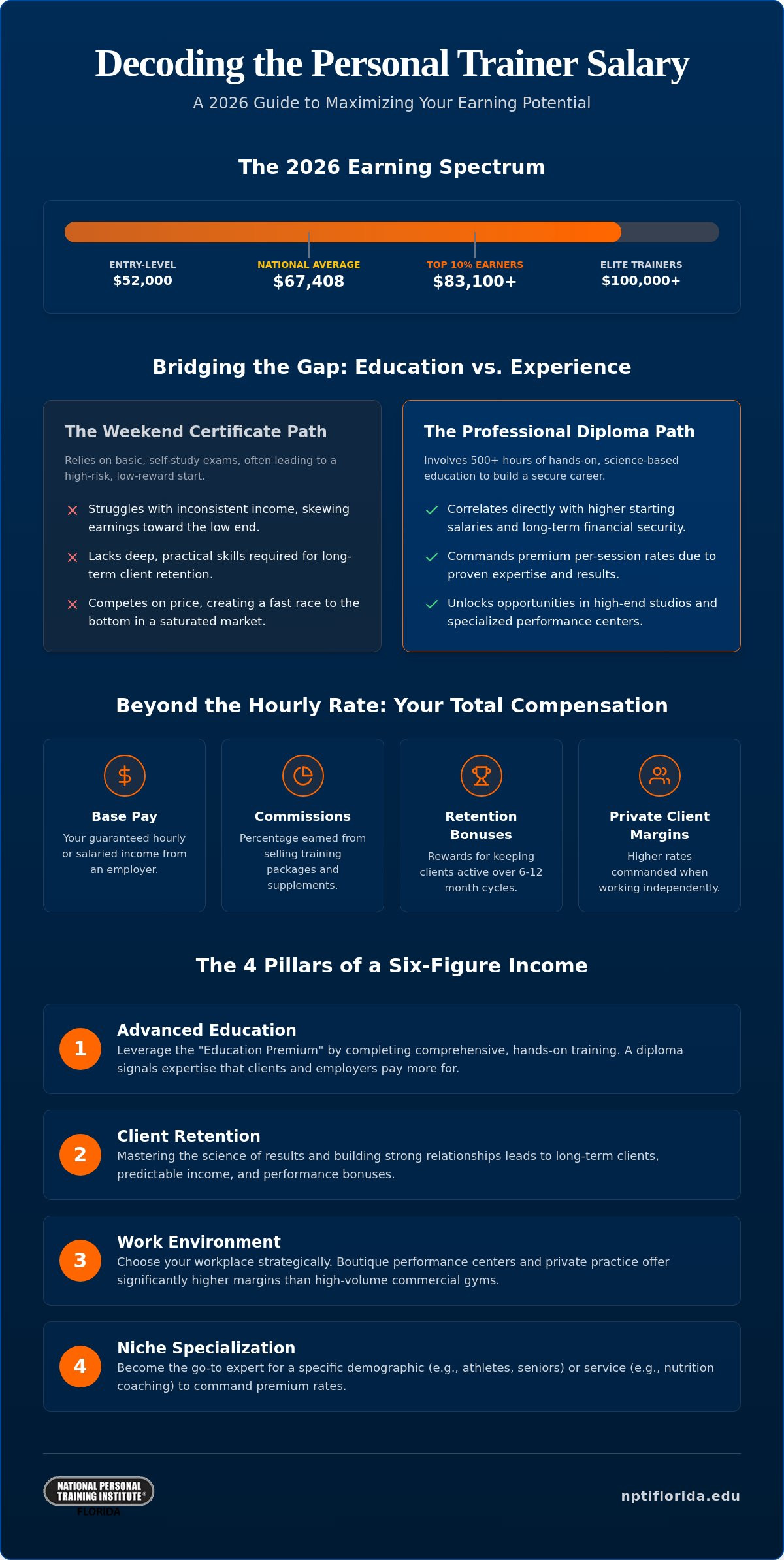
If you’re looking for a straight answer on how much do personal trainers make, you’ll likely find a confusing spread of numbers. Data from 2026 shows a significant range for full-time professionals, typically landing between $52,000 and $85,000 annually. While sites like Salary.com report a national average of $67,408, these figures only tell part of the story. The reality is that the fitness industry doesn’t have a single “set” salary; it has an income floor and an income ceiling that are both determined by your level of expertise and business structure. The floor represents entry-level positions often found in commercial gyms, while the ceiling for elite, specialized trainers can easily exceed $100,000.
Many people starting their research ask, What is a Personal Trainer? and quickly realize the role has evolved. It’s no longer just about counting reps; it’s about comprehensive health management. Because of this evolution, standard Bureau of Labor Statistics (BLS) data often underestimates what professional career trainers actually earn. These reports frequently include part-time employees or “weekend” trainers who don’t possess advanced vocational training, which pulls the reported averages down and masks the high-six-figure potential available to dedicated experts.
The ‘Side Hustle’ vs. Career Professional Gap
The gap between a hobbyist and a professional is often measured in hours of preparation. Part-time trainers who treat the gym as a side gig often struggle with inconsistent income, skewing national data toward the lower end of the spectrum. If you want to secure a higher starting salary, the evidence is clear: 500 or more hours of foundational education correlates directly with better pay. Those who rely on “weekend-only” certifications often face a high financial risk because they lack the deep practical skills required to retain clients in a competitive 2026 market. Without a science-based education, you’re competing on price alone, which is a fast race to the bottom. Enrolling in a personal training specialist program built on science-based depth and hands-on experience is the most reliable way to close this gap and position yourself for premium earnings from the start.
Total Compensation: Beyond the Hourly Rate
When you evaluate a job offer or plan your own business, don’t just look at the per-session rate. Professional compensation in this field is multifaceted. High-end health clubs and corporate wellness programs often provide benefits that go beyond a paycheck, including health insurance and paid time off. You should also account for gym commission structures where you earn a percentage of every package sold, alongside performance bonuses for meeting client retention targets. Total Fitness Compensation is the sum of session rates, retention bonuses, and passive digital revenue.
- Base Pay: Your guaranteed hourly or salaried income.
- Commissions: Additional percentages earned from selling training packages or supplements.
- Retention Bonuses: Rewards for keeping clients active over long-term cycles (6-12 months).
- Private Client Margins: The significantly higher rates you command when working independently or in boutique settings.
Understanding how much do personal trainers make requires looking at this full picture. By investing in a comprehensive diploma rather than a quick certificate, you position yourself to maximize every one of these income streams from day one.
The 4 Pillars That Determine Your Fitness Income
Your earning potential isn’t a roll of the dice. It’s a calculated result of four specific pillars. While many look at the Personal Trainer Salary in 2026 and see a flat number, the top 10% of earners, who now clear over $83,100 annually, know better. They understand that the answer to how much do personal trainers make is entirely dependent on how they leverage their education, retention rates, geography, and niche specialization. If you want to move beyond the industry average, you must master these variables.
Education: Diploma vs. Weekend Certificate
A weekend certificate might get you an entry-level job. A vocational diploma builds a long-term career. When you compare the ROI of a 500-hour comprehensive program to a $500 self-study exam, the difference is found in your hourly rate and employment opportunities. Employers at high-end studios and specialized performance centers prioritize graduates from licensed vocational schools because these individuals arrive with hundreds of hours of practical lab experience. This creates a “Confidence Factor.” When you have deep science-based knowledge, you deliver better results. Better results lead to more referrals, allowing you to raise your rates while others struggle to fill their schedules. If you’re ready to invest in a foundation that actually pays off, exploring an Advanced Personal Training Program is the logical first step toward premium earnings.
Retention is the second pillar of wealth in this industry. It’s a simple mathematical reality: keeping a client for 12 months is five times more profitable than constantly hunting for new ones. High earners focus on building deep relationships and long-term programming. This stability allows you to predict your monthly income with precision, removing the “feast or famine” anxiety that plagues under-educated trainers.
Specialization: The Path to Premium Pricing
Generalists are treated as commodities. Specialists are treated as consultants. If you want to maximize how much do personal trainers make, you must solve specific, high-value problems. By integrating Health and Nutrition Coaching into your business, you significantly increase the lifetime value of every client. You’re no longer just a “gym person”; you’re a vital health partner.
- Senior Fitness Specialists: Tapping into an affluent demographic that prioritizes longevity and mobility.
- Stretch Coaches: Providing high-demand recovery services that complement traditional strength training.
- Corrective Exercise: Commanding higher rates by helping clients overcome chronic pain and movement dysfunctions.
Specialization transforms a trainer from a general commodity into a high-value health consultant. By focusing on geographic demand in high-spending states like New Jersey or California and backing it with specialized credentials, you can effectively double your per-session rate within your first two years of practice.
Where You Work: A National Comparison of Earning Potential
Where you choose to plant your professional roots will dictate your financial trajectory as much as your actual training skill set. While the Bureau of Labor Statistics provides a broad baseline for the industry, your choice of workplace environment creates the real-world context for how much do personal trainers make. Some environments offer the safety net of a steady paycheck and benefits, while others provide an uncapped income potential that requires you to manage every aspect of your business. Understanding these tiers is vital to building a career that matches your financial goals.
Commercial Gyms: The Proving Ground
Most fitness professionals start their journey in commercial “big-box” gyms. These facilities offer a low barrier to entry and a high volume of potential clients. The primary advantage here is the built-in lead generation; the gym spends the marketing dollars to get people through the door, and you provide the service. Typical hourly splits might start lower, but most clubs use a tiered system. As you gain certifications and maintain high client retention, you move from a Level 1 trainer to a lead trainer or manager, where margins improve. It’s an excellent environment to sharpen your skills without the pressure of paying rent for floor space.
Boutique studios and specialized performance centers represent the next step up. These facilities often demand higher expectations and more advanced credentials, but they command premium rates. Clients at these locations aren’t just looking for a workout; they’re paying for a specific outcome, such as athletic performance or corrective exercise. This specialization allows for higher per-session rates and a more affluent client base.
The Independent Route: High Risk, High Reward
Independent training offers the highest earning potential in the industry, but it comes with 100% of the business overhead. When you work for yourself, you keep the entire session fee. However, you must calculate your real take-home pay after accounting for gym floor fees, which can range from $500 to $1,500 a month, as well as liability insurance and marketing costs. To succeed here, you need more than just fitness knowledge; you need a solid business foundation. Many successful independents find that completing a Personal Training Specialist Program gives them the vocational precision and business acumen required to manage these moving parts.
Corporate wellness is another growing sector, offering stability and consistent daytime hours. These roles often include full benefits packages, which can significantly increase your total compensation. Whether you choose the stability of a corporation or the hustle of independent work, the answer to how much do personal trainers make is ultimately defined by your ability to navigate these different market sectors with confidence and professional readiness.
Strategies to Scale Your Personal Training Business to Six Figures
Scaling your income toward the six-figure mark requires a fundamental shift in how you view your time. While the national average gives you a baseline for how much do personal trainers make, those at the top of the profession don’t rely solely on one-on-one hourly sessions. They build scalable systems that decouple their income from the number of hours they spend on the gym floor. By integrating advanced coaching models and multiple revenue streams, you can move beyond a standard salary and build a high-margin fitness business.
The Power of Hybrid Coaching
The fitness industry in 2026 has fully embraced the Hyflex model. In a professional context, this means balancing high-touch, hands-on sessions with digital coaching. This hybrid approach allows you to manage 20 or even 30 clients simultaneously without the burnout associated with back-to-back gym sessions. By using coaching apps to deliver programming, track metrics, and maintain accountability, you increase your billable hours without being physically present in the gym 24/7. This scalability is a primary reason why top-tier trainers often exceed the $83,100 annual income threshold reported for the top 10% of the industry.
Integrating Nutrition and Recovery
Every six-figure trainer is also a nutrition expert. If you only focus on the 60 minutes a client spends in the gym, you’re missing the other 23 hours of their day where the real results happen. Integrating Health and Nutrition Coaching into your service adds a second, highly profitable revenue stream. It transforms you from a trainer into a holistic health consultant, justifying a price tag of $150 or more per hour.
Recovery is the other side of the performance coin. By obtaining a Stretch Coach Certification, you can offer premium recovery sessions that complement traditional strength training. This holistic package creates a “one-stop-shop” experience for your clients, significantly increasing their lifetime value and your overall business stability.
- Semi-Private Training: Training 2-4 clients at once allows you to lower the cost for the individual while doubling or tripling your own hourly rate.
- Continuous Education: There is a direct link between your annual CEUs and your income growth; the more specialized your knowledge, the more you can charge.
- Digital Products: Selling pre-made templates or challenges provides passive revenue that supports your primary coaching income.
- Professional Networking: Connecting with other local business owners is a powerful way to generate high-quality referrals; learn more about Network In Action to see how joining a referral group can help you scale your business.
Scaling is about professional evolution. If you’re ready to stop trading hours for dollars and start building a sustainable, high-income career, you should apply for the Personal Fitness Training Program to master the science and business of elite coaching.
Understanding how much do personal trainers make is just the first step. The real goal is to implement these scaling strategies so that your income reflects the deep value you provide to your clients’ lives. By leveraging hybrid models and specialized health services, the path to a $100,000+ income becomes a matter of strategy rather than just hard work.
Why an NPTI Florida Diploma is Your Best Financial Investment
Your financial future in fitness depends entirely on the depth of your foundation. While basic certifications might provide a technical answer to how much do personal trainers make, an NPTI Florida diploma provides the professional weight required to reach the upper-tier earnings of the top 10%. Our 600-hour program consists of 382 hours of classroom theory and 218 hours of practical lab application. This ensures you aren’t just memorizing definitions for a screen; you’re mastering the craft in a real-world environment. With a legacy of over 25 years as a veteran-owned institution, we function as career architects rather than just a testing center. This intensive preparation is why our graduates enter the market with an average of 3.2 job offers before they even finish the program.
The ROI of Real-World Experience
Learning by doing is the only way to prevent the number one cause of trainer burnout: a lack of practical confidence. In our hands-on lab environment, you turn complex physiological theory into high-paying practical skills under the guidance of seasoned professionals. This reputation for excellence precedes you. High-end facilities and specialized performance centers actively seek out NPTI Florida graduates because they know our students have already logged hundreds of hours on the gym floor. You’ll enter your first interview not as a novice, but as a prepared professional with a vocational network already in place. This network is a “hidden” value that basic self-study courses can’t provide, connecting you to high-margin opportunities that aren’t always posted on public job boards. Professionals who complete a comprehensive personal training specialist program consistently report greater career longevity and faster advancement into premium roles than those who rely on basic certifications alone.
Flexible Learning for Career Changers
Transitioning into a new career shouldn’t mean sacrificing your current financial stability. Our Hyflex Learning Program offers a strategic balance, allowing you to maintain your current income while you train for your next one. This flexibility is vital for career changers and veterans looking for a stable, science-based path into wellness. As a VA-approved program, we take immense pride in helping veterans translate their leadership and discipline into successful fitness careers. The U.S. Department of Labor projects a 24% growth in this field through 2026, making this the ideal time to secure your place in the industry. Your investment here isn’t just for a piece of paper; it’s for a lifetime of professional growth and financial security. Apply for the Personal Fitness Training Program today and start building the high-six-figure career you deserve.
When you consider how much do personal trainers make, remember that the highest earners all have one thing in common: they didn’t take the shortcut. They invested in a comprehensive education that allowed them to command premium rates from day one. By choosing a licensed vocational path, you’re not just buying a credential; you’re securing a future where your income is limited only by your own ambition.
Take Control of Your Professional Earning Potential
The roadmap to a high-earning fitness career is no longer a mystery. It’s built on a foundation of science-based education and the strategic use of hybrid coaching models. You’ve seen that the answer to how much do personal trainers make isn’t a fixed number; it’s a direct reflection of your specialized skill set and your ability to retain clients through superior results. By moving beyond basic certificates and embracing a comprehensive vocational diploma, you position yourself to command the premium rates found in the industry’s top 10%.
NPTI Florida has spent over 25 years acting as a career architect for thousands of successful professionals. As a veteran-owned and operated institution, we provide 500+ hours of hands-on vocational training that turns your passion into a stable, high-earning reality. You don’t have to settle for the industry average when the tools for elite success are within your reach. Launch your high-earning fitness career with an NPTI Florida Diploma and start building a legacy of health and financial security today. Your future in the fitness industry is waiting, and it’s brighter than ever.
Frequently Asked Questions
Is it possible to make $100,000 a year as a personal trainer?
Yes, reaching a six-figure income is achievable for professionals who move beyond standard one-on-one hourly sessions. While the top 10% of the industry earns more than $83,100, those who leverage hybrid coaching models or independent business structures often exceed $100,000 annually. Success at this level requires a strategic mix of high-level specialization and business scalability that decouples your income from your physical presence on the gym floor.
How much do entry-level personal trainers make vs. experienced ones?
Entry-level trainers typically start with a salary range between $33,700 and $41,442 per year. As you gain three to five years of experience and build a solid client roster, the national average rises toward $67,408. Professionals who move into senior supervisor roles with over five years of experience often see their total compensation climb above $76,244 annually.
Do I need a college degree to earn a high salary in fitness?
You don’t need a four-year college degree to earn a high salary in the fitness industry. Many high-end employers actually prefer candidates with intensive vocational diplomas because these programs focus on practical lab application and science-based programming rather than just theoretical knowledge. A targeted 600-hour diploma often provides a faster return on investment than a general undergraduate degree.
How much more do trainers with a nutrition certification make?
Trainers who integrate nutrition coaching can significantly increase their per-client revenue by offering holistic health packages. By solving the “other 23 hours” of a client’s day, you’re no longer just selling a workout; you’re selling a lifestyle transformation. This allows you to justify higher hourly rates and increases your client retention, which is the primary driver of long-term income growth.
What is the average hourly rate for independent personal trainers?
Independent trainers often charge between $50 and $150 per hour depending on their location and specific expertise. While this rate is higher than what you’d earn as an employee at a commercial gym, you must account for overhead costs like floor fees, liability insurance, and marketing. Understanding how much do personal trainers make in your specific local market is crucial for setting competitive independent rates that reflect your value.
Does having a vocational diploma increase my starting pay?
Holding a vocational diploma definitely increases your starting pay potential by allowing you to enter the workforce at a higher “tier.” Graduates from comprehensive programs often bypass entry-level wages because they arrive with hundreds of hours of practical experience already logged. This advanced standing makes you more attractive to premium health clubs that offer higher commission structures and better benefits.
How long does it take to reach a stable full-time income in fitness?
Most professionals reach a stable full-time income within six to twelve months of consistent work. This timeline depends on your ability to build a roster and maintain high retention rates through excellent service. Starting with a strong educational foundation can shorten this window significantly by giving you the confidence to close sales and deliver immediate results for your clients.
What are the highest-paying niches in personal training?
The highest-paying niches currently include corrective exercise, senior fitness, and performance coaching for competitive athletes. Specializing in these areas allows you to function as a high-value consultant rather than a generalist. When you solve specific, high-stakes problems for affluent demographics, you can command premium rates that far exceed the national average.

What if your passion for fitness didn’t have to come with the “starving trainer” stereotype? Most aspiring pros feel a mix of excitement and anxiety when they look at the industry. You likely worry about inconsistent monthly paychecks or whether you’ll ever see a real return on your certification costs. It’s common to feel confused when searching for how much do personal trainers make, especially when “average” figures don’t seem to reflect the lifestyle you want to build. You deserve more than just a side hustle; you deserve a career that rewards your dedication with financial security.
We agree that the gap between entry-level wages and elite earnings can feel like a canyon. This guide is your bridge. You’ll discover the exact roadmap to a $75,000+ annual income and learn why certain credentials command significantly higher rates than others. Whether you’re starting out or looking to scale, we’ll show you how to move from basic 2026 averages, like the $67,408 national mean, into the top 10% of earners who now clear over $83,100 annually. We’ll explore the latest salary trends, the impact of specialized science-based education, and how to build a professional foundation that ensures long-term growth and career longevity.
Key Takeaways
- Master the 2026 salary landscape by understanding the trajectory from entry-level wages to the $83,100+ annual potential of top-tier professionals.
- Get a realistic answer to how much do personal trainers make by exploring total compensation models that include private client commissions and performance bonuses.
- Identify the “Education Premium” and learn how comprehensive hands-on training allows you to command significantly higher per-session rates than basic certifications.
- Discover actionable strategies to scale your income toward six figures by leveraging hybrid training models and integrated health and nutrition coaching.
- Compare the earning potential of different work environments, from the high-volume stability of commercial gyms to the premium margins of boutique performance centers.
Personal Trainer Salary in 2026: Understanding the Earning Landscape
If you’re looking for a straight answer on how much do personal trainers make, you’ll likely find a confusing spread of numbers. Data from 2026 shows a significant range for full-time professionals, typically landing between $52,000 and $85,000 annually. While sites like Salary.com report a national average of $67,408, these figures only tell part of the story. The reality is that the fitness industry doesn’t have a single “set” salary; it has an income floor and an income ceiling that are both determined by your level of expertise and business structure. The floor represents entry-level positions often found in commercial gyms, while the ceiling for elite, specialized trainers can easily exceed $100,000.
Many people starting their research ask, What is a Personal Trainer? and quickly realize the role has evolved. It’s no longer just about counting reps; it’s about comprehensive health management. Because of this evolution, standard Bureau of Labor Statistics (BLS) data often underestimates what professional career trainers actually earn. These reports frequently include part-time employees or “weekend” trainers who don’t possess advanced vocational training, which pulls the reported averages down and masks the high-six-figure potential available to dedicated experts.
The ‘Side Hustle’ vs. Career Professional Gap
The gap between a hobbyist and a professional is often measured in hours of preparation. Part-time trainers who treat the gym as a side gig often struggle with inconsistent income, skewing national data toward the lower end of the spectrum. If you want to secure a higher starting salary, the evidence is clear: 500 or more hours of foundational education correlates directly with better pay. Those who rely on “weekend-only” certifications often face a high financial risk because they lack the deep practical skills required to retain clients in a competitive 2026 market. Without a science-based education, you’re competing on price alone, which is a fast race to the bottom. Enrolling in a personal training specialist program built on science-based depth and hands-on experience is the most reliable way to close this gap and position yourself for premium earnings from the start.
Total Compensation: Beyond the Hourly Rate
When you evaluate a job offer or plan your own business, don’t just look at the per-session rate. Professional compensation in this field is multifaceted. High-end health clubs and corporate wellness programs often provide benefits that go beyond a paycheck, including health insurance and paid time off. You should also account for gym commission structures where you earn a percentage of every package sold, alongside performance bonuses for meeting client retention targets. Total Fitness Compensation is the sum of session rates, retention bonuses, and passive digital revenue.
- Base Pay: Your guaranteed hourly or salaried income.
- Commissions: Additional percentages earned from selling training packages or supplements.
- Retention Bonuses: Rewards for keeping clients active over long-term cycles (6-12 months).
- Private Client Margins: The significantly higher rates you command when working independently or in boutique settings.
Understanding how much do personal trainers make requires looking at this full picture. By investing in a comprehensive diploma rather than a quick certificate, you position yourself to maximize every one of these income streams from day one.
The 4 Pillars That Determine Your Fitness Income
Your earning potential isn’t a roll of the dice. It’s a calculated result of four specific pillars. While many look at the Personal Trainer Salary in 2026 and see a flat number, the top 10% of earners, who now clear over $83,100 annually, know better. They understand that the answer to how much do personal trainers make is entirely dependent on how they leverage their education, retention rates, geography, and niche specialization. If you want to move beyond the industry average, you must master these variables.
Education: Diploma vs. Weekend Certificate
A weekend certificate might get you an entry-level job. A vocational diploma builds a long-term career. When you compare the ROI of a 500-hour comprehensive program to a $500 self-study exam, the difference is found in your hourly rate and employment opportunities. Employers at high-end studios and specialized performance centers prioritize graduates from licensed vocational schools because these individuals arrive with hundreds of hours of practical lab experience. This creates a “Confidence Factor.” When you have deep science-based knowledge, you deliver better results. Better results lead to more referrals, allowing you to raise your rates while others struggle to fill their schedules. If you’re ready to invest in a foundation that actually pays off, exploring an Advanced Personal Training Program is the logical first step toward premium earnings.
Retention is the second pillar of wealth in this industry. It’s a simple mathematical reality: keeping a client for 12 months is five times more profitable than constantly hunting for new ones. High earners focus on building deep relationships and long-term programming. This stability allows you to predict your monthly income with precision, removing the “feast or famine” anxiety that plagues under-educated trainers.
Specialization: The Path to Premium Pricing
Generalists are treated as commodities. Specialists are treated as consultants. If you want to maximize how much do personal trainers make, you must solve specific, high-value problems. By integrating Health and Nutrition Coaching into your business, you significantly increase the lifetime value of every client. You’re no longer just a “gym person”; you’re a vital health partner.
- Senior Fitness Specialists: Tapping into an affluent demographic that prioritizes longevity and mobility.
- Stretch Coaches: Providing high-demand recovery services that complement traditional strength training.
- Corrective Exercise: Commanding higher rates by helping clients overcome chronic pain and movement dysfunctions.
Specialization transforms a trainer from a general commodity into a high-value health consultant. By focusing on geographic demand in high-spending states like New Jersey or California and backing it with specialized credentials, you can effectively double your per-session rate within your first two years of practice.
Where You Work: A National Comparison of Earning Potential
Where you choose to plant your professional roots will dictate your financial trajectory as much as your actual training skill set. While the Bureau of Labor Statistics provides a broad baseline for the industry, your choice of workplace environment creates the real-world context for how much do personal trainers make. Some environments offer the safety net of a steady paycheck and benefits, while others provide an uncapped income potential that requires you to manage every aspect of your business. Understanding these tiers is vital to building a career that matches your financial goals.
Commercial Gyms: The Proving Ground
Most fitness professionals start their journey in commercial “big-box” gyms. These facilities offer a low barrier to entry and a high volume of potential clients. The primary advantage here is the built-in lead generation; the gym spends the marketing dollars to get people through the door, and you provide the service. Typical hourly splits might start lower, but most clubs use a tiered system. As you gain certifications and maintain high client retention, you move from a Level 1 trainer to a lead trainer or manager, where margins improve. It’s an excellent environment to sharpen your skills without the pressure of paying rent for floor space.
Boutique studios and specialized performance centers represent the next step up. These facilities often demand higher expectations and more advanced credentials, but they command premium rates. Clients at these locations aren’t just looking for a workout; they’re paying for a specific outcome, such as athletic performance or corrective exercise. This specialization allows for higher per-session rates and a more affluent client base.
The Independent Route: High Risk, High Reward
Independent training offers the highest earning potential in the industry, but it comes with 100% of the business overhead. When you work for yourself, you keep the entire session fee. However, you must calculate your real take-home pay after accounting for gym floor fees, which can range from $500 to $1,500 a month, as well as liability insurance and marketing costs. To succeed here, you need more than just fitness knowledge; you need a solid business foundation. Many successful independents find that completing a Personal Training Specialist Program gives them the vocational precision and business acumen required to manage these moving parts.
Corporate wellness is another growing sector, offering stability and consistent daytime hours. These roles often include full benefits packages, which can significantly increase your total compensation. Whether you choose the stability of a corporation or the hustle of independent work, the answer to how much do personal trainers make is ultimately defined by your ability to navigate these different market sectors with confidence and professional readiness.
Strategies to Scale Your Personal Training Business to Six Figures
Scaling your income toward the six-figure mark requires a fundamental shift in how you view your time. While the national average gives you a baseline for how much do personal trainers make, those at the top of the profession don’t rely solely on one-on-one hourly sessions. They build scalable systems that decouple their income from the number of hours they spend on the gym floor. By integrating advanced coaching models and multiple revenue streams, you can move beyond a standard salary and build a high-margin fitness business.
The Power of Hybrid Coaching
The fitness industry in 2026 has fully embraced the Hyflex model. In a professional context, this means balancing high-touch, hands-on sessions with digital coaching. This hybrid approach allows you to manage 20 or even 30 clients simultaneously without the burnout associated with back-to-back gym sessions. By using coaching apps to deliver programming, track metrics, and maintain accountability, you increase your billable hours without being physically present in the gym 24/7. This scalability is a primary reason why top-tier trainers often exceed the $83,100 annual income threshold reported for the top 10% of the industry.
Integrating Nutrition and Recovery
Every six-figure trainer is also a nutrition expert. If you only focus on the 60 minutes a client spends in the gym, you’re missing the other 23 hours of their day where the real results happen. Integrating Health and Nutrition Coaching into your service adds a second, highly profitable revenue stream. It transforms you from a trainer into a holistic health consultant, justifying a price tag of $150 or more per hour.
Recovery is the other side of the performance coin. By obtaining a Stretch Coach Certification, you can offer premium recovery sessions that complement traditional strength training. This holistic package creates a “one-stop-shop” experience for your clients, significantly increasing their lifetime value and your overall business stability.
- Semi-Private Training: Training 2-4 clients at once allows you to lower the cost for the individual while doubling or tripling your own hourly rate.
- Continuous Education: There is a direct link between your annual CEUs and your income growth; the more specialized your knowledge, the more you can charge.
- Digital Products: Selling pre-made templates or challenges provides passive revenue that supports your primary coaching income.
- Professional Networking: Connecting with other local business owners is a powerful way to generate high-quality referrals; learn more about Network In Action to see how joining a referral group can help you scale your business.
Scaling is about professional evolution. If you’re ready to stop trading hours for dollars and start building a sustainable, high-income career, you should apply for the Personal Fitness Training Program to master the science and business of elite coaching.
Understanding how much do personal trainers make is just the first step. The real goal is to implement these scaling strategies so that your income reflects the deep value you provide to your clients’ lives. By leveraging hybrid models and specialized health services, the path to a $100,000+ income becomes a matter of strategy rather than just hard work.
Why an NPTI Florida Diploma is Your Best Financial Investment
Your financial future in fitness depends entirely on the depth of your foundation. While basic certifications might provide a technical answer to how much do personal trainers make, an NPTI Florida diploma provides the professional weight required to reach the upper-tier earnings of the top 10%. Our 600-hour program consists of 382 hours of classroom theory and 218 hours of practical lab application. This ensures you aren’t just memorizing definitions for a screen; you’re mastering the craft in a real-world environment. With a legacy of over 25 years as a veteran-owned institution, we function as career architects rather than just a testing center. This intensive preparation is why our graduates enter the market with an average of 3.2 job offers before they even finish the program.
The ROI of Real-World Experience
Learning by doing is the only way to prevent the number one cause of trainer burnout: a lack of practical confidence. In our hands-on lab environment, you turn complex physiological theory into high-paying practical skills under the guidance of seasoned professionals. This reputation for excellence precedes you. High-end facilities and specialized performance centers actively seek out NPTI Florida graduates because they know our students have already logged hundreds of hours on the gym floor. You’ll enter your first interview not as a novice, but as a prepared professional with a vocational network already in place. This network is a “hidden” value that basic self-study courses can’t provide, connecting you to high-margin opportunities that aren’t always posted on public job boards. Professionals who complete a comprehensive personal training specialist program consistently report greater career longevity and faster advancement into premium roles than those who rely on basic certifications alone.
Flexible Learning for Career Changers
Transitioning into a new career shouldn’t mean sacrificing your current financial stability. Our Hyflex Learning Program offers a strategic balance, allowing you to maintain your current income while you train for your next one. This flexibility is vital for career changers and veterans looking for a stable, science-based path into wellness. As a VA-approved program, we take immense pride in helping veterans translate their leadership and discipline into successful fitness careers. The U.S. Department of Labor projects a 24% growth in this field through 2026, making this the ideal time to secure your place in the industry. Your investment here isn’t just for a piece of paper; it’s for a lifetime of professional growth and financial security. Apply for the Personal Fitness Training Program today and start building the high-six-figure career you deserve.
When you consider how much do personal trainers make, remember that the highest earners all have one thing in common: they didn’t take the shortcut. They invested in a comprehensive education that allowed them to command premium rates from day one. By choosing a licensed vocational path, you’re not just buying a credential; you’re securing a future where your income is limited only by your own ambition.
Take Control of Your Professional Earning Potential
The roadmap to a high-earning fitness career is no longer a mystery. It’s built on a foundation of science-based education and the strategic use of hybrid coaching models. You’ve seen that the answer to how much do personal trainers make isn’t a fixed number; it’s a direct reflection of your specialized skill set and your ability to retain clients through superior results. By moving beyond basic certificates and embracing a comprehensive vocational diploma, you position yourself to command the premium rates found in the industry’s top 10%.
NPTI Florida has spent over 25 years acting as a career architect for thousands of successful professionals. As a veteran-owned and operated institution, we provide 500+ hours of hands-on vocational training that turns your passion into a stable, high-earning reality. You don’t have to settle for the industry average when the tools for elite success are within your reach. Launch your high-earning fitness career with an NPTI Florida Diploma and start building a legacy of health and financial security today. Your future in the fitness industry is waiting, and it’s brighter than ever.
Frequently Asked Questions
Is it possible to make $100,000 a year as a personal trainer?
Yes, reaching a six-figure income is achievable for professionals who move beyond standard one-on-one hourly sessions. While the top 10% of the industry earns more than $83,100, those who leverage hybrid coaching models or independent business structures often exceed $100,000 annually. Success at this level requires a strategic mix of high-level specialization and business scalability that decouples your income from your physical presence on the gym floor.
How much do entry-level personal trainers make vs. experienced ones?
Entry-level trainers typically start with a salary range between $33,700 and $41,442 per year. As you gain three to five years of experience and build a solid client roster, the national average rises toward $67,408. Professionals who move into senior supervisor roles with over five years of experience often see their total compensation climb above $76,244 annually.
Do I need a college degree to earn a high salary in fitness?
You don’t need a four-year college degree to earn a high salary in the fitness industry. Many high-end employers actually prefer candidates with intensive vocational diplomas because these programs focus on practical lab application and science-based programming rather than just theoretical knowledge. A targeted 600-hour diploma often provides a faster return on investment than a general undergraduate degree.
How much more do trainers with a nutrition certification make?
Trainers who integrate nutrition coaching can significantly increase their per-client revenue by offering holistic health packages. By solving the “other 23 hours” of a client’s day, you’re no longer just selling a workout; you’re selling a lifestyle transformation. This allows you to justify higher hourly rates and increases your client retention, which is the primary driver of long-term income growth.
What is the average hourly rate for independent personal trainers?
Independent trainers often charge between $50 and $150 per hour depending on their location and specific expertise. While this rate is higher than what you’d earn as an employee at a commercial gym, you must account for overhead costs like floor fees, liability insurance, and marketing. Understanding how much do personal trainers make in your specific local market is crucial for setting competitive independent rates that reflect your value.
Does having a vocational diploma increase my starting pay?
Holding a vocational diploma definitely increases your starting pay potential by allowing you to enter the workforce at a higher “tier.” Graduates from comprehensive programs often bypass entry-level wages because they arrive with hundreds of hours of practical experience already logged. This advanced standing makes you more attractive to premium health clubs that offer higher commission structures and better benefits.
How long does it take to reach a stable full-time income in fitness?
Most professionals reach a stable full-time income within six to twelve months of consistent work. This timeline depends on your ability to build a roster and maintain high retention rates through excellent service. Starting with a strong educational foundation can shorten this window significantly by giving you the confidence to close sales and deliver immediate results for your clients.
What are the highest-paying niches in personal training?
The highest-paying niches currently include corrective exercise, senior fitness, and performance coaching for competitive athletes. Specializing in these areas allows you to function as a high-value consultant rather than a generalist. When you solve specific, high-stakes problems for affluent demographics, you can command premium rates that far exceed the national average.