Degree Needed for Personal Training? What Employers Seek
A college degree isn’t the only route into personal training. If you’re asking, “do you need a degree to be a personal trainer,” the general answer in the U.S. is no. But employers may set different expectations, and a credential alone doesn’t show whether you can apply what you’ve learned when coaching clients.
Degrees, certifications, and diplomas serve different purposes. A degree offers broader academic study, a certification assesses professional knowledge under the issuing organization’s requirements, and a career-focused diploma can combine structured study with practical training. Some roles may favor or require a degree, while others focus on relevant credentials and coaching skills.
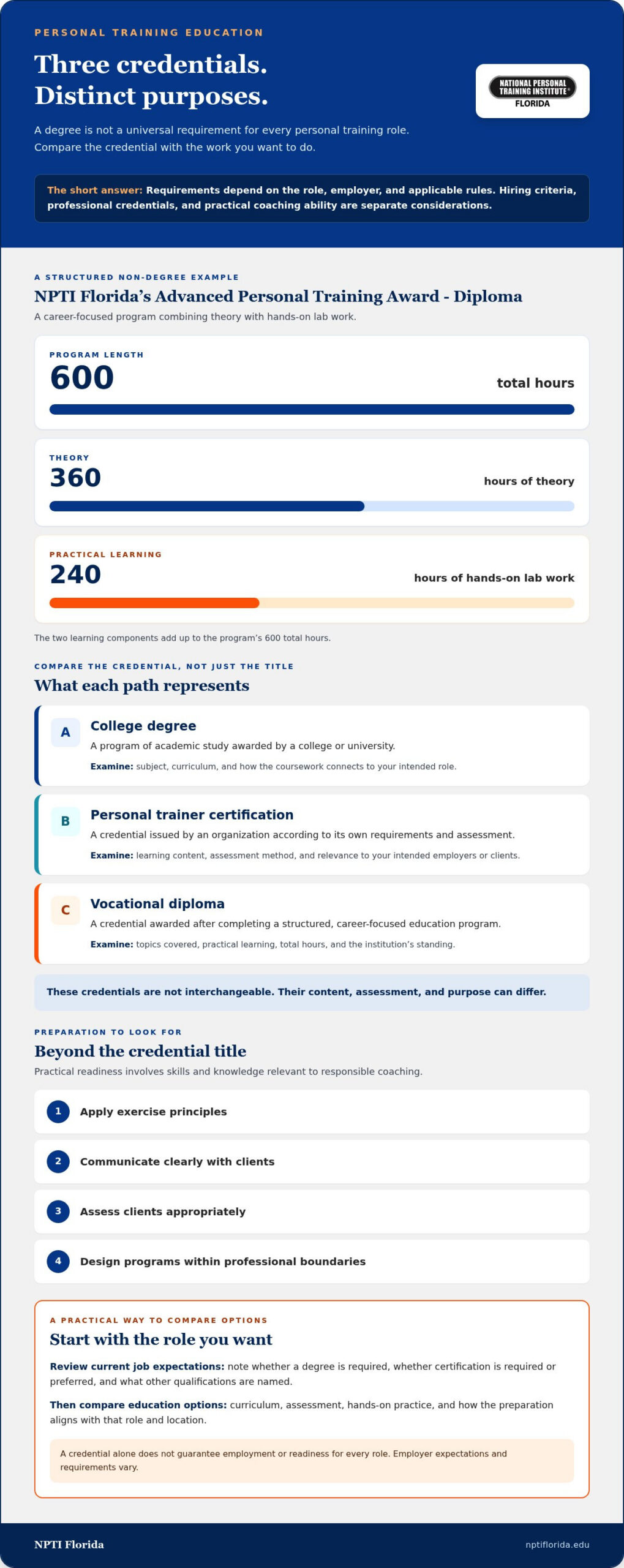
This article explains how requirements can vary by employer and role, where professional boundaries matter, and what to compare before choosing an education path. NPTI Florida’s non-degree Advanced Personal Training Award – Diploma provides a specific example: a 600-hour program with 360 hours of theory and 240 hours of hands-on lab work.
Key Takeaways
- If you’re asking “do you need a degree to be a personal trainer,” the answer depends on the role, employer, and applicable requirements.
- A degree, professional certification, and vocational diploma serve different purposes. Compare what each teaches and how it assesses learning.
- Look beyond credential titles to practical preparation in exercise principles, client communication, assessment, and program design.
- Define your target role, review its expectations, and compare education options by curriculum, hands-on practice, and institutional standing.
- Non-degree education can provide a structured path to consider, but no credential alone guarantees employment or readiness for every role.
Do You Need a Degree to Be a Personal Trainer? Short Answer
No, a college degree isn’t a universal requirement for every personal training role. The answer to “do you need a degree to be a personal trainer” depends on the position, the employer’s hiring criteria, and any rules that apply where you plan to work. A degree requirement, a preference for a professional certification, and the practical ability to coach clients responsibly are separate considerations.
That distinction helps explain why advice can differ. An employer may set its own education or credential standards, while independent work can involve different expectations, including those connected to professional insurance. Specialized settings may also call for additional education or experience. These examples don’t establish one rule for every workplace. Review the requirements for the specific role and location you’re considering. For general background on the profession’s roles and common qualifications, see the personal trainer Wikipedia article.
Degree requirements depend on the role and employer
Start with the job you want, not the assumption that every trainer needs the same qualification. Read current job postings for the type of work you’re considering, such as coaching in a gym, working independently, or pursuing a specialized setting. Note whether a degree is required, whether a certification is required or preferred, and whether the employer names other qualifications. Requirements vary, so review current expectations for your intended role and location before choosing an education path.
Legal rules and hiring policies aren’t interchangeable. An employer can set criteria for its own positions even when those criteria aren’t a general legal requirement. Likewise, requirements for one role or location shouldn’t be assumed to apply everywhere.
What a degree does, and doesn’t, tell an employer
A degree may provide broad academic study, depending on its subject and curriculum. A degree in an exercise-related field, for example, may cover topics relevant to movement and human performance. But the credential’s title alone doesn’t show exactly what a graduate studied, how much practical coaching they completed, or whether they hold a separate certification an employer expects.
Academic education shows what you studied; job-specific qualifications show how your preparation aligns with a particular role. Neither replaces the skills responsible coaching requires: clear communication, appropriate assessment, application of exercise principles, and program design within professional boundaries. A degree can be valuable, but it doesn’t automatically establish readiness for every personal training position.
Degree, Certification, or Diploma: What Each Personal Trainer Path Means
These credentials can all support career preparation, but they aren’t interchangeable. They may come from different organizations, cover different material, assess learning in different ways, and serve different purposes. Compare what each credential represents with the work you want to do.
| Credential | What it generally represents | What to examine |
|---|---|---|
| College degree | A program of academic study awarded by a college or university. | Subject, curriculum, and how the coursework connects to your intended role. |
| Personal trainer certification | A credential issued by an organization based on its own requirements and assessment. | Learning content, assessment method, and relevance to the employers or clients you aim to serve. |
| Vocational diploma | A credential awarded after completing a structured career-focused education program. | Topics covered, practical learning, total hours, and the institution’s standing. |
How personal trainer certifications differ from college degrees
A certification is defined by the organization that issues it. Its curriculum, assessment, and credentialing process depend on that organization, so don’t assume every certification covers the same material or is accepted by every employer. The Bureau of Labor Statistics’ information on fitness trainer education offers broader career context. For your decision, compare a certification’s subject matter and assessment with the responsibilities and requirements of your target role.
A degree generally represents broader academic study, while a certification is a distinct professional credential. Neither label tells you exactly how much practical experience someone has gained. If you’re asking, “do you need a degree to be a personal trainer,” focus on the requirements of the work you hope to do rather than treating one credential as a substitute for another.
What a vocational diploma can add to career preparation
A vocational diploma can offer a structured route through career-focused study, but it isn’t a bachelor’s degree or a promise of employment. NPTI’s Advanced Personal Training Award – Diploma is a 600-hour, non-degree credential. The program includes 360 hours of theory and 240 hours of hands-on lab work, combining classroom learning with practical instruction.
This format may suit learners looking for a broader educational experience than a single exam-focused credential. Review the curriculum and learning format to see how they align with your intended role. Explore NPTI’s personal training education program for details about this structured, non-degree option.
Is a Degree Enough to Prepare You for Personal Training?
No. A degree alone doesn’t automatically prepare someone for every personal training role. Academic study can build useful knowledge, but readiness also depends on applying exercise principles, communicating with clients, and making sound decisions within your professional scope. The degree’s subject and curriculum matter, as do any additional credentials or practical experience an employer expects.
Knowledge and coaching skills that matter beyond a credential
Responsible coaching brings several skills together. A foundation in anatomy and exercise principles helps you explain movements and select appropriate exercises. You also need to assess a client’s goals and current abilities, adapt instruction to their needs, and design a program that fits their situation rather than relying on a one-size-fits-all plan.
Communication matters just as much. Clear cues help clients understand how to perform an exercise, while listening and behavior-change support can help you coach in a way that respects their goals and experience. Professional boundaries matter, too: personal trainers provide general fitness coaching, not clinical diagnosis or treatment. If a client raises a medical concern outside your qualifications, stay within your scope rather than presenting yourself as a clinician.
A certification can assess specific knowledge, but the issuing organization sets its curriculum and process. For an example of how a certification program describes its focus, review the ACE Fitness personal trainer certification information. Then consider how that preparation aligns with the responsibilities of your intended role.
Why supervised, hands-on practice can strengthen preparation
Knowing an exercise concept is different from teaching it clearly. Practical work gives learners a chance to apply theory, demonstrate movements, give and adjust cues, and refine coaching technique. It also creates opportunities to observe how a client responds and adapt instruction appropriately.
NPTI’s 600-hour Advanced Personal Training program pairs 360 hours of theory with 240 hands-on lab hours. This is one example of structured education linking classroom concepts with applied learning. Practical experience supports preparation, but it doesn’t replace role-specific requirements or establish competence automatically.
Credentials indicate education or assessment; practical competence develops through application, feedback, and continued learning. When comparing education options, look beyond the credential title. Consider what you’ll study, how learning is assessed, and whether you’ll have opportunities to practice coaching skills.
How to Choose a Personal Trainer Education Path Without Assuming You Need a Degree
Choose your education by working backward from the role you want. Rather than starting with “do you need a degree to be a personal trainer,” identify the work you hope to do, then compare its requirements with what each program teaches and how it helps you apply that knowledge.
Start with the job you want, not the credential label
Consider the clients you’d like to coach and the setting you’re aiming for. A general fitness role, independent coaching, and a specialized or clinical environment may involve different expectations and professional boundaries. Review current job postings and role-specific requirements for the location where you plan to work. This helps distinguish a degree requirement from an employer’s preferred credential or other qualifications.
Use this five-step process to assess your options:
- Define your target role. Identify the client population and work setting you’re preparing for.
- Review its requirements. Compare current job postings and applicable requirements for that role and location.
- Compare curricula. Look for relevant topics, such as anatomy, exercise principles, assessment, communication, and safe program design.
- Assess practical learning. See how the program helps you apply theory, practice coaching, and receive feedback.
- Check institutional standing. Review the school’s accreditation, licensing information, and student policies, and understand what each represents.
Compare education quality and institutional information
A credential’s name won’t tell you everything. Examine course topics, the balance of theory and practice, assessment methods, and learning format. Consider whether the experience aligns with the clients and responsibilities you have in mind. Read the institution’s policies so you understand the educational commitment before enrolling.
NPTI is accredited by the Accrediting Commission of Career Schools and Colleges (ACCSC) and licensed by the Florida Commission for Independent Education. These describe institutional oversight; they don’t guarantee employment or mean every employer accepts every credential. Prospective students may request the Student Catalog before enrollment to review program and policy information.
NPTI’s Advanced Personal Training Award – Diploma is one example of structured, non-degree education. The program totals 600 hours, including 360 theory hours and 240 hands-on lab hours. Review the NPTI personal training program guide to compare its educational structure with your career goals.
A Degree Is Not the Only Route: Explore Structured Personal Trainer Education
If you’re still weighing the question, “do you need a degree to be a personal trainer,” remember that a degree is only one possible education path. Structured, non-degree education is another option to consider. The right choice depends on the work you want to pursue, the requirements for relevant roles, and whether a program’s learning experience fits your goals. No diploma or other credential guarantees employment or qualifies you for every position.
What NPTI’s 600-hour diploma program covers
NPTI provides non-degree personal-training education. Its 600-hour program is organized into three 200-hour modules:
- Health and Nutrition Coaching
- Corrective Exercise & Advanced Special Populations
- Advanced Youth Fitness
The credential awarded is the Advanced Personal Training Award – Diploma. It’s a non-degree credential, not a bachelor’s degree or a third-party personal trainer certification. The program combines 360 hours of theory with 240 hands-on lab hours, connecting classroom learning with practical work. These details give prospective students a clear basis for comparing how different education paths approach knowledge and application.
Course content can help you judge whether a program relates to your interests. If you’re drawn to coaching varied client populations, review the curriculum’s coverage of advanced special populations. If youth fitness interests you, look closely at that module’s place in the program. Match the subjects with your intended role and review any qualifications that role or location requires.
A practical next step before choosing a pathway
Before settling on a route, compare your career goal with the program’s curriculum, theory-practice balance, and learning format. Then review current expectations for the roles you’re considering. This lets you assess education by its substance rather than assuming a degree, certification, or diploma is interchangeable with another credential.
Prospective students may request the Student Catalog before enrollment. Reviewing it can help you understand the program and its policies, then decide whether its structure aligns with your goals. If you’re exploring a structured, non-degree route, consider how NPTI’s personal-training education fits the work you hope to do.
Choose Education That Fits the Work You Want to Do
So, do you need a degree to be a personal trainer? Not for every role. Employer expectations and qualifications vary, and a degree, certification, or diploma represents a different kind of preparation. Focus on the work you want to pursue, then compare its requirements with each education path’s curriculum, practical learning, and credential.
If you’re exploring structured non-degree education, NPTI’s 600-hour program includes 360 hours of theory and 240 hands-on lab hours. NPTI is accredited by ACCSC and licensed by the Florida Commission for Independent Education. These describe institutional oversight, not a guarantee of employment or acceptance of a credential by every employer. Prospective students can request the Student Catalog before enrollment to review program details.
Take your next step with clear goals and a commitment to responsible coaching. Explore NPTI’s personal training education program and consider whether its structure aligns with the career you’re building.
Frequently Asked Questions
Do you need a college degree to become a personal trainer?
A college degree is not a universal requirement for every personal training job. Employers may set their own education or credential criteria, and specialized positions can have additional expectations. If you’re asking, “do you need a degree to be a personal trainer,” start by identifying the work you want to do. Then review current requirements for that specific role and location. A degree may be useful, but it’s one possible form of preparation.
Can you be a personal trainer with a certification but no degree?
Yes, some people pursue personal training certification without earning a college degree, but hiring expectations vary by employer and role. Certification criteria also depend on the issuing organization. Compare its curriculum and assessment with your career goals, and consider how you’ll develop practical coaching skills. A certification by itself shouldn’t be assumed to qualify you for every fitness or healthcare-related position.
Is a personal training diploma the same as a degree?
No. A diploma and a college degree are distinct credentials, and the program and institution determine what each represents. NPTI’s Advanced Personal Training Award – Diploma is a non-degree credential awarded after a 600-hour program. It isn’t a bachelor’s degree or a third-party personal trainer certification. Review a program’s official materials to understand its curriculum, learning format, and credential before deciding whether it fits your goals.
What qualifications do employers look for in a personal trainer?
Employers may consider education, certifications, practical coaching ability, communication, and fit for the position, but expectations differ. A job listing can show what a particular employer expects, including whether it specifies a degree or another credential. Roles involving specialized populations or particular settings may have additional qualifications. Use the requirements for the work you intend to pursue rather than assuming one degree or certification is required everywhere.
Can you become a personal trainer without a degree or experience?
A degree isn’t a universal prerequisite, but you’ll still need preparation suited to the work you pursue. Education can build foundational knowledge, while practical learning can help develop communication and coaching skills. Employers may also set experience or credential expectations. Identify the roles you’re interested in, then compare their stated requirements with the curriculum and practical components of education options. A credential alone doesn’t guarantee readiness for every position.
Does a personal trainer need a degree to work independently?
There isn’t one answer for every independent trainer because applicable requirements can depend on location and the services offered. Don’t assume that rules for one place or type of work apply elsewhere. Before working independently, review current authoritative requirements for your specific situation and keep your services within your professional scope. Personal training is fitness coaching, not clinical diagnosis or treatment, so refer medical concerns to an appropriately qualified professional.
Is a 600-hour personal training diploma a degree?
No. A diploma remains a diploma regardless of the number of instructional hours. NPTI’s Advanced Personal Training Award – Diploma is a 600-hour non-degree credential, comprising 360 hours of theory and 240 hours of hands-on lab work. Those details describe the program structure and credential; they don’t make it a college degree or guarantee employment or acceptance for every role. Review the official program materials to understand what it includes.

A college degree isn’t the only route into personal training. If you’re asking, “do you need a degree to be a personal trainer,” the general answer in the U.S. is no. But employers may set different expectations, and a credential alone doesn’t show whether you can apply what you’ve learned when coaching clients.
Degrees, certifications, and diplomas serve different purposes. A degree offers broader academic study, a certification assesses professional knowledge under the issuing organization’s requirements, and a career-focused diploma can combine structured study with practical training. Some roles may favor or require a degree, while others focus on relevant credentials and coaching skills.
This article explains how requirements can vary by employer and role, where professional boundaries matter, and what to compare before choosing an education path. NPTI Florida’s non-degree Advanced Personal Training Award – Diploma provides a specific example: a 600-hour program with 360 hours of theory and 240 hours of hands-on lab work.
Key Takeaways
- If you’re asking “do you need a degree to be a personal trainer,” the answer depends on the role, employer, and applicable requirements.
- A degree, professional certification, and vocational diploma serve different purposes. Compare what each teaches and how it assesses learning.
- Look beyond credential titles to practical preparation in exercise principles, client communication, assessment, and program design.
- Define your target role, review its expectations, and compare education options by curriculum, hands-on practice, and institutional standing.
- Non-degree education can provide a structured path to consider, but no credential alone guarantees employment or readiness for every role.
Do You Need a Degree to Be a Personal Trainer? Short Answer
No, a college degree isn’t a universal requirement for every personal training role. The answer to “do you need a degree to be a personal trainer” depends on the position, the employer’s hiring criteria, and any rules that apply where you plan to work. A degree requirement, a preference for a professional certification, and the practical ability to coach clients responsibly are separate considerations.
That distinction helps explain why advice can differ. An employer may set its own education or credential standards, while independent work can involve different expectations, including those connected to professional insurance. Specialized settings may also call for additional education or experience. These examples don’t establish one rule for every workplace. Review the requirements for the specific role and location you’re considering. For general background on the profession’s roles and common qualifications, see the personal trainer Wikipedia article.
Degree requirements depend on the role and employer
Start with the job you want, not the assumption that every trainer needs the same qualification. Read current job postings for the type of work you’re considering, such as coaching in a gym, working independently, or pursuing a specialized setting. Note whether a degree is required, whether a certification is required or preferred, and whether the employer names other qualifications. Requirements vary, so review current expectations for your intended role and location before choosing an education path.
Legal rules and hiring policies aren’t interchangeable. An employer can set criteria for its own positions even when those criteria aren’t a general legal requirement. Likewise, requirements for one role or location shouldn’t be assumed to apply everywhere.
What a degree does, and doesn’t, tell an employer
A degree may provide broad academic study, depending on its subject and curriculum. A degree in an exercise-related field, for example, may cover topics relevant to movement and human performance. But the credential’s title alone doesn’t show exactly what a graduate studied, how much practical coaching they completed, or whether they hold a separate certification an employer expects.
Academic education shows what you studied; job-specific qualifications show how your preparation aligns with a particular role. Neither replaces the skills responsible coaching requires: clear communication, appropriate assessment, application of exercise principles, and program design within professional boundaries. A degree can be valuable, but it doesn’t automatically establish readiness for every personal training position.
Degree, Certification, or Diploma: What Each Personal Trainer Path Means
These credentials can all support career preparation, but they aren’t interchangeable. They may come from different organizations, cover different material, assess learning in different ways, and serve different purposes. Compare what each credential represents with the work you want to do.
| Credential | What it generally represents | What to examine |
|---|---|---|
| College degree | A program of academic study awarded by a college or university. | Subject, curriculum, and how the coursework connects to your intended role. |
| Personal trainer certification | A credential issued by an organization based on its own requirements and assessment. | Learning content, assessment method, and relevance to the employers or clients you aim to serve. |
| Vocational diploma | A credential awarded after completing a structured career-focused education program. | Topics covered, practical learning, total hours, and the institution’s standing. |
How personal trainer certifications differ from college degrees
A certification is defined by the organization that issues it. Its curriculum, assessment, and credentialing process depend on that organization, so don’t assume every certification covers the same material or is accepted by every employer. The Bureau of Labor Statistics’ information on fitness trainer education offers broader career context. For your decision, compare a certification’s subject matter and assessment with the responsibilities and requirements of your target role.
A degree generally represents broader academic study, while a certification is a distinct professional credential. Neither label tells you exactly how much practical experience someone has gained. If you’re asking, “do you need a degree to be a personal trainer,” focus on the requirements of the work you hope to do rather than treating one credential as a substitute for another.
What a vocational diploma can add to career preparation
A vocational diploma can offer a structured route through career-focused study, but it isn’t a bachelor’s degree or a promise of employment. NPTI’s Advanced Personal Training Award – Diploma is a 600-hour, non-degree credential. The program includes 360 hours of theory and 240 hours of hands-on lab work, combining classroom learning with practical instruction.
This format may suit learners looking for a broader educational experience than a single exam-focused credential. Review the curriculum and learning format to see how they align with your intended role. Explore NPTI’s personal training education program for details about this structured, non-degree option.
Is a Degree Enough to Prepare You for Personal Training?
No. A degree alone doesn’t automatically prepare someone for every personal training role. Academic study can build useful knowledge, but readiness also depends on applying exercise principles, communicating with clients, and making sound decisions within your professional scope. The degree’s subject and curriculum matter, as do any additional credentials or practical experience an employer expects.
Knowledge and coaching skills that matter beyond a credential
Responsible coaching brings several skills together. A foundation in anatomy and exercise principles helps you explain movements and select appropriate exercises. You also need to assess a client’s goals and current abilities, adapt instruction to their needs, and design a program that fits their situation rather than relying on a one-size-fits-all plan.
Communication matters just as much. Clear cues help clients understand how to perform an exercise, while listening and behavior-change support can help you coach in a way that respects their goals and experience. Professional boundaries matter, too: personal trainers provide general fitness coaching, not clinical diagnosis or treatment. If a client raises a medical concern outside your qualifications, stay within your scope rather than presenting yourself as a clinician.
A certification can assess specific knowledge, but the issuing organization sets its curriculum and process. For an example of how a certification program describes its focus, review the ACE Fitness personal trainer certification information. Then consider how that preparation aligns with the responsibilities of your intended role.
Why supervised, hands-on practice can strengthen preparation
Knowing an exercise concept is different from teaching it clearly. Practical work gives learners a chance to apply theory, demonstrate movements, give and adjust cues, and refine coaching technique. It also creates opportunities to observe how a client responds and adapt instruction appropriately.
NPTI’s 600-hour Advanced Personal Training program pairs 360 hours of theory with 240 hands-on lab hours. This is one example of structured education linking classroom concepts with applied learning. Practical experience supports preparation, but it doesn’t replace role-specific requirements or establish competence automatically.
Credentials indicate education or assessment; practical competence develops through application, feedback, and continued learning. When comparing education options, look beyond the credential title. Consider what you’ll study, how learning is assessed, and whether you’ll have opportunities to practice coaching skills.
How to Choose a Personal Trainer Education Path Without Assuming You Need a Degree
Choose your education by working backward from the role you want. Rather than starting with “do you need a degree to be a personal trainer,” identify the work you hope to do, then compare its requirements with what each program teaches and how it helps you apply that knowledge.
Start with the job you want, not the credential label
Consider the clients you’d like to coach and the setting you’re aiming for. A general fitness role, independent coaching, and a specialized or clinical environment may involve different expectations and professional boundaries. Review current job postings and role-specific requirements for the location where you plan to work. This helps distinguish a degree requirement from an employer’s preferred credential or other qualifications.
Use this five-step process to assess your options:
- Define your target role. Identify the client population and work setting you’re preparing for.
- Review its requirements. Compare current job postings and applicable requirements for that role and location.
- Compare curricula. Look for relevant topics, such as anatomy, exercise principles, assessment, communication, and safe program design.
- Assess practical learning. See how the program helps you apply theory, practice coaching, and receive feedback.
- Check institutional standing. Review the school’s accreditation, licensing information, and student policies, and understand what each represents.
Compare education quality and institutional information
A credential’s name won’t tell you everything. Examine course topics, the balance of theory and practice, assessment methods, and learning format. Consider whether the experience aligns with the clients and responsibilities you have in mind. Read the institution’s policies so you understand the educational commitment before enrolling.
NPTI is accredited by the Accrediting Commission of Career Schools and Colleges (ACCSC) and licensed by the Florida Commission for Independent Education. These describe institutional oversight; they don’t guarantee employment or mean every employer accepts every credential. Prospective students may request the Student Catalog before enrollment to review program and policy information.
NPTI’s Advanced Personal Training Award – Diploma is one example of structured, non-degree education. The program totals 600 hours, including 360 theory hours and 240 hands-on lab hours. Review the NPTI personal training program guide to compare its educational structure with your career goals.
A Degree Is Not the Only Route: Explore Structured Personal Trainer Education
If you’re still weighing the question, “do you need a degree to be a personal trainer,” remember that a degree is only one possible education path. Structured, non-degree education is another option to consider. The right choice depends on the work you want to pursue, the requirements for relevant roles, and whether a program’s learning experience fits your goals. No diploma or other credential guarantees employment or qualifies you for every position.
What NPTI’s 600-hour diploma program covers
NPTI provides non-degree personal-training education. Its 600-hour program is organized into three 200-hour modules:
- Health and Nutrition Coaching
- Corrective Exercise & Advanced Special Populations
- Advanced Youth Fitness
The credential awarded is the Advanced Personal Training Award – Diploma. It’s a non-degree credential, not a bachelor’s degree or a third-party personal trainer certification. The program combines 360 hours of theory with 240 hands-on lab hours, connecting classroom learning with practical work. These details give prospective students a clear basis for comparing how different education paths approach knowledge and application.
Course content can help you judge whether a program relates to your interests. If you’re drawn to coaching varied client populations, review the curriculum’s coverage of advanced special populations. If youth fitness interests you, look closely at that module’s place in the program. Match the subjects with your intended role and review any qualifications that role or location requires.
A practical next step before choosing a pathway
Before settling on a route, compare your career goal with the program’s curriculum, theory-practice balance, and learning format. Then review current expectations for the roles you’re considering. This lets you assess education by its substance rather than assuming a degree, certification, or diploma is interchangeable with another credential.
Prospective students may request the Student Catalog before enrollment. Reviewing it can help you understand the program and its policies, then decide whether its structure aligns with your goals. If you’re exploring a structured, non-degree route, consider how NPTI’s personal-training education fits the work you hope to do.
Choose Education That Fits the Work You Want to Do
So, do you need a degree to be a personal trainer? Not for every role. Employer expectations and qualifications vary, and a degree, certification, or diploma represents a different kind of preparation. Focus on the work you want to pursue, then compare its requirements with each education path’s curriculum, practical learning, and credential.
If you’re exploring structured non-degree education, NPTI’s 600-hour program includes 360 hours of theory and 240 hands-on lab hours. NPTI is accredited by ACCSC and licensed by the Florida Commission for Independent Education. These describe institutional oversight, not a guarantee of employment or acceptance of a credential by every employer. Prospective students can request the Student Catalog before enrollment to review program details.
Take your next step with clear goals and a commitment to responsible coaching. Explore NPTI’s personal training education program and consider whether its structure aligns with the career you’re building.
Frequently Asked Questions
Do you need a college degree to become a personal trainer?
A college degree is not a universal requirement for every personal training job. Employers may set their own education or credential criteria, and specialized positions can have additional expectations. If you’re asking, “do you need a degree to be a personal trainer,” start by identifying the work you want to do. Then review current requirements for that specific role and location. A degree may be useful, but it’s one possible form of preparation.
Can you be a personal trainer with a certification but no degree?
Yes, some people pursue personal training certification without earning a college degree, but hiring expectations vary by employer and role. Certification criteria also depend on the issuing organization. Compare its curriculum and assessment with your career goals, and consider how you’ll develop practical coaching skills. A certification by itself shouldn’t be assumed to qualify you for every fitness or healthcare-related position.
Is a personal training diploma the same as a degree?
No. A diploma and a college degree are distinct credentials, and the program and institution determine what each represents. NPTI’s Advanced Personal Training Award – Diploma is a non-degree credential awarded after a 600-hour program. It isn’t a bachelor’s degree or a third-party personal trainer certification. Review a program’s official materials to understand its curriculum, learning format, and credential before deciding whether it fits your goals.
What qualifications do employers look for in a personal trainer?
Employers may consider education, certifications, practical coaching ability, communication, and fit for the position, but expectations differ. A job listing can show what a particular employer expects, including whether it specifies a degree or another credential. Roles involving specialized populations or particular settings may have additional qualifications. Use the requirements for the work you intend to pursue rather than assuming one degree or certification is required everywhere.
Can you become a personal trainer without a degree or experience?
A degree isn’t a universal prerequisite, but you’ll still need preparation suited to the work you pursue. Education can build foundational knowledge, while practical learning can help develop communication and coaching skills. Employers may also set experience or credential expectations. Identify the roles you’re interested in, then compare their stated requirements with the curriculum and practical components of education options. A credential alone doesn’t guarantee readiness for every position.
Does a personal trainer need a degree to work independently?
There isn’t one answer for every independent trainer because applicable requirements can depend on location and the services offered. Don’t assume that rules for one place or type of work apply elsewhere. Before working independently, review current authoritative requirements for your specific situation and keep your services within your professional scope. Personal training is fitness coaching, not clinical diagnosis or treatment, so refer medical concerns to an appropriately qualified professional.
Is a 600-hour personal training diploma a degree?
No. A diploma remains a diploma regardless of the number of instructional hours. NPTI’s Advanced Personal Training Award – Diploma is a 600-hour non-degree credential, comprising 360 hours of theory and 240 hours of hands-on lab work. Those details describe the program structure and credential; they don’t make it a college degree or guarantee employment or acceptance for every role. Review the official program materials to understand what it includes.