Client Injury Prevention Guide for Personal Trainers
What if the safest response to a client’s pain isn’t finding a substitute exercise, but stopping the session? Exercise can support health and fitness, but new pain or unusual symptoms can make it hard to know what to do next. Understanding common client injuries and prevention starts with recognizing possible problems without trying to diagnose them, and knowing when a client needs qualified medical care.
This guide explains how to respond with confidence while staying within your professional scope. You’ll learn about exercise-related problems clients may report, ways to adapt sessions to their experience and ability, and signs that mean it’s time to pause training and refer them to an appropriate healthcare professional. Thoughtful screening, sensible progression, and clear communication can help manage avoidable risks. The goal isn’t to promise that injuries can always be prevented. It’s to make sound coaching decisions that put a client’s well-being first.
Key Takeaways
- Discomfort can have many causes. Observe and communicate without attempting to diagnose an injury.
- Training load, unfamiliar movements, fatigue, and recovery can affect how a client responds. Adapt sessions to the person in front of you.
- Choose an appropriate response, from modifying an exercise to stopping activity and recommending medical assessment.
- Use a consistent session routine to check readiness, coach and monitor exercise, and document relevant changes.
- Structured education can build practical coaching skills. NPTI Florida’s flagship program includes 600 hours, comprising 360 theory and 240 practical hours.
Common Client Injuries and Exercise-Related Problems: What Trainers Should Know
Exercise-related problems range from temporary discomfort during or after activity to concerns that need assessment by a healthcare professional. A trainer can share general information and observe a client’s response to exercise, but those observations aren’t a diagnosis. Pain, stiffness, or reduced comfort can have different causes, and the same description doesn’t mean the same thing for every person.
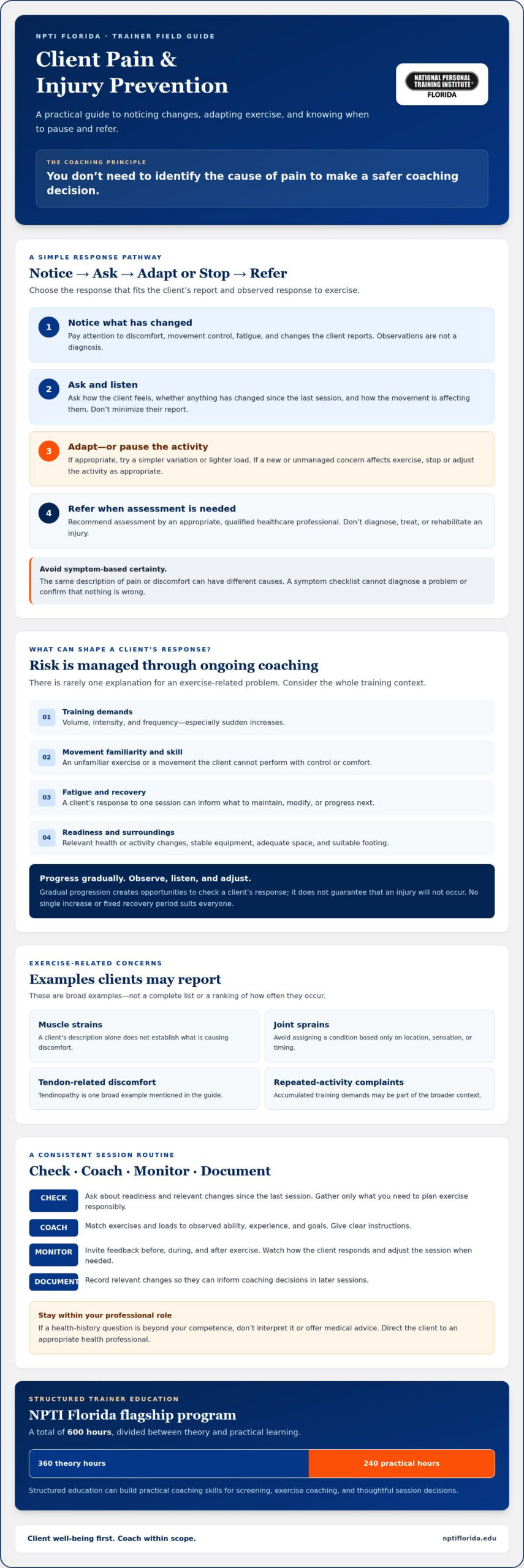
For common client injuries and prevention, start by noticing, asking, and responding within your role. A personal trainer can adapt exercise and manage avoidable training risks, but should not diagnose, treat, or rehabilitate an injury.
Which exercise-related complaints may trainers encounter?
Clients may report muscle strains, joint sprains, tendon-related discomfort such as tendinopathy, or complaints associated with repeated activity and accumulated training demands. These are broad examples, not a complete list or a ranking of what happens most often. This overview of common sports injuries provides general context on the range of issues discussed in sports and exercise.
Be cautious with labels. A client saying their shoulder hurts after lifting doesn’t establish what’s causing the pain or which structure may be involved. Ask them to describe what they’re experiencing in their own words. Don’t name a condition based only on the location, sensation, or timing of discomfort. If a new or unmanaged concern affects exercise, stop or adjust the activity as appropriate and refer the client to a qualified healthcare professional for assessment.
How is ordinary training discomfort different from a warning sign?
People experience soreness and discomfort differently. Their response can depend on the exercise, effort, familiarity, and individual context, so no single sensation reliably separates ordinary training effects from an injury. Don’t use a symptom checklist to diagnose a problem or reassure a client that nothing is wrong.
Keep communication open before, during, and after exercise. Ask how the client feels, whether anything has changed since the last session, and how a movement is affecting them. If they report pain or another concerning change, listen without minimizing it. Pause the exercise when needed, ask only relevant questions, and discuss referral rather than trying to identify the cause. This helps you make a thoughtful decision while keeping the client involved and staying within your professional limits.
Why Client Injuries Happen: Training Load, Technique, and Readiness
There’s rarely one explanation for an exercise-related problem. Training demands, movement familiarity, fatigue, recovery, health context, and the exercise environment can all influence how a client responds. Technique matters, but a movement that suits one person may not suit another at the same load or experience level. Treat risk as something to manage through ongoing coaching decisions, not as proof that a particular exercise is inherently unsafe.
A useful principle is to progress gradually. This gives you opportunities to observe how a client responds before adding more demand. It doesn’t guarantee that an injury won’t occur, but it helps you adjust training based on what you see and hear.
How do workload and recovery affect training tolerance?
A sudden increase in training volume, intensity, or frequency may be harder to tolerate, especially when exercises are unfamiliar or sessions leave a client fatigued. Track changes across these variables instead of viewing each workout in isolation. Ask for feedback and consider it alongside observed performance when planning what comes next.
Recovery needs vary. A client’s response to a session can help guide the next plan, including whether to maintain, modify, or progress the workload. There’s no single increase or fixed recovery period that suits everyone.
Why do movement skill and client readiness matter?
Choose exercises and loads to match the client’s observed ability, experience, and goals. Give clear instructions, then try a simpler variation or lighter load if the client can’t perform the movement with control or comfort. Check the surroundings too. Stable equipment, adequate space, and suitable footing can support a well-managed session.
Readiness also includes relevant changes in health or activity. Ask only what you need to plan exercise responsibly. If a client raises a health-history question beyond your competence, don’t interpret it or offer medical advice. Direct them to an appropriate healthcare professional. A suitable warm-up can help prepare clients for a session, and the Mayo Clinic’s guidance on warm-up and cool-down offers general exercise tips.
These considerations give “common client injuries and prevention” a practical coaching framework: observe the client, adjust the demands, and make responsive decisions instead of relying on a one-size-fits-all rule. Trainers who want to develop assessment and adaptation skills can explore NPTI’s Advanced Personal Training Program. Its curriculum includes assessment and corrective strategies for orthopedic and biomechanical concerns. This education supports responsible coaching, not injury diagnosis or treatment.
Injury Prevention Choices Compared: Modify, Progress, Rest, or Refer
There isn’t one response that fits every client or session. Use the client’s feedback, current capabilities, and relevant context to decide whether to adjust an exercise, reduce the session demand, stop activity, or recommend professional assessment. Good technique matters, but careful coaching and well-executed movement can’t guarantee that an injury won’t occur. Harvard Health’s Injury Prevention Guidelines also reinforce sensible exercise habits, including preparation and recovery.
| Option | When it may fit | Non-diagnostic example |
|---|---|---|
| Modify | The client can continue comfortably with an adjustment that suits their goals and ability. | Reduce a movement’s range or choose a simpler variation after the client reports discomfort. |
| Reduce session demand | The client seems unusually fatigued or says the planned workload feels harder than expected. | Lower resistance or volume, then check how the client responds. |
| Stop activity | Symptoms worsen, concern the client, or make continuing inappropriate. | End the set when discomfort increases rather than asking the client to push through. |
| Refer | The concern is new, unmanaged, or outside the trainer’s knowledge and scope. | Recommend assessment by an appropriate healthcare professional before resuming affected activity. |
These are coaching options, not a diagnostic pathway. Circumstances vary, and a modification isn’t treatment. For common client injuries and prevention, a sound decision means responding to the person in front of you, not assuming that a particular exercise or “perfect form” makes training risk-free.
When should a trainer adjust an exercise or session?
Start with the client’s report and what you observe. If an exercise feels uncomfortable but the client can continue without worsening symptoms, consider a smaller range of motion, less resistance, a simpler variation, or a different exercise that still supports their stated goal. Check in again after the change. If discomfort persists or increases, don’t keep adjusting in an effort to coach through it. Stop the activity and consider referral.
When should exercise stop and a client be referred?
Stop exercise when symptoms are concerning, worsening, or beyond your scope to assess. If the client reports potentially serious symptoms, advise them to seek urgent medical attention rather than continuing the session. Don’t diagnose the cause, promise recovery, or prescribe treatment. NPTI’s advanced personal training curriculum covers assessment and corrective strategies for orthopedic and biomechanical concerns within a fitness education context.
A Practical Injury-Prevention Routine for Every Client Session
A consistent routine helps you make thoughtful adjustments without turning a training session into a medical assessment. Keep the process simple: check in, review readiness, plan, coach, monitor, and document. Each step gives you an opportunity to respond to the client’s needs while keeping the focus on exercise and your professional scope.
What should a trainer check before exercise begins?
Start with a brief, relevant conversation. Ask how the client feels today, whether anything has changed since the last session, and whether they have a concern that could affect the planned activity. Avoid collecting personal medical details you don’t need. If a health question falls outside your qualifications, don’t try to interpret it. Follow appropriate screening guidance and refer the client to a qualified healthcare professional when needed.
Use the check-in to decide whether to proceed as planned, adjust the session, or defer exercise. Then prepare a suitable plan: choose a warm-up related to the session, explain each exercise clearly, and select resistance and complexity that fit the client’s current ability and goals. A plan is a starting point, not a reason to complete every exercise regardless of how the client responds.
How should trainers monitor and document a session?
Stay attentive while the client exercises. Check that your instructions are clear, observe the client’s response, and invite feedback throughout the session. If they report concerning symptoms, respond promptly. Stop the activity, listen to the client, and help them connect with appropriate medical care when needed. Don’t attempt to identify the cause or recommend treatment.
After a notable concern or adjustment, make a brief, factual record. Keep notes neutral and specific to the coaching decision:
- Record the client’s relevant feedback in their own words where practical.
- Note the exercise or session change and the next step agreed with the client.
- Store information securely and follow applicable privacy and record-handling policies.
For example, note that a client reported discomfort during a particular movement, that you stopped or changed the activity, and that you discussed seeking professional assessment. Avoid clinical labels or conclusions. If the client later shares guidance from a healthcare professional, don’t interpret clinical findings. Discuss only how training may be adapted within your role and any direction the client has been given to share.
This repeatable approach puts common client injuries and prevention into daily practice through communication, responsive coaching, and clear records. To build a foundation in responsible exercise coaching, explore personal training education.
Build Injury-Prevention Skills Through Structured Personal Trainer Education
Sound coaching takes more than knowing how to demonstrate an exercise. Trainers also need to make thoughtful decisions about exercise selection, progression, client communication, and when a concern calls for referral. Structured education can connect foundational knowledge with practical coaching, helping you respond to what a client can do today without confusing fitness guidance with medical assessment or treatment.
What can formal fitness education add to a trainer’s practice?
Coursework and practical learning can help future trainers build a repeatable approach: observe movement, explain exercises clearly, adapt a plan to the client’s goals and abilities, and recognize the limits of their role. Practice can also help develop confidence in communicating with clients, including listening to feedback and supporting habits that make training more consistent.
That preparation has boundaries. Fitness education doesn’t make a trainer a healthcare professional or authorize them to diagnose or treat injuries. Its value is in strengthening exercise-coaching judgment: knowing how to adjust training appropriately, communicate clearly, and seek qualified guidance when a question goes beyond the trainer’s competence. Those skills are central to responsible work with common client injuries and prevention.
How does NPTI’s curriculum relate to responsible exercise coaching?
NPTI’s flagship Advanced Personal Fitness Training program comprises 600 hours total: 360 theory hours and 240 practical hours. Its Corrective Exercise & Advanced Special Populations module covers assessment and corrective strategies for orthopedic and biomechanical conditions. This curriculum can inform exercise coaching and movement-quality decisions within a trainer’s scope. It isn’t clinical evaluation, rehabilitation, or a promise that injuries can be prevented.
For a prospective trainer, combining theory with hands-on lab learning offers an opportunity to connect concepts with practical coaching decisions. For example, understanding how to observe movement and adapt an exercise can help a trainer choose an appropriate variation. Clear communication also helps ensure the client understands the plan and can share relevant feedback.
Interested in how structured study could support your goals? Review personal training program details and ask NPTI about requesting the Student Catalog. Review the curriculum, learning format, and program information as you consider your next step toward a responsible fitness career.
Make Safer Coaching Part of Your Professional Practice
Responsible injury prevention isn’t about identifying a condition or promising to eliminate every risk. It’s a coaching process: pay attention to client feedback, adapt training to readiness and ability, and stop or refer when a concern is beyond your scope. Understanding common client injuries and prevention can help you make those decisions with care and keep the client’s well-being at the center.
Strong practice also depends on preparation. Structured education can help you build exercise knowledge, practical coaching skills, and awareness of your professional boundaries. NPTI’s flagship program includes 600 total hours: 360 theory and 240 practical hours. NPTI is accredited by ACCSC and licensed by the Florida Commission for Independent Education, License #2442.
As you consider a career in fitness, explore NPTI’s personal training education programs and request the Student Catalog. Use the catalog to review program information as you plan your next step.
Frequently Asked Questions
What are the most common injuries personal training clients experience?
Clients may report muscle strains, joint sprains, tendon-related discomfort such as tendinopathy, or complaints linked to repeated activity. These are general examples, not a ranking or a diagnosis. A client’s pain location or description alone can’t establish the cause. Ask what they’re experiencing, take their concerns seriously, and adjust or stop exercise as appropriate. Refer new or unmanaged problems to a qualified healthcare professional for assessment.
Can personal trainers prevent every client injury?
No. Trainers can manage avoidable risks, but no program or technique can guarantee that injuries won’t occur. A thoughtful approach to common client injuries and prevention includes checking a client’s readiness, adapting exercise to their current ability, progressing training sensibly, and paying attention to feedback. These steps support responsible coaching, but they don’t replace medical assessment or eliminate every risk associated with exercise.
How can a personal trainer reduce injury risk during a workout?
Begin with a relevant check-in, then choose exercises, resistance, and complexity that fit the client’s goals, experience, and current readiness. Give clear instructions, coach controlled movement, and monitor how the client responds. Adjust the plan if an exercise feels uncomfortable or the workload seems too demanding. Also check the training space and equipment. These practices help manage risk, but they can’t guarantee an injury-free session.
What should a trainer do if a client feels pain during exercise?
Pause the exercise and ask the client to describe what they’re feeling without suggesting a diagnosis. Don’t pressure them to continue or try to identify the cause. Depending on the client’s response and the circumstances, end the activity, modify the session, or recommend assessment by a qualified healthcare professional. Record relevant feedback and the steps you agreed on using clear, neutral language, and stay within your professional scope.
Is muscle soreness after exercise always an injury?
No. Soreness can occur after exercise, but people experience it differently, and soreness alone doesn’t tell a trainer whether an injury is present. Consider the client’s own description and whether the discomfort affects their ability or willingness to exercise. Don’t diagnose or dismiss a concern as ordinary soreness. If symptoms are worrying, worsening, or interfering with activity, pause or adjust training and recommend qualified medical advice as appropriate.
When should a personal trainer refer a client to a healthcare professional?
Refer a client when they report a new or unmanaged injury, symptoms that worsen or concern them, or a health question beyond your qualifications. Stop exercise if continuing doesn’t seem appropriate. If the client has potentially serious symptoms, advise them to seek urgent medical attention rather than continuing the session. Don’t diagnose, promise recovery, or recommend a treatment plan. A healthcare professional can assess the concern and provide clinical guidance.
Does corrective exercise training qualify a personal trainer to treat injuries?
No. Corrective exercise education doesn’t qualify a personal trainer to diagnose, treat, or rehabilitate injuries. It can support exercise assessment and movement coaching within a trainer’s professional scope, but it isn’t a substitute for clinical care. A trainer may adapt an exercise based on a client’s ability, for example, but should refer an injury concern to a qualified healthcare professional. Training can prepare coaches to make responsible decisions, not confer clinical authority.

What if the safest response to a client’s pain isn’t finding a substitute exercise, but stopping the session? Exercise can support health and fitness, but new pain or unusual symptoms can make it hard to know what to do next. Understanding common client injuries and prevention starts with recognizing possible problems without trying to diagnose them, and knowing when a client needs qualified medical care.
This guide explains how to respond with confidence while staying within your professional scope. You’ll learn about exercise-related problems clients may report, ways to adapt sessions to their experience and ability, and signs that mean it’s time to pause training and refer them to an appropriate healthcare professional. Thoughtful screening, sensible progression, and clear communication can help manage avoidable risks. The goal isn’t to promise that injuries can always be prevented. It’s to make sound coaching decisions that put a client’s well-being first.
Key Takeaways
- Discomfort can have many causes. Observe and communicate without attempting to diagnose an injury.
- Training load, unfamiliar movements, fatigue, and recovery can affect how a client responds. Adapt sessions to the person in front of you.
- Choose an appropriate response, from modifying an exercise to stopping activity and recommending medical assessment.
- Use a consistent session routine to check readiness, coach and monitor exercise, and document relevant changes.
- Structured education can build practical coaching skills. NPTI Florida’s flagship program includes 600 hours, comprising 360 theory and 240 practical hours.
Common Client Injuries and Exercise-Related Problems: What Trainers Should Know
Exercise-related problems range from temporary discomfort during or after activity to concerns that need assessment by a healthcare professional. A trainer can share general information and observe a client’s response to exercise, but those observations aren’t a diagnosis. Pain, stiffness, or reduced comfort can have different causes, and the same description doesn’t mean the same thing for every person.
For common client injuries and prevention, start by noticing, asking, and responding within your role. A personal trainer can adapt exercise and manage avoidable training risks, but should not diagnose, treat, or rehabilitate an injury.
Which exercise-related complaints may trainers encounter?
Clients may report muscle strains, joint sprains, tendon-related discomfort such as tendinopathy, or complaints associated with repeated activity and accumulated training demands. These are broad examples, not a complete list or a ranking of what happens most often. This overview of common sports injuries provides general context on the range of issues discussed in sports and exercise.
Be cautious with labels. A client saying their shoulder hurts after lifting doesn’t establish what’s causing the pain or which structure may be involved. Ask them to describe what they’re experiencing in their own words. Don’t name a condition based only on the location, sensation, or timing of discomfort. If a new or unmanaged concern affects exercise, stop or adjust the activity as appropriate and refer the client to a qualified healthcare professional for assessment.
How is ordinary training discomfort different from a warning sign?
People experience soreness and discomfort differently. Their response can depend on the exercise, effort, familiarity, and individual context, so no single sensation reliably separates ordinary training effects from an injury. Don’t use a symptom checklist to diagnose a problem or reassure a client that nothing is wrong.
Keep communication open before, during, and after exercise. Ask how the client feels, whether anything has changed since the last session, and how a movement is affecting them. If they report pain or another concerning change, listen without minimizing it. Pause the exercise when needed, ask only relevant questions, and discuss referral rather than trying to identify the cause. This helps you make a thoughtful decision while keeping the client involved and staying within your professional limits.
Why Client Injuries Happen: Training Load, Technique, and Readiness
There’s rarely one explanation for an exercise-related problem. Training demands, movement familiarity, fatigue, recovery, health context, and the exercise environment can all influence how a client responds. Technique matters, but a movement that suits one person may not suit another at the same load or experience level. Treat risk as something to manage through ongoing coaching decisions, not as proof that a particular exercise is inherently unsafe.
A useful principle is to progress gradually. This gives you opportunities to observe how a client responds before adding more demand. It doesn’t guarantee that an injury won’t occur, but it helps you adjust training based on what you see and hear.
How do workload and recovery affect training tolerance?
A sudden increase in training volume, intensity, or frequency may be harder to tolerate, especially when exercises are unfamiliar or sessions leave a client fatigued. Track changes across these variables instead of viewing each workout in isolation. Ask for feedback and consider it alongside observed performance when planning what comes next.
Recovery needs vary. A client’s response to a session can help guide the next plan, including whether to maintain, modify, or progress the workload. There’s no single increase or fixed recovery period that suits everyone.
Why do movement skill and client readiness matter?
Choose exercises and loads to match the client’s observed ability, experience, and goals. Give clear instructions, then try a simpler variation or lighter load if the client can’t perform the movement with control or comfort. Check the surroundings too. Stable equipment, adequate space, and suitable footing can support a well-managed session.
Readiness also includes relevant changes in health or activity. Ask only what you need to plan exercise responsibly. If a client raises a health-history question beyond your competence, don’t interpret it or offer medical advice. Direct them to an appropriate healthcare professional. A suitable warm-up can help prepare clients for a session, and the Mayo Clinic’s guidance on warm-up and cool-down offers general exercise tips.
These considerations give “common client injuries and prevention” a practical coaching framework: observe the client, adjust the demands, and make responsive decisions instead of relying on a one-size-fits-all rule. Trainers who want to develop assessment and adaptation skills can explore NPTI’s Advanced Personal Training Program. Its curriculum includes assessment and corrective strategies for orthopedic and biomechanical concerns. This education supports responsible coaching, not injury diagnosis or treatment.
Injury Prevention Choices Compared: Modify, Progress, Rest, or Refer
There isn’t one response that fits every client or session. Use the client’s feedback, current capabilities, and relevant context to decide whether to adjust an exercise, reduce the session demand, stop activity, or recommend professional assessment. Good technique matters, but careful coaching and well-executed movement can’t guarantee that an injury won’t occur. Harvard Health’s Injury Prevention Guidelines also reinforce sensible exercise habits, including preparation and recovery.
| Option | When it may fit | Non-diagnostic example |
|---|---|---|
| Modify | The client can continue comfortably with an adjustment that suits their goals and ability. | Reduce a movement’s range or choose a simpler variation after the client reports discomfort. |
| Reduce session demand | The client seems unusually fatigued or says the planned workload feels harder than expected. | Lower resistance or volume, then check how the client responds. |
| Stop activity | Symptoms worsen, concern the client, or make continuing inappropriate. | End the set when discomfort increases rather than asking the client to push through. |
| Refer | The concern is new, unmanaged, or outside the trainer’s knowledge and scope. | Recommend assessment by an appropriate healthcare professional before resuming affected activity. |
These are coaching options, not a diagnostic pathway. Circumstances vary, and a modification isn’t treatment. For common client injuries and prevention, a sound decision means responding to the person in front of you, not assuming that a particular exercise or “perfect form” makes training risk-free.
When should a trainer adjust an exercise or session?
Start with the client’s report and what you observe. If an exercise feels uncomfortable but the client can continue without worsening symptoms, consider a smaller range of motion, less resistance, a simpler variation, or a different exercise that still supports their stated goal. Check in again after the change. If discomfort persists or increases, don’t keep adjusting in an effort to coach through it. Stop the activity and consider referral.
When should exercise stop and a client be referred?
Stop exercise when symptoms are concerning, worsening, or beyond your scope to assess. If the client reports potentially serious symptoms, advise them to seek urgent medical attention rather than continuing the session. Don’t diagnose the cause, promise recovery, or prescribe treatment. NPTI’s advanced personal training curriculum covers assessment and corrective strategies for orthopedic and biomechanical concerns within a fitness education context.
A Practical Injury-Prevention Routine for Every Client Session
A consistent routine helps you make thoughtful adjustments without turning a training session into a medical assessment. Keep the process simple: check in, review readiness, plan, coach, monitor, and document. Each step gives you an opportunity to respond to the client’s needs while keeping the focus on exercise and your professional scope.
What should a trainer check before exercise begins?
Start with a brief, relevant conversation. Ask how the client feels today, whether anything has changed since the last session, and whether they have a concern that could affect the planned activity. Avoid collecting personal medical details you don’t need. If a health question falls outside your qualifications, don’t try to interpret it. Follow appropriate screening guidance and refer the client to a qualified healthcare professional when needed.
Use the check-in to decide whether to proceed as planned, adjust the session, or defer exercise. Then prepare a suitable plan: choose a warm-up related to the session, explain each exercise clearly, and select resistance and complexity that fit the client’s current ability and goals. A plan is a starting point, not a reason to complete every exercise regardless of how the client responds.
How should trainers monitor and document a session?
Stay attentive while the client exercises. Check that your instructions are clear, observe the client’s response, and invite feedback throughout the session. If they report concerning symptoms, respond promptly. Stop the activity, listen to the client, and help them connect with appropriate medical care when needed. Having a solid grasp of basic emergency response protocols can also give coaches greater peace of mind during urgent situations; learn more about Siren Training to see how first aid education supports workplace and fitness safety. Don’t attempt to identify the cause or recommend treatment.
After a notable concern or adjustment, make a brief, factual record. Keep notes neutral and specific to the coaching decision:
- Record the client’s relevant feedback in their own words where practical.
- Note the exercise or session change and the next step agreed with the client.
- Store information securely and follow applicable privacy and record-handling policies.
For example, note that a client reported discomfort during a particular movement, that you stopped or changed the activity, and that you discussed seeking professional assessment. Avoid clinical labels or conclusions. If the client later shares guidance from a healthcare professional, don’t interpret clinical findings. Discuss only how training may be adapted within your role and any direction the client has been given to share.
This repeatable approach puts common client injuries and prevention into daily practice through communication, responsive coaching, and clear records. To build a foundation in responsible exercise coaching, explore personal training education.
Build Injury-Prevention Skills Through Structured Personal Trainer Education
Sound coaching takes more than knowing how to demonstrate an exercise. Trainers also need to make thoughtful decisions about exercise selection, progression, client communication, and when a concern calls for referral. Structured education can connect foundational knowledge with practical coaching, helping you respond to what a client can do today without confusing fitness guidance with medical assessment or treatment.
What can formal fitness education add to a trainer’s practice?
Coursework and practical learning can help future trainers build a repeatable approach: observe movement, explain exercises clearly, adapt a plan to the client’s goals and abilities, and recognize the limits of their role. Practice can also help develop confidence in communicating with clients, including listening to feedback and supporting habits that make training more consistent.
That preparation has boundaries. Fitness education doesn’t make a trainer a healthcare professional or authorize them to diagnose or treat injuries. Its value is in strengthening exercise-coaching judgment: knowing how to adjust training appropriately, communicate clearly, and seek qualified guidance when a question goes beyond the trainer’s competence. Those skills are central to responsible work with common client injuries and prevention.
How does NPTI’s curriculum relate to responsible exercise coaching?
NPTI’s flagship Advanced Personal Fitness Training program comprises 600 hours total: 360 theory hours and 240 practical hours. Its Corrective Exercise & Advanced Special Populations module covers assessment and corrective strategies for orthopedic and biomechanical conditions. This curriculum can inform exercise coaching and movement-quality decisions within a trainer’s scope. It isn’t clinical evaluation, rehabilitation, or a promise that injuries can be prevented.
For a prospective trainer, combining theory with hands-on lab learning offers an opportunity to connect concepts with practical coaching decisions. For example, understanding how to observe movement and adapt an exercise can help a trainer choose an appropriate variation. Clear communication also helps ensure the client understands the plan and can share relevant feedback.
Interested in how structured study could support your goals? Review personal training program details and ask NPTI about requesting the Student Catalog. Review the curriculum, learning format, and program information as you consider your next step toward a responsible fitness career.
Make Safer Coaching Part of Your Professional Practice
Responsible injury prevention isn’t about identifying a condition or promising to eliminate every risk. It’s a coaching process: pay attention to client feedback, adapt training to readiness and ability, and stop or refer when a concern is beyond your scope. Understanding common client injuries and prevention can help you make those decisions with care and keep the client’s well-being at the center.
Strong practice also depends on preparation. Structured education can help you build exercise knowledge, practical coaching skills, and awareness of your professional boundaries. NPTI’s flagship program includes 600 total hours: 360 theory and 240 practical hours. NPTI is accredited by ACCSC and licensed by the Florida Commission for Independent Education, License #2442.
As you consider a career in fitness, explore NPTI’s personal training education programs and request the Student Catalog. Use the catalog to review program information as you plan your next step.
Frequently Asked Questions
What are the most common injuries personal training clients experience?
Clients may report muscle strains, joint sprains, tendon-related discomfort such as tendinopathy, or complaints linked to repeated activity. These are general examples, not a ranking or a diagnosis. A client’s pain location or description alone can’t establish the cause. Ask what they’re experiencing, take their concerns seriously, and adjust or stop exercise as appropriate. Refer new or unmanaged problems to a qualified healthcare professional for assessment.
Can personal trainers prevent every client injury?
No. Trainers can manage avoidable risks, but no program or technique can guarantee that injuries won’t occur. A thoughtful approach to common client injuries and prevention includes checking a client’s readiness, adapting exercise to their current ability, progressing training sensibly, and paying attention to feedback. These steps support responsible coaching, but they don’t replace medical assessment or eliminate every risk associated with exercise.
How can a personal trainer reduce injury risk during a workout?
Begin with a relevant check-in, then choose exercises, resistance, and complexity that fit the client’s goals, experience, and current readiness. Give clear instructions, coach controlled movement, and monitor how the client responds. Adjust the plan if an exercise feels uncomfortable or the workload seems too demanding. Also check the training space and equipment. These practices help manage risk, but they can’t guarantee an injury-free session.
What should a trainer do if a client feels pain during exercise?
Pause the exercise and ask the client to describe what they’re feeling without suggesting a diagnosis. Don’t pressure them to continue or try to identify the cause. Depending on the client’s response and the circumstances, end the activity, modify the session, or recommend assessment by a qualified healthcare professional. Record relevant feedback and the steps you agreed on using clear, neutral language, and stay within your professional scope.
Is muscle soreness after exercise always an injury?
No. Soreness can occur after exercise, but people experience it differently, and soreness alone doesn’t tell a trainer whether an injury is present. Consider the client’s own description and whether the discomfort affects their ability or willingness to exercise. Don’t diagnose or dismiss a concern as ordinary soreness. If symptoms are worrying, worsening, or interfering with activity, pause or adjust training and recommend qualified medical advice as appropriate.
When should a personal trainer refer a client to a healthcare professional?
Refer a client when they report a new or unmanaged injury, symptoms that worsen or concern them, or a health question beyond your qualifications. Stop exercise if continuing doesn’t seem appropriate. If the client has potentially serious symptoms, advise them to seek urgent medical attention rather than continuing the session. For acute situations, maintaining certified skills through providers like Coolangatta First Aid & CPR Training ensures trainers know how to respond safely while awaiting emergency personnel. Don’t diagnose, promise recovery, or recommend a treatment plan. A healthcare professional can assess the concern and provide clinical guidance.
Does corrective exercise training qualify a personal trainer to treat injuries?
No. Corrective exercise education doesn’t qualify a personal trainer to diagnose, treat, or rehabilitate injuries. It can support exercise assessment and movement coaching within a trainer’s professional scope, but it isn’t a substitute for clinical care. A trainer may adapt an exercise based on a client’s ability, for example, but should refer an injury concern to a qualified healthcare professional. Training can prepare coaches to make responsible decisions, not confer clinical authority.