Personal Training for Special Populations: Skills, Safety, and Career Preparation
What if adapting a workout matters just as much as choosing the right exercise? In personal training for special populations, clients may have different abilities, health considerations, and goals, so a plan that works for one person may not suit another. Trainers need to know how to make thoughtful adjustments while staying within their professional role.
Responsible training starts with learning about the client, making appropriate exercise adaptations, and recognizing when a concern calls for support from a healthcare professional. This article explains who may be included under the term “special populations,” how to approach assessment and programming, and which communication and coaching skills can support clients.
If you’re comparing specialist coursework with broader personal-training preparation, look for education that combines relevant theory with practical learning. NPTI Florida’s non-degree Advanced Personal Fitness Training program includes 600 hours: 360 theory hours and 240 hands-on lab hours. Its curriculum covers Corrective Exercise & Advanced Special Populations alongside broader training subjects. That foundation can help prepare you to adapt exercise with care, maintain clear boundaries, and continue developing as a fitness professional.
Key Takeaways
- See why personal training for special populations covers a wide range of ages, abilities, health considerations, and goals.
- Use a practical sequence to shape and refine exercise plans around each client’s needs.
- Compare planning considerations for older adults, youth, and clients with different health conditions.
- Recognize when an exercise adjustment is within a trainer’s role and when referral is appropriate.
- Learn what to look for in education that connects population-specific knowledge with coaching skills and hands-on practice.
What Does Personal Training for Special Populations Mean?
Personal training for special populations adapts exercise to a client’s abilities, goals, personal context, and relevant health considerations. The phrase describes an approach, not a single type of client or a fixed workout method. A young person, an older adult, and someone with an orthopedic or cardiopulmonary consideration may all need individualized planning, but their goals and training needs can differ significantly.
Specialized training builds on familiar fitness principles: understand the client, set meaningful goals, and choose exercises that support them. The added consideration is applying those principles with attention to the person’s movement, communication preferences, experience, and changing circumstances. A diagnosis or age category can provide context, but it does not tell a trainer what a person can do or wants to achieve.
Who may be considered a special-population client?
Examples include older adults, youth, and people with chronic or movement-related considerations, such as metabolic, neuromuscular, or orthopedic conditions. The category can also reflect circumstances that affect how someone participates in exercise. It is not a judgment about ability. Ask about the client’s goals and preferences, learn relevant context, and assess only within your training and competence. Seek consent before coaching, adjusting an exercise, or discussing sensitive information.
How is specialized personal training different from general training?
The fundamentals remain the same: communicate clearly, coach sound movement, and progress exercise thoughtfully. Specialized knowledge helps a trainer tailor exercise selection, instructions, intensity, progression, and monitoring to the individual. One client may benefit from a simpler cue or added support; another may need a different starting level or more recovery between efforts. These are individualized decisions, not assumptions based on a label.
There is also a clear professional boundary. Fitness coaching supports exercise participation and general fitness goals; it does not authorize a trainer to diagnose a condition, provide rehabilitation, or deliver medical treatment. Specialist education can deepen understanding of relevant considerations, but it does not make a personal trainer a healthcare professional. If a client’s needs call for clinical assessment or treatment, stay within your role and direct the client toward appropriate healthcare support.
How Do Trainers Adapt Exercise for Different Needs?
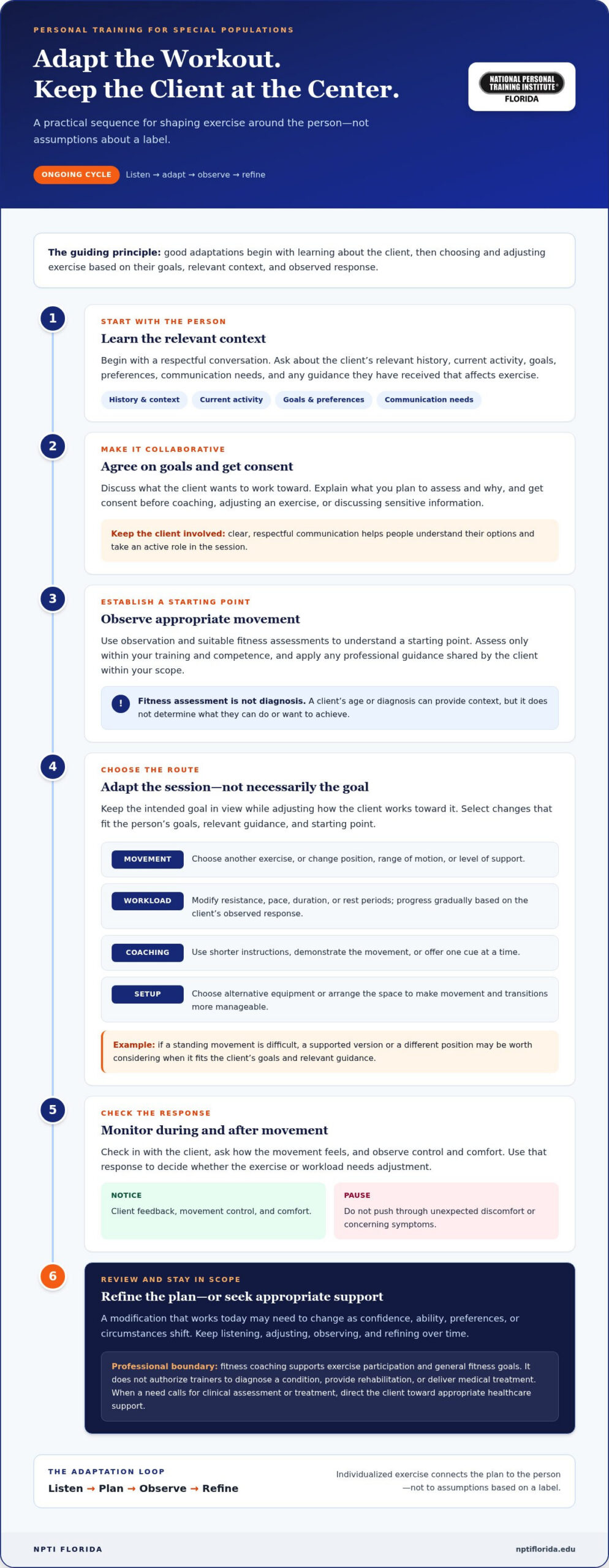
Good adaptations begin with a process, not a preset workout for a diagnosis. In personal training for special populations, the trainer gathers relevant context, agrees on goals, observes appropriate movement, selects a starting point, and monitors and reviews the plan. Each step keeps exercise connected to the person rather than to assumptions about a label.
Individualized adaptation is an ongoing cycle of listening, adjusting, observing the client’s response, and refining the plan over time. A modification that works today may need to change as confidence, ability, preferences, or circumstances shift.
What should a trainer understand before planning a session?
Start with a conversation. Ask about relevant history, current activity, goals, preferences, communication needs, and any guidance the client has received that affects exercise. Explain what you plan to assess and why, then get consent. Clear, respectful communication helps clients understand their options and take an active role in the session.
Observation and suitable fitness assessments can help establish a starting point, but they are not a way to diagnose a condition. If a client shares professional guidance, apply it within your training and scope. For additional background on accessible activity and program adaptation, consult NCHPAD resources for special populations.
Which parts of an exercise session can be adapted?
Often, the goal can stay the same while the route changes. A trainer may adjust:
- Movement: Choose another exercise or change the position, range of motion, or level of support.
- Workload: Modify resistance, pace, duration, or rest periods, then progress gradually based on the client’s observed response.
- Coaching: Use shorter instructions, demonstrate the movement, or offer one cue at a time.
- Setup: Select alternative equipment or arrange the space to make movement and transitions more manageable.
For example, if a client finds a standing movement difficult, a supported version or a different position may be worth considering if it fits their goals and relevant guidance. Check in during and after the movement: ask how it feels, observe control and comfort, and adjust if the response suggests a change. Do not push through unexpected discomfort or concerning symptoms. Pause and follow appropriate professional guidance.
Building this judgment takes both knowledge and practice. NPTI Florida’s non-degree Advanced Personal Fitness Training program combines theory with hands-on learning. The Advanced Personal Fitness Training program includes study in corrective exercise and advanced special populations.
How Do Training Considerations Differ Across Special Populations?
In personal training for special populations, the same exercise can call for different coaching decisions depending on the person’s goals, experience, relevant guidance, and response. The comparison below offers planning prompts, not universal prescriptions. Use them to guide conversation and individualized assessment, rather than to infer ability from a category.
| Client context | Planning questions | Possible adaptations | Scope cautions |
|---|---|---|---|
| Older adults | What are the person’s goals, current function, experience, and confidence with movement? | Consider support, exercise position, pace, and gradual progression based on observed movement and feedback. | Age alone does not establish capacity. Refer concerns that require clinical assessment or treatment. |
| Youth | What instruction style suits the young person’s developmental stage, interests, and experience? | Use clear demonstrations, age-appropriate goals, and suitable supervision and activities. | Keep coaching within your training and role; involve appropriate adults as relevant to the setting. |
| Orthopedic considerations | Which movements or positions are comfortable, and is there relevant professional guidance? | Explore a different exercise, range, position, or resistance when appropriate. | Do not diagnose an injury or provide rehabilitation. Seek appropriate clinical input for issues beyond fitness coaching. |
| Metabolic considerations | What relevant guidance or individual factors should inform session planning and monitoring? | Adjust session demands and rest according to the client’s goals and observed response. | Do not interpret symptoms or change medical treatment; refer questions outside your competence. |
| Cardiopulmonary considerations | What guidance applies to activity, and how does the client respond to effort? | Modify pace, duration, recovery, or exercise selection as appropriate to the client’s context. | Pause for concerning or unexpected symptoms and direct the client to appropriate healthcare support. |
| Neuromuscular considerations | What movement, balance, coordination, or communication needs should shape the session? | Consider support, setup, simple cues, and alternative exercises based on observation and client feedback. | Do not infer safety or capability from a diagnosis; seek guidance when needs exceed your expertise. |
What may change when training older adults or youth?
For an older adult, planning may center on an individual goal, current function, and confidence rather than age-based assumptions. For a young client, developmental stage, instruction style, supervision, and age-appropriate goals may influence how an activity is taught and progressed. Neither age group calls for a single template. The client’s preferences and observed response matter.
What may change with health or movement considerations?
Orthopedic, metabolic, cardiopulmonary, and neuromuscular contexts are not interchangeable. Each can raise different planning questions, so exercise choice and session demands should reflect relevant guidance and the client’s response, not a generalized rule. The Physical Activity Guidelines for Americans offer a broad evidence-based reference, but they do not replace individualized direction. People may also have overlapping identities or conditions. Labels can inform questions, but they cannot replace assessment, consent, and professional judgment.
Can Personal Trainers Work Safely With Special Populations?
Yes. Trainers can adapt fitness programming within their education, experience, and professional scope. That does not mean every exercise is appropriate for every client, or that a trainer can promise a risk-free session or a particular outcome. Responsible practice means knowing what you can coach, following relevant guidance, observing how a client responds, and pausing when a concern falls outside your competence.
Use this decision sequence to guide your work:
- Clarify your scope. Identify what you’re qualified to teach and where your role ends.
- Gather relevant context. Discuss goals, exercise experience, preferences, and guidance that may affect participation.
- Use appropriate guidance. Apply relevant professional recommendations without treating them as a diagnosis or treatment plan.
- Adapt conservatively. Choose an appropriate starting point and make adjustments based on the client’s needs and feedback.
- Monitor and document. Observe the client’s response and record goals, agreed modifications, and relevant session observations.
- Refer or consult when needed. If a question or concern exceeds your competence or available guidance, pause and direct the client toward appropriate professional support.
Where does a personal trainer’s scope of practice end?
A trainer teaches and coaches exercise. That role does not include diagnosing conditions, providing medical treatment or rehabilitation, or changing a client’s medical advice. Specialist knowledge can help you make informed fitness decisions, but it does not replace clinical expertise. If a client raises a concern you cannot confidently address within your role, do not guess or improvise. Pause, explain the limit clearly, and recommend appropriate consultation before proceeding when needed.
Good records support consistent, respectful coaching. Note the client’s stated goals, the modifications you agreed on, and relevant observations from sessions. Keep health-related conversations private and share information only as appropriate to your professional role and the client’s consent.
How can communication support a safe, respectful session?
Ask rather than assume. A client may have preferences about language, demonstrations, assistance, or equipment; invite them to explain what works. Before an exercise, describe what you’ll ask them to do and why, then check that they’re comfortable trying it. During the movement, ask about comfort and perceived effort, and welcome requests to pause or adjust. Respectful communication helps preserve dignity while giving you useful information for coaching decisions.
NPTI Florida’s non-degree, 600-hour Advanced Personal Fitness Training program includes 360 theory hours and 240 practical hours. Its curriculum combines population-specific coursework with hands-on learning to support sound coaching decisions.
How Can Specialized Education Prepare You for This Work?
Preparing for personal training for special populations takes more than memorizing exercise modifications. Trainers need population-specific knowledge, movement assessment skills, practical experience, and communication techniques that help them understand client goals and respond thoughtfully. Strong education also reinforces professional boundaries: knowing how to support fitness goals is essential, as is recognizing when a question needs clinical expertise.
NPTI Florida’s non-degree Advanced Personal Fitness Training program totals 600 hours, with 360 theory hours and 240 hands-on lab hours. It is organized into three 200-hour modules, connecting broad personal-training preparation with focused study across client needs.
What does NPTI Florida’s curriculum cover?
Corrective Exercise & Advanced Special Populations addresses corrective strategies and fitness considerations related to orthopedic, metabolic, cardiopulmonary, neuromuscular, cognitive, cancer-related, senior, and female-specific contexts. Health and Nutrition Coaching develops behavior-change, communication, and coaching skills, alongside nutrition-programming topics. Advanced Youth Fitness covers youth development, strength and conditioning, and behavior strategies. Together, these subjects connect theory to practical coaching decisions without replacing clinical training.
Details about NPTI Florida’s fitness education programs outline the curriculum and its areas of study.
How can you evaluate a learning path for this work?
Look for a curriculum that brings together relevant population knowledge, opportunities to practice movement assessment and exercise adaptation, coaching communication, and clear scope-of-practice principles. Practical learning matters because adapting a plan requires applying knowledge, observing movement, and responding to feedback, not simply recalling facts.
For a closer look at course structure, read about the advanced personal training curriculum. You can also explore the senior fitness specialist guide and the health and nutrition coaching program for related areas of study.
A well-rounded learning path can help connect these topics to day-to-day coaching decisions.
Build the Skills to Coach with Confidence
Strong personal training for special populations begins with an individual approach: adapt exercise to the client, keep communication open, and stay within your professional scope. A label never tells the whole story, so thoughtful assessment and ongoing feedback matter more than a one-size-fits-all plan. Responsible trainers also recognize when a client’s needs call for guidance beyond fitness coaching.
Preparation can help turn those principles into practical skills. NPTI Florida’s non-degree Advanced Personal Fitness Training program includes 600 hours of education, with 360 theory hours and 240 hands-on lab hours. Its curriculum brings specialized population considerations into broader personal-training education. NPTI Florida is accredited by ACCSC and licensed by the Florida Commission for Independent Education.
If you’re ready to build a foundation in movement assessment, client communication, and adaptable programming, explore NPTI Florida’s fitness education programs.
Frequently Asked Questions
What is personal training for special populations?
Personal training for special populations is fitness coaching adapted to a client’s abilities, goals, circumstances, and relevant health considerations. It can include work with older adults, youth, and people with disabilities or other conditions, but these categories do not define an individual’s capacity or needs. Trainers should tailor programming using appropriate education, client feedback, and relevant guidance. The term does not authorize trainers to diagnose or treat medical conditions.
Can a personal trainer work with clients who have medical conditions?
Yes, if the training stays within the trainer’s education, competence, and professional scope. A trainer can use relevant guidance to adapt fitness activities, monitor the client’s response, and adjust exercise accordingly. They should not diagnose or treat a condition, or make clinical decisions without appropriate qualifications. If a client’s needs exceed the trainer’s expertise or available guidance, referral or consultation is more responsible than guessing.
How do personal trainers adapt workouts for special-population clients?
Trainers start by learning about the client’s goals, preferences, relevant circumstances, and any guidance that affects exercise. They may then adjust exercise selection, position, range of motion, resistance, pace, rest, instructions, or equipment. For example, a movement might be performed with support or replaced with another exercise that better fits the client’s goals. Trainers monitor feedback and observed response, then review and refine the plan over time.
What populations are included in special-population training?
The term may include older adults, youth, and people with orthopedic, metabolic, cardiopulmonary, neuromuscular, cognitive, or other relevant considerations. Its meaning can vary across education programs and professional contexts. These categories point to areas where additional knowledge may be useful, but they are not a substitute for learning about the person. A client’s goals, preferences, abilities, and relevant guidance should inform the training plan.
What training does a personal trainer need to work with special populations?
Preparation should combine foundational exercise knowledge with population-specific education, movement assessment, communication, and practical experience adapting sessions. Trainers also need to understand professional boundaries and when referral or consultation is appropriate. NPTI Florida’s non-degree, 600-hour Advanced Personal Fitness Training program includes Corrective Exercise & Advanced Special Populations alongside Health and Nutrition Coaching and Advanced Youth Fitness. The curriculum includes 360 theory hours and 240 hands-on lab hours.
Does special-population training include older adults and youth?
Yes. Both groups may be included, but their needs and coaching considerations differ. For an older adult, planning should reflect individual goals, current function, confidence, preferences, and suitable progression. With youth, developmental stage, instruction style, supervision, and age-appropriate goals matter. Neither age group is uniform. Trainers should avoid assumptions based on age and adapt coaching to the individual’s needs, feedback, and relevant professional guidance.
What is the difference between a personal trainer and a physical therapist?
Personal trainers teach and coach exercise within their education and professional scope. Physical therapists provide clinical services within their own professional scope. A trainer should not diagnose or treat an injury or condition, or describe fitness coaching as rehabilitation. If a client needs clinical assessment or treatment, or their needs exceed the trainer’s competence, the trainer should pause and support appropriate referral or consultation.

What if adapting a workout matters just as much as choosing the right exercise? In personal training for special populations, clients may have different abilities, health considerations, and goals, so a plan that works for one person may not suit another. Trainers need to know how to make thoughtful adjustments while staying within their professional role.
Responsible training starts with learning about the client, making appropriate exercise adaptations, and recognizing when a concern calls for support from a healthcare professional. This article explains who may be included under the term “special populations,” how to approach assessment and programming, and which communication and coaching skills can support clients.
If you’re comparing specialist coursework with broader personal-training preparation, look for education that combines relevant theory with practical learning. NPTI Florida’s non-degree Advanced Personal Fitness Training program includes 600 hours: 360 theory hours and 240 hands-on lab hours. Its curriculum covers Corrective Exercise & Advanced Special Populations alongside broader training subjects. That foundation can help prepare you to adapt exercise with care, maintain clear boundaries, and continue developing as a fitness professional.
Key Takeaways
- See why personal training for special populations covers a wide range of ages, abilities, health considerations, and goals.
- Use a practical sequence to shape and refine exercise plans around each client’s needs.
- Compare planning considerations for older adults, youth, and clients with different health conditions.
- Recognize when an exercise adjustment is within a trainer’s role and when referral is appropriate.
- Learn what to look for in education that connects population-specific knowledge with coaching skills and hands-on practice.
What Does Personal Training for Special Populations Mean?
Personal training for special populations adapts exercise to a client’s abilities, goals, personal context, and relevant health considerations. The phrase describes an approach, not a single type of client or a fixed workout method. A young person, an older adult, and someone with an orthopedic or cardiopulmonary consideration may all need individualized planning, but their goals and training needs can differ significantly.
Specialized training builds on familiar fitness principles: understand the client, set meaningful goals, and choose exercises that support them. The added consideration is applying those principles with attention to the person’s movement, communication preferences, experience, and changing circumstances. A diagnosis or age category can provide context, but it does not tell a trainer what a person can do or wants to achieve.
Who may be considered a special-population client?
Examples include older adults, youth, and people with chronic or movement-related considerations, such as metabolic, neuromuscular, or orthopedic conditions. The category can also reflect circumstances that affect how someone participates in exercise. It is not a judgment about ability. Ask about the client’s goals and preferences, learn relevant context, and assess only within your training and competence. Seek consent before coaching, adjusting an exercise, or discussing sensitive information.
How is specialized personal training different from general training?
The fundamentals remain the same: communicate clearly, coach sound movement, and progress exercise thoughtfully. Specialized knowledge helps a trainer tailor exercise selection, instructions, intensity, progression, and monitoring to the individual. One client may benefit from a simpler cue or added support; another may need a different starting level or more recovery between efforts. These are individualized decisions, not assumptions based on a label.
There is also a clear professional boundary. Fitness coaching supports exercise participation and general fitness goals; it does not authorize a trainer to diagnose a condition, provide rehabilitation, or deliver medical treatment. Specialist education can deepen understanding of relevant considerations, but it does not make a personal trainer a healthcare professional. If a client’s needs call for clinical assessment or treatment, stay within your role and direct the client toward appropriate healthcare support.
How Do Trainers Adapt Exercise for Different Needs?
Good adaptations begin with a process, not a preset workout for a diagnosis. In personal training for special populations, the trainer gathers relevant context, agrees on goals, observes appropriate movement, selects a starting point, and monitors and reviews the plan. Each step keeps exercise connected to the person rather than to assumptions about a label.
Individualized adaptation is an ongoing cycle of listening, adjusting, observing the client’s response, and refining the plan over time. A modification that works today may need to change as confidence, ability, preferences, or circumstances shift.
What should a trainer understand before planning a session?
Start with a conversation. Ask about relevant history, current activity, goals, preferences, communication needs, and any guidance the client has received that affects exercise. Explain what you plan to assess and why, then get consent. Clear, respectful communication helps clients understand their options and take an active role in the session.
Observation and suitable fitness assessments can help establish a starting point, but they are not a way to diagnose a condition. If a client shares professional guidance, apply it within your training and scope. For additional background on accessible activity and program adaptation, consult NCHPAD resources for special populations.
Which parts of an exercise session can be adapted?
Often, the goal can stay the same while the route changes. A trainer may adjust:
- Movement: Choose another exercise or change the position, range of motion, or level of support.
- Workload: Modify resistance, pace, duration, or rest periods, then progress gradually based on the client’s observed response.
- Coaching: Use shorter instructions, demonstrate the movement, or offer one cue at a time.
- Setup: Select alternative equipment or arrange the space to make movement and transitions more manageable.
For example, if a client finds a standing movement difficult, a supported version or a different position may be worth considering if it fits their goals and relevant guidance. Check in during and after the movement: ask how it feels, observe control and comfort, and adjust if the response suggests a change. Do not push through unexpected discomfort or concerning symptoms. Pause and follow appropriate professional guidance.
Building this judgment takes both knowledge and practice. NPTI Florida’s non-degree Advanced Personal Fitness Training program combines theory with hands-on learning. The Advanced Personal Fitness Training program includes study in corrective exercise and advanced special populations.
How Do Training Considerations Differ Across Special Populations?
In personal training for special populations, the same exercise can call for different coaching decisions depending on the person’s goals, experience, relevant guidance, and response. The comparison below offers planning prompts, not universal prescriptions. Use them to guide conversation and individualized assessment, rather than to infer ability from a category.
| Client context | Planning questions | Possible adaptations | Scope cautions |
|---|---|---|---|
| Older adults | What are the person’s goals, current function, experience, and confidence with movement? | Consider support, exercise position, pace, and gradual progression based on observed movement and feedback. | Age alone does not establish capacity. Refer concerns that require clinical assessment or treatment. |
| Youth | What instruction style suits the young person’s developmental stage, interests, and experience? | Use clear demonstrations, age-appropriate goals, and suitable supervision and activities. | Keep coaching within your training and role; involve appropriate adults as relevant to the setting. |
| Orthopedic considerations | Which movements or positions are comfortable, and is there relevant professional guidance? | Explore a different exercise, range, position, or resistance when appropriate. | Do not diagnose an injury or provide rehabilitation. Seek appropriate clinical input for issues beyond fitness coaching. |
| Metabolic considerations | What relevant guidance or individual factors should inform session planning and monitoring? | Adjust session demands and rest according to the client’s goals and observed response. | Do not interpret symptoms or change medical treatment; refer questions outside your competence. |
| Cardiopulmonary considerations | What guidance applies to activity, and how does the client respond to effort? | Modify pace, duration, recovery, or exercise selection as appropriate to the client’s context. | Pause for concerning or unexpected symptoms and direct the client to appropriate healthcare support. |
| Neuromuscular considerations | What movement, balance, coordination, or communication needs should shape the session? | Consider support, setup, simple cues, and alternative exercises based on observation and client feedback. | Do not infer safety or capability from a diagnosis; seek guidance when needs exceed your expertise. |
What may change when training older adults or youth?
For an older adult, planning may center on an individual goal, current function, and confidence rather than age-based assumptions. For a young client, developmental stage, instruction style, supervision, and age-appropriate goals may influence how an activity is taught and progressed. Neither age group calls for a single template. The client’s preferences and observed response matter.
What may change with health or movement considerations?
Orthopedic, metabolic, cardiopulmonary, and neuromuscular contexts are not interchangeable. Each can raise different planning questions, so exercise choice and session demands should reflect relevant guidance and the client’s response, not a generalized rule. The Physical Activity Guidelines for Americans offer a broad evidence-based reference, but they do not replace individualized direction. People may also have overlapping identities or conditions. Labels can inform questions, but they cannot replace assessment, consent, and professional judgment.
Can Personal Trainers Work Safely With Special Populations?
Yes. Trainers can adapt fitness programming within their education, experience, and professional scope. That does not mean every exercise is appropriate for every client, or that a trainer can promise a risk-free session or a particular outcome. Responsible practice means knowing what you can coach, following relevant guidance, observing how a client responds, and pausing when a concern falls outside your competence.
Use this decision sequence to guide your work:
- Clarify your scope. Identify what you’re qualified to teach and where your role ends.
- Gather relevant context. Discuss goals, exercise experience, preferences, and guidance that may affect participation.
- Use appropriate guidance. Apply relevant professional recommendations without treating them as a diagnosis or treatment plan.
- Adapt conservatively. Choose an appropriate starting point and make adjustments based on the client’s needs and feedback.
- Monitor and document. Observe the client’s response and record goals, agreed modifications, and relevant session observations.
- Refer or consult when needed. If a question or concern exceeds your competence or available guidance, pause and direct the client toward appropriate professional support.
Where does a personal trainer’s scope of practice end?
A trainer teaches and coaches exercise. That role does not include diagnosing conditions, providing medical treatment or rehabilitation, or changing a client’s medical advice. Specialist knowledge can help you make informed fitness decisions, but it does not replace clinical expertise. If a client raises a concern you cannot confidently address within your role, do not guess or improvise. Pause, explain the limit clearly, and recommend appropriate consultation before proceeding when needed.
Good records support consistent, respectful coaching. Note the client’s stated goals, the modifications you agreed on, and relevant observations from sessions. Keep health-related conversations private and share information only as appropriate to your professional role and the client’s consent.
How can communication support a safe, respectful session?
Ask rather than assume. A client may have preferences about language, demonstrations, assistance, or equipment; invite them to explain what works. Before an exercise, describe what you’ll ask them to do and why, then check that they’re comfortable trying it. During the movement, ask about comfort and perceived effort, and welcome requests to pause or adjust. Respectful communication helps preserve dignity while giving you useful information for coaching decisions.
NPTI Florida’s non-degree, 600-hour Advanced Personal Fitness Training program includes 360 theory hours and 240 practical hours. Its curriculum combines population-specific coursework with hands-on learning to support sound coaching decisions.
How Can Specialized Education Prepare You for This Work?
Preparing for personal training for special populations takes more than memorizing exercise modifications. Trainers need population-specific knowledge, movement assessment skills, practical experience, and communication techniques that help them understand client goals and respond thoughtfully. Strong education also reinforces professional boundaries: knowing how to support fitness goals is essential, as is recognizing when a question needs clinical expertise.
NPTI Florida’s non-degree Advanced Personal Fitness Training program totals 600 hours, with 360 theory hours and 240 hands-on lab hours. It is organized into three 200-hour modules, connecting broad personal-training preparation with focused study across client needs.
What does NPTI Florida’s curriculum cover?
Corrective Exercise & Advanced Special Populations addresses corrective strategies and fitness considerations related to orthopedic, metabolic, cardiopulmonary, neuromuscular, cognitive, cancer-related, senior, and female-specific contexts. Health and Nutrition Coaching develops behavior-change, communication, and coaching skills, alongside nutrition-programming topics. Advanced Youth Fitness covers youth development, strength and conditioning, and behavior strategies. Together, these subjects connect theory to practical coaching decisions without replacing clinical training.
Details about NPTI Florida’s fitness education programs outline the curriculum and its areas of study.
How can you evaluate a learning path for this work?
Look for a curriculum that brings together relevant population knowledge, opportunities to practice movement assessment and exercise adaptation, coaching communication, and clear scope-of-practice principles. Practical learning matters because adapting a plan requires applying knowledge, observing movement, and responding to feedback, not simply recalling facts.
For a closer look at course structure, read about the advanced personal training curriculum. You can also explore the senior fitness specialist guide and the health and nutrition coaching program for related areas of study.
A well-rounded learning path can help connect these topics to day-to-day coaching decisions.
Build the Skills to Coach with Confidence
Strong personal training for special populations begins with an individual approach: adapt exercise to the client, keep communication open, and stay within your professional scope. A label never tells the whole story, so thoughtful assessment and ongoing feedback matter more than a one-size-fits-all plan. Responsible trainers also recognize when a client’s needs call for guidance beyond fitness coaching.
Preparation can help turn those principles into practical skills. NPTI Florida’s non-degree Advanced Personal Fitness Training program includes 600 hours of education, with 360 theory hours and 240 hands-on lab hours. Its curriculum brings specialized population considerations into broader personal-training education. NPTI Florida is accredited by ACCSC and licensed by the Florida Commission for Independent Education.
If you’re ready to build a foundation in movement assessment, client communication, and adaptable programming, explore NPTI Florida’s fitness education programs.
Frequently Asked Questions
What is personal training for special populations?
Personal training for special populations is fitness coaching adapted to a client’s abilities, goals, circumstances, and relevant health considerations. It can include work with older adults, youth, and people with disabilities or other conditions, but these categories do not define an individual’s capacity or needs. Trainers should tailor programming using appropriate education, client feedback, and relevant guidance. The term does not authorize trainers to diagnose or treat medical conditions.
Can a personal trainer work with clients who have medical conditions?
Yes, if the training stays within the trainer’s education, competence, and professional scope. A trainer can use relevant guidance to adapt fitness activities, monitor the client’s response, and adjust exercise accordingly. They should not diagnose or treat a condition, or make clinical decisions without appropriate qualifications. If a client’s needs exceed the trainer’s expertise or available guidance, referral or consultation is more responsible than guessing.
How do personal trainers adapt workouts for special-population clients?
Trainers start by learning about the client’s goals, preferences, relevant circumstances, and any guidance that affects exercise. They may then adjust exercise selection, position, range of motion, resistance, pace, rest, instructions, or equipment. For example, a movement might be performed with support or replaced with another exercise that better fits the client’s goals. Trainers monitor feedback and observed response, then review and refine the plan over time.
What populations are included in special-population training?
The term may include older adults, youth, and people with orthopedic, metabolic, cardiopulmonary, neuromuscular, cognitive, or other relevant considerations. Its meaning can vary across education programs and professional contexts. These categories point to areas where additional knowledge may be useful, but they are not a substitute for learning about the person. A client’s goals, preferences, abilities, and relevant guidance should inform the training plan.
What training does a personal trainer need to work with special populations?
Preparation should combine foundational exercise knowledge with population-specific education, movement assessment, communication, and practical experience adapting sessions. Trainers also need to understand professional boundaries and when referral or consultation is appropriate. NPTI Florida’s non-degree, 600-hour Advanced Personal Fitness Training program includes Corrective Exercise & Advanced Special Populations alongside Health and Nutrition Coaching and Advanced Youth Fitness. The curriculum includes 360 theory hours and 240 hands-on lab hours.
Does special-population training include older adults and youth?
Yes. Both groups may be included, but their needs and coaching considerations differ. For an older adult, planning should reflect individual goals, current function, confidence, preferences, and suitable progression. With youth, developmental stage, instruction style, supervision, and age-appropriate goals matter. Neither age group is uniform. Trainers should avoid assumptions based on age and adapt coaching to the individual’s needs, feedback, and relevant professional guidance.
What is the difference between a personal trainer and a physical therapist?
Personal trainers teach and coach exercise within their education and professional scope. Physical therapists provide clinical services within their own professional scope. A trainer should not diagnose or treat an injury or condition, or describe fitness coaching as rehabilitation. If a client needs clinical assessment or treatment, or their needs exceed the trainer’s competence, the trainer should pause and support appropriate referral or consultation.