Mastering the First Meeting: The Ultimate Personal Trainer Consultation Questions Checklist
What if your first meeting with a prospect wasn’t a sales pitch, but the first 60 minutes of a science-based transformation? Most trainers feel like they’re playing the role of a salesperson rather than a coach during that initial gym tour. It’s a common frustration. You want to focus on movement and physiology, yet you’re stuck worrying about how to handle objections or missing a critical medical red flag. This guide provides the high-impact personal trainer consultation questions that shift the dynamic from “selling” to “prescribing” based on vocational precision.
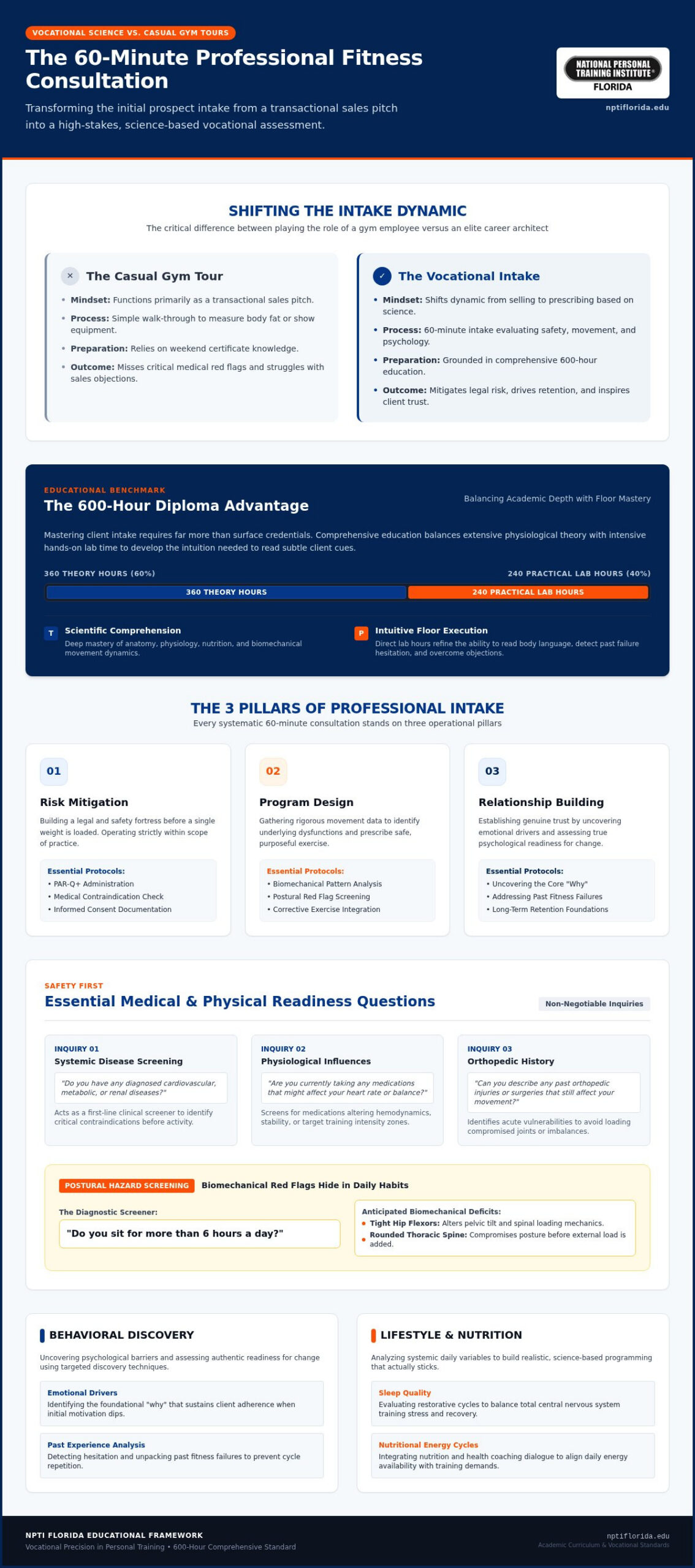
We’ll explore a repeatable intake framework rooted in the same principles found in a 600-hour comprehensive diploma, which balances 360 theory hours with 240 practical lab hours. You’ll discover how to integrate health and nutrition coaching into your dialogue to build immediate trust. This approach ensures your client conversion rates rise alongside your confidence in designing safe, effective programs. It’s time to move beyond mere credentials and embrace the role of a career architect who understands the nuances of the industry from the very first handshake.
Key Takeaways
- Transform the initial meeting from a basic tour into a systematic intake process focused on risk mitigation and professional relationship building.
- Identify critical medical red flags by asking the right personal trainer consultation questions regarding cardiovascular health and medication use.
- Uncover psychological barriers and assess a client’s true readiness for change using targeted behavioral discovery techniques.
- Analyze lifestyle variables, including sleep quality and nutritional energy cycles, to design science-based programs that actually stick.
- Bridge the gap between theory and practice by understanding how 240 hands-on lab hours refine your ability to handle complex client objections.
What is a Professional Fitness Consultation?
A professional fitness consultation is far more than a casual walk-through of the weight room. It is a systematic intake process designed to evaluate health risks, physical capabilities, and psychological readiness before a single weight is lifted. While some competitors describe this window as a simple session to measure body fat, true professionals recognize it as a high-stakes vocational assessment. It’s the difference between being a gym employee and a career architect. This 60-minute interaction sets the foundation for everything that follows, shifting the dynamic from a transactional “gym tour” to a science-based intake.
The process relies on three critical pillars. First is Risk Mitigation, where you identify medical contraindications. Second is Program Design, where you gather data on physical movement patterns. Third is Relationship Building, which focuses on the psychological connection between coach and client. A weekend certificate rarely provides the depth needed to master these nuances. In contrast, a comprehensive personal training program rooted in 600 hours of education ensures you have the vocational precision to ask the right personal trainer consultation questions from the start.
The Legal and Safety Necessity of Consultations
Safety is your primary responsibility. Establishing professional boundaries and liability protection begins the moment your client sits down. Using a PAR-Q+ (Physical Activity Readiness Questionnaire) is a non-negotiable starting point for any professional. This document helps you operate within the personal trainer scope of practice, ensuring you don’t overstep into clinical physical therapy or medical diagnosis. Informed consent is equally vital. It protects your business while clearly outlining what the client can expect from your professional relationship. You aren’t just checking boxes; you’re building a legal and safety fortress for your practice.
Setting the Stage for Long-Term Retention
Great trainers don’t just hear a client’s goals; they understand their “why.” This distinction is what drives long-term retention. During the intake, your ability to read body language and subtle cues is paramount. This level of intuition is built through experience, specifically the 240 hours of hands-on lab time included in a 600-hour diploma program. When you balance 360 hours of theory with practical application, you learn to spot the hesitation in a client’s voice when they discuss past failures. By using targeted personal trainer consultation questions, you move past surface-level desires and uncover the emotional drivers that keep clients committed when motivation inevitably dips. This transition from a transactional mindset to a career-focused approach is what separates industry leaders from the rest.
Essential Medical and Physical Readiness Questions
What if the most significant risk in your gym isn’t a heavy barbell, but a client’s undisclosed heart condition? When you dive into personal trainer consultation questions, you’re acting as a first-line screener for your client’s safety. This isn’t just about gathering data. It’s about building a professional wall of protection for both your practice and the person standing in front of you. You must move beyond surface-level inquiries to uncover the physiological realities that will dictate your program design.
Start with these non-negotiable medical inquiries:
- Do you have any diagnosed cardiovascular, metabolic, or renal diseases?
- Are you currently taking any medications that might affect your heart rate or balance?
- Can you describe any past orthopedic injuries or surgeries that still affect your movement?
Fitness professionals must identify and address underlying movement dysfunctions before introducing external loads to prevent exacerbating existing imbalances or causing acute injury. This proactive approach ensures that every exercise you prescribe serves a specific, safe purpose.
Screening for Movement Dysfunction
Biomechanical red flags often hide in a client’s daily habits. Asking a simple question like “Do you sit for more than 6 hours a day?” can reveal likely tight hip flexors or a rounded thoracic spine before you even begin a physical assessment. These lifestyle cues allow you to apply the Advanced Personal Training Curriculum with precision. By identifying these postural hazards early, you can integrate corrective exercises that address the root cause of potential pain. This level of detail is exactly what separates a professional coach from a casual instructor.
Special Populations and Safety
Working with senior clients or individuals with chronic conditions requires a deep understanding of pathology. You need to know when a client’s health status necessitates a medical clearance form from their physician. Referencing the Physical Activity Guidelines for Americans helps you establish realistic baseline benchmarks for aerobic and muscle-strengthening activities. If a client falls significantly below these standards, your initial focus must be on foundational stability rather than high-intensity performance. Mastering these safety protocols is a cornerstone of the Advanced Personal Training Program, where you learn to navigate complex health histories with confidence and vocational authority.
Behavioral and Psychology Discovery Questions
While medical screening ensures a client’s safety, behavioral discovery ensures their success. Most trainers fail because they focus solely on the “what” rather than the “why.” If you only ask about weight loss goals, you’re missing the psychological engine that drives adherence. To truly excel, you must integrate science-based personal trainer consultation questions that uncover a client’s readiness for change. You are not just a trainer; you are a coach who understands the complexities of human behavior.
Start with these high-impact discovery questions:
- What has stopped you from achieving this goal in the past?
- On a scale of 1-10, how ready are you to change your daily habits today?
- What does your “perfect” support system look like at home or work?
- How do you typically respond to setbacks or missed sessions?
These inquiries provide a roadmap for your coaching strategy. If a client rates their readiness below a seven, you know you must focus on building foundational habits before pushing for high-intensity performance. Understanding their response to setbacks allows you to build a plan that accounts for the reality of a busy life, rather than an idealized version of it.
The Psychology of Client Adherence
Predicting and preventing client “ghosting” starts during the first hour. By identifying whether a client is driven by intrinsic joy or extrinsic pressure, you can tailor your cues and feedback. This high-level communication isn’t just a soft skill; it’s a vocational necessity. This is why the Health and Nutrition Coaching module within our 600-hour program is so critical. It bridges the gap between knowing the science and applying it to a human being with a complex life. When you balance 360 hours of theory with 240 practical lab hours, you learn to read the subtle cues that signal a client’s true commitment level.
Identifying Barriers to Success
Success often hides behind obstacles that have nothing to do with the gym floor. Sleep hygiene, chronic stress, and poor time management are the “hidden” barriers that derail even the best programs. Utilizing a structured initial client consultation and screening process helps you build rapport through active listening and professional empathy. Don’t settle for surface-level answers. Employ the “Five Whys” technique to dig deeper than “I want to lose weight.” When you understand the core emotional driver, you become a career architect for their wellness. If you’re ready to master these professional nuances, consider how our Advanced Personal Training Program can elevate your intake process.
Lifestyle, Nutrition, and Commitment Assessment
Training sessions usually account for only three to five hours of a client’s week. The remaining 163 to 165 hours determine whether they succeed or plateau. To bridge this gap, you must utilize personal trainer consultation questions that probe into the client’s daily recovery and metabolic habits. You aren’t just looking for a food log; you’re looking for the physiological context that supports or hinders progress. Sleep, energy cycles, and time management are the invisible variables that dictate your program’s effectiveness.
Integrate these specific inquiries into your intake process:
- How many hours of actual sleep do you get on an average weeknight?
- Can you describe your typical energy levels throughout the day (morning, afternoon, evening)?
- How much time can you realistically commit to exercise outside of our sessions?
- What is your current relationship with meal planning and home cooking?
Understanding energy fluctuations helps you schedule sessions when the client is most capable of high-intensity effort. Similarly, knowing their sleep patterns allows you to adjust volume and intensity to prevent overtraining. You are building a lifestyle architecture, not just a workout plan.
Nutrition Coaching as a Career Differentiator
Nutrition is often where clients struggle most. Moving beyond a simple 24-hour food recall, you should ask about “Modern Meal Planning” to understand how their environment affects their choices. Do they rely on delivery apps? Do they have the skills to prep at home? Providing this guidance requires staying within your professional scope of practice, focusing on habit formation rather than clinical dietetics. Mastering this balance is a core component of being a “career architect.” For a deeper look at how to integrate these skills, consult our Health and Nutrition Coaching Program Guide.
Managing Expectations and Logistics
Misaligned expectations are the primary cause of early cancellations. You must clarify whether the client needs a “Coach” to provide technical expertise or a “Cheerleader” for external motivation. Establishing this role early prevents friction later. Be direct about budget and schedule flexibility. If a client can only commit to one day a week but expects radical transformation, you must use your vocational authority to reset those goals. This “Contract of Success” ensures both parties are aligned on the work required. If you’re ready to master the art of the professional intake, start your journey with NPTI Florida today.
Mastering the Consultation: From Questions to Career Success
You now have a framework for the most impactful personal trainer consultation questions. Execution is the next hurdle. It isn’t enough to simply read from a checklist; you must deliver these inquiries with the authority of a seasoned professional. Clients don’t just buy a workout. They buy into your expertise and your ability to lead them through a safe, science-based transformation. Moving from a novice to a career architect requires a structured approach to your professional development.
Follow these steps to ensure your intake process is flawless:
- Step 1: Complete a comprehensive personal training program. This provides the scientific bedrock for every inquiry you make.
- Step 2: Accumulate lab hours practicing intake with diverse populations. Real-world repetition is the only way to build professional intuition.
- Step 3: Develop a standardized, digital or physical intake form. Consistency ensures you never miss a medical red flag or a psychological cue.
- Step 4: Role-play consultations. Practicing your delivery with peers helps you build fluidity and confidence before you ever meet a paying prospect.
Why 600 Hours Matters for Your Consultations
A two-day certificate might give you a list of questions, but a 600-hour vocational diploma gives you the “why” behind them. With 360 hours of theory, you understand the physiological and metabolic consequences of a client’s answers. You aren’t just hearing them; you’re analyzing them. The 240 hours of hands-on lab time provides the confidence that only comes from repetition. You learn to read body language and handle objections in a controlled environment. This depth of education transforms you from a trainer who asks questions into an expert who provides solutions.
The NPTI Florida Advantage
Our ACCSC accredited institution prepares you for high-stakes environments, ranging from elite athletic programs to specialized rehab centers. We understand that modern students need options. Our Hyflex Learning Program balances the convenience of remote theory with the necessity of in-person practical mastery. This isn’t just about getting a credential. It’s about investing in a foundational education that supports career longevity. It’s time to turn your passion for fitness into a stable, licensed career. Join a legacy of over 25 years of excellence and start your journey toward professional mastery today.
Elevate Your Intake Process Today
Mastering the initial meeting is about more than a simple checklist; it’s about establishing your authority as a career architect from the very first handshake. By integrating these high-impact personal trainer consultation questions into your practice, you shift from a casual gym tour to a professional vocational assessment. You now have the tools to screen for medical red flags, uncover deep psychological drivers, and analyze the lifestyle variables that dictate long-term client success.
This level of precision requires a foundation built on science and practical application. Our 600-hour comprehensive diploma provides exactly that, balancing 360 hours of theory with 240 hours of hands-on lab work. As an ACCSC accredited and veteran-owned institution, we focus on the professional evolution of our students rather than just providing credentials. It’s about ensuring you’re ready for the realities of the fitness industry.
Ready to turn your passion into a stable, licensed career? Start Your Professional Fitness Career with NPTI Florida and gain the confidence to lead every client toward lasting results. Your journey toward becoming an industry leader starts with a single, professional step.
Frequently Asked Questions
What is the most important question to ask a new personal training client?
The most important question identifies the client’s core motivation and past obstacles, such as asking “What has stopped you from achieving this goal in the past?” This inquiry uncovers the psychological engine behind their commitment. By understanding their “why,” you can tailor your coaching strategy to prevent future setbacks. This approach is a hallmark of professional health and nutrition coaching, ensuring you address the person, not just the physical goal.
How long should a professional fitness consultation take?
A professional fitness consultation typically takes 45 to 60 minutes to complete thoroughly. This timeframe allows you to balance medical screening, movement assessments, and psychological discovery without rushing the relationship-building process. Rushing this window often leads to missed red flags or a lack of client buy-in. Using a structured intake framework ensures you cover all critical personal trainer consultation questions while respecting the client’s schedule and maintaining a professional momentum.
Do I need a medical degree to ask health-related questions?
You don’t need a medical degree to ask health-related questions, but you must operate within the personal trainer scope of practice. Your role is to screen for known risks and identify when a client needs a physician’s clearance. Professional programs, like a 600-hour diploma, provide the theory needed to understand pathologies without overstepping into medical diagnosis. This vocational precision ensures you protect your clients and your practice from a legal standpoint.
What should I do if a client refuses to answer medical questions?
If a client refuses to answer essential medical questions, you should explain that you cannot safely design a program or mitigate injury risks without that data. Professional training is a science-based practice, and incomplete information creates a significant liability. You must maintain your professional boundaries. If the client remains unwilling to share necessary health history, it is often best to decline the training relationship to ensure their safety and your career’s longevity.
How do consultation questions change for senior fitness clients?
Consultation questions for senior fitness clients shift toward functional independence, balance, and chronic disease management. You should ask specific questions about medications that might affect heart rate or stability during movement. Understanding their ability to perform activities of daily living (ADLs) becomes a priority. This specialized approach is covered extensively in the 600-hour curriculum, ensuring you can safely adapt your intake process for populations with complex orthopedic or metabolic histories.
Can I conduct a personal trainer consultation online or via video?
Yes, you can conduct personal trainer consultation questions via video, though it requires a different approach to physical assessments. While you can still gather medical history and psychological data, movement screens may be limited by camera angles and space. Many professionals use a hybrid model, conducting the discovery phase online and the physical lab work in person. This flexibility is similar to the Hyflex Learning Program, which balances remote theory with hands-on practical mastery.
What is a PAR-Q+ and why is it used in consultations?
The PAR-Q+ is the Physical Activity Readiness Questionnaire, a standardized tool used to determine if a client is safe to begin an exercise program. It serves as a non-negotiable legal and safety document that screens for cardiovascular, metabolic, and renal risks. By using this form, you ensure that you are following industry-standard safety protocols. It is the first line of defense in risk mitigation, protecting both the client’s health and the trainer’s professional liability.
How do I transition from the consultation to the first paid session?
Transitioning to the first paid session involves summarizing the intake findings and presenting a clear, science-based path forward. Once you’ve addressed their goals and risks, ask for their commitment to the “Contract of Success.” Explain how your 600-hour training framework, including 240 hours of lab work, will be applied to their needs. Finalize the logistics, schedule the first workout, and collect the initial payment to solidify the professional agreement and move into action.

What if your first meeting with a prospect wasn’t a sales pitch, but the first 60 minutes of a science-based transformation? Most trainers feel like they’re playing the role of a salesperson rather than a coach during that initial gym tour. It’s a common frustration. You want to focus on movement and physiology, yet you’re stuck worrying about how to handle objections or missing a critical medical red flag. This guide provides the high-impact personal trainer consultation questions that shift the dynamic from “selling” to “prescribing” based on vocational precision.
We’ll explore a repeatable intake framework rooted in the same principles found in a 600-hour comprehensive diploma, which balances 360 theory hours with 240 practical lab hours. You’ll discover how to integrate health and nutrition coaching into your dialogue to build immediate trust. This approach ensures your client conversion rates rise alongside your confidence in designing safe, effective programs. It’s time to move beyond mere credentials and embrace the role of a career architect who understands the nuances of the industry from the very first handshake.
Key Takeaways
- Transform the initial meeting from a basic tour into a systematic intake process focused on risk mitigation and professional relationship building.
- Identify critical medical red flags by asking the right personal trainer consultation questions regarding cardiovascular health and medication use.
- Uncover psychological barriers and assess a client’s true readiness for change using targeted behavioral discovery techniques.
- Analyze lifestyle variables, including sleep quality and nutritional energy cycles, to design science-based programs that actually stick.
- Bridge the gap between theory and practice by understanding how 240 hands-on lab hours refine your ability to handle complex client objections.
What is a Professional Fitness Consultation?
A professional fitness consultation is far more than a casual walk-through of the weight room. It is a systematic intake process designed to evaluate health risks, physical capabilities, and psychological readiness before a single weight is lifted. While some competitors describe this window as a simple session to measure body fat, true professionals recognize it as a high-stakes vocational assessment. It’s the difference between being a gym employee and a career architect. This 60-minute interaction sets the foundation for everything that follows, shifting the dynamic from a transactional “gym tour” to a science-based intake.
The process relies on three critical pillars. First is Risk Mitigation, where you identify medical contraindications. Second is Program Design, where you gather data on physical movement patterns. Third is Relationship Building, which focuses on the psychological connection between coach and client. A weekend certificate rarely provides the depth needed to master these nuances. In contrast, a comprehensive personal training program rooted in 600 hours of education ensures you have the vocational precision to ask the right personal trainer consultation questions from the start.
The Legal and Safety Necessity of Consultations
Safety is your primary responsibility. Establishing professional boundaries and liability protection begins the moment your client sits down. Using a PAR-Q+ (Physical Activity Readiness Questionnaire) is a non-negotiable starting point for any professional. This document helps you operate within the personal trainer scope of practice, ensuring you don’t overstep into clinical physical therapy or medical diagnosis. Informed consent is equally vital. It protects your business while clearly outlining what the client can expect from your professional relationship. You aren’t just checking boxes; you’re building a legal and safety fortress for your practice.
Setting the Stage for Long-Term Retention
Great trainers don’t just hear a client’s goals; they understand their “why.” This distinction is what drives long-term retention. During the intake, your ability to read body language and subtle cues is paramount. This level of intuition is built through experience, specifically the 240 hours of hands-on lab time included in a 600-hour diploma program. When you balance 360 hours of theory with practical application, you learn to spot the hesitation in a client’s voice when they discuss past failures. By using targeted personal trainer consultation questions, you move past surface-level desires and uncover the emotional drivers that keep clients committed when motivation inevitably dips. This transition from a transactional mindset to a career-focused approach is what separates industry leaders from the rest.
Essential Medical and Physical Readiness Questions
What if the most significant risk in your gym isn’t a heavy barbell, but a client’s undisclosed heart condition? When you dive into personal trainer consultation questions, you’re acting as a first-line screener for your client’s safety. This isn’t just about gathering data. It’s about building a professional wall of protection for both your practice and the person standing in front of you. You must move beyond surface-level inquiries to uncover the physiological realities that will dictate your program design.
Start with these non-negotiable medical inquiries:
- Do you have any diagnosed cardiovascular, metabolic, or renal diseases?
- Are you currently taking any medications that might affect your heart rate or balance?
- Can you describe any past orthopedic injuries or surgeries that still affect your movement?
Fitness professionals must identify and address underlying movement dysfunctions before introducing external loads to prevent exacerbating existing imbalances or causing acute injury. This proactive approach ensures that every exercise you prescribe serves a specific, safe purpose. If a client’s movement challenges seem related to visual-motor integration, you might check out Hope Vision for specialized therapy that can enhance their physical progress.
Biomechanical red flags often hide in a client’s daily habits. Asking a simple question like “Do you sit for more than 6 hours a day?” can reveal likely tight hip flexors or a rounded thoracic spine before you even begin a physical assessment. These lifestyle cues allow you to apply the Advanced Personal Training Curriculum with precision. By identifying these postural hazards early, you can integrate corrective exercises that address the root cause of potential pain. This level of detail is exactly what separates a professional coach from a casual instructor.
Special Populations and Safety
Working with senior clients or individuals with chronic conditions requires a deep understanding of pathology. You need to know when a client’s health status necessitates a medical clearance form from their physician. Referencing the Physical Activity Guidelines for Americans helps you establish realistic baseline benchmarks for aerobic and muscle-strengthening activities. If a client falls significantly below these standards, your initial focus must be on foundational stability rather than high-intensity performance. Mastering these safety protocols is a cornerstone of the Advanced Personal Training Program, where you learn to navigate complex health histories with confidence and vocational authority.
Behavioral and Psychology Discovery Questions
While medical screening ensures a client’s safety, behavioral discovery ensures their success. Most trainers fail because they focus solely on the “what” rather than the “why.” If you only ask about weight loss goals, you’re missing the psychological engine that drives adherence. To truly excel, you must integrate science-based personal trainer consultation questions that uncover a client’s readiness for change. You are not just a trainer; you are a coach who understands the complexities of human behavior.
Start with these high-impact discovery questions:
- What has stopped you from achieving this goal in the past?
- On a scale of 1-10, how ready are you to change your daily habits today?
- What does your “perfect” support system look like at home or work?
- How do you typically respond to setbacks or missed sessions?
These inquiries provide a roadmap for your coaching strategy. If a client rates their readiness below a seven, you know you must focus on building foundational habits before pushing for high-intensity performance. Understanding their response to setbacks allows you to build a plan that accounts for the reality of a busy life, rather than an idealized version of it.
The Psychology of Client Adherence
Predicting and preventing client “ghosting” starts during the first hour. By identifying whether a client is driven by intrinsic joy or extrinsic pressure, you can tailor your cues and feedback. This high-level communication isn’t just a soft skill; it’s a vocational necessity. This is why the Health and Nutrition Coaching module within our 600-hour program is so critical. It bridges the gap between knowing the science and applying it to a human being with a complex life. When you balance 360 hours of theory with 240 practical lab hours, you learn to read the subtle cues that signal a client’s true commitment level.
Identifying Barriers to Success
Success often hides behind obstacles that have nothing to do with the gym floor. Sleep hygiene, chronic stress, and poor time management are the “hidden” barriers that derail even the best programs. Utilizing a structured initial client consultation and screening process helps you build rapport through active listening and professional empathy. Don’t settle for surface-level answers. Employ the “Five Whys” technique to dig deeper than “I want to lose weight.” When you understand the core emotional driver, you become a career architect for their wellness. If you’re ready to master these professional nuances, consider how our Advanced Personal Training Program can elevate your intake process.
Lifestyle, Nutrition, and Commitment Assessment
Training sessions usually account for only three to five hours of a client’s week. The remaining 163 to 165 hours determine whether they succeed or plateau. To bridge this gap, you must utilize personal trainer consultation questions that probe into the client’s daily recovery and metabolic habits. You aren’t just looking for a food log; you’re looking for the physiological context that supports or hinders progress. Sleep, energy cycles, and time management are the invisible variables that dictate your program’s effectiveness.
Integrate these specific inquiries into your intake process:
- How many hours of actual sleep do you get on an average weeknight?
- Can you describe your typical energy levels throughout the day (morning, afternoon, evening)?
- How much time can you realistically commit to exercise outside of our sessions?
- What is your current relationship with meal planning and home cooking?
Understanding energy fluctuations helps you schedule sessions when the client is most capable of high-intensity effort. Similarly, knowing their sleep patterns allows you to adjust volume and intensity to prevent overtraining. You are building a lifestyle architecture, not just a workout plan.
Nutrition Coaching as a Career Differentiator
Nutrition is often where clients struggle most. Moving beyond a simple 24-hour food recall, you should ask about “Modern Meal Planning” to understand how their environment affects their choices. Do they rely on delivery apps? Do they have the skills to prep at home? Providing this guidance requires staying within your professional scope of practice, focusing on habit formation rather than clinical dietetics. Mastering this balance is a core component of being a “career architect.” For a deeper look at how to integrate these skills, consult our Health and Nutrition Coaching Program Guide.
Managing Expectations and Logistics
Misaligned expectations are the primary cause of early cancellations. You must clarify whether the client needs a “Coach” to provide technical expertise or a “Cheerleader” for external motivation. Establishing this role early prevents friction later. Be direct about budget and schedule flexibility. If a client can only commit to one day a week but expects radical transformation, you must use your vocational authority to reset those goals. This “Contract of Success” ensures both parties are aligned on the work required. If you’re ready to master the art of the professional intake, start your journey with NPTI Florida today.
Mastering the Consultation: From Questions to Career Success
You now have a framework for the most impactful personal trainer consultation questions. Execution is the next hurdle. It isn’t enough to simply read from a checklist; you must deliver these inquiries with the authority of a seasoned professional. Clients don’t just buy a workout. They buy into your expertise and your ability to lead them through a safe, science-based transformation. Moving from a novice to a career architect requires a structured approach to your professional development.
Follow these steps to ensure your intake process is flawless:
- Step 1: Complete a comprehensive personal training program. This provides the scientific bedrock for every inquiry you make.
- Step 2: Accumulate lab hours practicing intake with diverse populations. Real-world repetition is the only way to build professional intuition.
- Step 3: Develop a standardized, digital or physical intake form. Consistency ensures you never miss a medical red flag or a psychological cue.
- Step 4: Role-play consultations. Practicing your delivery with peers helps you build fluidity and confidence before you ever meet a paying prospect.
Why 600 Hours Matters for Your Consultations
Our ACCSC accredited institution prepares you for high-stakes environments, ranging from elite athletic programs to specialized rehab centers. We understand that modern students need options. Our Hyflex Learning Program balances the convenience of remote theory with the necessity of in-person practical mastery. This isn’t just about getting a credential. It’s about investing in a foundational education that supports career longevity. It’s time to turn your passion for fitness into a stable, licensed career. Join a legacy of over 25 years of excellence and start your journey toward professional mastery today.
Elevate Your Intake Process Today
Mastering the initial meeting is about more than a simple checklist; it’s about establishing your authority as a career architect from the very first handshake. By integrating these high-impact personal trainer consultation questions into your practice, you shift from a casual gym tour to a professional vocational assessment. You now have the tools to screen for medical red flags, uncover deep psychological drivers, and analyze the lifestyle variables that dictate long-term client success.
This level of precision requires a foundation built on science and practical application. Our 600-hour comprehensive diploma provides exactly that, balancing 360 hours of theory with 240 hours of hands-on lab work. As an ACCSC accredited and veteran-owned institution, we focus on the professional evolution of our students rather than just providing credentials. It’s about ensuring you’re ready for the realities of the fitness industry.
Ready to turn your passion into a stable, licensed career? Start Your Professional Fitness Career with NPTI Florida and gain the confidence to lead every client toward lasting results. Your journey toward becoming an industry leader starts with a single, professional step.
Frequently Asked Questions
What is the most important question to ask a new personal training client?
The most important question identifies the client’s core motivation and past obstacles, such as asking “What has stopped you from achieving this goal in the past?” This inquiry uncovers the psychological engine behind their commitment. By understanding their “why,” you can tailor your coaching strategy to prevent future setbacks. This approach is a hallmark of professional health and nutrition coaching, ensuring you address the person, not just the physical goal.
How long should a professional fitness consultation take?
A professional fitness consultation typically takes 45 to 60 minutes to complete thoroughly. This timeframe allows you to balance medical screening, movement assessments, and psychological discovery without rushing the relationship-building process. Rushing this window often leads to missed red flags or a lack of client buy-in. Using a structured intake framework ensures you cover all critical personal trainer consultation questions while respecting the client’s schedule and maintaining a professional momentum.
Do I need a medical degree to ask health-related questions?
You don’t need a medical degree to ask health-related questions, but you must operate within the personal trainer scope of practice. Your role is to screen for known risks and identify when a client needs a physician’s clearance. Professional programs, like a 600-hour diploma, provide the theory needed to understand pathologies without overstepping into medical diagnosis. This vocational precision ensures you protect your clients and your practice from a legal standpoint.
What should I do if a client refuses to answer medical questions?
If a client refuses to answer essential medical questions, you should explain that you cannot safely design a program or mitigate injury risks without that data. Professional training is a science-based practice, and incomplete information creates a significant liability. You must maintain your professional boundaries. If the client remains unwilling to share necessary health history, it is often best to decline the training relationship to ensure their safety and your career’s longevity.
How do consultation questions change for senior fitness clients?
Consultation questions for senior fitness clients shift toward functional independence, balance, and chronic disease management. You should ask specific questions about medications that might affect heart rate or stability during movement. Understanding their ability to perform activities of daily living (ADLs) becomes a priority. This specialized approach is covered extensively in the 600-hour curriculum, ensuring you can safely adapt your intake process for populations with complex orthopedic or metabolic histories.
Can I conduct a personal trainer consultation online or via video?
Yes, you can conduct personal trainer consultation questions via video, though it requires a different approach to physical assessments. While you can still gather medical history and psychological data, movement screens may be limited by camera angles and space. Many professionals use a hybrid model, conducting the discovery phase online and the physical lab work in person. This flexibility is similar to the Hyflex Learning Program, which balances remote theory with hands-on practical mastery.
What is a PAR-Q+ and why is it used in consultations?
The PAR-Q+ is the Physical Activity Readiness Questionnaire, a standardized tool used to determine if a client is safe to begin an exercise program. It serves as a non-negotiable legal and safety document that screens for cardiovascular, metabolic, and renal risks. By using this form, you ensure that you are following industry-standard safety protocols. It is the first line of defense in risk mitigation, protecting both the client’s health and the trainer’s professional liability.
How do I transition from the consultation to the first paid session?
Transitioning to the first paid session involves summarizing the intake findings and presenting a clear, science-based path forward. Once you’ve addressed their goals and risks, ask for their commitment to the “Contract of Success.” Explain how your 600-hour training framework, including 240 hours of lab work, will be applied to their needs. Finalize the logistics, schedule the first workout, and collect the initial payment to solidify the professional agreement and move into action.