Is 50 Too Old to Become a Personal Trainer? The Truth About Second Careers in Fitness
Most people assume the fitness industry belongs to the twenty-somethings with six-packs and social media filters. The truth is that your gray hair might be the most valuable asset in your gym bag. If you’re asking is 50 too old to become a personal trainer, you aren’t just late to the game; you’re entering it at the perfect moment. It’s natural to feel anxious about learning complex anatomy or worry that you’ll be aged out by younger instructors. You might even be skeptical of short, online-only certificates that promise a career in a weekend but lack real substance.
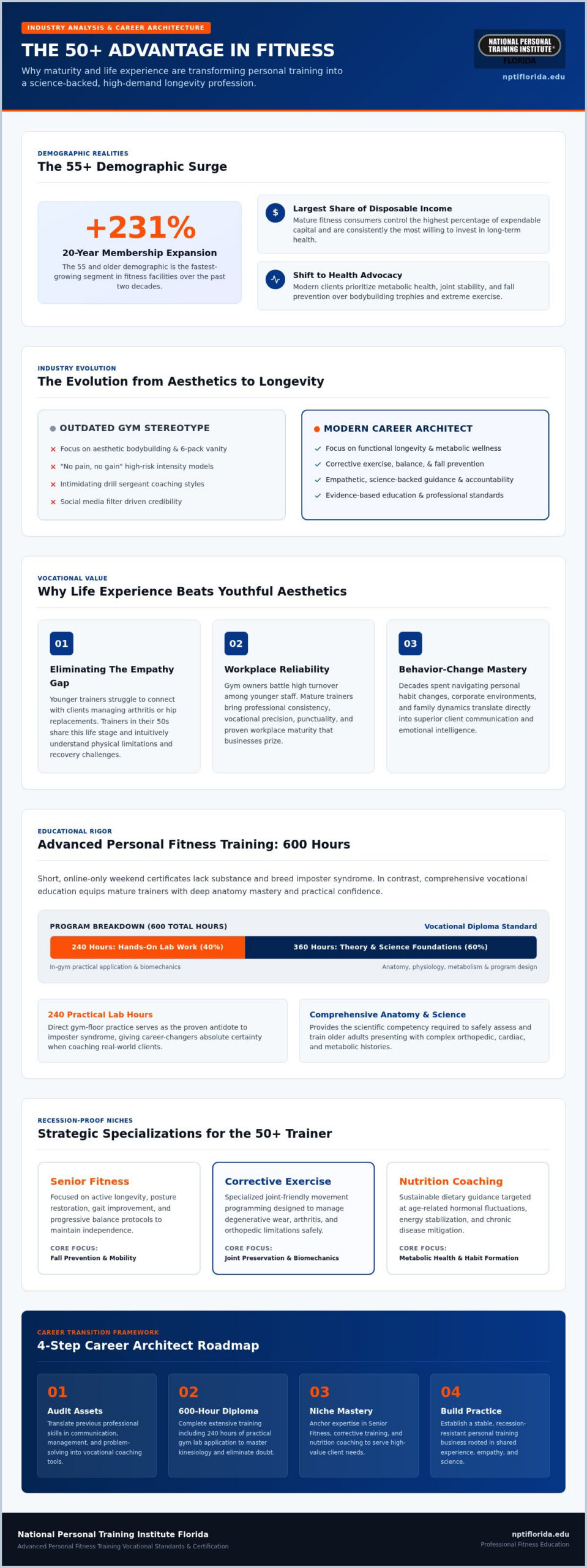
Your life experience is a bridge, not a barrier. We’ll show you why maturity is a massive competitive advantage in a field where the 55 and older demographic has expanded by 231 percent over the last two decades. You’ll discover how to transition into a professional role with total confidence in your skills. This guide previews the roadmap to becoming a career architect, from mastering corrective exercise to completing the Advanced Personal Fitness Training – 600 Hours program. It’s time to turn your passion for wellness into a science-based career that rewards your wisdom and provides the professional stability you deserve.
Key Takeaways
- Stop wondering is 50 too old to become a personal trainer and learn why your maturity makes you the ideal mentor for the fitness industry’s fastest-growing and wealthiest demographic.
- Discover how decades of professional life experience translate into superior client communication and reliability, traits that elite gym owners value over youthful aesthetics.
- Understand why 240 hours of hands-on lab work within a 600-hour vocational program is the essential cure for imposter syndrome, providing confidence that weekend certificates cannot match.
- Explore how specializing in Senior Fitness and Health and Nutrition Coaching creates a recession-proof career path tailored to clients with complex orthopedic and metabolic needs.
- Follow a clear, professional roadmap to audit your existing skills and transition into a career architect role through a comprehensive Advanced Personal Fitness Training diploma.
Debunking the Youth Myth: Why the Fitness Industry Needs Trainers Over 50
If you look at social media, you might think the fitness industry is exclusively for twenty-somethings with perfect lighting and zero joint pain. This stereotype is a relic of the past. The reality of the modern personal training client is someone looking for longevity, not a bodybuilding trophy. When people ask is 50 too old to become a personal trainer, they often overlook the fact that the 55 and older demographic is the fastest-growing segment in gym memberships, expanding by 231 percent over the last two decades. These clients aren’t seeking a drill sergeant. They’re looking for an expert who understands their unique physical needs.
The industry has shifted its focus from aesthetic bodybuilding toward functional longevity. Clients today prioritize metabolic health, balance, and fall prevention over muscle size. Consequently, the modern fitness professional is a science-based health advocate rather than a gym enthusiast.
The Demographics of Wealth and Wellness
Older clients generally possess the largest share of disposable income and are the most willing to invest in their health. They often feel intimidated or misunderstood by younger trainers who haven’t experienced the hormonal shifts or recovery challenges that come with age. This empathy gap is a significant hurdle for younger instructors. A 20-year-old might struggle to connect with a 60-year-old client who is managing arthritis or recovering from a hip replacement. A trainer who shares their life stage understands these physical concerns intuitively. By entering the personal training profession and standards as a mature adult, you offer a level of relatability and professional accountability that younger peers simply can’t match.
The Maturation of the Fitness Industry
The fitness world has evolved far beyond the “no pain, no gain” mantras of the 1980s. It has matured into a field rooted in corrective exercise and holistic wellness. This evolution creates a massive opportunity for the career architect who wants to build a sustainable, long-term practice. You aren’t just showing people how to lift weights; you’re helping them maintain independence. Programs like the Advanced Personal Fitness Training – 600 Hours provide the rigorous, science-based foundation required to handle these complex needs. Choosing a path that emphasizes practical lab work ensures you aren’t just another enthusiast, but a qualified professional ready to lead the charge in active longevity.
The Life Experience Advantage: Why Your Age is a Competitive Edge
Many aspiring trainers worry about their birth year. If you’re asking is 50 too old to become a personal trainer, you should realize that your professional history is actually your greatest asset. Gym owners and health club managers frequently struggle with high turnover among younger staff who may lack workplace maturity. In contrast, a trainer in their 50s brings a level of reliability and professionalism that is rare. You understand the value of showing up on time, dressing the part, and treating every client interaction with vocational precision. These are the soft skills that drive long-term success in the fitness industry.
Communication skills developed over decades in other fields are incredibly transferable. Whether you were in management, sales, or education, you’ve spent years learning how to listen and adapt your message. This emotional intelligence allows you to navigate complex client psychology with ease. Behavior-change psychology is often more intuitive for those with extensive life experience because they have navigated their own decades of habit formation and personal evolution. According to the U.S. Bureau of Labor Statistics occupational outlook, the demand for fitness professionals continues to grow as health remains a top priority across all age groups.
Building Trust Through Shared Experience
It’s common to feel a touch of imposter syndrome when stepping onto the gym floor for the first time. You can overcome this by framing your career change as a purpose-driven evolution. You aren’t “starting over”; you’re applying your wisdom to a new domain. Clients trust someone who has lived through similar physical challenges. Being a walking testimonial for lifelong health carries more weight than any social media post ever could. When you speak about joint health or heart health, your words have the gravity of experience. If you’re ready to leverage your background, exploring an Advanced Personal Training Program can help you bridge the gap between your past career and your future in fitness.
The Professionalism Quotient
Mature trainers often see higher client retention rates because they prioritize the relationship over the workout. You know how to manage a schedule and handle administrative tasks without being prompted. This level of organization makes you a dream hire for gym owners. They know they can trust you with their most valuable clients. Your ability to provide a consistent, high-quality experience is what builds a referral-based business that lasts for years. This isn’t just about fitness; it’s about professional excellence in every session.
Beyond the Weekend Certificate: Why Comprehensive Education is Essential at 50
Many online platforms promise a fitness career in as little as four weeks. For a professional entering a second career, this fast-track approach is often a recipe for imposter syndrome. If you’re asking is 50 too old to become a personal trainer, you should be less concerned with the speed of your certification and more focused on the depth of your knowledge. A weekend workshop or a multiple-choice test cannot prepare you for the medical and physical complexities of real-world clients. You need a vocational foundation that replaces career-change anxiety with professional certainty. The Advanced Personal Training Curriculum is designed to provide this exact depth, moving far beyond the basics of “counting reps.”
The Science of the Aging Body
Understanding the nuances of human movement is non-negotiable when training a mature demographic. Your clients won’t just want to “get fit”; they’ll often be managing orthopedic and biomechanical conditions such as osteoarthritis, osteoporosis, or post-surgical recovery. A science-based foundation protects both you and your clients. Mastering Corrective Exercise is an essential part of the 50+ trainer’s toolkit. It allows you to identify movement dysfunctions and implement protocols that restore function. This level of expertise elevates your status from a gym enthusiast to a science-based health advocate. As noted in the U.S. Bureau of Labor Statistics occupational outlook for fitness trainers, professionals with specialized training are better positioned to meet the rising demand for health services.
Hands-On Experience vs. Screen Time
You cannot learn the art of coaching through a computer screen alone. The industry gold standard for vocational readiness is the Advanced Personal Fitness Training – 600 Hours program. This comprehensive model balances 360 hours of theory with 240 hours of hands-on lab work. This practical floor time is the ultimate antidote to the fear of being “aged out.” You’ll practice assessments, program design, and exercise spotting in a real-world gym setting under expert supervision. For those transitioning from another full-time career, the Hyflex Learning Program provides a perfect solution. It combines the flexibility of digital theory with the critical, supervised gym experience that builds true confidence. You’ll graduate not just with a diploma, but with the practical skills to lead a client through a professional training session from day one.
Strategic Specialization: Mastering the Senior Fitness and Nutrition Niches
Specialization is the secret to career longevity. If you’re wondering is 50 too old to become a personal trainer, the answer depends on your willingness to carve out a high-value niche. Generalist trainers are everywhere, but specialists are essential. The Senior Fitness Specialist Guide highlights why this path is the most recession-proof sector in the industry. As the population ages, the demand for professionals who understand metabolic conditions and neuromuscular health continues to skyrocket. Roughly 12 percent of health club members explicitly seek training tailored to unique medical or orthopedic needs. You aren’t just a trainer; you’re a vital link in the healthcare continuum.
Becoming a Health and Nutrition Coach
Nutrition is often the missing link for clients over 50. Metabolic rates shift and hormonal changes occur, meaning a workout alone rarely yields complete results. By integrating Choosing a Health and Nutrition Coaching Program into your professional development, you offer a holistic solution. You’ll master behavior-change coaching techniques that help clients overcome decades of ingrained habits. This isn’t about restrictive dieting. It’s about providing the science-based guidance that ensures their efforts in the gym translate into real-world vitality and improved metabolic health.
Corrective Exercise for Longevity
Movement dysfunction is a common reality for an aging workforce. Decades of sedentary office work or physical repetitive stress lead to significant muscle imbalances. You can address these issues directly through specialized expertise. Earning a Stretch Coach Certification adds immediate, tangible value to every session you lead. It enables you to help clients regain mobility and joint preservation they thought was lost to time. Corrective exercise is a professional necessity for active longevity. When you combine this technical skill with your seasoned communication, you become a high-value asset to any rehabilitation center or athletic program.
Building a second career at 50 requires a strategic, science-based approach. You need more than just a basic credential; you need a comprehensive toolkit that addresses the whole person. If you’re ready to become a leader in the growing field of senior wellness, apply for the Personal Training Specialist Program today.
Your 50+ Career Roadmap: Transitioning into Professional Training
Transitioning into a new field requires a tactical approach. If you’re still questioning is 50 too old to become a personal trainer, remember that a successful second career isn’t built on speed; it’s built on a solid foundation. You don’t need to quit your current job tomorrow to start. Instead, follow a structured roadmap that leverages your maturity while building the technical expertise required for the modern gym floor. This process turns your life experience into a professional credential that employers respect.
- Step 1: Audit your professional skills. Your ability to manage time, communicate clearly, and handle client expectations is already ahead of most entry-level trainers. These are “soft skills” that take decades to master.
- Step 2: Choose a vocational program. Opt for a Career Diploma over a light, online-only certificate. Employers value the Advanced Personal Fitness Training – 600 Hours curriculum because it proves you’ve invested in deep, science-based knowledge.
- Step 3: Leverage flexible learning. Use the Hyflex Learning Program to balance your education with your current income. You can master the theory digitally and schedule your practical lab hours when they fit your life.
- Step 4: Build your network. Use your 240 hours of lab time to connect with gym managers and rehabilitation specialists. These hours are your “on-the-job” audition where you demonstrate your professionalism in real time.
Finding Your First Professional Role
When you walk into an interview, position your age as a premium offering. You aren’t just another trainer; you’re a seasoned professional who understands accountability and client retention. Having an accredited, state-licensed education on your resume is vital for standing out. NPTI Florida is accredited by ACCSC and licensed by the Florida Commission for Independent Education, which gives your credentials immediate weight in the eyes of hiring managers. If you’re a veteran, you can also leverage benefits from a veteran-owned and operated institution that has served the community for over 25 years. This pedigree tells employers you are serious about excellence and professional readiness.
The Long-Term Vision
Your journey doesn’t end with becoming a trainer. You are a career architect. Your second career can evolve into owning a gym, managing a wellness center, or becoming a specialized consultant for senior health. This is about creating a legacy that promotes vitality for yourself and your peers. It’s about moving from simply being a “trainer” to becoming a respected fitness professional who impacts community health. Success at this stage of life is about longevity and purpose. Start your journey with NPTI Florida’s 600-Hour Advanced Program and build a career that rewards your experience.
Your Future as a Career Architect Starts Now
The fitness industry is no longer just a playground for the young; it’s a professional landscape where wisdom and reliability are the new gold standards. You’ve seen why your life experience is a massive competitive advantage, especially when serving the fastest-growing demographic in health clubs today. Real success in this second career requires more than a weekend certificate. It demands a science-based foundation that only a comprehensive, accredited program can provide. If you’ve been wondering is 50 too old to become a personal trainer, the answer is clear. Your age isn’t a hurdle; it’s the bridge to a more fulfilling professional life.
Choosing a path with NPTI Florida means investing in an Advanced Personal Fitness Training – 600 Hours diploma. You’ll benefit from 240 hours of hands-on gym lab time, ensuring you graduate with the confidence to lead. Our institution is accredited by ACCSC and state licensed, providing the professional security you need to transition with total peace of mind. It’s time to stop waiting and start building your legacy in wellness.
Download the NPTI Florida Student Catalog and Start Your Second Career Today. You have the experience; now get the credentials to match. Your most rewarding professional chapter is just beginning.
Frequently Asked Questions
Is there an age limit for getting a personal trainer certification?
There is no upper age limit for earning a professional fitness credential. Most accredited organizations only require that candidates are at least 18 years old and hold a high school diploma or equivalent. If you’re asking is 50 too old to become a personal trainer, the industry actually welcomes mature professionals. Your life experience and established communication skills provide a stable foundation for the rigors of a science-based curriculum and the demands of client management.
Will gyms hire a 50-year-old personal trainer without prior experience?
Gym owners frequently prioritize reliability and professional accountability, making mature candidates highly attractive hires. While you may lack prior fitness industry experience, a comprehensive 600-hour diploma that includes 240 hours of hands-on lab work serves as a powerful substitute for traditional employment history. Managers value trainers who understand professional standards and can relate to the wealthiest gym demographic. Your maturity often translates to higher client retention rates, which is a critical metric for any successful facility.
How long does it take to become a personal trainer if I’m working full-time?
The timeline for certification varies based on the depth of the curriculum and your personal schedule. A comprehensive vocational program like the Advanced Personal Fitness Training – 600 Hours can typically be completed in about six months. Utilizing a Hyflex Learning Program allows you to study theoretical modules online while attending practical gym sessions at your convenience. This flexibility ensures you can maintain your current income while building a science-based foundation for your new professional career in fitness.
Do I need to be in ‘perfect’ shape to be a personal trainer at 50?
You don’t need to look like a fitness model to be a successful coach. Clients in their 50s and 60s often feel more comfortable working with someone who looks relatable rather than someone with a bodybuilder physique. Your value lies in your science-based knowledge of biomechanics, corrective exercise, and nutrition. Being a walking testimonial for functional health and active longevity is far more persuasive to your target audience than maintaining a “perfect” aesthetic or low body fat percentage.
What is the best certification for a 50-year-old career changer?
If you’re asking is 50 too old to become a personal trainer, the best path involves a 600-hour curriculum that balances 360 hours of theory with 240 hours of practical floor time. A vocational diploma is superior to a light, weekend-only certificate for career changers. This depth ensures you have the technical skills to handle complex orthopedic conditions. Programs offering an Advanced Personal Training Award – Diploma provide the professional credibility needed to stand out and avoid imposter syndrome.
Can I use my military benefits for personal trainer school?
Yes, you can often use your military benefits at institutions that are VA-approved and veteran-owned. NPTI Florida has been veteran-owned and operated for over 25 years, focusing on providing high-quality vocational education for transitioning service members and civilians alike. This status reflects a commitment to discipline and professional excellence. If you have served, these benefits can significantly offset the cost of your 600-hour diploma, helping you launch your second career with a stable financial foundation.
How much do personal trainers over 50 typically earn?
Earnings vary based on location, experience, and your chosen niche. According to 2025 Bureau of Labor Statistics data, the median annual wage for fitness trainers is $47,160, with the top 10 percent earning over $83,100. Independent trainers often charge between $40 and $100 per hour. Mature trainers often command higher rates by specializing in senior fitness or corrective exercise, as these niches cater to a demographic with higher disposable income and complex health needs.
What are the most in-demand specializations for older trainers?
The most lucrative and in-demand fields for mature trainers include Senior Fitness, Corrective Exercise, and Health and Nutrition Coaching. As the population ages, there’s a massive surge in clients seeking help with functional mobility, joint preservation, and metabolic health. Specializing in these areas allows you to function as a science-based health advocate. Mastering these niches makes you essential to rehabilitation centers and athletic programs, providing a recession-proof career path that rewards your decades of life experience.

Most people assume the fitness industry belongs to the twenty-somethings with six-packs and social media filters. The truth is that your gray hair might be the most valuable asset in your gym bag. If you’re asking is 50 too old to become a personal trainer, you aren’t just late to the game; you’re entering it at the perfect moment. It’s natural to feel anxious about learning complex anatomy or worry that you’ll be aged out by younger instructors. You might even be skeptical of short, online-only certificates that promise a career in a weekend but lack real substance.
Your life experience is a bridge, not a barrier. We’ll show you why maturity is a massive competitive advantage in a field where the 55 and older demographic has expanded by 231 percent over the last two decades. You’ll discover how to transition into a professional role with total confidence in your skills. This guide previews the roadmap to becoming a career architect, from mastering corrective exercise to completing the Advanced Personal Fitness Training – 600 Hours program. It’s time to turn your passion for wellness into a science-based career that rewards your wisdom and provides the professional stability you deserve.
Key Takeaways
- Stop wondering is 50 too old to become a personal trainer and learn why your maturity makes you the ideal mentor for the fitness industry’s fastest-growing and wealthiest demographic.
- Discover how decades of professional life experience translate into superior client communication and reliability, traits that elite gym owners value over youthful aesthetics.
- Understand why 240 hours of hands-on lab work within a 600-hour vocational program is the essential cure for imposter syndrome, providing confidence that weekend certificates cannot match.
- Explore how specializing in Senior Fitness and Health and Nutrition Coaching creates a recession-proof career path tailored to clients with complex orthopedic and metabolic needs.
- Follow a clear, professional roadmap to audit your existing skills and transition into a career architect role through a comprehensive Advanced Personal Fitness Training diploma.
Debunking the Youth Myth: Why the Fitness Industry Needs Trainers Over 50
If you look at social media, you might think the fitness industry is exclusively for twenty-somethings with perfect lighting and zero joint pain. This stereotype is a relic of the past. The reality of the modern personal training client is someone looking for longevity, not a bodybuilding trophy. When people ask is 50 too old to become a personal trainer, they often overlook the fact that the 55 and older demographic is the fastest-growing segment in gym memberships, expanding by 231 percent over the last two decades. These clients aren’t seeking a drill sergeant. They’re looking for an expert who understands their unique physical needs.
The industry has shifted its focus from aesthetic bodybuilding toward functional longevity. Clients today prioritize metabolic health, balance, and fall prevention over muscle size. Consequently, the modern fitness professional is a science-based health advocate rather than a gym enthusiast.
The Demographics of Wealth and Wellness
Older clients generally possess the largest share of disposable income and are the most willing to invest in their health. They often feel intimidated or misunderstood by younger trainers who haven’t experienced the hormonal shifts or recovery challenges that come with age. This empathy gap is a significant hurdle for younger instructors. A 20-year-old might struggle to connect with a 60-year-old client who is managing arthritis or recovering from a hip replacement. A trainer who shares their life stage understands these physical concerns intuitively. By entering the personal training profession and standards as a mature adult, you offer a level of relatability and professional accountability that younger peers simply can’t match.
The Maturation of the Fitness Industry
The fitness world has evolved far beyond the “no pain, no gain” mantras of the 1980s. It has matured into a field rooted in corrective exercise and holistic wellness. This evolution creates a massive opportunity for the career architect who wants to build a sustainable, long-term practice. You aren’t just showing people how to lift weights; you’re helping them maintain independence. Programs like the Advanced Personal Fitness Training – 600 Hours provide the rigorous, science-based foundation required to handle these complex needs. Choosing a path that emphasizes practical lab work ensures you aren’t just another enthusiast, but a qualified professional ready to lead the charge in active longevity.
The Life Experience Advantage: Why Your Age is a Competitive Edge
Many aspiring trainers worry about their birth year. If you’re asking is 50 too old to become a personal trainer, you should realize that your professional history is actually your greatest asset. Gym owners and health club managers frequently struggle with high turnover among younger staff who may lack workplace maturity. In contrast, a trainer in their 50s brings a level of reliability and professionalism that is rare. You understand the value of showing up on time, dressing the part, and treating every client interaction with vocational precision. These are the soft skills that drive long-term success in the fitness industry.
Communication skills developed over decades in other fields are incredibly transferable. Whether you were in management, sales, or education, you’ve spent years learning how to listen and adapt your message. This emotional intelligence allows you to navigate complex client psychology with ease. Behavior-change psychology is often more intuitive for those with extensive life experience because they have navigated their own decades of habit formation and personal evolution. According to the U.S. Bureau of Labor Statistics occupational outlook, the demand for fitness professionals continues to grow as health remains a top priority across all age groups.
Building Trust Through Shared Experience
It’s common to feel a touch of imposter syndrome when stepping onto the gym floor for the first time. You can overcome this by framing your career change as a purpose-driven evolution. You aren’t “starting over”; you’re applying your wisdom to a new domain. Clients trust someone who has lived through similar physical challenges. Being a walking testimonial for lifelong health carries more weight than any social media post ever could. When you speak about joint health or heart health, your words have the gravity of experience. If you’re ready to leverage your background, exploring an Advanced Personal Training Program can help you bridge the gap between your past career and your future in fitness.
The Professionalism Quotient
Mature trainers often see higher client retention rates because they prioritize the relationship over the workout. You know how to manage a schedule and handle administrative tasks without being prompted. This level of organization makes you a dream hire for gym owners. They know they can trust you with their most valuable clients. Your ability to provide a consistent, high-quality experience is what builds a referral-based business that lasts for years. This isn’t just about fitness; it’s about professional excellence in every session.
Beyond the Weekend Certificate: Why Comprehensive Education is Essential at 50
Many online platforms promise a fitness career in as little as four weeks. For a professional entering a second career, this fast-track approach is often a recipe for imposter syndrome. If you’re asking is 50 too old to become a personal trainer, you should be less concerned with the speed of your certification and more focused on the depth of your knowledge. A weekend workshop or a multiple-choice test cannot prepare you for the medical and physical complexities of real-world clients. You need a vocational foundation that replaces career-change anxiety with professional certainty. The Advanced Personal Training Curriculum is designed to provide this exact depth, moving far beyond the basics of “counting reps.”
The Science of the Aging Body
Understanding the nuances of human movement is non-negotiable when training a mature demographic. Your clients won’t just want to “get fit”; they’ll often be managing orthopedic and biomechanical conditions such as osteoarthritis, osteoporosis, or post-surgical recovery. A science-based foundation protects both you and your clients. Mastering Corrective Exercise is an essential part of the 50+ trainer’s toolkit. It allows you to identify movement dysfunctions and implement protocols that restore function. This level of expertise elevates your status from a gym enthusiast to a science-based health advocate. As noted in the U.S. Bureau of Labor Statistics occupational outlook for fitness trainers, professionals with specialized training are better positioned to meet the rising demand for health services.
Hands-On Experience vs. Screen Time
You cannot learn the art of coaching through a computer screen alone. The industry gold standard for vocational readiness is the Advanced Personal Fitness Training – 600 Hours program. This comprehensive model balances 360 hours of theory with 240 hours of hands-on lab work. This practical floor time is the ultimate antidote to the fear of being “aged out.” You’ll practice assessments, program design, and exercise spotting in a real-world gym setting under expert supervision. For those transitioning from another full-time career, the Hyflex Learning Program provides a perfect solution. It combines the flexibility of digital theory with the critical, supervised gym experience that builds true confidence. You’ll graduate not just with a diploma, but with the practical skills to lead a client through a professional training session from day one.
Strategic Specialization: Mastering the Senior Fitness and Nutrition Niches
Specialization is the secret to career longevity. If you’re wondering is 50 too old to become a personal trainer, the answer depends on your willingness to carve out a high-value niche. Generalist trainers are everywhere, but specialists are essential. The Senior Fitness Specialist Guide highlights why this path is the most recession-proof sector in the industry. As the population ages, the demand for professionals who understand metabolic conditions and neuromuscular health continues to skyrocket. Roughly 12 percent of health club members explicitly seek training tailored to unique medical or orthopedic needs. You aren’t just a trainer; you’re a vital link in the healthcare continuum.
Becoming a Health and Nutrition Coach
Nutrition is often the missing link for clients over 50. Metabolic rates shift and hormonal changes occur, meaning a workout alone rarely yields complete results. By integrating Choosing a Health and Nutrition Coaching Program into your professional development, you offer a holistic solution. You’ll master behavior-change coaching techniques that help clients overcome decades of ingrained habits. This isn’t about restrictive dieting. It’s about providing the science-based guidance that ensures their efforts in the gym translate into real-world vitality and improved metabolic health.
Corrective Exercise for Longevity
Movement dysfunction is a common reality for an aging workforce. Decades of sedentary office work or physical repetitive stress lead to significant muscle imbalances. You can address these issues directly through specialized expertise. Earning a Stretch Coach Certification adds immediate, tangible value to every session you lead. It enables you to help clients regain mobility and joint preservation they thought was lost to time. Corrective exercise is a professional necessity for active longevity. When you combine this technical skill with your seasoned communication, you become a high-value asset to any rehabilitation center or athletic program.
Building a second career at 50 requires a strategic, science-based approach. You need more than just a basic credential; you need a comprehensive toolkit that addresses the whole person. If you’re ready to become a leader in the growing field of senior wellness, apply for the Personal Training Specialist Program today.
Your 50+ Career Roadmap: Transitioning into Professional Training
Transitioning into a new field requires a tactical approach. If you’re still questioning is 50 too old to become a personal trainer, remember that a successful second career isn’t built on speed; it’s built on a solid foundation. You don’t need to quit your current job tomorrow to start. Instead, follow a structured roadmap that leverages your maturity while building the technical expertise required for the modern gym floor. This process turns your life experience into a professional credential that employers respect.
- Step 1: Audit your professional skills. Your ability to manage time, communicate clearly, and handle client expectations is already ahead of most entry-level trainers. These are “soft skills” that take decades to master.
- Step 2: Choose a vocational program. Opt for a Career Diploma over a light, online-only certificate. Employers value the Advanced Personal Fitness Training – 600 Hours curriculum because it proves you’ve invested in deep, science-based knowledge.
- Step 3: Leverage flexible learning. Use the Hyflex Learning Program to balance your education with your current income. You can master the theory digitally and schedule your practical lab hours when they fit your life.
- Step 4: Build your network. Use your 240 hours of lab time to connect with gym managers and rehabilitation specialists. These hours are your “on-the-job” audition where you demonstrate your professionalism in real time.
Finding Your First Professional Role
When you walk into an interview, position your age as a premium offering. You aren’t just another trainer; you’re a seasoned professional who understands accountability and client retention. Having an accredited, state-licensed education on your resume is vital for standing out. NPTI Florida is accredited by ACCSC and licensed by the Florida Commission for Independent Education, which gives your credentials immediate weight in the eyes of hiring managers. If you’re a veteran, you can also leverage benefits from a veteran-owned and operated institution that has served the community for over 25 years. This pedigree tells employers you are serious about excellence and professional readiness.
The Long-Term Vision
Your journey doesn’t end with becoming a trainer. You are a career architect. Your second career can evolve into owning a gym, managing a wellness center, or becoming a specialized consultant for senior health. This is about creating a legacy that promotes vitality for yourself and your peers. It’s about moving from simply being a “trainer” to becoming a respected fitness professional who impacts community health. Success at this stage of life is about longevity and purpose. Start your journey with NPTI Florida’s 600-Hour Advanced Program and build a career that rewards your experience.
Your Future as a Career Architect Starts Now
The fitness industry is no longer just a playground for the young; it’s a professional landscape where wisdom and reliability are the new gold standards. You’ve seen why your life experience is a massive competitive advantage, especially when serving the fastest-growing demographic in health clubs today. Real success in this second career requires more than a weekend certificate. It demands a science-based foundation that only a comprehensive, accredited program can provide. If you’ve been wondering is 50 too old to become a personal trainer, the answer is clear. Your age isn’t a hurdle; it’s the bridge to a more fulfilling professional life.
Choosing a path with NPTI Florida means investing in an Advanced Personal Fitness Training – 600 Hours diploma. You’ll benefit from 240 hours of hands-on gym lab time, ensuring you graduate with the confidence to lead. Our institution is accredited by ACCSC and state licensed, providing the professional security you need to transition with total peace of mind. It’s time to stop waiting and start building your legacy in wellness.
Download the NPTI Florida Student Catalog and Start Your Second Career Today. You have the experience; now get the credentials to match. Your most rewarding professional chapter is just beginning.
Frequently Asked Questions
Is there an age limit for getting a personal trainer certification?
There is no upper age limit for earning a professional fitness credential. Most accredited organizations only require that candidates are at least 18 years old and hold a high school diploma or equivalent. If you’re asking is 50 too old to become a personal trainer, the industry actually welcomes mature professionals. Your life experience and established communication skills provide a stable foundation for the rigors of a science-based curriculum and the demands of client management.
Will gyms hire a 50-year-old personal trainer without prior experience?
Gym owners frequently prioritize reliability and professional accountability, making mature candidates highly attractive hires. While you may lack prior fitness industry experience, a comprehensive 600-hour diploma that includes 240 hours of hands-on lab work serves as a powerful substitute for traditional employment history. Managers value trainers who understand professional standards and can relate to the wealthiest gym demographic. Your maturity often translates to higher client retention rates, which is a critical metric for any successful facility.
How long does it take to become a personal trainer if I’m working full-time?
The timeline for certification varies based on the depth of the curriculum and your personal schedule. A comprehensive vocational program like the Advanced Personal Fitness Training – 600 Hours can typically be completed in about six months. Utilizing a Hyflex Learning Program allows you to study theoretical modules online while attending practical gym sessions at your convenience. This flexibility ensures you can maintain your current income while building a science-based foundation for your new professional career in fitness.
Do I need to be in ‘perfect’ shape to be a personal trainer at 50?
You don’t need to look like a fitness model to be a successful coach. Clients in their 50s and 60s often feel more comfortable working with someone who looks relatable rather than someone with a bodybuilder physique. Your value lies in your science-based knowledge of biomechanics, corrective exercise, and nutrition. Being a walking testimonial for functional health and active longevity is far more persuasive to your target audience than maintaining a “perfect” aesthetic or low body fat percentage.
What is the best certification for a 50-year-old career changer?
If you’re asking is 50 too old to become a personal trainer, the best path involves a 600-hour curriculum that balances 360 hours of theory with 240 hours of practical floor time. A vocational diploma is superior to a light, weekend-only certificate for career changers. This depth ensures you have the technical skills to handle complex orthopedic conditions. Programs offering an Advanced Personal Training Award – Diploma provide the professional credibility needed to stand out and avoid imposter syndrome.
Can I use my military benefits for personal trainer school?
Yes, you can often use your military benefits at institutions that are VA-approved and veteran-owned. NPTI Florida has been veteran-owned and operated for over 25 years, focusing on providing high-quality vocational education for transitioning service members and civilians alike. This status reflects a commitment to discipline and professional excellence. If you have served, these benefits can significantly offset the cost of your 600-hour diploma, helping you launch your second career with a stable financial foundation.
How much do personal trainers over 50 typically earn?
Earnings vary based on location, experience, and your chosen niche. According to 2025 Bureau of Labor Statistics data, the median annual wage for fitness trainers is $47,160, with the top 10 percent earning over $83,100. Independent trainers often charge between $40 and $100 per hour. Mature trainers often command higher rates by specializing in senior fitness or corrective exercise, as these niches cater to a demographic with higher disposable income and complex health needs.
What are the most in-demand specializations for older trainers?
The most lucrative and in-demand fields for mature trainers include Senior Fitness, Corrective Exercise, and Health and Nutrition Coaching. As the population ages, there’s a massive surge in clients seeking help with functional mobility, joint preservation, and metabolic health. Specializing in these areas allows you to function as a science-based health advocate. Mastering these niches makes you essential to rehabilitation centers and athletic programs, providing a recession-proof career path that rewards your decades of life experience.