Hybrid Personal Training School: The 2026 Guide to Flexible Fitness Careers
A multiple-choice certification won’t prepare you for the reality of coaching a living, breathing client through a complex movement pattern. You already know that memorizing anatomy terms on flashcards is useless if you freeze when it’s time to spot a lift or correct movement dysfunction on the gym floor. You need an educational format that respects your busy work schedule, but you refuse to sacrifice practical coaching confidence. That is why choosing an accredited hybrid personal training school has become the premier pathway for aspiring fitness professionals.
True fitness mastery requires merging digital sports science theory with intensive gym floor practice. In this comprehensive guide, you’ll discover how a hybrid personal training school seamlessly blends interactive online theory with mandatory hands-on gym labs to build authentic vocational competence. We will break down how flexible hyflex learning schedules operate day-to-day, examine the curriculum standards that top employers demand, and show you how to select a respected program that sets you up for long-term client retention.
Key Takeaways
- Understand how an accredited hybrid personal training school bridges flexible online sports science theory with mandatory in-person coaching labs to fit your busy schedule.
- Discover why a rigorous 600-hour vocational structure dividing 360 lecture hours and 240 gym lab hours sets the benchmark employers demand.
- Learn how supervised gym floor experience eliminates coaching anxiety by sharpening your tactile assessment, spotting, and movement cueing skills.
- Pinpoint key institutional markers like ACCSC national accreditation and state vocational licensure that separate respected diplomas from entry-level exam certificates.
- Map out diverse career paths and see how advanced training in nutrition coaching and corrective exercise positions you for higher retention and earning power.
What Is a Hybrid Personal Training School and How Does It Function?
A hybrid personal training school bridges the gap between academic theory and practical coaching execution. Rather than relying on static PDF study guides or demanding forty hours of weekly classroom seat time, this format pairs structured digital coursework with mandatory, supervised gym instruction. You master exercise science remotely, then immediately translate those principles into client results on the weight-room floor. This dual-track approach directly contrasts with standard weekend certification tests, replacing passive multiple-choice prep with guided vocational repetitions.
Online Scientific Theory vs. Supervised In-Person Gym Labs
Digital lecture platforms excel at delivering foundational sports science. Through live synchronous sessions and recorded modules, you study bioenergetics, musculoskeletal anatomy, and client psychology at your own pace without wasting hours sitting in daily traffic. You absorb the formal scope of practice for personal trainers, learning how to interpret joint actions and program design variables before setting foot on the lifting platform.
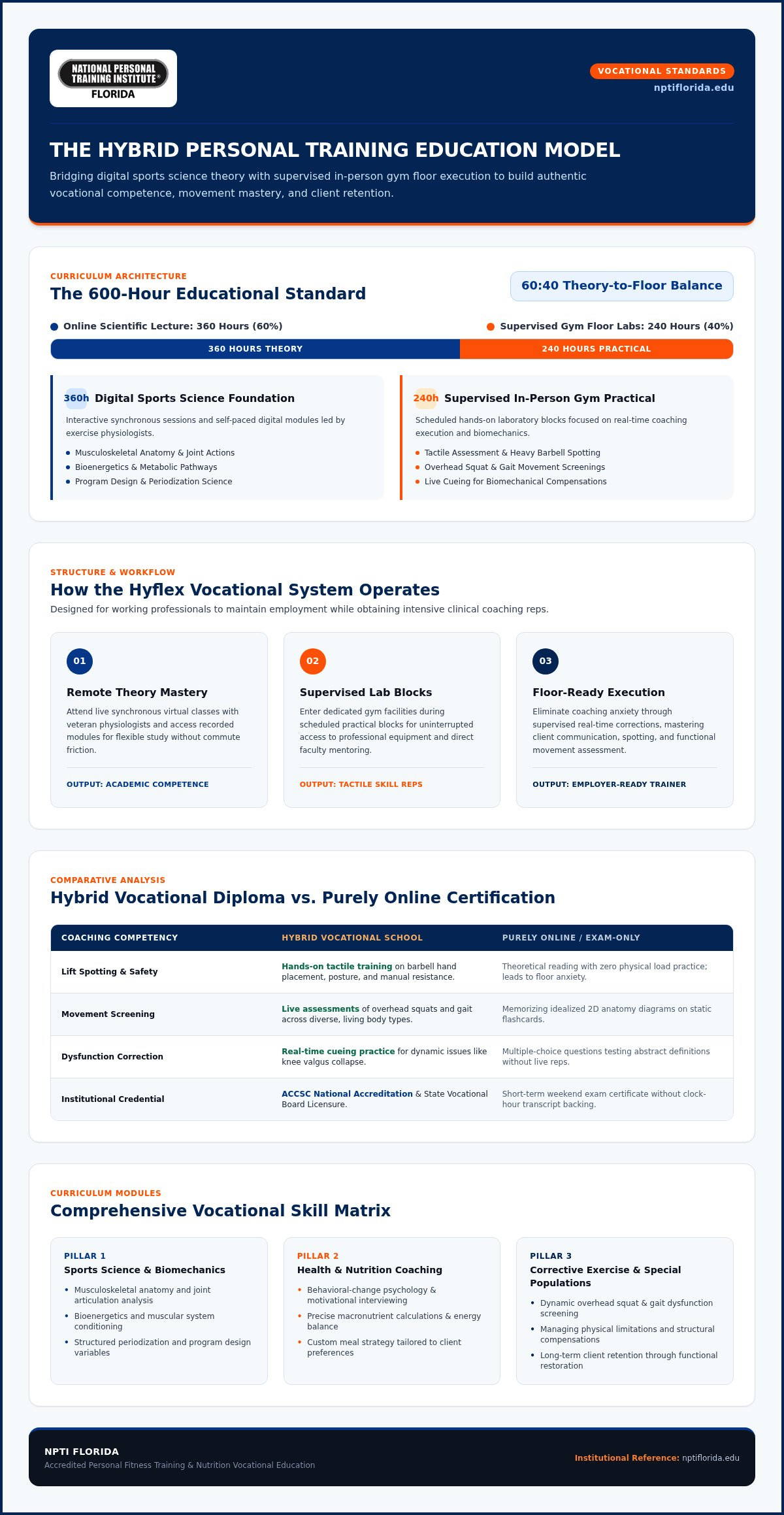
Book knowledge hits a hard wall when facing real-world human movement. Reading about a squat compensation cannot teach you how to position your hands for a heavy barbell spot, nor can a video demonstrate the precise verbal cue needed to correct a client’s valgus knee collapse. Supervised gym labs provide:
- Real-Time Tactile Feedback: Instructors correct your hand placement, posture, and manual resistance techniques on the spot.
- Dynamic Movement Screening: You conduct live overhead squat and gait assessments on diverse body types rather than idealized diagrams.
- Coaching Communication Reps: You practice translating complex biomechanical concepts into clear, encouraging cues that clients understand instantly.
The Hyflex Learning Model Explained
Modern vocational education must adapt to working professionals. Through a Hyflex Learning Program, students attend interactive virtual lectures led by veteran exercise physiologists, participating in real-time case discussions and movement breakdowns from home. This flexibility allows adult learners to keep their current jobs while completing a comprehensive vocational diploma.
Gym practicals occur in scheduled blocks, giving you uninterrupted access to professional equipment and direct faculty mentoring. When you enter a premier hybrid personal training school, you aren’t buying test prep. You’re investing in an interactive vocational framework that fits your everyday life while forging legitimate gym-floor authority.
Core Curriculum: What High-Quality Hybrid Personal Training Schools Teach
High-level fitness careers demand structured, immersive instruction. An elite hybrid personal training school builds its curriculum around an extensive 600-hour vocational framework rather than an abbreviated exam-prep guide. This institutional standard divides education into 360 hours of scientific lecture and 240 hours of supervised gym floor training, establishing a rigorous 60:40 balance between physiological understanding and practical coaching execution. Reviewing the depth in an Advanced Personal Training Curriculum reveals how clock-hour vocational education prepares candidates to meet the robust hiring demands recorded in the Bureau of Labor Statistics occupational outlook for fitness trainers.
Health and Nutrition Coaching Fundamentals
Long-term client transformations depend on daily lifestyle management outside the weight room. This module integrates behavioral-change psychology and motivational interviewing methods to build lasting client adherence. Students learn to calculate precise macronutrient targets, analyze metabolic pathways, and design real-world meal plans that respect client preferences. Reviewing the coursework taught in a professional Health and Nutrition Coaching Program illustrates how combining nutritional guidance with exercise programming maximizes client retention.
Corrective Exercise and Special Populations
Modern gym floors present trainers with clients managing complex physical limitations. Students learn to assess kinetic chain dysfunctions, identify postural compensations, and prescribe targeted corrective drills. Instruction covers exercise adaptations for orthopedic limitations, cardiovascular conditions, and neuromuscular challenges. Students also practice tailoring resistance loads for youth athletes and aging adults who need balance and functional mobility.
Mastering these advanced modules transforms you from a standard rep counter into an indispensable movement specialist. If you want an educational pathway that combines scientific rigor with real-world application, exploring your options through NPTI Florida vocational programs gives you the hands-on foundation needed for a lasting career in the industry.
Hands-On Lab Hours: Why Purely Online Personal Training Certifications Fall Short
The greatest fear holding back new fitness professionals isn’t passing a written exam. It’s the paralyzing anxiety of stepping onto a bustling weight floor with a real client for the very first time. While earning an NCCA-accredited personal training certification validates your foundational exercise science comprehension, pure distance learning leaves your physical coaching toolkit completely untested. Reading about biomechanics will never teach your hands how to support a client losing balance under load.
Completing 240 supervised lab hours inside an accredited hybrid personal training school systematically dismantles that beginner imposter syndrome. Through structured peer-to-peer coaching labs, you step into the trainer role dozens of times under the watchful eye of experienced instructors. You practice administering assessments, setting up equipment, and giving real-time feedback in a controlled environment before you ever take paying clients. As detailed in The Hyflex Fitness Training Program, bridging digital study with rigorous physical gym labs builds genuine vocational fluency.
Developing Tactile Coaching and Real-Time Form Correction
Coaching is an active three-dimensional craft. Static videos and digital diagrams fail to replicate how dynamic compensations appear in real life. Supervised gym practicals teach you to spot subtle movement errors, such as early lumbar flexion during a deadlift or asymmetrical weight shifts during unilateral lunges. You learn critical manual spotting techniques that protect client joints during heavy compound lifts, discovering exactly where to place your hands to maintain safety without restricting their natural range of motion.
Mastering Equipment Across Diverse Gym Environments
Commercial gym floors feature dozens of distinct resistance systems, and high-performing trainers must navigate them with absolute precision. Dedicated gym practicals give you hands-on fluency across diverse tools:
- Free Weights and Barbells: Setting safety pins, checking bar paths, and selecting appropriate collars for multi-joint lifts.
- Cable and Pulley Systems: Adjusting line-of-pull angles to match client muscular attachments and active joint angles.
- Selectorized and Plate-Loaded Machines: Calibrating cam alignments, seat heights, and backrests to fit varying torso and limb lengths.
When peak gym hours leave your planned station occupied, you won’t panic. Hands-on floor experience teaches you how to pivot exercise selections seamlessly, keeping your client moving safely while maintaining session momentum.
How to Choose the Best Hybrid Personal Training School for Your Goals
Not all fitness programs are created equal. Searching for a hybrid personal training school can quickly overwhelm you with flashy marketing from unregulated test prep websites. To protect your investment and build a resilient career, you must evaluate institutions using strict educational criteria. Looking closely at accreditation, clock hours, and faculty background ensures you graduate with practical skills that commercial health clubs and private wellness centers actively seek.
Accreditation, State Licensure, and Academic Standards
Institutional accreditation serves as your strongest consumer safeguard. When a vocational school holds national accreditation through an agency recognized by the U.S. Department of Education, such as the Accrediting Commission of Career Schools and Colleges (ACCSC), it proves that their curriculum, facilities, and student outcomes meet rigorous independent standards. Legitimate schools also operate under official state postsecondary vocational licensure, which legally protects enrolled students and mandates an approved academic catalog.
Unregulated online exam providers rarely submit to this level of accountability. High-caliber vocational programs provide transparent enrollment agreements, clear academic calendars, and a required threshold of at least 200 practical lab hours directly supervised by seasoned industry practitioners.
Career Placement Support and Professional Industry Recognition
Commercial athletic clubs, private studios, and sports performance centers clearly differentiate between a standard pass-fail certificate and a comprehensive vocational diploma. Diploma graduates frequently step into preferred hiring tiers because employers know they have completed hundreds of hours of hands-on client assessment and exercise prescription. In contrast, candidates with digital-only certificates often require extensive on-the-job training before managers trust them on the floor.
Before enrolling, examine the institution’s graduate support network. Reputable schools provide proactive career placement assistance, helping you polish your professional resume, connect with hiring fitness managers, and master live coaching interviews. For a thorough breakdown of institutional criteria, consult The Ultimate Personal Training Program Guide to ensure your education aligns with industry hiring demands.
Take control of your future in fitness. Explore available course schedules and apply to an accredited vocational program at NPTI to turn your dedication into an enduring, respected career.
Launching Your Fitness Career with an Accredited Hybrid Diploma
Completing a comprehensive vocational diploma sets you apart in a crowded job market. Fitness directors recognize the immense value of hands-on coaching experience, often placing diploma graduates into higher compensation tiers right away. When you pair kinetic chain assessments with behavioral nutrition coaching, your client value compounds. Clients don’t simply hire you for sixty minutes of sweating; they retain you for complete lifestyle management. That dual expertise creates dependable, recurring income whether you work in an established athletic facility or launch your own private training practice.
Career Pathways for Hybrid Fitness Graduates
Graduating from a recognized hybrid personal training school unlocks diverse vocational avenues across the health and wellness sector:
- Commercial and Luxury Fitness Clubs: Step directly onto premier fitness floors with immediate credibility, bypassing entry-level probationary tiers.
- Corporate Wellness and Athletic Academies: Direct functional mobility initiatives for corporate staff or coach youth athletes through foundational movement mechanics.
- Specialized Demographic Practice: Program corrective routines for active seniors or clients managing orthopedic limitations.
- Independent Studio Ownership: Build a thriving private training business combining in-person sessions with remote nutrition guidance.
The NPTI Difference: Practical Excellence and Career Readiness
Longevity matters when choosing where to build your professional foundation. Backed by over 25 years of dedicated veteran-owned vocational leadership, NPTI sets the standard for practical fitness training. The flagship 600-hour Advanced Personal Training Program delivers an intensive diploma framework that merges 360 lecture hours with 240 supervised gym lab hours, giving you the exact repetitions needed to coach with authority from day one.
Stepping into this career is a structured, supported process. Connect with an advisor to evaluate class schedules, review curriculum requirements, and launch your journey through NPTI Personal Training Programs today.
Build Your Enduring Fitness Career with Proven Hands-On Authority
Your passion for health deserves an educational foundation that builds genuine coaching authority. Choosing an accredited hybrid personal training school ensures you never have to sacrifice flexible scheduling for real gym floor competence. By uniting digital sports science lectures with intensive practical labs, you develop the kinetic chain expertise, equipment mastery, and tactile cueing confidence that top employers demand.
Backed by over 25 years of veteran-owned educational leadership, NPTI provides an ACCSC-accredited vocational experience designed for lasting professional success. Our structured 600-hour curriculum pairs rigorous theory with 240 supervised gym lab hours, transforming your enthusiasm into verified client results. Take the definitive step toward a rewarding, flexible career on your own terms. Download the Student Catalog and Apply to NPTI Today.
Frequently Asked Questions
What makes a hybrid personal training school different from an online certification?
A hybrid personal training school combines digital sports science lectures with mandatory, in-person practical gym labs. Unlike self-paced online certifications that only prepare you for a digital exam, a hybrid vocational program focuses on real coaching repetitions. You learn anatomy and physiology online, then apply biomechanics, spotting techniques, and client movement assessments directly on the gym floor under the live supervision of veteran instructors, graduating with authentic coaching confidence.
How many hours of hands-on gym training are included in a hybrid program?
A comprehensive vocational program provides 240 hours of supervised, hands-on gym practicals alongside 360 hours of classroom theory. This exact 60:40 balance ensures you spend ample time applying lifting biomechanics, mastering equipment calibration, and performing movement screens on diverse body types. Rather than observing video demonstrations, you actively cue lifts and spot peers under the direct guidance of experienced exercise physiologists.
Can I maintain a full-time job while attending a hybrid personal training school?
Yes, you can maintain your full-time job while enrolled through flexible Hyflex Learning Program scheduling. This format allows you to complete interactive lecture coursework remotely on your schedule, keeping your current career intact while transitioning into fitness. Hands-on gym labs take place during structured, dedicated blocks, giving working adults a predictable routine that balances personal obligations with intensive hybrid personal training school instruction.
Is an accredited hybrid personal training diploma recognized by commercial gyms nationwide?
Yes, top commercial health clubs, sports facilities, and boutique studios actively seek graduates who hold an ACCSC-accredited vocational diploma. Gym employers know that clock-hour graduates possess hundreds of hours of supervised gym-floor experience. While standard certification holders often require weeks of onboarding, hybrid diploma graduates step onto the weight floor ready to screen clients, teach complex movements, and drive immediate client retention.
What modules are covered in a 600-hour advanced personal training curriculum?
A 600-hour curriculum spans three comprehensive 200-hour modules: Health and Nutrition Coaching, Corrective Exercise & Advanced Special Populations, and Advanced Youth Fitness. Each module integrates 120 lecture theory hours with 80 practical gym hours. Students progress from behavioral psychology and modern meal planning to kinetic chain assessments, youth conditioning mechanics, and exercise modifications for clients with orthopedic, cardiovascular, or metabolic conditions.
Do hybrid personal training schools teach both fitness programming and nutrition coaching?
Yes, reputable hybrid programs integrate extensive nutritional education alongside exercise science. The curriculum dedicates entire courses to modern meal planning, macronutrient distribution, and behavioral-change psychology. You learn how to calculate metabolic baselines and conduct motivational interviews, allowing you to offer holistic lifestyle coaching. Combining sound nutrition protocols with personalized resistance programs significantly increases client adherence and overall business value.
What prerequisites are required before enrolling in a hybrid personal training program?
Enrolling in a professional vocational diploma requires a high school diploma or equivalent along with a genuine commitment to health and wellness. You don’t need a prior college degree or collegiate athletic background to succeed. Prospective students simply review the student catalog, complete an enrollment agreement, and speak with an admissions advisor to evaluate upcoming program start dates.

A multiple-choice certification won’t prepare you for the reality of coaching a living, breathing client through a complex movement pattern. You already know that memorizing anatomy terms on flashcards is useless if you freeze when it’s time to spot a lift or correct movement dysfunction on the gym floor. You need an educational format that respects your busy work schedule, but you refuse to sacrifice practical coaching confidence. That is why choosing an accredited hybrid personal training school has become the premier pathway for aspiring fitness professionals.
True fitness mastery requires merging digital sports science theory with intensive gym floor practice. In this comprehensive guide, you’ll discover how a hybrid personal training school seamlessly blends interactive online theory with mandatory hands-on gym labs to build authentic vocational competence. We will break down how flexible hyflex learning schedules operate day-to-day, examine the curriculum standards that top employers demand, and show you how to select a respected program that sets you up for long-term client retention.
Key Takeaways
- Understand how an accredited hybrid personal training school bridges flexible online sports science theory with mandatory in-person coaching labs to fit your busy schedule.
- Discover why a rigorous 600-hour vocational structure dividing 360 lecture hours and 240 gym lab hours sets the benchmark employers demand.
- Learn how supervised gym floor experience eliminates coaching anxiety by sharpening your tactile assessment, spotting, and movement cueing skills.
- Pinpoint key institutional markers like ACCSC national accreditation and state vocational licensure that separate respected diplomas from entry-level exam certificates.
- Map out diverse career paths and see how advanced training in nutrition coaching and corrective exercise positions you for higher retention and earning power.
What Is a Hybrid Personal Training School and How Does It Function?
A hybrid personal training school bridges the gap between academic theory and practical coaching execution. Rather than relying on static PDF study guides or demanding forty hours of weekly classroom seat time, this format pairs structured digital coursework with mandatory, supervised gym instruction. You master exercise science remotely, then immediately translate those principles into client results on the weight-room floor. This dual-track approach directly contrasts with standard weekend certification tests, replacing passive multiple-choice prep with guided vocational repetitions.
Online Scientific Theory vs. Supervised In-Person Gym Labs
Digital lecture platforms excel at delivering foundational sports science. Through live synchronous sessions and recorded modules, you study bioenergetics, musculoskeletal anatomy, and client psychology at your own pace without wasting hours sitting in daily traffic. You absorb the formal scope of practice for personal trainers, learning how to interpret joint actions and program design variables before setting foot on the lifting platform.
Book knowledge hits a hard wall when facing real-world human movement. Reading about a squat compensation cannot teach you how to position your hands for a heavy barbell spot, nor can a video demonstrate the precise verbal cue needed to correct a client’s valgus knee collapse. Supervised gym labs provide:
- Real-Time Tactile Feedback: Instructors correct your hand placement, posture, and manual resistance techniques on the spot.
- Dynamic Movement Screening: You conduct live overhead squat and gait assessments on diverse body types rather than idealized diagrams.
- Coaching Communication Reps: You practice translating complex biomechanical concepts into clear, encouraging cues that clients understand instantly.
The Hyflex Learning Model Explained
Modern vocational education must adapt to working professionals. Through a Hyflex Learning Program, students attend interactive virtual lectures led by veteran exercise physiologists, participating in real-time case discussions and movement breakdowns from home. This flexibility allows adult learners to keep their current jobs while completing a comprehensive vocational diploma.
Gym practicals occur in scheduled blocks, giving you uninterrupted access to professional equipment and direct faculty mentoring. When you enter a premier hybrid personal training school, you aren’t buying test prep. You’re investing in an interactive vocational framework that fits your everyday life while forging legitimate gym-floor authority.
Core Curriculum: What High-Quality Hybrid Personal Training Schools Teach
High-level fitness careers demand structured, immersive instruction. An elite hybrid personal training school builds its curriculum around an extensive 600-hour vocational framework rather than an abbreviated exam-prep guide. This institutional standard divides education into 360 hours of scientific lecture and 240 hours of supervised gym floor training, establishing a rigorous 60:40 balance between physiological understanding and practical coaching execution. Reviewing the depth in an Advanced Personal Training Curriculum reveals how clock-hour vocational education prepares candidates to meet the robust hiring demands recorded in the Bureau of Labor Statistics occupational outlook for fitness trainers.
Health and Nutrition Coaching Fundamentals
Long-term client transformations depend on daily lifestyle management outside the weight room. This module integrates behavioral-change psychology and motivational interviewing methods to build lasting client adherence. Students learn to calculate precise macronutrient targets, analyze metabolic pathways, and design real-world meal plans that respect client preferences. Reviewing the coursework taught in a professional Health and Nutrition Coaching Program illustrates how combining nutritional guidance with exercise programming maximizes client retention.
Corrective Exercise and Special Populations
Modern gym floors present trainers with clients managing complex physical limitations. Students learn to assess kinetic chain dysfunctions, identify postural compensations, and prescribe targeted corrective drills. Instruction covers exercise adaptations for orthopedic limitations, cardiovascular conditions, and neuromuscular challenges. Students also practice tailoring resistance loads for youth athletes and aging adults who need balance and functional mobility.
Mastering these advanced modules transforms you from a standard rep counter into an indispensable movement specialist. If you want an educational pathway that combines scientific rigor with real-world application, exploring your options through NPTI Florida vocational programs gives you the hands-on foundation needed for a lasting career in the industry.
Hands-On Lab Hours: Why Purely Online Personal Training Certifications Fall Short
The greatest fear holding back new fitness professionals isn’t passing a written exam. It’s the paralyzing anxiety of stepping onto a bustling weight floor with a real client for the very first time. While earning an NCCA-accredited personal training certification validates your foundational exercise science comprehension, pure distance learning leaves your physical coaching toolkit completely untested. Reading about biomechanics will never teach your hands how to support a client losing balance under load.
Completing 240 supervised lab hours inside an accredited hybrid personal training school systematically dismantles that beginner imposter syndrome. Through structured peer-to-peer coaching labs, you step into the trainer role dozens of times under the watchful eye of experienced instructors. You practice administering assessments, setting up equipment, and giving real-time feedback in a controlled environment before you ever take paying clients. As detailed in The Hyflex Fitness Training Program, bridging digital study with rigorous physical gym labs builds genuine vocational fluency.
Developing Tactile Coaching and Real-Time Form Correction
Coaching is an active three-dimensional craft. Static videos and digital diagrams fail to replicate how dynamic compensations appear in real life. Supervised gym practicals teach you to spot subtle movement errors, such as early lumbar flexion during a deadlift or asymmetrical weight shifts during unilateral lunges. You learn critical manual spotting techniques that protect client joints during heavy compound lifts, discovering exactly where to place your hands to maintain safety without restricting their natural range of motion.
Mastering Equipment Across Diverse Gym Environments
Commercial gym floors feature dozens of distinct resistance systems, and high-performing trainers must navigate them with absolute precision. Dedicated gym practicals give you hands-on fluency across diverse tools:
- Free Weights and Barbells: Setting safety pins, checking bar paths, and selecting appropriate collars for multi-joint lifts.
- Cable and Pulley Systems: Adjusting line-of-pull angles to match client muscular attachments and active joint angles.
- Selectorized and Plate-Loaded Machines: Calibrating cam alignments, seat heights, and backrests to fit varying torso and limb lengths.
When peak gym hours leave your planned station occupied, you won’t panic. Hands-on floor experience teaches you how to pivot exercise selections seamlessly, keeping your client moving safely while maintaining session momentum.
How to Choose the Best Hybrid Personal Training School for Your Goals
Not all fitness programs are created equal. Searching for a hybrid personal training school can quickly overwhelm you with flashy marketing from unregulated test prep websites. To protect your investment and build a resilient career, you must evaluate institutions using strict educational criteria. As you compare program options and explore Course Tuition and Certification Fees, looking closely at accreditation, clock hours, and faculty background ensures you graduate with practical skills that commercial health clubs and private wellness centers actively seek.
Accreditation, State Licensure, and Academic Standards
Institutional accreditation serves as your strongest consumer safeguard. When a vocational school holds national accreditation through an agency recognized by the U.S. Department of Education, such as the Accrediting Commission of Career Schools and Colleges (ACCSC), it proves that their curriculum, facilities, and student outcomes meet rigorous independent standards. Legitimate schools also operate under official state postsecondary vocational licensure, which legally protects enrolled students and mandates an approved academic catalog.
Unregulated online exam providers rarely submit to this level of accountability. High-caliber vocational programs provide transparent enrollment agreements, clear academic calendars, and a required threshold of at least 200 practical lab hours directly supervised by seasoned industry practitioners.
Career Placement Support and Professional Industry Recognition
Commercial athletic clubs, private studios, and sports performance centers clearly differentiate between a standard pass-fail certificate and a comprehensive vocational diploma. Diploma graduates frequently step into preferred hiring tiers because employers know they have completed hundreds of hours of hands-on client assessment and exercise prescription. In contrast, candidates with digital-only certificates often require extensive on-the-job training before managers trust them on the floor.
Before enrolling, examine the institution’s graduate support network. Reputable schools provide proactive career placement assistance, helping you polish your professional resume, connect with hiring fitness managers, and master live coaching interviews. For a thorough breakdown of institutional criteria, consult The Ultimate Personal Training Program Guide to ensure your education aligns with industry hiring demands.
Take control of your future in fitness. Explore available course schedules and apply to an accredited vocational program at NPTI to turn your dedication into an enduring, respected career.
Launching Your Fitness Career with an Accredited Hybrid Diploma
Completing a comprehensive vocational diploma sets you apart in a crowded job market. Fitness directors recognize the immense value of hands-on coaching experience, often placing diploma graduates into higher compensation tiers right away. When you pair kinetic chain assessments with behavioral nutrition coaching, your client value compounds. Clients don’t simply hire you for sixty minutes of sweating; they retain you for complete lifestyle management. That dual expertise creates dependable, recurring income whether you work in an established athletic facility or launch your own private training practice.
Career Pathways for Hybrid Fitness Graduates
Graduating from a recognized hybrid personal training school unlocks diverse vocational avenues across the health and wellness sector:
- Commercial and Luxury Fitness Clubs: Step directly onto premier fitness floors with immediate credibility, bypassing entry-level probationary tiers.
- Corporate Wellness and Athletic Academies: Direct functional mobility initiatives for corporate staff or coach youth athletes through foundational movement mechanics.
- Specialized Demographic Practice: Program corrective routines for active seniors or clients managing orthopedic limitations.
- Independent Studio Ownership: Build a thriving private training business combining in-person sessions with remote nutrition guidance.
The NPTI Difference: Practical Excellence and Career Readiness
Longevity matters when choosing where to build your professional foundation. Backed by over 25 years of dedicated veteran-owned vocational leadership, NPTI sets the standard for practical fitness training. The flagship 600-hour Advanced Personal Training Program delivers an intensive diploma framework that merges 360 lecture hours with 240 supervised gym lab hours, giving you the exact repetitions needed to coach with authority from day one.
Stepping into this career is a structured, supported process. Connect with an advisor to evaluate class schedules, review curriculum requirements, and launch your journey through NPTI Personal Training Programs today.
Build Your Enduring Fitness Career with Proven Hands-On Authority
Your passion for health deserves an educational foundation that builds genuine coaching authority. Choosing an accredited hybrid personal training school ensures you never have to sacrifice flexible scheduling for real gym floor competence. By uniting digital sports science lectures with intensive practical labs, you develop the kinetic chain expertise, equipment mastery, and tactile cueing confidence that top employers demand.
Backed by over 25 years of veteran-owned educational leadership, NPTI provides an ACCSC-accredited vocational experience designed for lasting professional success. Our structured 600-hour curriculum pairs rigorous theory with 240 supervised gym lab hours, transforming your enthusiasm into verified client results. Take the definitive step toward a rewarding, flexible career on your own terms. Download the Student Catalog and Apply to NPTI Today.
Frequently Asked Questions
What makes a hybrid personal training school different from an online certification?
A hybrid personal training school combines digital sports science lectures with mandatory, in-person practical gym labs. Unlike self-paced online certifications that only prepare you for a digital exam, a hybrid vocational program focuses on real coaching repetitions. You learn anatomy and physiology online, then apply biomechanics, spotting techniques, and client movement assessments directly on the gym floor under the live supervision of veteran instructors, graduating with authentic coaching confidence.
How many hours of hands-on gym training are included in a hybrid program?
A comprehensive vocational program provides 240 hours of supervised, hands-on gym practicals alongside 360 hours of classroom theory. This exact 60:40 balance ensures you spend ample time applying lifting biomechanics, mastering equipment calibration, and performing movement screens on diverse body types. Rather than observing video demonstrations, you actively cue lifts and spot peers under the direct guidance of experienced exercise physiologists.
Can I maintain a full-time job while attending a hybrid personal training school?
Yes, you can maintain your full-time job while enrolled through flexible Hyflex Learning Program scheduling. This format allows you to complete interactive lecture coursework remotely on your schedule, keeping your current career intact while transitioning into fitness. Hands-on gym labs take place during structured, dedicated blocks, giving working adults a predictable routine that balances personal obligations with intensive hybrid personal training school instruction.
Is an accredited hybrid personal training diploma recognized by commercial gyms nationwide?
Yes, top commercial health clubs, sports facilities, and boutique studios actively seek graduates who hold an ACCSC-accredited vocational diploma. Gym employers know that clock-hour graduates possess hundreds of hours of supervised gym-floor experience. While standard certification holders often require weeks of onboarding, hybrid diploma graduates step onto the weight floor ready to screen clients, teach complex movements, and drive immediate client retention.
What modules are covered in a 600-hour advanced personal training curriculum?
A 600-hour curriculum spans three comprehensive 200-hour modules: Health and Nutrition Coaching, Corrective Exercise & Advanced Special Populations, and Advanced Youth Fitness. Each module integrates 120 lecture theory hours with 80 practical gym hours. Students progress from behavioral psychology and modern meal planning to kinetic chain assessments, youth conditioning mechanics, and exercise modifications for clients with orthopedic, cardiovascular, or metabolic conditions.
Do hybrid personal training schools teach both fitness programming and nutrition coaching?
Yes, reputable hybrid programs integrate extensive nutritional education alongside exercise science. The curriculum dedicates entire courses to modern meal planning, macronutrient distribution, and behavioral-change psychology. You learn how to calculate metabolic baselines and conduct motivational interviews, allowing you to offer holistic lifestyle coaching. Combining sound nutrition protocols with personalized resistance programs significantly increases client adherence and overall business value.
What prerequisites are required before enrolling in a hybrid personal training program?
Enrolling in a professional vocational diploma requires a high school diploma or equivalent along with a genuine commitment to health and wellness. You don’t need a prior college degree or collegiate athletic background to succeed. Prospective students simply review the student catalog, complete an enrollment agreement, and speak with an admissions advisor to evaluate upcoming program start dates.