How to Manage Personal Training Clients: A Complete Professional System
Great workout programming won’t save your business if your daily operations are chaotic. If you find yourself answering client texts late at night, digging through scattered spreadsheets to check an exercise progression, or stressing over unexpected cancellations, you aren’t alone. Most trainers enter the industry to change lives, only to find themselves overwhelmed by administrative disorder. Learning how to manage personal training clients systematically requires bringing the same deliberate structure to your business habits that you bring to human movement.
Apps and spreadsheets can store your notes, but genuine retention comes down to structured communication boundaries, thorough assessments, and behavioral coaching frameworks. In this guide, you’ll master a step-by-step operating system that covers seamless client onboarding, reliable scheduling policies that protect your personal time, and data-driven tracking methods that prove client results. Here is your actionable blueprint to replace everyday guesswork with a sustainable, high-retention coaching workflow.
Key Takeaways
- Standardize your onboarding with comprehensive health screenings and lifestyle intakes during the first fourteen days to secure immediate client commitment.
- Learn how to manage personal training clients with firm communication boundaries and scheduling policies that prevent burnout and eliminate no-shows.
- Replace random daily routines with structured, periodized training blocks and objective tracking metrics that demonstrate undeniable physical progression.
- Build retention across diverse rosters by mastering corrective exercise modifications and behavioral strategies for clients with orthopedic or lifestyle hurdles.
- Elevate your practice from an ad-hoc hustle into an enduring career by pairing structured administrative systems with deep, practical movement expertise.
Establishing a Professional Personal Training Client Onboarding Workflow
Client retention is won or lost in the first fourteen days. While automated apps promise instant client management, genuine retention depends on systematic screening, medical diligence, and human connection. As a professional personal trainer, your onboarding process signals to a new client whether you operate as a licensed professional or an amateur gym enthusiast. Mastering how to manage personal training clients begins long before their first set of squats; it starts with an intake workflow that secures legal safety, assesses mechanical limitations, and aligns realistic human expectations.
Standardizing Intake Paperwork and Legal Documentation
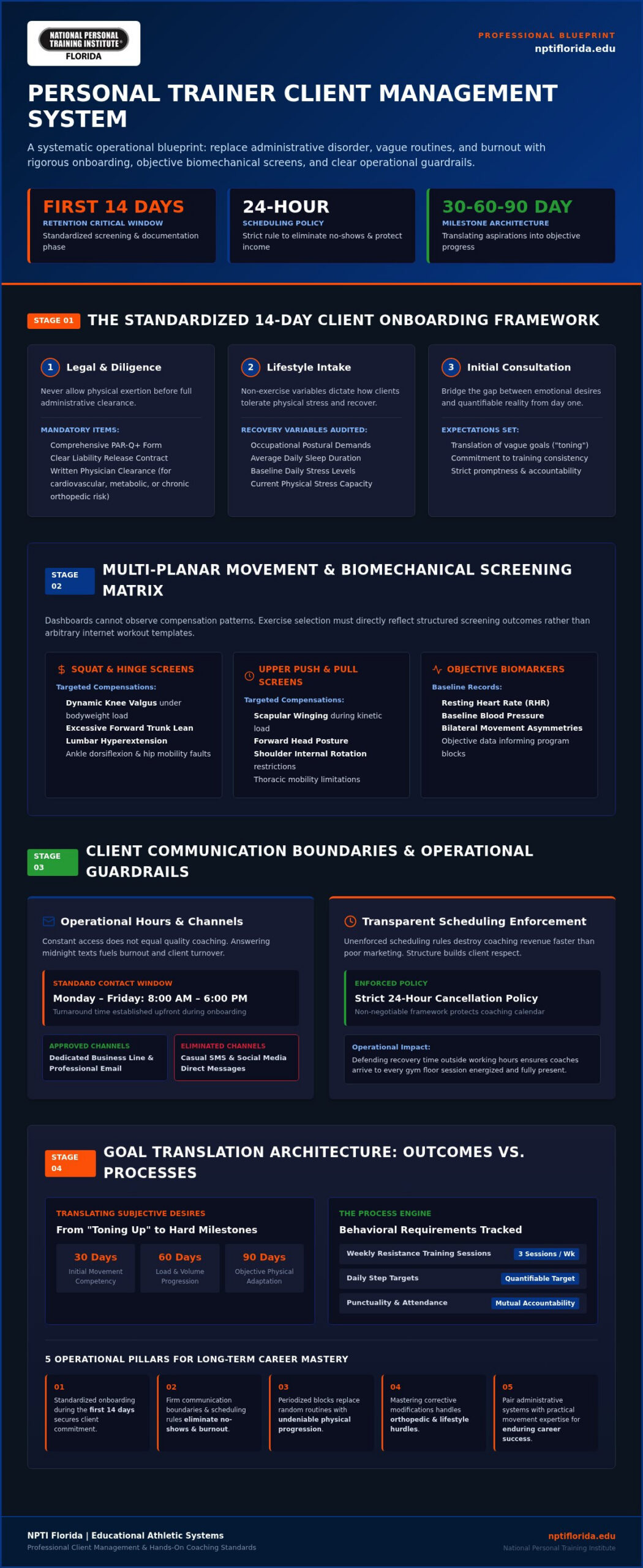
Never permit physical exertion before securing complete administrative paperwork. A standardized onboarding packet must include a comprehensive Physical Activity Readiness Questionnaire (such as the PAR-Q+), a clear liability release, and a thorough lifestyle intake form. If a client presents cardiovascular, metabolic, or chronic orthopedic risk factors, secure written clearance from their attending physician first. Capture occupational postural demands, average sleep duration, and daily stress levels; these non-exercise variables dictate how well your client tolerates physical stress and recovers from training loads.
Conducting Movement and Baseline Biomechanical Screenings
Software dashboards cannot observe compensation patterns. During your initial evaluation, guide clients through structured, multi-planar movement assessments to evaluate ankle dorsiflexion, hip stability, and thoracic mobility:
- Overhead Squat & Hinge Assessments: Reveal dynamic knee valgus, excessive forward trunk lean, or lumbar hyperextension under bodyweight load.
- Upper-Body Push and Pull Screens: Identify scapular winging, forward head posture, or shoulder internal rotation restrictions.
- Baseline Biomarkers: Record resting heart rate, baseline blood pressure, and movement asymmetries to inform intelligent program design.
Exercise selections must directly reflect these screening outcomes rather than arbitrary internet workout templates.
Structuring the Initial Goal-Setting Consultation
Knowing how to manage personal training clients effectively means bridging the gap between emotional desires and quantifiable reality. Clients frequently state vague aspirations like “toning up” or “feeling healthier.” Your role as an expert coach is to translate those subjective wishes into measurable 30-, 60-, and 90-day physical milestones. Clearly separate outcome goals from the specific behavioral processes required to achieve them, such as completing three resistance sessions weekly and hitting daily step targets. Finally, establish mutual expectations regarding training consistency, promptness, and accountability from day one.
Mastering Client Communication, Boundaries, and Retention Systems
Constant access does not equal quality coaching. Many fitness professionals mistakenly believe that answering midnight texts proves dedication, only to end up exhausted, resentful, and facing high client turnover. Genuine retention stems from professional structure and mutual respect. Research published on Strengthening the Client-Personal Trainer Relationship demonstrates that clear communication frameworks build deeper trust than unregulated availability. When understanding how to manage personal training clients over multi-year careers, maintaining firm operational guardrails protects your energy while teaching clients to value your time.
Setting Operational Hours and Contact Channels
Keep your professional conversations separated from your personal life. Eliminate direct messaging through social media platforms or casual text threads. Instead, funnel all training inquiries and workout feedback through a dedicated business line or professional email. Establish specific communication windows, such as Monday through Friday between 8:00 AM and 6:00 PM, and state your standard response turnaround time during onboarding. When you defend your personal recovery time outside working hours, you show up to every gym floor session energized and fully present.
Enforcing Fair and Transparent Cancellation Policies
Unenforced scheduling rules destroy coaching revenue faster than poor marketing. Implement a strict, non-negotiable 24-hour cancellation and rescheduling policy documented during your initial consultation:
- Clear Notice Windows: Require clients to provide at least 24 hours of advance notice to reschedule a booked appointment without forfeiting their session.
- Equitable Enforcement: Charge for late cancellations consistently, regardless of client tenure, to maintain clear professional respect.
- Empathetic Boundaries: Handle genuine medical emergencies with grace, but hold the line against routine schedule conflicts and casual oversights.
Running Effective Weekly Accountability Check-Ins
Long-term adherence happens between workouts. Schedule weekly five-minute touchpoints to evaluate recovery, stress loads, and dietary habits. Don’t let progress discussions revolve entirely around bodyweight fluctuations. Instead, celebrate non-scale victories like increased lifting volume, improved postural endurance during office hours, and consistent meal prep routines. Mastering how to manage personal training clients through behavioral roadblocks requires a deep grasp of lifestyle design, which you can cultivate through an accredited health and nutrition coaching program. If you want to refine these behavioral feedback loops, explore how systematic vocational education at nptiflorida.edu turns everyday client accountability into reliable career longevity.
Organizing Workout Programming, Data Tracking, and Progression Metrics
Winging workouts on the gym floor guarantees plateaued clients and empty schedules. Random exercise selection might break a sweat, but it builds neither physical resilience nor client retention. Understanding how to manage personal training clients over the long haul requires treating program design as an applied science. Whether you record numbers on physical clipboards, custom spreadsheets, or specialized coaching software, tracking progression metrics ensures that every repetition serves a clear training outcome.
Structuring Periodized Mesocycles for General Population Clients
Structure your training calendar into dedicated four-to-eight-week mesocycles centered on defined physiological adaptations, such as baseline neuromuscular control, muscular hypertrophy, or functional strength. Systematically manipulating training volume, mechanical intensity, and rest intervals prevents overuse injuries and breaks through stagnation. When a movement pattern breaks down under load, insert seamless regressions without pausing session momentum. Swapping a barbell back squat for a goblet squat preserves client confidence while protecting spinal integrity.
Tracking Volume Load and Performance Data Accurately
Review past training data before your client steps onto the gym floor. Logging precise variables turns abstract workout routines into objective, demonstrable progress metrics:
- Volume Load Calculation: Multiply completed sets by repetitions and resistance to verify progressive overload week over week.
- Standardized Rest Intervals: Track rest periods between sets to ensure cardiovascular and neuromuscular targets match the intended adaptation.
- Movement Execution Quality: Document technical improvements across compound lifts to show clients undeniable physical development.
These rigorous data collection methods form the backbone of an advanced personal training curriculum, reinforcing your value as an indispensable health partner.
Autoregulation and Managing In-Session Program Modifications
Real life regularly derails spreadsheet calculations. When clients arrive depleted from poor sleep or occupational stress, blindly forcing heavy compound lifts invites acute injury. True expertise in how to manage personal training clients involves active autoregulation. Use the specific movement warm-up to evaluate joint mechanics, then employ Rate of Perceived Exertion (RPE) scoring to regulate training intensities safely. If a prescribed warm-up load feels unusually taxing, reduce the working weight or substitute a joint-friendly variation, noting the change in your records to refine future programming blocks.
Managing Special Populations and Behavioral Roadblocks
A 2026 industry report revealed that 88% of personal trainers identify longevity and healthspan as their clients’ primary focus, easily surpassing aesthetic motivations. Your client roster will rarely consist entirely of uninjured twenty-somethings chasing muscle gains. Instead, you’ll encounter desk workers with chronic back issues, active seniors preserving independence, and young athletes building movement literacy. A major gap in standard coaching resources is the complete neglect of diverse demographics. Truly grasping how to manage personal training clients means expanding your coaching toolkit beyond generic workout templates to meet unique physiological and psychological realities.
Managing Clients with Orthopedic and Chronic Pathologies
Working around joint limitations requires anatomical precision, not guesswork. When working with clients presenting lumbar disc issues, replace compressive overhead loading with chest-supported rows and hip hinges that preserve a neutral spine. For joint replacements or degenerative osteoarthritis, modify ranges of motion and alter lever arms to build strength without aggravating synovial joints. Never diagnose injuries; operate strictly within your professional scope of practice by collaborating with physical therapists to execute prescribed rehabilitative transitions safely.
Coaching Youth and Senior Demographics Effectively
Communication styles must shift alongside your client’s biological age. Delivering effective programming across generations demands distinct structural approaches:
- Senior Populations: Emphasize multi-planar balance, fall prevention mechanics, ankle stability, and functional rotational strength to ensure daily physical autonomy.
- Youth Demographics: Center sessions on foundational coordination, landing mechanics, and playful agility games rather than early sports specialization or maximal lifting.
- Instructional Cues: Replace complex anatomical terms with external tactile cues for youth, while providing clear functional explanations for mature adults.
Overcoming Motivational Relapse and Behavioral Obstacles
Missed workouts and sudden disengagement signal emotional fatigue long before a client cancels their package. Developing skill in how to manage personal training clients involves utilizing motivational interviewing. Ask open-ended questions like, “What felt most challenging about completing your walking goals this week?” rather than placing blame. If external life stress spikes, immediately pivot away from exhaustive lifting toward restorative mobility and breathing drills. Keeping clients engaged through life turbulence proves you value their lifelong wellness over an arbitrary workout chart. To build real competency across these complex scenarios, explore the comprehensive vocational diploma programs at nptiflorida.edu and master the art of special populations coaching.
Elevating Client Management from Ad-Hoc Hustle to Career Mastery
No software application can compensate for poor coaching mechanics. Digital tools excel at organizing schedules and logging workout weights, but they cannot spot a collapsing knee during a heavy lunge or sense the subtle hesitation of an anxious client. Truly mastering how to manage personal training clients requires stepping beyond administrative automation. Long-term career success comes from deep vocational mastery, clinical movement acumen, and the confident interpersonal skills that turn casual gym members into lifetime clients.
The Limits of Software Tools Without Coaching Competency
Digital dashboards only amplify existing habits. If your underlying exercise selection is flawed or your movement assessments are superficial, software simply accelerates client frustration. Real coaching relies on acute sensory awareness. You must read subtle changes in breathing, detect microscopic pelvic shifts during a deadlift, and deliver intuitive verbal cues that correct form instantly. Digital algorithms cannot replicate human empathy, biomechanical troubleshooting, or the relational trust that keeps clients committed month after month.
Investing in Hands-On Vocational Training and Accreditation
Shallow credentials produce fragile businesses. A quick weekend certificate might give you basic liability coverage, but it leaves you unprepared for real-world gym floor realities. True career confidence requires systematic, immersive study:
- Substantial Supervised Hours: Accumulating 240 hours of hands-on practical lab experience lets you refine spotting techniques, posture analysis, and cueing methods under expert faculty guidance.
- Grounded Exercise Science: Mastering 360 hours of classroom theory across functional biomechanics, human anatomy, and physiological energy pathways.
- Accredited Standards: Studying through an institution accredited by the Accrediting Commission of Career Schools and Colleges (ACCSC) ensures your training meets rigorous academic criteria.
Enrolling in a comprehensive personal training program transforms fitness enthusiasm into lifelong career mastery.
Building a Sustainable, High-Retention Fitness Business
Exceptional client management creates an organic referral engine. When you consistently deliver pain-free physical transformations and conduct yourself like a healthcare professional, your roster remains full without aggressive sales tactics. Learning how to manage personal training clients with standardized onboarding workflows, structured periodization, and professional communication boundaries sets you apart from the sea of disorganized trainers. Invest in verified educational depth, establish unshakeable operational systems, and build a lasting fitness career grounded in proven excellence.
Transform Your Coaching Systems into Long-Term Career Success
Thriving fitness professionals don’t leave retention to chance. By establishing airtight onboarding workflows, enforcing clear scheduling boundaries, and tracking progression with periodized science, you protect your time while maximizing client results. Mastering how to manage personal training clients transforms a chaotic side hustle into a predictable, highly respected career.
True coaching authority requires more than administrative apps; it demands elite vocational preparation. Backed by over 25 years of industry leadership, our ACCSC-accredited and state-licensed 600-hour diploma combines 360 classroom theory hours with 240 practical gym lab hours. Through targeted instruction in Health and Nutrition Coaching, Corrective Exercise, and Youth Fitness, you develop the real-world mastery needed to solve complex client roadblocks on the gym floor. Take the defining step in your fitness journey and enroll in an ACCSC-accredited personal training diploma program today to build a lasting, high-impact career.
Frequently Asked Questions
How many personal training clients can one trainer manage effectively?
A full-time personal trainer can manage 15 to 25 active one-on-one clients effectively without experiencing burnout. If you coach clients two to three times per week, 20 clients equates to 40 to 60 floor hours, leaving minimal time for program design and administrative tracking. Trainers utilizing a hybrid delivery model can often manage 30 to 40 clients by blending in-person sessions with remote check-ins and structured independent programming.
What is the best way to track personal training client workouts and progress?
The best way to track client progress is through a centralized system that records total volume load, exercise variations, and qualitative movement mechanics. Whether you choose digital spreadsheets, specialized coaching apps, or structured physical binders, consistency is what matters most. Review past lifting metrics before each session so you can apply progressive overload deliberately, ensuring your client sees undeniable physical proof of their functional development over time.
How should personal trainers handle last-minute client cancellations?
Enforce a transparent, non-negotiable 24-hour cancellation policy that is signed during the initial client onboarding phase. If a client cancels with less than 24 hours of notice without a verified medical emergency, charge them for the session. Applying this rule consistently protects your income, maintains mutual professional respect, and encourages clients to prioritize their scheduled commitments just like any other medical or business appointment.
What documents are legally required before training a new fitness client?
Before conducting physical exercise, you must collect a signed Physical Activity Readiness Questionnaire (PAR-Q+), an informed consent document, and a liability waiver. If the PAR-Q+ indicates preexisting cardiovascular, metabolic, or chronic orthopedic risk factors, require a physician clearance form before starting. Knowing how to manage personal training clients legally protects your business liability while ensuring you have emergency contacts and relevant medical histories documented safely.
How often should personal trainers reassess their clients’ physical progress?
Reassess functional movement screens and physical performance metrics every four to eight weeks, aligning directly with your periodized mesocycles. Avoid running full biometric assessments every week, as natural body composition and strength fluctuations can create unnecessary client anxiety. Instead, evaluate daily movement quality during warm-ups, track weekly training volume progressions, and reserve comprehensive testing dates for the end of each multi-week training phase.
Can you manage personal training clients without paid coaching software?
Yes, you can successfully learn how to manage personal training clients using basic tools like cloud spreadsheets, calendar apps, and structured intake forms. Free digital spreadsheets allow you to build custom volume-tracking templates and progressive overload charts tailored to each lifter. While paid platforms offer convenient automated scheduling, true coaching retention always depends on your vocational exercise knowledge and human communication rather than high-priced administrative software.
What should a trainer do when a client consistently misses their nutrition goals?
Shift from aggressive dietary rules to collaborative, single-habit behavior changes using motivational interviewing techniques. When a client repeatedly struggles with meal targets, ask open-ended questions to uncover the lifestyle barriers causing friction. Break overwhelming nutrition goals down into smaller, manageable actions, like adding one palm-sized portion of protein per meal or tracking daily hydration, to rebuild their behavioral consistency and confidence gradually.

Great workout programming won’t save your business if your daily operations are chaotic. If you find yourself answering client texts late at night, digging through scattered spreadsheets to check an exercise progression, or stressing over unexpected cancellations, you aren’t alone. Most trainers enter the industry to change lives, only to find themselves overwhelmed by administrative disorder. Learning how to manage personal training clients systematically requires bringing the same deliberate structure to your business habits that you bring to human movement.
Apps and spreadsheets can store your notes, but genuine retention comes down to structured communication boundaries, thorough assessments, and behavioral coaching frameworks. In this guide, you’ll master a step-by-step operating system that covers seamless client onboarding, reliable scheduling policies that protect your personal time, and data-driven tracking methods that prove client results. Here is your actionable blueprint to replace everyday guesswork with a sustainable, high-retention coaching workflow.
Key Takeaways
- Standardize your onboarding with comprehensive health screenings and lifestyle intakes during the first fourteen days to secure immediate client commitment.
- Learn how to manage personal training clients with firm communication boundaries and scheduling policies that prevent burnout and eliminate no-shows.
- Replace random daily routines with structured, periodized training blocks and objective tracking metrics that demonstrate undeniable physical progression.
- Build retention across diverse rosters by mastering corrective exercise modifications and behavioral strategies for clients with orthopedic or lifestyle hurdles.
- Elevate your practice from an ad-hoc hustle into an enduring career by pairing structured administrative systems with deep, practical movement expertise.
Establishing a Professional Personal Training Client Onboarding Workflow
Client retention is won or lost in the first fourteen days. While automated apps promise instant client management, genuine retention depends on systematic screening, medical diligence, and human connection. As a professional personal trainer, your onboarding process signals to a new client whether you operate as a licensed professional or an amateur gym enthusiast. Mastering how to manage personal training clients begins long before their first set of squats; it starts with an intake workflow that secures legal safety, assesses mechanical limitations, and aligns realistic human expectations.
Standardizing Intake Paperwork and Legal Documentation
Never permit physical exertion before securing complete administrative paperwork. A standardized onboarding packet must include a comprehensive Physical Activity Readiness Questionnaire (such as the PAR-Q+), a clear liability release, and a thorough lifestyle intake form. If a client presents cardiovascular, metabolic, or chronic orthopedic risk factors, secure written clearance from their attending physician first. Capture occupational postural demands, average sleep duration, and daily stress levels; these non-exercise variables dictate how well your client tolerates physical stress and recovers from training loads.
Conducting Movement and Baseline Biomechanical Screenings
Software dashboards cannot observe compensation patterns. During your initial evaluation, guide clients through structured, multi-planar movement assessments to evaluate ankle dorsiflexion, hip stability, and thoracic mobility:
- Overhead Squat & Hinge Assessments: Reveal dynamic knee valgus, excessive forward trunk lean, or lumbar hyperextension under bodyweight load.
- Upper-Body Push and Pull Screens: Identify scapular winging, forward head posture, or shoulder internal rotation restrictions.
- Baseline Biomarkers: Record resting heart rate, baseline blood pressure, and movement asymmetries to inform intelligent program design.
Exercise selections must directly reflect these screening outcomes rather than arbitrary internet workout templates.
Structuring the Initial Goal-Setting Consultation
Knowing how to manage personal training clients effectively means bridging the gap between emotional desires and quantifiable reality. Clients frequently state vague aspirations like “toning up” or “feeling healthier.” Your role as an expert coach is to translate those subjective wishes into measurable 30-, 60-, and 90-day physical milestones. Clearly separate outcome goals from the specific behavioral processes required to achieve them, such as completing three resistance sessions weekly and hitting daily step targets. Finally, establish mutual expectations regarding training consistency, promptness, and accountability from day one.
Mastering Client Communication, Boundaries, and Retention Systems
Constant access does not equal quality coaching. Many fitness professionals mistakenly believe that answering midnight texts proves dedication, only to end up exhausted, resentful, and facing high client turnover. Genuine retention stems from professional structure and mutual respect. Research published on Strengthening the Client-Personal Trainer Relationship demonstrates that clear communication frameworks build deeper trust than unregulated availability. When understanding how to manage personal training clients over multi-year careers, maintaining firm operational guardrails protects your energy while teaching clients to value your time.
Setting Operational Hours and Contact Channels
Keep your professional conversations separated from your personal life. Eliminate direct messaging through social media platforms or casual text threads. Instead, funnel all training inquiries and workout feedback through a dedicated business line or professional email. Establish specific communication windows, such as Monday through Friday between 8:00 AM and 6:00 PM, and state your standard response turnaround time during onboarding. When you defend your personal recovery time outside working hours, you show up to every gym floor session energized and fully present.
Enforcing Fair and Transparent Cancellation Policies
Unenforced scheduling rules destroy coaching revenue faster than poor marketing. Implement a strict, non-negotiable 24-hour cancellation and rescheduling policy documented during your initial consultation:
- Clear Notice Windows: Require clients to provide at least 24 hours of advance notice to reschedule a booked appointment without forfeiting their session.
- Equitable Enforcement: Charge for late cancellations consistently, regardless of client tenure, to maintain clear professional respect.
- Empathetic Boundaries: Handle genuine medical emergencies with grace, but hold the line against routine schedule conflicts and casual oversights.
Running Effective Weekly Accountability Check-Ins
Long-term adherence happens between workouts. Schedule weekly five-minute touchpoints to evaluate recovery, stress loads, and dietary habits. Don’t let progress discussions revolve entirely around bodyweight fluctuations. Instead, celebrate non-scale victories like increased lifting volume, improved postural endurance during office hours, and consistent meal prep routines. Mastering how to manage personal training clients through behavioral roadblocks requires a deep grasp of lifestyle design, which you can cultivate through an accredited health and nutrition coaching program. If you want to refine these behavioral feedback loops, explore how systematic vocational education at nptiflorida.edu turns everyday client accountability into reliable career longevity.
Organizing Workout Programming, Data Tracking, and Progression Metrics
Winging workouts on the gym floor guarantees plateaued clients and empty schedules. Random exercise selection might break a sweat, but it builds neither physical resilience nor client retention. Understanding how to manage personal training clients over the long haul requires treating program design as an applied science. Whether you record numbers on physical clipboards, custom spreadsheets, or specialized coaching software, tracking progression metrics ensures that every repetition serves a clear training outcome.
Structuring Periodized Mesocycles for General Population Clients
Structure your training calendar into dedicated four-to-eight-week mesocycles centered on defined physiological adaptations, such as baseline neuromuscular control, muscular hypertrophy, or functional strength. Systematically manipulating training volume, mechanical intensity, and rest intervals prevents overuse injuries and breaks through stagnation. When a movement pattern breaks down under load, insert seamless regressions without pausing session momentum. Swapping a barbell back squat for a goblet squat preserves client confidence while protecting spinal integrity.
Tracking Volume Load and Performance Data Accurately
Review past training data before your client steps onto the gym floor. Logging precise variables turns abstract workout routines into objective, demonstrable progress metrics:
- Volume Load Calculation: Multiply completed sets by repetitions and resistance to verify progressive overload week over week.
- Standardized Rest Intervals: Track rest periods between sets to ensure cardiovascular and neuromuscular targets match the intended adaptation.
- Movement Execution Quality: Document technical improvements across compound lifts to show clients undeniable physical development.
These rigorous data collection methods form the backbone of an advanced personal training curriculum, reinforcing your value as an indispensable health partner.
Autoregulation and Managing In-Session Program Modifications
Real life regularly derails spreadsheet calculations. When clients arrive depleted from poor sleep or occupational stress, blindly forcing heavy compound lifts invites acute injury. True expertise in how to manage personal training clients involves active autoregulation. Use the specific movement warm-up to evaluate joint mechanics, then employ Rate of Perceived Exertion (RPE) scoring to regulate training intensities safely. If a prescribed warm-up load feels unusually taxing, reduce the working weight or substitute a joint-friendly variation, noting the change in your records to refine future programming blocks.
Managing Special Populations and Behavioral Roadblocks
A 2026 industry report revealed that 88% of personal trainers identify longevity and healthspan as their clients’ primary focus, easily surpassing aesthetic motivations. Your client roster will rarely consist entirely of uninjured twenty-somethings chasing muscle gains. Instead, you’ll encounter desk workers with chronic back issues, active seniors preserving independence, and young athletes building movement literacy. A major gap in standard coaching resources is the complete neglect of diverse demographics. Truly grasping how to manage personal training clients means expanding your coaching toolkit beyond generic workout templates to meet unique physiological and psychological realities.
Managing Clients with Orthopedic and Chronic Pathologies
Working around joint limitations requires anatomical precision, not guesswork. When working with clients presenting lumbar disc issues, replace compressive overhead loading with chest-supported rows and hip hinges that preserve a neutral spine. For joint replacements or degenerative osteoarthritis, modify ranges of motion and alter lever arms to build strength without aggravating synovial joints. Never diagnose injuries; operate strictly within your professional scope of practice by collaborating with physical therapists to execute prescribed rehabilitative transitions safely.
Coaching Youth and Senior Demographics Effectively
Communication styles must shift alongside your client’s biological age. Delivering effective programming across generations demands distinct structural approaches:
- Senior Populations: Emphasize multi-planar balance, fall prevention mechanics, ankle stability, and functional rotational strength to ensure daily physical autonomy.
- Youth Demographics: Center sessions on foundational coordination, landing mechanics, and playful agility games rather than early sports specialization or maximal lifting.
- Instructional Cues: Replace complex anatomical terms with external tactile cues for youth, while providing clear functional explanations for mature adults.
Overcoming Motivational Relapse and Behavioral Obstacles
Missed workouts and sudden disengagement signal emotional fatigue long before a client cancels their package. Developing skill in how to manage personal training clients involves utilizing motivational interviewing. Ask open-ended questions like, “What felt most challenging about completing your walking goals this week?” rather than placing blame. If external life stress spikes, immediately pivot away from exhaustive lifting toward restorative mobility and breathing drills. Keeping clients engaged through life turbulence proves you value their lifelong wellness over an arbitrary workout chart. To build real competency across these complex scenarios, explore the comprehensive vocational diploma programs at nptiflorida.edu and master the art of special populations coaching.
Elevating Client Management from Ad-Hoc Hustle to Career Mastery
No software application can compensate for poor coaching mechanics. Digital tools excel at organizing schedules and logging workout weights, but they cannot spot a collapsing knee during a heavy lunge or sense the subtle hesitation of an anxious client. Truly mastering how to manage personal training clients requires stepping beyond administrative automation. Long-term career success comes from deep vocational mastery, clinical movement acumen, and the confident interpersonal skills that turn casual gym members into lifetime clients.
The Limits of Software Tools Without Coaching Competency
Digital dashboards only amplify existing habits. If your underlying exercise selection is flawed or your movement assessments are superficial, software simply accelerates client frustration. Real coaching relies on acute sensory awareness. You must read subtle changes in breathing, detect microscopic pelvic shifts during a deadlift, and deliver intuitive verbal cues that correct form instantly. Digital algorithms cannot replicate human empathy, biomechanical troubleshooting, or the relational trust that keeps clients committed month after month.
Investing in Hands-On Vocational Training and Accreditation
Shallow credentials produce fragile businesses. A quick weekend certificate might give you basic liability coverage, but it leaves you unprepared for real-world gym floor realities. True career confidence requires systematic, immersive study:
- Substantial Supervised Hours: Accumulating 240 hours of hands-on practical lab experience lets you refine spotting techniques, posture analysis, and cueing methods under expert faculty guidance.
- Grounded Exercise Science: Mastering 360 hours of classroom theory across functional biomechanics, human anatomy, and physiological energy pathways.
- Accredited Standards: Studying through an institution accredited by the Accrediting Commission of Career Schools and Colleges (ACCSC) ensures your training meets rigorous academic criteria.
Enrolling in a comprehensive personal training program transforms fitness enthusiasm into lifelong career mastery.
Building a Sustainable, High-Retention Fitness Business
Exceptional client management creates an organic referral engine. When you consistently deliver pain-free physical transformations and conduct yourself like a healthcare professional, your roster remains full without aggressive sales tactics. Whether coaching independently or training clients in well-equipped fitness spaces like gymngo.co.uk, learning how to manage personal training clients with standardized onboarding workflows, structured periodization, and professional communication boundaries sets you apart from the sea of disorganized trainers. Invest in verified educational depth, establish unshakeable operational systems, and build a lasting fitness career grounded in proven excellence.
Transform Your Coaching Systems into Long-Term Career Success
Thriving fitness professionals don’t leave retention to chance. By establishing airtight onboarding workflows, enforcing clear scheduling boundaries, and tracking progression with periodized science, you protect your time while maximizing client results. Mastering how to manage personal training clients transforms a chaotic side hustle into a predictable, highly respected career.
True coaching authority requires more than administrative apps; it demands elite vocational preparation. Backed by over 25 years of industry leadership, our ACCSC-accredited and state-licensed 600-hour diploma combines 360 classroom theory hours with 240 practical gym lab hours. Through targeted instruction in Health and Nutrition Coaching, Corrective Exercise, and Youth Fitness, you develop the real-world mastery needed to solve complex client roadblocks on the gym floor. Take the defining step in your fitness journey and enroll in an ACCSC-accredited personal training diploma program today to build a lasting, high-impact career.
Frequently Asked Questions
How many personal training clients can one trainer manage effectively?
A full-time personal trainer can manage 15 to 25 active one-on-one clients effectively without experiencing burnout. If you coach clients two to three times per week, 20 clients equates to 40 to 60 floor hours, leaving minimal time for program design and administrative tracking. Trainers utilizing a hybrid delivery model can often manage 30 to 40 clients by blending in-person sessions with remote check-ins and structured independent programming.
What is the best way to track personal training client workouts and progress?
The best way to track client progress is through a centralized system that records total volume load, exercise variations, and qualitative movement mechanics. Whether you choose digital spreadsheets, specialized coaching apps, or structured physical binders, consistency is what matters most. Review past lifting metrics before each session so you can apply progressive overload deliberately, ensuring your client sees undeniable physical proof of their functional development over time.
How should personal trainers handle last-minute client cancellations?
Enforce a transparent, non-negotiable 24-hour cancellation policy that is signed during the initial client onboarding phase. If a client cancels with less than 24 hours of notice without a verified medical emergency, charge them for the session. Applying this rule consistently protects your income, maintains mutual professional respect, and encourages clients to prioritize their scheduled commitments just like any other medical or business appointment.
What documents are legally required before training a new fitness client?
Before conducting physical exercise, you must collect a signed Physical Activity Readiness Questionnaire (PAR-Q+), an informed consent document, and a liability waiver. If the PAR-Q+ indicates preexisting cardiovascular, metabolic, or chronic orthopedic risk factors, require a physician clearance form before starting. Knowing how to manage personal training clients legally protects your business liability while ensuring you have emergency contacts and relevant medical histories documented safely.
How often should personal trainers reassess their clients’ physical progress?
Reassess functional movement screens and physical performance metrics every four to eight weeks, aligning directly with your periodized mesocycles. Avoid running full biometric assessments every week, as natural body composition and strength fluctuations can create unnecessary client anxiety. Instead, evaluate daily movement quality during warm-ups, track weekly training volume progressions, and reserve comprehensive testing dates for the end of each multi-week training phase.
Can you manage personal training clients without paid coaching software?
Yes, you can successfully learn how to manage personal training clients using basic tools like cloud spreadsheets, calendar apps, and structured intake forms. Free digital spreadsheets allow you to build custom volume-tracking templates and progressive overload charts tailored to each lifter. For trainers running their own studio or facility who prefer an all-in-one management platform, you can learn more about AppyBee to explore automated scheduling and member administration. While paid platforms offer convenient operational support, true coaching retention always depends on your vocational exercise knowledge and human communication rather than software alone.
What should a trainer do when a client consistently misses their nutrition goals?
Shift from aggressive dietary rules to collaborative, single-habit behavior changes using motivational interviewing techniques. When a client repeatedly struggles with meal targets, ask open-ended questions to uncover the lifestyle barriers causing friction. Break overwhelming nutrition goals down into smaller, manageable actions, like adding one palm-sized portion of protein per meal or tracking daily hydration, to rebuild their behavioral consistency and confidence gradually.