From Desk Job to Fitness Pro: 2026 Career Guide
A 2026 ISSA report revealed that 94% of gym hiring managers see a critical readiness gap among newly certified coaches. Passing an online exam at a desk doesn’t prepare you to lead real clients on a dynamic gym floor. If you spend your days locked in a sedentary office routine, you already know the physical stiffness and mental exhaustion that come with it. You want active, purposeful work, yet taking the leap from desk job to fitness professional feels daunting when your financial security is on the line.
You don’t have to choose between a steady paycheck and meaningful work, nor do you need an athletic background to become an exceptional coach. In this guide, you’ll discover how to transition from a corporate desk job into a thriving, accredited fitness career without sacrificing financial stability. We map out the exact blueprint to earn respected credentials, build practical floor confidence, and launch your new vocational path safely.
Key Takeaways
- Explore how moving from desk job to fitness professional helps reverse the physical toll of sedentary work while capitalizing on rapid wellness industry expansion.
- Compare short-term weekend certifications with structured vocational diplomas to avoid career stagnation and overcome coach imposter syndrome.
- Implement a phased transition blueprint that protects your current salary through flexible study formats before launching into full-time training.
- Understand why 240 hours of practical gym lab instruction build real-world cueing and movement diagnosis skills that textbooks cannot teach.
- Discover how combining personal training credentials with nutrition coaching expands service offerings, enhances client retention, and secures long-term earning potential.
Why Transition from a Desk Job to a Fitness Professional in 2026?
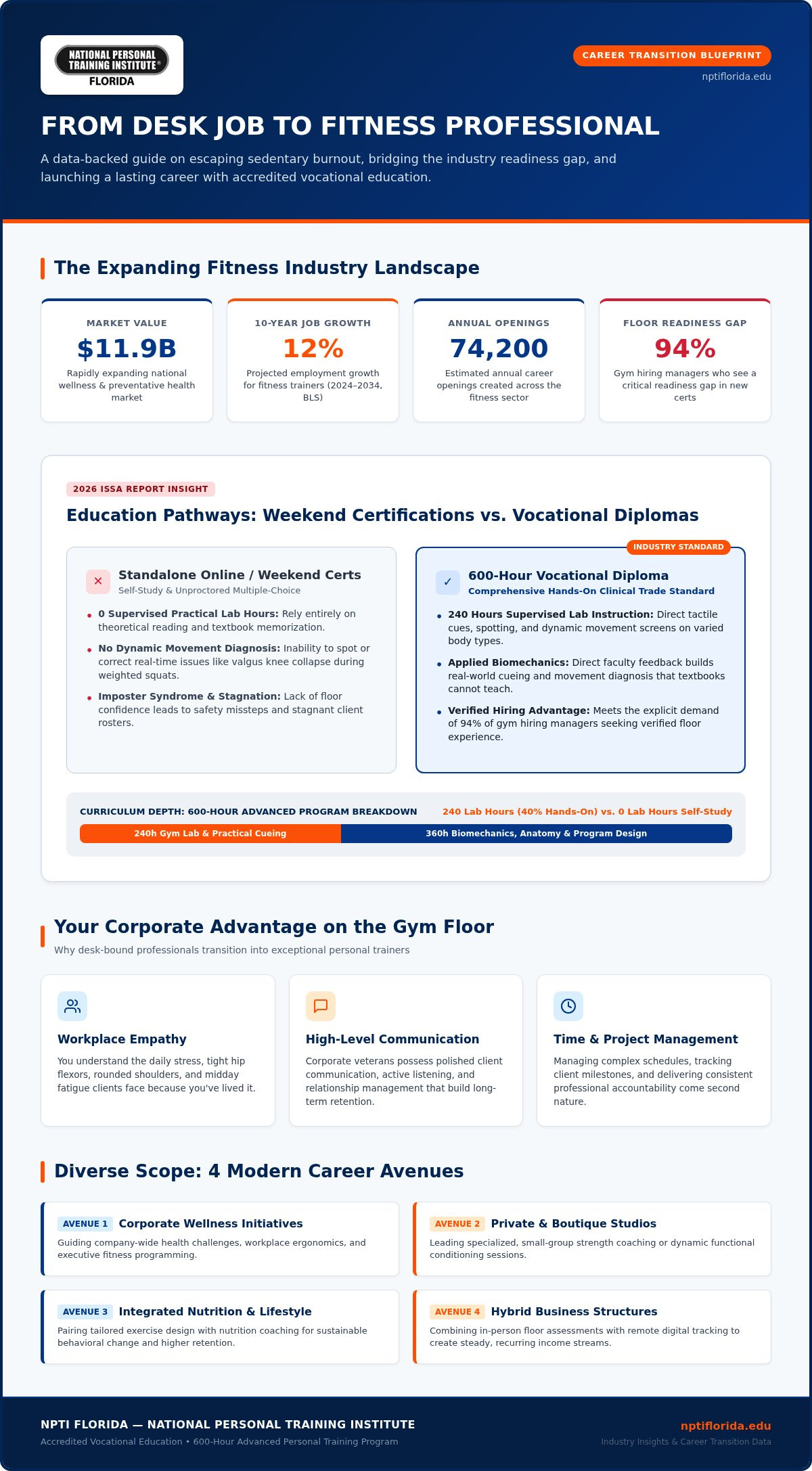
Sitting behind a desk for eight to ten hours a day takes a measurable physical toll. Tight hip flexors, rounded shoulders, and midday brain fog are not just minor workplace annoyances; they are symptoms of chronic inactivity. According to the U.S. Bureau of Labor Statistics, employment for fitness trainers and instructors is projected to grow 12% between 2024 and 2034, creating roughly 74,200 annual job openings. Making the move from desk job to fitness professional allows you to escape this sedentary cycle while entering a market valued at $11.9 billion.
Your previous corporate experience provides a distinct competitive advantage on the gym floor. While movement science forms the foundation of coaching, your professional background equips you with the high-level communication, time management, and client empathy that many fitness newcomers lack. You already understand the workplace pressures your future clients experience every single day, which makes your guidance far more relatable.
Escaping Sedentary Burnout for Purpose-Driven Work
Trading spreadsheet fatigue for active coaching restores your physical health while creating daily job satisfaction. Guiding an individual from chronic back pain to pain-free movement delivers immediate, tangible fulfillment. When you transition from desk job to fitness professional, you align your working hours with your personal health values, spending your days demonstrating proper biomechanics rather than being trapped in an office chair.
The Expanding Scope of Modern Fitness Careers
Modern coaching has expanded far past the traditional hourly gym floor routine. Today, a qualified personal trainer works across diverse environments and dynamic business structures, including:
- Corporate Wellness Initiatives: Guiding company-wide health challenges, workplace ergonomics, and executive fitness programming.
- Private and Boutique Studios: Leading specialized, small-group strength or functional conditioning sessions.
- Integrated Lifestyle Support: Combining tailored exercise design with sustainable Health and Nutrition Coaching to support long-term behavioral change.
- Hybrid Business Structures: Pairing hands-on in-person assessments with remote digital check-ins to create steady, recurring income streams.
Demand for holistic lifestyle interventions continues to climb. Clients no longer seek basic workout supervision alone; they need comprehensive guidance that integrates exercise programming with sustainable habit formation. Stepping into this vocational space allows you to build a secure, diversified career dedicated to preventative health.
Comparing Education Pathways: Weekend Certificates vs. Vocational Diplomas
Your educational foundation determines the ceiling of your coaching career. While the job outlook for fitness trainers reflects rapid national expansion, entering the field unprepared creates immediate roadblocks. Career changers often gravitate toward accelerated certifications, assuming speed equals efficiency. In reality, choosing a superficial credential over comprehensive vocational training frequently leads to imposter syndrome, safety missteps, and stagnant client rosters.
The Limits of Standalone Online Fitness Certifications
Most commercial certifications rely entirely on self-study textbooks and an unproctored multiple-choice exam. Memorizing anatomical terms on paper fails to build real-time movement assessment skills. When you step onto a commercial floor with paying clients, a textbook cannot show you how to correct valgus knee collapse during a weighted squat. A 2026 industry survey found that 94% of gym hiring managers actively seek candidates who already possess verified practical experience, exposing a massive preparation gap among independently certified applicants.
The Comprehensive 600-Hour Vocational Diploma Advantage
Vocational diplomas bridge this divide by treating fitness as a skilled clinical trade rather than a hobby. When transitioning from desk job to fitness professional, you need immersion to replace missing athletic or kinesiology backgrounds. A structured program like the 600-hour Advanced Personal Training Program delivers hundreds of supervised hours balancing biomechanics with practical application:
- Extensive Supervised Lab Work: Practicing tactile cues, spotting techniques, and dynamic movement screens on varied body types under direct faculty supervision.
- Special Population Competencies: Mastering safe exercise regressions for clients presenting with lower-back pathologies, osteoarthritis, or metabolic conditions.
- Multi-Credential Mastery: Combining resistance training design with accredited Health and Nutrition Coaching to address total client wellness.
Investing in a structured, state-licensed vocational curriculum builds genuine competence long before you accept your first paying client. You can explore how these components integrate by reviewing our advanced personal training curriculum. If you want to build a sustainable, high-earning coaching business, begin by exploring comprehensive diploma options at nptiflorida.edu to secure a durable professional career.
Step-by-Step Blueprint: Moving from Desk Worker to Fitness Professional
Leaping blindly into a career pivot creates unnecessary stress. Transitioning successfully from desk job to fitness professional requires a calculated strategy that preserves your cash flow while systematically building hands-on competence. By following a structured roadmap, you eliminate panic and set yourself up for lasting commercial success.
Phase 1: Financial Planning and Schedule Audit
Begin by calculating your core monthly living expenses to establish a realistic three-to-six-month reserve fund. Next, map out ten to fifteen hours each week dedicated entirely to vocational study without cutting into your core work output. Catalog your existing corporate assets. Experience in managing calendars, communicating with executives, and meeting project milestones translates directly into high-touch client management.
Phase 2: Enrolling in an Accredited Vocational Program
Choose an institution backed by established accreditation, such as the Accrediting Commission of Career Schools and Colleges (ACCSC). Working professionals can protect their day jobs by utilizing flexible scheduling, like the Hyflex Learning Program. This hybrid approach lets you complete rigorous theory coursework in human anatomy and biomechanics on your own schedule while reserving dedicated blocks for hands-on gym practicals.
- Target Accredited Quality: Choose programs backed by recognized accrediting bodies to secure industry-wide credibility.
- Protect Your Paycheck: Rely on flexible learning formats to master technical exercise science while keeping your primary salary intact.
- Master Multi-Disciplinary Skills: Complete foundational coursework in biomechanics alongside practical modules like Health and Nutrition Coaching.
Phase 3: Launching Your Professional Training Practice
Build a professional portfolio documenting your verified practical gym hours, movement screening experience, and specialized adaptations. Premium boutique studios and corporate wellness directors favor coaches who present verified lab hours over those with unverified online tests. Position your corporate sales, active listening, and consultative skills to sign higher-paying clientele right out of the gate. For an in-depth breakdown of launch methodologies, review our ultimate personal training program guide to ensure your path from desk job to fitness professional is built on proven career systems.
Why Hands-On Practical Lab Hours Trump Self-Study for Career Changers
Reading an anatomical breakdown of a hip hinge is completely different from coaching it under a loaded barbell. Transitioning from desk job to fitness professional without prior athletic experience often triggers severe imposter syndrome. You wonder how you can credibly train an athlete, an active senior, or a desk-bound worker dealing with sciatica when your background was spent managing projects. The remedy isn’t reading another textbook; it is accumulating supervised floor hours that develop intuitive coaching reflexes.
Mastering Real-Time Movement Dysfunction and Biomechanics
Live coaching demands instant sensory processing. When a client performs an overhead squat, compensations happen across multiple planes simultaneously. A foot pronates, an anterior pelvic tilt appears, or the thoracic spine rounds under load. Supervised gym labs teach you to prioritize which breakdown to correct first, how to give tactile cues safely, and how to regress the movement seamlessly. For actionable strategies on pairing mechanical coaching with client lifestyle guidance, review our guide to choosing a health and nutrition coaching program.
Building Client Rapport and Real-World Floor Confidence
Working through hundreds of simulated training scenarios removes the dread of running your initial commercial sessions. Instead of guessing how to handle a client who arrives with sudden shoulder impingement, you already know the regression pathways from your lab repetitions. Over 25 years of institutional fitness education reveals that real-world repetitions build distinct coaching advantages:
- Dynamic Spotting Safety: Mastering mechanical leverage to keep clients secure during heavy compound lifts without interfering with their movement path.
- Precise Kinesthetic Cueing: Translating dry biomechanical concepts into clear, concise vocal and physical directions that clients understand instantly.
- Pathology Adaptations: Adjusting angles, loads, and ranges of motion on the spot when clients experience pain or mobility restrictions.
- Interpersonal Communication: Developing authentic floor presence and leadership while directing diverse body types through challenging workouts.
Completing 240 hours of hands-on practical gym lab experience transforms nervous career pivoters into composed, authoritative trainers. Rather than crossing your fingers and hoping self-study was enough, you enter the facility confident in your abilities. If you are ready to make the jump from desk job to fitness professional with real coaching certainty, check out nptiflorida.edu to enroll in an ACCSC-accredited training program today.
Building Longevity: Diversifying Your Credentials for Long-Term Career Success
Relying solely on single-hour training sessions caps your potential earnings and leaves you vulnerable to burnout. A successful leap from desk job to fitness professional requires thinking like an architect building an enduring business. While entry-level instructors sell individual training hours, seasoned practitioners build comprehensive coaching packages that integrate habit modification, nutrition guidance, and specialized population care. This multi-layered approach elevates your perceived value, deepens client retention, and establishes resilient income streams.
Combining Health and Nutrition Coaching with Personal Training
Workouts represent only three to four hours of a client’s 168-hour week. The remaining hours determine whether they reach their body composition and energy goals. When you integrate accredited Health and Nutrition Coaching into your training framework, you bridge the gap between gym performance and everyday habits. Guiding clients through dietary behavior changes and macro management allows you to package full-scope transformation programs that command premium monthly retainers.
Serving High-Demand Populations: Youth, Seniors, and Corrective Exercise
General fitness programming is a crowded category. Specializing in high-need demographics immediately differentiates your practice in a competitive market:
- Active Older Adults: Completing coursework as a Senior Fitness Specialist allows you to program specifically for bone mineral density, joint health, and fall prevention.
- Youth Athletic Conditioning: Applying age-appropriate periodization, motor development, and neuromuscular safety for young athletes builds deep trust with parents.
- Corrective Exercise and Mobility: Incorporating specialized Stretch Coach Certification techniques helps desk-bound clients resolve postural adaptations and move without joint pain.
Deepening these skill sets transforms you from a standard workout supervisor into an indispensable preventative wellness authority.
The Hyflex Advantage for Working Adults
Acquiring multiple recognized credentials does not require an all-or-nothing leap away from your corporate salary. Modern adult learning models let you maintain existing workplace responsibilities while progressing through rigorous academic modules. You can explore how structured distance learning fits around a 9-to-5 by checking out the Hyflex fitness training program guide. Taking control of your long-term vocational trajectory begins with an accredited foundation; take your next step by exploring our national comprehensive personal training diploma program to begin your evolution from desk job to fitness professional on solid ground.
Transform Your Passion into a Resilient Fitness Career
Sedentary office hours don’t have to define your working life. Shifting from desk job to fitness professional isn’t just about escaping physical burnout; it’s about building a sustainable trade rooted in scientific movement analysis, holistic nutrition, and structured coaching confidence. When you combine your existing professional acumen with deep practical competence, you step onto the floor ready to lead.
As an ACCSC-accredited vocational institution with over 25 years of educational experience, we believe genuine coaching readiness demands real floor time. Through our 600-hour comprehensive diploma featuring 240 dedicated hands-on practical lab hours, you gain the tactile instincts that multiple-choice tests can’t replicate. Our flexible Hyflex learning format is designed specifically for working adults and career changers, letting you study without walking away from your current income. Take your first decisive step today: Download the Student Catalog and Start Your Fitness Career and build the active, purposeful livelihood you deserve.
Frequently Asked Questions
Can I transition from a desk job to a fitness professional while still working full-time?
Yes, you can complete your transition from a desk job to a fitness professional without resigning immediately. Utilizing flexible models like the Hyflex Learning Program allows you to study exercise science theory online during evenings while attending dedicated in-person gym labs on scheduled days. This structure preserves your steady income while you accumulate essential practical coaching competencies.
How long does it take to become a fully qualified personal trainer?
While basic online test prep can take a few weeks, completing a comprehensive vocational program typically takes between six to twelve months. A 600-hour vocational diploma requires around 360 hours of scientific theory and 240 hours of supervised gym floor practicals. This paced timeline ensures you master movement screening, exercise physiology, and real-time coaching adjustments before taking on paying clients.
What is the difference between a weekend fitness certification and a vocational diploma?
A weekend certification focuses primarily on memorizing textbook concepts to pass an unproctored multiple-choice exam, often offering zero real-world coaching practice. In contrast, an accredited vocational diploma provides an intensive 600-hour curriculum featuring hundreds of supervised practical lab hours. This vocational trade approach builds kinesthetic cueing, corrective exercise protocols, and client assessment skills that short-format certifications simply cannot deliver.
Do I need a sports science degree to become a professional personal trainer?
No, a four-year sports science or kinesiology degree is not legally required to build a lucrative fitness career. Commercial facilities and private clients look for accredited vocational credentials and proven movement analysis competence rather than academic degrees. Enrolling in an ACCSC-accredited diploma program provides targeted biomechanics, anatomy, and program design training tailored directly to practical coaching without spending four years in general university courses.
Can someone from a non-athletic desk background succeed as a fitness coach?
Yes, professionals from corporate desk backgrounds frequently thrive because they possess superior communication, organization, and customer empathy. Making the leap from desk job to fitness professional allows you to relate directly to clients struggling with desk-bound postural dysfunction and workplace stress. Your ability to explain complex concepts clearly and manage client schedules often outweighs a personal history in competitive athletics.
What credentials allow me to provide nutrition coaching alongside fitness training?
Completing a recognized Health and Nutrition Coaching program equips you to deliver behavior-change strategies and dietary guidance within a trainer’s legal scope of practice. While you cannot prescribe clinical medical nutrition therapy without dietetic licensure, an accredited coaching credential qualifies you to design macronutrient targets, assist with habit restructuring, and build sustainable meal strategies that support client workout performance.
How many hands-on gym training hours do employers typically prefer for new trainers?
Gym directors and boutique studio owners strongly prefer candidates with at least 200 to 240 hours of documented, supervised floor instruction. Entry-level applicants with only paper credentials often struggle during floor practical interviews. Having hundreds of verified lab hours demonstrates that you already understand spotting safety, dynamic cueing, and rapid exercise regression, eliminating the onboarding risk that hiring managers worry about most.

A 2026 ISSA report revealed that 94% of gym hiring managers see a critical readiness gap among newly certified coaches. Passing an online exam at a desk doesn’t prepare you to lead real clients on a dynamic gym floor. If you spend your days locked in a sedentary office routine, you already know the physical stiffness and mental exhaustion that come with it. You want active, purposeful work, yet taking the leap from desk job to fitness professional feels daunting when your financial security is on the line.
You don’t have to choose between a steady paycheck and meaningful work, nor do you need an athletic background to become an exceptional coach. In this guide, you’ll discover how to transition from a corporate desk job into a thriving, accredited fitness career without sacrificing financial stability. We map out the exact blueprint to earn respected credentials, build practical floor confidence, and launch your new vocational path safely.
Key Takeaways
- Explore how moving from desk job to fitness professional helps reverse the physical toll of sedentary work while capitalizing on rapid wellness industry expansion.
- Compare short-term weekend certifications with structured vocational diplomas to avoid career stagnation and overcome coach imposter syndrome.
- Implement a phased transition blueprint that protects your current salary through flexible study formats before launching into full-time training.
- Understand why 240 hours of practical gym lab instruction build real-world cueing and movement diagnosis skills that textbooks cannot teach.
- Discover how combining personal training credentials with nutrition coaching expands service offerings, enhances client retention, and secures long-term earning potential.
Why Transition from a Desk Job to a Fitness Professional in 2026?
Sitting behind a desk for eight to ten hours a day takes a measurable physical toll. Tight hip flexors, rounded shoulders, and midday brain fog are not just minor workplace annoyances; they are symptoms of chronic inactivity. According to the U.S. Bureau of Labor Statistics, employment for fitness trainers and instructors is projected to grow 12% between 2024 and 2034, creating roughly 74,200 annual job openings. Making the move from desk job to fitness professional allows you to escape this sedentary cycle while entering a market valued at $11.9 billion.
Your previous corporate experience provides a distinct competitive advantage on the gym floor. While movement science forms the foundation of coaching, your professional background equips you with the high-level communication, time management, and client empathy that many fitness newcomers lack. You already understand the workplace pressures your future clients experience every single day, which makes your guidance far more relatable.
Escaping Sedentary Burnout for Purpose-Driven Work
Trading spreadsheet fatigue for active coaching restores your physical health while creating daily job satisfaction. Guiding an individual from chronic back pain to pain-free movement delivers immediate, tangible fulfillment. When you transition from desk job to fitness professional, you align your working hours with your personal health values, spending your days demonstrating proper biomechanics rather than being trapped in an office chair.
The Expanding Scope of Modern Fitness Careers
Modern coaching has expanded far past the traditional hourly gym floor routine. Today, a qualified personal trainer works across diverse environments and dynamic business structures, including:
- Corporate Wellness Initiatives: Guiding company-wide health challenges, workplace ergonomics, and executive fitness programming.
- Private and Boutique Studios: Leading specialized, small-group strength or functional conditioning sessions.
- Integrated Lifestyle Support: Combining tailored exercise design with sustainable Health and Nutrition Coaching to support long-term behavioral change.
- Hybrid Business Structures: Pairing hands-on in-person assessments with remote digital check-ins to create steady, recurring income streams.
Demand for holistic lifestyle interventions continues to climb. Clients no longer seek basic workout supervision alone; they need comprehensive guidance that integrates exercise programming with sustainable habit formation. Stepping into this vocational space allows you to build a secure, diversified career dedicated to preventative health.
Comparing Education Pathways: Weekend Certificates vs. Vocational Diplomas
Your educational foundation determines the ceiling of your coaching career. While the job outlook for fitness trainers reflects rapid national expansion, entering the field unprepared creates immediate roadblocks. Career changers often gravitate toward accelerated certifications, assuming speed equals efficiency. In reality, choosing a superficial credential over comprehensive vocational training frequently leads to imposter syndrome, safety missteps, and stagnant client rosters.
The Limits of Standalone Online Fitness Certifications
Most commercial certifications rely entirely on self-study textbooks and an unproctored multiple-choice exam. Memorizing anatomical terms on paper fails to build real-time movement assessment skills. When you step onto a commercial floor with paying clients, a textbook cannot show you how to correct valgus knee collapse during a weighted squat. A 2026 industry survey found that 94% of gym hiring managers actively seek candidates who already possess verified practical experience, exposing a massive preparation gap among independently certified applicants.
The Comprehensive 600-Hour Vocational Diploma Advantage
Vocational diplomas bridge this divide by treating fitness as a skilled clinical trade rather than a hobby. When transitioning from desk job to fitness professional, you need immersion to replace missing athletic or kinesiology backgrounds. A structured program like the 600-hour Advanced Personal Training Program delivers hundreds of supervised hours balancing biomechanics with practical application:
- Extensive Supervised Lab Work: Practicing tactile cues, spotting techniques, and dynamic movement screens on varied body types under direct faculty supervision.
- Special Population Competencies: Mastering safe exercise regressions for clients presenting with lower-back pathologies, osteoarthritis, or metabolic conditions.
- Multi-Credential Mastery: Combining resistance training design with accredited Health and Nutrition Coaching to address total client wellness.
Investing in a structured, state-licensed vocational curriculum builds genuine competence long before you accept your first paying client. You can explore how these components integrate by reviewing our advanced personal training curriculum. If you want to build a sustainable, high-earning coaching business, begin by exploring comprehensive diploma options at nptiflorida.edu to secure a durable professional career.
Step-by-Step Blueprint: Moving from Desk Worker to Fitness Professional
Leaping blindly into a career pivot creates unnecessary stress. Transitioning successfully from desk job to fitness professional requires a calculated strategy that preserves your cash flow while systematically building hands-on competence. For corporate professionals mapping out such a transition, career development guidance from Rainmakers Coaching International can provide the clarity needed to navigate the shift with confidence. By following a structured roadmap, you eliminate panic and set yourself up for lasting commercial success.
Phase 1: Financial Planning and Schedule Audit
Begin by calculating your core monthly living expenses to establish a realistic three-to-six-month reserve fund. Next, map out ten to fifteen hours each week dedicated entirely to vocational study without cutting into your core work output. Catalog your existing corporate assets. Experience in managing calendars, communicating with executives, and meeting project milestones translates directly into high-touch client management.
Phase 2: Enrolling in an Accredited Vocational Program
Choose an institution backed by established accreditation, such as the Accrediting Commission of Career Schools and Colleges (ACCSC). Working professionals can protect their day jobs by utilizing flexible scheduling, like the Hyflex Learning Program. This hybrid approach lets you complete rigorous theory coursework in human anatomy and biomechanics on your own schedule while reserving dedicated blocks for hands-on gym practicals.
- Target Accredited Quality: Choose programs backed by recognized accrediting bodies to secure industry-wide credibility.
- Protect Your Paycheck: Rely on flexible learning formats to master technical exercise science while keeping your primary salary intact.
- Master Multi-Disciplinary Skills: Complete foundational coursework in biomechanics alongside practical modules like Health and Nutrition Coaching.
Phase 3: Launching Your Professional Training Practice
Build a professional portfolio documenting your verified practical gym hours, movement screening experience, and specialized adaptations. Premium boutique studios and corporate wellness directors favor coaches who present verified lab hours over those with unverified online tests. Position your corporate sales, active listening, and consultative skills to sign higher-paying clientele right out of the gate. For an in-depth breakdown of launch methodologies, review our ultimate personal training program guide to ensure your path from desk job to fitness professional is built on proven career systems.
Why Hands-On Practical Lab Hours Trump Self-Study for Career Changers
Reading an anatomical breakdown of a hip hinge is completely different from coaching it under a loaded barbell. Transitioning from desk job to fitness professional without prior athletic experience often triggers severe imposter syndrome. You wonder how you can credibly train an athlete, an active senior, or a desk-bound worker dealing with sciatica when your background was spent managing projects. The remedy isn’t reading another textbook; it is accumulating supervised floor hours that develop intuitive coaching reflexes.
Mastering Real-Time Movement Dysfunction and Biomechanics
Live coaching demands instant sensory processing. When a client performs an overhead squat, compensations happen across multiple planes simultaneously. A foot pronates, an anterior pelvic tilt appears, or the thoracic spine rounds under load. Supervised gym labs teach you to prioritize which breakdown to correct first, how to give tactile cues safely, and how to regress the movement seamlessly. For actionable strategies on pairing mechanical coaching with client lifestyle guidance, review our guide to choosing a health and nutrition coaching program.
Building Client Rapport and Real-World Floor Confidence
Working through hundreds of simulated training scenarios removes the dread of running your initial commercial sessions. Instead of guessing how to handle a client who arrives with sudden shoulder impingement, you already know the regression pathways from your lab repetitions. Over 25 years of institutional fitness education reveals that real-world repetitions build distinct coaching advantages:
- Dynamic Spotting Safety: Mastering mechanical leverage to keep clients secure during heavy compound lifts without interfering with their movement path.
- Precise Kinesthetic Cueing: Translating dry biomechanical concepts into clear, concise vocal and physical directions that clients understand instantly.
- Pathology Adaptations: Adjusting angles, loads, and ranges of motion on the spot when clients experience pain or mobility restrictions.
- Interpersonal Communication: Developing authentic floor presence and leadership while directing diverse body types through challenging workouts.
Completing 240 hours of hands-on practical gym lab experience transforms nervous career pivoters into composed, authoritative trainers. Rather than crossing your fingers and hoping self-study was enough, you enter the facility confident in your abilities. If you are ready to make the jump from desk job to fitness professional with real coaching certainty, check out nptiflorida.edu to enroll in an ACCSC-accredited training program today.
Building Longevity: Diversifying Your Credentials for Long-Term Career Success
Relying solely on single-hour training sessions caps your potential earnings and leaves you vulnerable to burnout. A successful leap from desk job to fitness professional requires thinking like an architect building an enduring business. While entry-level instructors sell individual training hours, seasoned practitioners build comprehensive coaching packages that integrate habit modification, nutrition guidance, and specialized population care. This multi-layered approach elevates your perceived value, deepens client retention, and establishes resilient income streams.
Combining Health and Nutrition Coaching with Personal Training
Workouts represent only three to four hours of a client’s 168-hour week. The remaining hours determine whether they reach their body composition and energy goals. When you integrate accredited Health and Nutrition Coaching into your training framework, you bridge the gap between gym performance and everyday habits. Guiding clients through dietary behavior changes and macro management allows you to package full-scope transformation programs that command premium monthly retainers.
Serving High-Demand Populations: Youth, Seniors, and Corrective Exercise
General fitness programming is a crowded category. Specializing in high-need demographics immediately differentiates your practice in a competitive market:
- Active Older Adults: Completing coursework as a Senior Fitness Specialist allows you to program specifically for bone mineral density, joint health, and fall prevention.
- Youth Athletic Conditioning: Applying age-appropriate periodization, motor development, and neuromuscular safety for young athletes builds deep trust with parents.
- Corrective Exercise and Mobility: Incorporating specialized Stretch Coach Certification techniques helps desk-bound clients resolve postural adaptations and move without joint pain.
Deepening these skill sets transforms you from a standard workout supervisor into an indispensable preventative wellness authority.
The Hyflex Advantage for Working Adults
Acquiring multiple recognized credentials does not require an all-or-nothing leap away from your corporate salary. Modern adult learning models let you maintain existing workplace responsibilities while progressing through rigorous academic modules. You can explore how structured distance learning fits around a 9-to-5 by checking out the Hyflex fitness training program guide. Taking control of your long-term vocational trajectory begins with an accredited foundation; take your next step by exploring our national comprehensive personal training diploma program to begin your evolution from desk job to fitness professional on solid ground.
Transform Your Passion into a Resilient Fitness Career
Sedentary office hours don’t have to define your working life. Shifting from desk job to fitness professional isn’t just about escaping physical burnout; it’s about building a sustainable trade rooted in scientific movement analysis, holistic nutrition, and structured coaching confidence. When you combine your existing professional acumen with deep practical competence, you step onto the floor ready to lead.
As an ACCSC-accredited vocational institution with over 25 years of educational experience, we believe genuine coaching readiness demands real floor time. Through our 600-hour comprehensive diploma featuring 240 dedicated hands-on practical lab hours, you gain the tactile instincts that multiple-choice tests can’t replicate. Our flexible Hyflex learning format is designed specifically for working adults and career changers, letting you study without walking away from your current income. Take your first decisive step today: Download the Student Catalog and Start Your Fitness Career and build the active, purposeful livelihood you deserve.
Frequently Asked Questions
Can I transition from a desk job to a fitness professional while still working full-time?
Yes, you can complete your transition from a desk job to a fitness professional without resigning immediately. Utilizing flexible models like the Hyflex Learning Program allows you to study exercise science theory online during evenings while attending dedicated in-person gym labs on scheduled days. This structure preserves your steady income while you accumulate essential practical coaching competencies.
How long does it take to become a fully qualified personal trainer?
While basic online test prep can take a few weeks, completing a comprehensive vocational program typically takes between six to twelve months. A 600-hour vocational diploma requires around 360 hours of scientific theory and 240 hours of supervised gym floor practicals. This paced timeline ensures you master movement screening, exercise physiology, and real-time coaching adjustments before taking on paying clients.
What is the difference between a weekend fitness certification and a vocational diploma?
A weekend certification focuses primarily on memorizing textbook concepts to pass an unproctored multiple-choice exam, often offering zero real-world coaching practice. In contrast, an accredited vocational diploma provides an intensive 600-hour curriculum featuring hundreds of supervised practical lab hours. This vocational trade approach builds kinesthetic cueing, corrective exercise protocols, and client assessment skills that short-format certifications simply cannot deliver.
Do I need a sports science degree to become a professional personal trainer?
No, a four-year sports science or kinesiology degree is not legally required to build a lucrative fitness career. Commercial facilities and private clients look for accredited vocational credentials and proven movement analysis competence rather than academic degrees. Enrolling in an ACCSC-accredited diploma program provides targeted biomechanics, anatomy, and program design training tailored directly to practical coaching without spending four years in general university courses.
Can someone from a non-athletic desk background succeed as a fitness coach?
Yes, professionals from corporate desk backgrounds frequently thrive because they possess superior communication, organization, and customer empathy. Making the leap from desk job to fitness professional allows you to relate directly to clients struggling with desk-bound postural dysfunction and workplace stress. Your ability to explain complex concepts clearly and manage client schedules often outweighs a personal history in competitive athletics.
What credentials allow me to provide nutrition coaching alongside fitness training?
Completing a recognized Health and Nutrition Coaching program equips you to deliver behavior-change strategies and dietary guidance within a trainer’s legal scope of practice. While you cannot prescribe clinical medical nutrition therapy without dietetic licensure, an accredited coaching credential qualifies you to design macronutrient targets, assist with habit restructuring, and build sustainable meal strategies that support client workout performance.
How many hands-on gym training hours do employers typically prefer for new trainers?
Gym directors and boutique studio owners strongly prefer candidates with at least 200 to 240 hours of documented, supervised floor instruction. Entry-level applicants with only paper credentials often struggle during floor practical interviews. Having hundreds of verified lab hours demonstrates that you already understand spotting safety, dynamic cueing, and rapid exercise regression, eliminating the onboarding risk that hiring managers worry about most.