Biomechanics for Strength Training: Better Movement Guide
What if the “perfect” squat isn’t the right squat for every lifter? Biomechanics for strength training helps explain why: joint positions, body proportions, and the direction of resistance all influence how an exercise feels and where its demands fall. Yet terms such as torque and moment arm can sound abstract, while online technique tips often make movement seem one-size-fits-all.
You’re right to look for more than a list of rules. The goal is to understand what a movement asks of the lifter and use that insight to make thoughtful training choices. This guide explains the mechanical principles behind resistance exercises, then offers a practical framework for observing movement and comparing exercise variations. You’ll learn how to connect what you see, such as balance, range of motion, and joint position, with the exercise goal and the lifter’s feedback. You’ll also learn when a concern calls for assessment beyond a fitness professional’s role.
Key Takeaways
- Learn how torque and moment arms help explain why an exercise can feel more demanding at certain joint positions.
- Use biomechanics for strength training to compare squat, hinge, and press variations by their goals and load positions, not by a universal “best” technique.
- Apply a practical coaching process: clarify the goal, observe the movement, ask questions, make one adjustment, and reassess.
- Make movement observations more useful by connecting what you see with the lifter’s experience and the purpose of the exercise.
- See how structured theory and hands-on learning can support responsible, scope-aware decisions about movement and exercise.
What Is Biomechanics for Strength Training, and Why Does It Matter?
Biomechanics for strength training examines how forces interact with the body during movement against resistance. It helps explain why changing a load’s position, a joint angle, or the movement goal can change an exercise’s demands and what a coach might adjust. Biomechanics studies how forces affect movement, while anatomy describes the body’s structures. The fields are connected, but they answer different questions. For a broader overview, Biomechanics covers the study’s application to human movement and sport.
Biomechanics is a tool for making informed decisions about exercise selection, technique cues, and training adjustments. It doesn’t prescribe one ideal-looking form for every person. The right choice depends on the task, the individual, and how the movement responds.
What does biomechanics explain during a lift?
An external load is resistance outside the body, such as a barbell or dumbbell. Biomechanics considers how that load and the lifter’s position interact throughout a repetition. For example, holding a bar on the back rather than in front changes where the load sits relative to the body. To stay balanced and complete the squat, a lifter may use a different torso angle.
That visible change is something a coach can describe, but it doesn’t prove what is happening inside the body. A coach can observe the bar path, depth, balance, and joint positions, then ask how the movement feels and whether it suits the goal. Appearance alone can’t reveal a person’s internal structures or explain pain.
Why does movement vary between lifters?
People differ in limb proportions, mobility, training experience, and goals. These differences can affect comfortable range of motion, stance, grip, and movement strategy. A beginner learning a controlled squat may need a different cue from an experienced lifter preparing to move a challenging load.
Technique is a task-specific choice, not a universal visual template. If a lifter moves differently from an online demonstration, first consider the exercise goal and the person’s feedback. A coach can test a small adjustment, such as changing stance or reducing the load, and observe the response. Don’t diagnose dysfunction or infer injury from appearance alone. Concerns beyond a fitness professional’s scope call for appropriate assessment or referral.
How Force, Torque, and Leverage Shape Strength Exercises
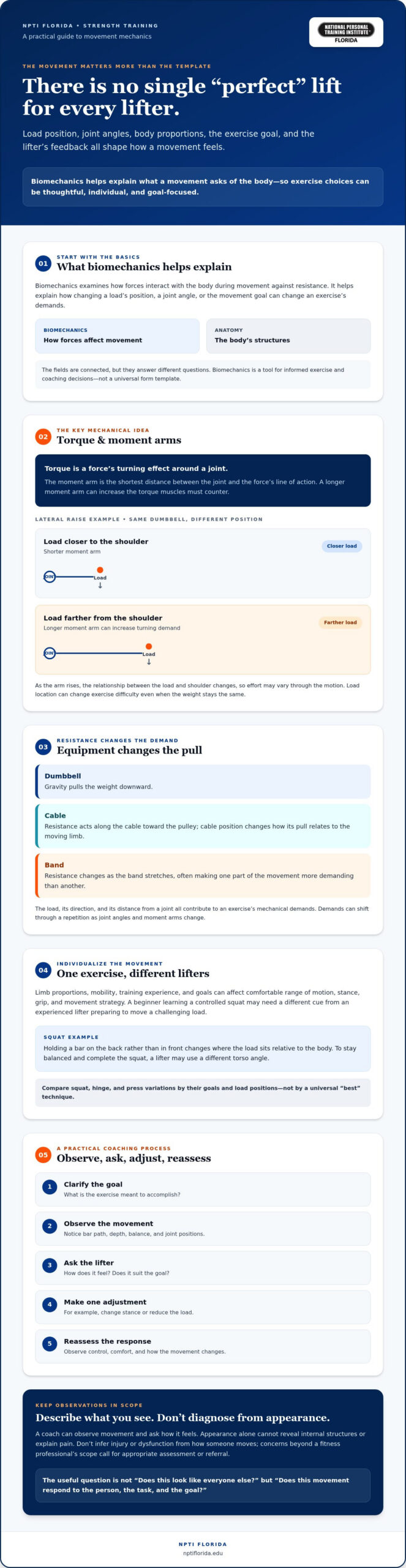
A weight doesn’t challenge a joint simply because it has mass. The force it creates, the direction it pulls, and its distance from a joint all affect an exercise’s mechanical demands. In biomechanics for strength training, torque means a force’s turning effect around a joint. The moment arm is the shortest distance between that joint and the force’s line of action. A longer moment arm can increase the torque muscles must counter, though the lifter’s effort also depends on factors such as position and movement.
External load and muscular effort aren’t interchangeable measures. Two exercises using the same dumbbell can feel different if the load is positioned differently or follows another path. Demands can also shift through a repetition as joint angles and moment arms change. A lift may feel hardest in one part of its range and easier in another.
How do joint position and moment arms affect a lift?
Consider a lateral raise. Holding a dumbbell close to the shoulder keeps the load nearer the shoulder joint. Moving it farther away increases its moment arm and can increase the turning demand at that joint. As the arm rises, the relationship between the load and shoulder changes, so effort may vary through the motion. This illustrates why load location can change exercise difficulty even when the weight stays the same. The example explains mechanics, not a required setup for every lifter.
A coach can use this principle when considering whether a variation suits the person’s goal and current ability. Changing the range, load, or position may alter the challenge, but the response should be observed rather than assumed. Comfort and control matter.
How do resistance and equipment change exercise demands?
Equipment changes the direction and pattern of resistance. With a dumbbell, gravity pulls the weight downward. With a cable, resistance acts along the cable toward the pulley, so changing the cable’s position can change how its pull relates to the moving limb. A band can also provide changing resistance as it stretches, often making one part of the movement more demanding than another.
These tools offer different ways to match resistance to an exercise goal, but none removes the need for sound coaching. Notice the movement path, control, and lifter’s feedback before deciding whether a setup is appropriate. For a stronger foundation in connecting movement science with practical coaching, explore fitness education programs.
How Biomechanics Changes Across Squats, Hinges, and Presses
Biomechanics helps explain what an exercise asks the body to do, not what every repetition must look like. Stance, range of motion, implement, and individual proportions can all influence how someone performs a lift. A coach considers whether the movement fits the goal and the lifter rather than comparing everyone with one visual template. Ordinary variation isn’t, by itself, evidence of injury.
| Movement | General goal | Load position | Useful coaching observations |
|---|---|---|---|
| Squat | Lower and raise the body with substantial knee and hip movement | Can be held at the sides, in front, or across the upper back | Balance, control, depth, and how stance affects the movement |
| Hip hinge | Move mainly through the hips while managing a relatively stable trunk | Often held in front of the body, such as in a deadlift pattern | Hip movement, load path, and control through the chosen range |
| Press | Push resistance away from the body | May be held overhead or in front, using a bar, dumbbells, or a machine | Grip, pressing path, range, and the lifter’s control and feedback |
What can a squat teach about changing movement demands?
A wider or narrower stance, a different depth, or a changed load position can lead to a different squat strategy. A coach can observe balance, the load’s path, and whether the lifter maintains control without labeling every shift in torso angle or knee position a fault. The useful question is whether the variation supports the lifter’s goal and current capabilities. A squat that works well for one person or task may not suit another.
How do hinges and presses create different demands?
A squat generally combines bending at the knees and hips, while a hip hinge emphasizes moving the hips back and forward with less knee bend. Presses involve pushing resistance away. For example, a dumbbell press allows each hand to move independently, while a barbell connects the hands and can shape the pressing path. Grip and implement influence positioning, but neither dictates one correct form for everyone.
In biomechanics for strength training, these differences help guide exercise selection, not rank variations from best to worst. Consider the training goal, available equipment, comfortable range, and observed control. Choose a version that fits the context, then reassess as the lifter’s needs or experience change.
A Practical Framework for Applying Biomechanics to Training
Movement observation is most useful when it leads to a clear question, not an instant correction. This five-step process applies biomechanics for strength training while keeping the lifter’s goal, feedback, and individual needs in view.
- Clarify the goal. Identify what the exercise is meant to develop, then consider relevant training history and experience. The right movement choice depends partly on the task.
- Observe the whole movement. Notice control, balance, range, and how the person manages resistance across the repetition. Avoid judging a single frame or treating one body position as a diagnosis.
- Ask before interpreting. Check comfort, confidence, and intended effort. The lifter’s feedback adds context that appearance alone can’t provide.
- Adjust one thing. Choose a purposeful change, such as reducing load, shortening range, changing tempo or stance, or trying another implement. Keep the adjustment connected to the original goal.
- Reassess. Observe the next repetitions and ask whether the change improved control, comfort, or fit with the task. Keep it, refine it, or return to the previous setup based on the response.
Clarify the goal, observe the movement, ask about the lifter’s experience, make one targeted adjustment, and reassess the response.
How can a trainer assess movement without overcorrecting?
Start with the exercise’s purpose and the person’s relevant training background. Watch the full repetition, not just one joint or moment, and ask what feels comfortable, confident, and appropriately challenging. Separate what you can see from what you’re assuming. A visual assessment can guide a coaching conversation, but it can’t diagnose a condition or establish that someone is injured.
Make one adjustment at a time so the response is easier to interpret. For instance, if a lifter struggles to maintain control, a coach might reduce the load before changing the stance or movement pattern. Changing several things at once can make it harder to tell what helped.
When should an exercise variation or referral be considered?
Consider a regression, different implement, or adjusted range when it makes the exercise more appropriate for the goal and the person’s current capabilities. Check that the modified version still trains what it was intended to train. A change isn’t automatically an improvement just because the repetition looks more conventional.
If someone reports pain, raises a medical concern, or has complex limitations beyond a fitness professional’s scope, recommend consultation with an appropriately qualified healthcare professional. Stay within your role and avoid presenting an exercise adjustment as treatment. To build coaching knowledge through structured fitness education, explore fitness education programs.
Build Biomechanics Knowledge Through Structured Fitness Education
Understanding biomechanics for strength training takes more than memorizing terms. Foundational theory helps explain how movement and resistance interact. Practical study gives learners opportunities to observe exercises, test coaching ideas, and connect concepts with movement. Together, they can support clearer exercise choices and more thoughtful coaching decisions.
For aspiring strength coaches, useful movement education should cover exercise mechanics, assessment, and professional boundaries. Look for learning that helps you describe what you observe, ask relevant questions, and recognize when a concern falls outside a fitness professional’s role. Assessment coursework isn’t a license to diagnose or provide clinical treatment. It can inform responsible training decisions, including when to recommend qualified healthcare support.
What should aspiring strength coaches look for in movement education?
Consider whether the curriculum explains movement principles and provides opportunities to apply them, rather than presenting technique as a set of rigid visual rules. Practical experience can help you practice observing, communicating, and adjusting an exercise to suit its goal and the individual. Before choosing a program, review its current catalog for curriculum details, total hours, and the scope of its coursework.
How does NPTI Florida connect theory with practical study?
NPTI Florida’s Advanced Personal Fitness Training program is a 600-hour diploma program, with 360 theory hours and 240 hands-on lab hours. Selected coursework covers human movement dysfunction assessment and corrective exercise strategies. This content provides educational context for fitness training decisions; it isn’t clinical assessment or treatment.
The balance of theory and lab work offers a structured way to study concepts and practice observing and discussing movement. For specifics, review the advanced personal training curriculum guide, then compare it with the personal training program guide to understand the broader education pathway. Confirm current program details and terms in the latest catalog before making an enrollment decision.
Turn Movement Insight Into Better Coaching Decisions
Biomechanics for strength training gives you a practical way to understand how forces, positions, and movement patterns shape an exercise. Use that knowledge to choose variations with purpose, observe how a lifter responds, and make one thoughtful adjustment at a time. The aim isn’t to impose one ideal form. It’s to support the person and the task while recognizing when a concern needs assessment beyond a fitness professional’s scope.
If you’re ready to deepen your movement knowledge, structured education can connect foundational theory with hands-on practice. NPTI’s Advanced Personal Fitness Training program is a 600-hour diploma program, including 360 theory hours and 240 hands-on lab hours. NPTI is accredited by the Accrediting Commission of Career Schools and Colleges (ACCSC) and licensed by the Florida Commission for Independent Education. Review current program details as you consider your next steps.
Explore NPTI’s personal training education programs and take the next step toward building knowledge to coach with care, confidence, and sound judgment.
Frequently Asked Questions
What is biomechanics in strength training?
Biomechanics in strength training examines how forces interact with the body during resistance exercise. It can help explain why a change in load position, joint angle, or movement path alters an exercise’s demands. For example, moving a weight farther from a joint can increase its turning demand. Anatomy describes body structures; biomechanics focuses on how forces affect movement. Coaches use these ideas to inform exercise choices and observations, not to impose one form on everyone.
How does biomechanics help improve exercise technique?
Biomechanics helps a coach connect an observable movement with the exercise’s purpose and the lifter’s experience. If a repetition looks difficult to control, the coach might ask how it feels, then consider a small adjustment to load, range, stance, or equipment. The coach can observe the response before deciding what to do next. This makes technique guidance more specific than relying on a universal cue or correcting every movement difference.
Can biomechanics tell you the correct form for every exercise?
No. Biomechanics explains how movement and resistance interact, but it doesn’t prescribe one ideal form for every body or training goal. Limb proportions, mobility, experience, equipment, and the purpose of the lift can influence how someone moves. A coach can use mechanical principles to assess whether an exercise variation suits the task and lifter, while considering control and feedback. Visual differences alone don’t prove that a technique is wrong or harmful.
How do torque and moment arms affect lifting exercises?
Torque is the turning effect of a force around a joint. A moment arm is the shortest distance between that joint and the force’s line of action. In a dumbbell raise, holding the weight farther from the shoulder can increase the rotational demand around it compared with keeping the weight close. Demands can also shift as the arm moves through its range. These terms help explain changes in exercise difficulty, but they don’t measure effort on their own.
Does biomechanics change which squat or press variation someone should use?
It can inform the choice, but it doesn’t rank one squat or press variation as best for everyone. A squat’s stance, depth, and load position can shape the movement strategy. In a press, grip and implement, such as dumbbells or a barbell, can affect positioning and movement path. The coach should consider the training goal, the person’s current capabilities, and their response, then choose and reassess a suitable variation.
Can a personal trainer use biomechanics to diagnose pain or injury?
No. A personal trainer can observe movement, ask about comfort, and make training adjustments within their professional scope, but biomechanics doesn’t qualify them to diagnose pain or injury. Appearance alone can’t establish what’s causing a concern. If a client reports pain, raises a medical issue, or has complex limitations, the trainer should recommend assessment by an appropriately qualified healthcare professional. Exercise modifications support training decisions; they aren’t a substitute for clinical evaluation or treatment.
How can aspiring trainers learn biomechanics and movement assessment?
Aspiring trainers can look for education that combines movement-science fundamentals with opportunities to practice observing and discussing exercises. NPTI’s Advanced Personal Fitness Training program is a 600-hour diploma program with 360 theory hours and 240 hands-on lab hours. Selected coursework covers human movement dysfunction assessment and corrective exercise strategies as educational content, not clinical treatment. Review current program details and catalog terms to understand the curriculum and its scope before deciding whether it fits your learning goals.

What if the “perfect” squat isn’t the right squat for every lifter? Biomechanics for strength training helps explain why: joint positions, body proportions, and the direction of resistance all influence how an exercise feels and where its demands fall. Yet terms such as torque and moment arm can sound abstract, while online technique tips often make movement seem one-size-fits-all.
You’re right to look for more than a list of rules. The goal is to understand what a movement asks of the lifter and use that insight to make thoughtful training choices. This guide explains the mechanical principles behind resistance exercises, then offers a practical framework for observing movement and comparing exercise variations. You’ll learn how to connect what you see, such as balance, range of motion, and joint position, with the exercise goal and the lifter’s feedback. You’ll also learn when a concern calls for assessment beyond a fitness professional’s role.
Key Takeaways
- Learn how torque and moment arms help explain why an exercise can feel more demanding at certain joint positions.
- Use biomechanics for strength training to compare squat, hinge, and press variations by their goals and load positions, not by a universal “best” technique.
- Apply a practical coaching process: clarify the goal, observe the movement, ask questions, make one adjustment, and reassess.
- Make movement observations more useful by connecting what you see with the lifter’s experience and the purpose of the exercise.
- See how structured theory and hands-on learning can support responsible, scope-aware decisions about movement and exercise.
What Is Biomechanics for Strength Training, and Why Does It Matter?
Biomechanics for strength training examines how forces interact with the body during movement against resistance. It helps explain why changing a load’s position, a joint angle, or the movement goal can change an exercise’s demands and what a coach might adjust. Biomechanics studies how forces affect movement, while anatomy describes the body’s structures. The fields are connected, but they answer different questions. For a broader overview, Biomechanics covers the study’s application to human movement and sport.
Biomechanics is a tool for making informed decisions about exercise selection, technique cues, and training adjustments. It doesn’t prescribe one ideal-looking form for every person. The right choice depends on the task, the individual, and how the movement responds.
What does biomechanics explain during a lift?
An external load is resistance outside the body, such as a barbell or dumbbell. Biomechanics considers how that load and the lifter’s position interact throughout a repetition. For example, holding a bar on the back rather than in front changes where the load sits relative to the body. To stay balanced and complete the squat, a lifter may use a different torso angle.
That visible change is something a coach can describe, but it doesn’t prove what is happening inside the body. A coach can observe the bar path, depth, balance, and joint positions, then ask how the movement feels and whether it suits the goal. Appearance alone can’t reveal a person’s internal structures or explain pain.
Why does movement vary between lifters?
People differ in limb proportions, mobility, training experience, and goals. These differences can affect comfortable range of motion, stance, grip, and movement strategy. A beginner learning a controlled squat may need a different cue from an experienced lifter preparing to move a challenging load.
Technique is a task-specific choice, not a universal visual template. If a lifter moves differently from an online demonstration, first consider the exercise goal and the person’s feedback. A coach can test a small adjustment, such as changing stance or reducing the load, and observe the response. Don’t diagnose dysfunction or infer injury from appearance alone. Concerns beyond a fitness professional’s scope call for appropriate assessment or referral.
How Force, Torque, and Leverage Shape Strength Exercises
A weight doesn’t challenge a joint simply because it has mass. The force it creates, the direction it pulls, and its distance from a joint all affect an exercise’s mechanical demands. In biomechanics for strength training, torque means a force’s turning effect around a joint. The moment arm is the shortest distance between that joint and the force’s line of action. A longer moment arm can increase the torque muscles must counter, though the lifter’s effort also depends on factors such as position and movement.
External load and muscular effort aren’t interchangeable measures. Two exercises using the same dumbbell can feel different if the load is positioned differently or follows another path. Demands can also shift through a repetition as joint angles and moment arms change. A lift may feel hardest in one part of its range and easier in another.
How do joint position and moment arms affect a lift?
Consider a lateral raise. Holding a dumbbell close to the shoulder keeps the load nearer the shoulder joint. Moving it farther away increases its moment arm and can increase the turning demand at that joint. As the arm rises, the relationship between the load and shoulder changes, so effort may vary through the motion. This illustrates why load location can change exercise difficulty even when the weight stays the same. The example explains mechanics, not a required setup for every lifter.
A coach can use this principle when considering whether a variation suits the person’s goal and current ability. Changing the range, load, or position may alter the challenge, but the response should be observed rather than assumed. Comfort and control matter.
How do resistance and equipment change exercise demands?
Equipment changes the direction and pattern of resistance. With a dumbbell, gravity pulls the weight downward. With a cable, resistance acts along the cable toward the pulley, so changing the cable’s position can change how its pull relates to the moving limb. A band can also provide changing resistance as it stretches, often making one part of the movement more demanding than another.
These tools offer different ways to match resistance to an exercise goal, but none removes the need for sound coaching. Notice the movement path, control, and lifter’s feedback before deciding whether a setup is appropriate. For a stronger foundation in connecting movement science with practical coaching, explore fitness education programs.
How Biomechanics Changes Across Squats, Hinges, and Presses
Biomechanics helps explain what an exercise asks the body to do, not what every repetition must look like. Stance, range of motion, implement, and individual proportions can all influence how someone performs a lift. A coach considers whether the movement fits the goal and the lifter rather than comparing everyone with one visual template. Ordinary variation isn’t, by itself, evidence of injury.
| Movement | General goal | Load position | Useful coaching observations |
|---|---|---|---|
| Squat | Lower and raise the body with substantial knee and hip movement | Can be held at the sides, in front, or across the upper back | Balance, control, depth, and how stance affects the movement |
| Hip hinge | Move mainly through the hips while managing a relatively stable trunk | Often held in front of the body, such as in a deadlift pattern | Hip movement, load path, and control through the chosen range |
| Press | Push resistance away from the body | May be held overhead or in front, using a bar, dumbbells, or a machine | Grip, pressing path, range, and the lifter’s control and feedback |
What can a squat teach about changing movement demands?
A wider or narrower stance, a different depth, or a changed load position can lead to a different squat strategy. A coach can observe balance, the load’s path, and whether the lifter maintains control without labeling every shift in torso angle or knee position a fault. The useful question is whether the variation supports the lifter’s goal and current capabilities. A squat that works well for one person or task may not suit another.
How do hinges and presses create different demands?
A squat generally combines bending at the knees and hips, while a hip hinge emphasizes moving the hips back and forward with less knee bend. Presses involve pushing resistance away. For example, a dumbbell press allows each hand to move independently, while a barbell connects the hands and can shape the pressing path. Grip and implement influence positioning, but neither dictates one correct form for everyone.
In biomechanics for strength training, these differences help guide exercise selection, not rank variations from best to worst. Consider the training goal, available equipment, comfortable range, and observed control. Choose a version that fits the context, then reassess as the lifter’s needs or experience change.
A Practical Framework for Applying Biomechanics to Training
Movement observation is most useful when it leads to a clear question, not an instant correction. This five-step process applies biomechanics for strength training while keeping the lifter’s goal, feedback, and individual needs in view.
- Clarify the goal. Identify what the exercise is meant to develop, then consider relevant training history and experience. The right movement choice depends partly on the task.
- Observe the whole movement. Notice control, balance, range, and how the person manages resistance across the repetition. Avoid judging a single frame or treating one body position as a diagnosis.
- Ask before interpreting. Check comfort, confidence, and intended effort. The lifter’s feedback adds context that appearance alone can’t provide.
- Adjust one thing. Choose a purposeful change, such as reducing load, shortening range, changing tempo or stance, or trying another implement. Keep the adjustment connected to the original goal.
- Reassess. Observe the next repetitions and ask whether the change improved control, comfort, or fit with the task. Keep it, refine it, or return to the previous setup based on the response.
Clarify the goal, observe the movement, ask about the lifter’s experience, make one targeted adjustment, and reassess the response.
How can a trainer assess movement without overcorrecting?
Start with the exercise’s purpose and the person’s relevant training background. Watch the full repetition, not just one joint or moment, and ask what feels comfortable, confident, and appropriately challenging. Separate what you can see from what you’re assuming. A visual assessment can guide a coaching conversation, but it can’t diagnose a condition or establish that someone is injured.
Make one adjustment at a time so the response is easier to interpret. For instance, if a lifter struggles to maintain control, a coach might reduce the load before changing the stance or movement pattern. Changing several things at once can make it harder to tell what helped.
When should an exercise variation or referral be considered?
Consider a regression, different implement, or adjusted range when it makes the exercise more appropriate for the goal and the person’s current capabilities. Check that the modified version still trains what it was intended to train. A change isn’t automatically an improvement just because the repetition looks more conventional.
If someone reports pain, raises a medical concern, or has complex limitations beyond a fitness professional’s scope, recommend consultation with an appropriately qualified healthcare professional. Stay within your role and avoid presenting an exercise adjustment as treatment. To build coaching knowledge through structured fitness education, explore fitness education programs.
Build Biomechanics Knowledge Through Structured Fitness Education
Understanding biomechanics for strength training takes more than memorizing terms. Foundational theory helps explain how movement and resistance interact. Practical study gives learners opportunities to observe exercises, test coaching ideas, and connect concepts with movement. Together, they can support clearer exercise choices and more thoughtful coaching decisions.
For aspiring strength coaches, useful movement education should cover exercise mechanics, assessment, and professional boundaries. Look for learning that helps you describe what you observe, ask relevant questions, and recognize when a concern falls outside a fitness professional’s role. Assessment coursework isn’t a license to diagnose or provide clinical treatment. It can inform responsible training decisions, including when to recommend qualified healthcare support.
What should aspiring strength coaches look for in movement education?
Consider whether the curriculum explains movement principles and provides opportunities to apply them, rather than presenting technique as a set of rigid visual rules. Practical experience can help you practice observing, communicating, and adjusting an exercise to suit its goal and the individual. Before choosing a program, review its current catalog for curriculum details, total hours, and the scope of its coursework.
How does NPTI Florida connect theory with practical study?
NPTI Florida’s Advanced Personal Fitness Training program is a 600-hour diploma program, with 360 theory hours and 240 hands-on lab hours. Selected coursework covers human movement dysfunction assessment and corrective exercise strategies. This content provides educational context for fitness training decisions; it isn’t clinical assessment or treatment.
The balance of theory and lab work offers a structured way to study concepts and practice observing and discussing movement. For specifics, review the advanced personal training curriculum guide, then compare it with the personal training program guide to understand the broader education pathway. Confirm current program details and terms in the latest catalog before making an enrollment decision.
Turn Movement Insight Into Better Coaching Decisions
Biomechanics for strength training gives you a practical way to understand how forces, positions, and movement patterns shape an exercise. Use that knowledge to choose variations with purpose, observe how a lifter responds, and make one thoughtful adjustment at a time. The aim isn’t to impose one ideal form. It’s to support the person and the task while recognizing when a concern needs assessment beyond a fitness professional’s scope.
If you’re ready to deepen your movement knowledge, structured education can connect foundational theory with hands-on practice. NPTI’s Advanced Personal Fitness Training program is a 600-hour diploma program, including 360 theory hours and 240 hands-on lab hours. NPTI is accredited by the Accrediting Commission of Career Schools and Colleges (ACCSC) and licensed by the Florida Commission for Independent Education. Review current program details as you consider your next steps.
Explore NPTI’s personal training education programs and take the next step toward building knowledge to coach with care, confidence, and sound judgment.
Frequently Asked Questions
What is biomechanics in strength training?
Biomechanics in strength training examines how forces interact with the body during resistance exercise. It can help explain why a change in load position, joint angle, or movement path alters an exercise’s demands. For example, moving a weight farther from a joint can increase its turning demand. Anatomy describes body structures; biomechanics focuses on how forces affect movement. Coaches use these ideas to inform exercise choices and observations, not to impose one form on everyone.
How does biomechanics help improve exercise technique?
Biomechanics helps a coach connect an observable movement with the exercise’s purpose and the lifter’s experience. If a repetition looks difficult to control, the coach might ask how it feels, then consider a small adjustment to load, range, stance, or equipment. The coach can observe the response before deciding what to do next. This makes technique guidance more specific than relying on a universal cue or correcting every movement difference.
Can biomechanics tell you the correct form for every exercise?
No. Biomechanics explains how movement and resistance interact, but it doesn’t prescribe one ideal form for every body or training goal. Limb proportions, mobility, experience, equipment, and the purpose of the lift can influence how someone moves. A coach can use mechanical principles to assess whether an exercise variation suits the task and lifter, while considering control and feedback. Visual differences alone don’t prove that a technique is wrong or harmful.
How do torque and moment arms affect lifting exercises?
Torque is the turning effect of a force around a joint. A moment arm is the shortest distance between that joint and the force’s line of action. In a dumbbell raise, holding the weight farther from the shoulder can increase the rotational demand around it compared with keeping the weight close. Demands can also shift as the arm moves through its range. These terms help explain changes in exercise difficulty, but they don’t measure effort on their own.
Does biomechanics change which squat or press variation someone should use?
It can inform the choice, but it doesn’t rank one squat or press variation as best for everyone. A squat’s stance, depth, and load position can shape the movement strategy. In a press, grip and implement, such as dumbbells or a barbell, can affect positioning and movement path. The coach should consider the training goal, the person’s current capabilities, and their response, then choose and reassess a suitable variation.
Can a personal trainer use biomechanics to diagnose pain or injury?
No. A personal trainer can observe movement, ask about comfort, and make training adjustments within their professional scope, but biomechanics doesn’t qualify them to diagnose pain or injury. Appearance alone can’t establish what’s causing a concern. If a client reports pain, raises a medical issue, or has complex limitations, the trainer should recommend assessment by an appropriately qualified healthcare professional. Exercise modifications support training decisions; they aren’t a substitute for clinical evaluation or treatment.
How can aspiring trainers learn biomechanics and movement assessment?
Aspiring trainers can look for education that combines movement-science fundamentals with opportunities to practice observing and discussing exercises. NPTI’s Advanced Personal Fitness Training program is a 600-hour diploma program with 360 theory hours and 240 hands-on lab hours. Selected coursework covers human movement dysfunction assessment and corrective exercise strategies as educational content, not clinical treatment. Review current program details and catalog terms to understand the curriculum and its scope before deciding whether it fits your learning goals.