Best Certifications for Training Older Adults: 2026 Guide
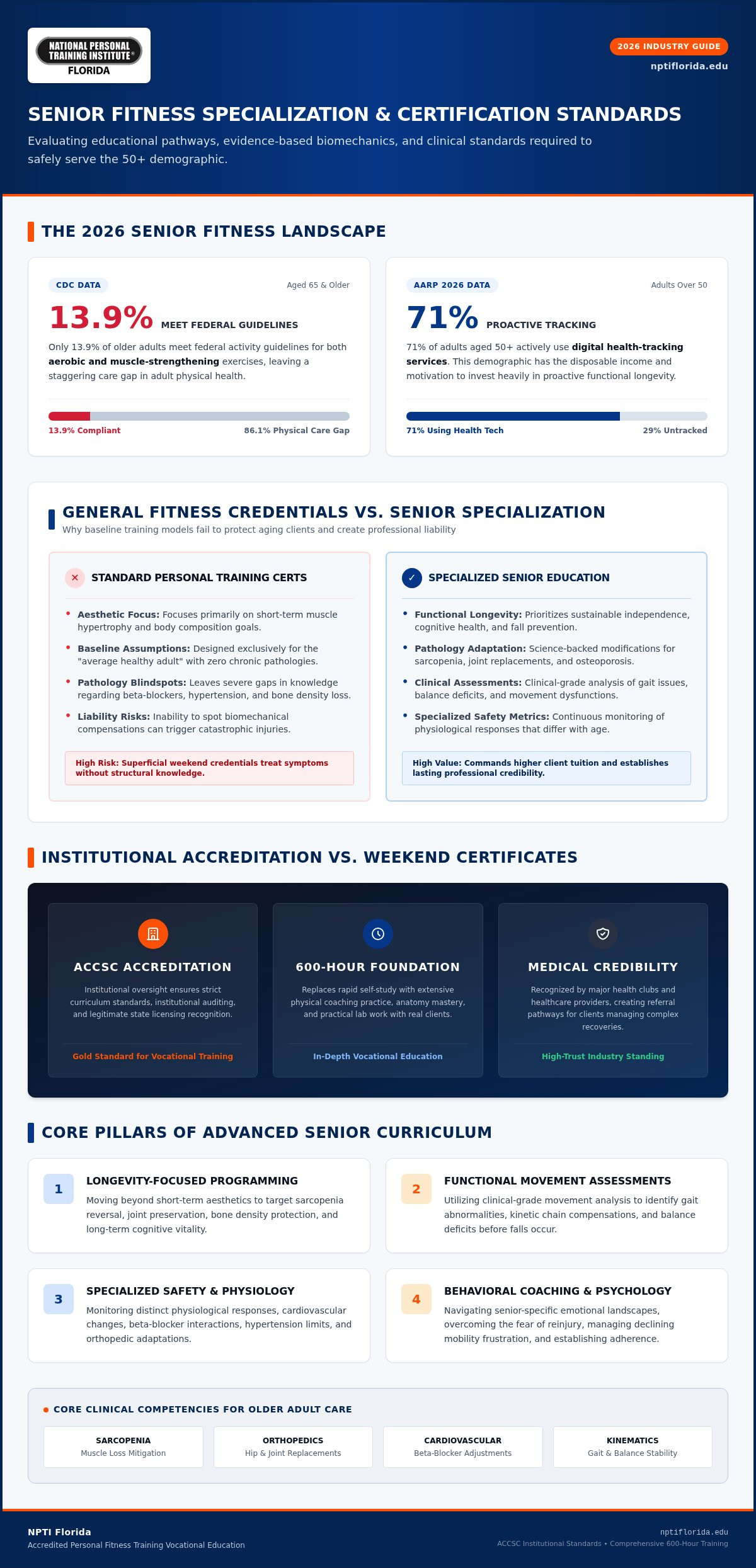
Recent CDC data reveals that only 13.9% of adults aged 65 and older meet the federal guidelines for both aerobic and muscle-strengthening activities. It’s a staggering gap in care. You’re likely here because you want to bridge that gap, yet you feel the weight of responsibility. It’s natural to worry about the risks of injury when working with complex health histories or to feel overwhelmed by superficial weekend courses. You need more than a digital badge; you need a science-based foundation.
Finding the right certification for training older adults is the most critical investment you’ll make in your professional longevity. In this 2026 guide, you’ll discover how to evaluate and choose a pathway that builds a safe, high-paying, and sustainable career. We’ll explore the distinction between basic credentials and comprehensive education, ensuring you gain the corrective exercise expertise needed to command higher tuition. From fall prevention to managing sarcopenia, we’re covering everything you need to become a confident, seasoned guide for the fastest-growing demographic in fitness.
Key Takeaways
- Understand how the massive demographic shift in 2026 is creating a high-paying market for trainers who possess specialized expertise.
- Learn to evaluate the right certification for training older adults by prioritizing accredited institutional standards over superficial weekend workshops.
- Discover why physical coaching practice and hands-on lab work are essential for safely managing complex health histories.
- Identify the critical curriculum modules, such as corrective exercise, that allow you to design sustainable programs for seniors.
- Recognize how a comprehensive vocational education provides the scientific foundation and practical experience to truly excel in the industry.
Evaluating a Certification for Training Older Adults: Why the Choice Matters
Professional excellence isn’t accidental. In 2026, a premium educational path for senior fitness goes far beyond basic rep counting; it requires a rigorous, science-based understanding of age-related biology and biomechanics. Choosing the right certification for training older adults determines whether you’re just another gym employee or a high-value specialist. You aren’t just selling sets. You’re selling independence, safety, and longevity through evidence-based physical activity. This choice defines your reputation and your professional ceiling.
The Surging Demand for Senior Fitness Professionals
The market is shifting rapidly. AARP data from early 2026 shows that 71% of adults over 50 are now actively using digital health-tracking services, signaling a massive demographic shift toward proactive wellness. These individuals have the disposable income to invest in their health and the motivation to stay active. They aren’t looking for “beach body” workouts. They’re looking for specialists who can protect them from age-related functional decline and sarcopenia. By positioning yourself as an expert, you tap into a loyal client base that provides long-term financial stability and professional fulfillment.
Why General Fitness Certifications Leave Gaps
Standard personal training credentials often fail when applied to the 50 plus population. These baseline courses are typically designed for the “average” healthy adult, leaving dangerous gaps in knowledge regarding complex orthopedic or cardiovascular pathologies. If you don’t understand how to adjust for bone density loss or beta-blockers, you’re a liability. Specialized education prevents human movement dysfunction by identifying biomechanical compensations before they lead to catastrophic injury. Without this depth, you risk not only the safety of your clients but also your legal standing and professional credibility.
To truly excel, you must look for a curriculum that prioritizes:
- Longevity-Focused Programming: Shifting the focus from short-term aesthetic gains to long-term mobility and cognitive health.
- Functional Movement Assessments: Using clinical-grade analysis to identify gait issues and balance deficits.
- Specialized Safety Metrics: Monitoring physiological responses that differ significantly in older populations.
You’re building a career, not just getting a badge. A weekend workshop can’t prepare you for the nuances of a client with a hip replacement and hypertension. You need a foundation that commands respect and justifies higher tuition because you’re providing a level of care that generalists simply cannot match.
Core Criteria for Choosing the Best Senior Fitness Certification
Selecting a certification for training older adults is a defining moment for your career. You aren’t just looking for a piece of paper; you’re seeking a foundation that supports a high-paying, sustainable practice. To navigate the sea of options, you need a clear evaluation framework. A premium program must offer more than just exercise physiology. It should provide a holistic approach that covers everything from orthopedic safety to the psychological nuances of aging. If a program doesn’t challenge you, it won’t change your career trajectory.
Institutional Accreditation vs. Unaccredited Certificates
Don’t be misled by flashy marketing or “open enrollment” promises that lack oversight. The gold standard for vocational education is institutional accreditation, specifically from bodies like the ACCSC. While many online-only certificates offer convenience, they often lack the rigorous curriculum standards required for state licensing. An accredited 600-hour program represents a significant investment in your professional readiness, contrasting sharply with superficial digital badges earned over a single weekend. Choosing a state-licensed pathway ensures your education is recognized by major health clubs and medical professionals alike, giving you the credibility needed to lead in this space.
Curriculum Depth and Behavioral Coaching Integration
Working with the 50 plus demographic requires a mastery of behavioral psychology that standard certifications often overlook. Older adults aren’t just dealing with physical limitations; they’re often navigating complex emotional landscapes, including the fear of injury or the frustration of declining mobility. Your training must include distinct communication strategies that foster trust and long-term adherence. This means looking for a curriculum that blends movement mechanics with modern lifestyle coaching.
Nutrition plays an equally vital role in senior wellness. A trainer who understands how to fuel an aging body is significantly more valuable than one who only knows how to program a treadmill. To see how these pieces fit together, read The Definitive Guide to Choosing a Health and Nutrition Coaching Program in 2026. Staying current with ACSM resources for aging ensures your practice remains rooted in the latest scientific updates, such as the 2026 resistance-training guidelines. When you integrate behavior change and nutrition into your skill set, you stop being a commodity and start being a life-changing specialist. Ready to elevate your career? Consider enrolling in a Personal Training Specialist Program to gain the hands-on expertise you need.
Online Self-Study vs. Hands-On Comprehensive Fitness Education
Don’t trade competence for convenience. While a digital bundle might seem like the fastest path, a certification for training older adults that lacks a physical component leaves you vulnerable on the gym floor. Reading about a movement pattern is a world away from coaching a client with limited range of motion through a safe, effective set. You can’t feel the tension in a muscle or hear the subtle click of a joint through a laptop speaker. True mastery requires an immersive environment where theory meets application.
The Limitations of 100% Online Learning for Special Populations
Digital-only programs present hidden risks when you’re dealing with special populations. Studying complex biomechanics through a screen often leads to a significant confidence gap when you finally face a real client. Assessing movement dysfunction isn’t a multiple-choice exercise; it’s a real-time, physical observation that requires immediate feedback and adjustment. Employers know this. They frequently prioritize candidates who have been tested in real-world scenarios over those who only possess a digital badge. If you can’t physically demonstrate a corrective exercise or spot a compensatory pattern in person, your credential loses its value in a professional setting.
The Power of Dedicated Practical Lab Hours
A balanced educational split is the only way to ensure you’re career-ready. At a vocational institution, a 600-hour curriculum provides a rigorous foundation, but it’s the 240 dedicated hands-on lab hours that transform your capability. This is where you move beyond the textbook. You practice assessments on diverse body types, learning how a 70 year old’s squat differs from a 50 year old’s under the watchful eye of master instructors. This supervised environment allows you to make mistakes and receive corrections before you ever step foot in a commercial gym.
This practical experience is exactly why hands-on personal trainer training matters for your long-term success. You leave the program not just with a piece of paper, but with the muscle memory and professional poise of a seasoned expert. You’ll know how to adjust a program on the fly when a client reports hip pain, and you’ll have the confidence to justify your choices to medical professionals. This isn’t just about passing a test; it’s about building the skills that command respect and higher tuition from a discerning senior clientele.
Essential Modules to Look For in an Advanced Senior Training Curriculum
Excellence in senior fitness isn’t achieved through generic modifications. It’s about precision. When you evaluate a certification for training older adults, you must look beyond the surface level of basic exercise science. You need a curriculum that mirrors the complexity of the human body as it ages. A high-value specialist understands that a 70 year old client isn’t just a “slower” version of a 30 year old. They possess a unique physiological profile that requires a sophisticated, multi-layered approach to programming. Your education should reflect this reality.
Corrective Exercise and Advanced Special Populations
Decades of life result in decades of movement history, often involving compensations and previous injuries. A robust curriculum must provide deep dives into orthopedic, cardiovascular, neuromuscular, and cognitive conditions. You need to know how to program for a client with osteoarthritis just as confidently as you handle someone recovering from a stroke or managing early-stage dementia. Advanced training covers everything from biomechanical issues to metabolic disorders. Mastering these nuances allows you to provide a level of safety that generalists cannot offer. To see how these modules integrate into a professional career, explore the Advanced Personal Training Curriculum: The 2026 Professional Career Guide.
Nutritional Programming for Aging Bodies
Metabolic efficiency changes significantly over time. Older adults face unique metabolic, immunologic, and digestive challenges that directly impact their fitness outcomes. Your education must include specialized nutritional programming that goes beyond basic calorie counting to address modern meal planning for seniors. You need to understand how protein synthesis changes with age and how specific micronutrients support bone density and cognitive health. Nutrition isn’t just a side topic; it’s a primary driver for recovery and lean muscle preservation. When you can coach a client on how to fuel their recovery, you ensure the work they do in the gym actually translates into long-term functional gains.
Finally, consider the psychological component. Long-term client adherence in the senior demographic often hinges on behavioral strategies that foster trust and self-efficacy. You aren’t just a coach; you’re a partner in their longevity. You must learn to navigate the fear of falling or the frustration of physical limitations with empathy and science-backed motivation. This holistic skill set is what separates the elite specialists from the rest of the industry. Ready to start your journey as a leader in senior wellness? Apply for our Advanced Personal Training Program today and build the career you deserve.
Launching Your Career with NPTI’s Advanced Personal Training Program
You’ve seen the requirements for excellence. Now, you must choose the path that delivers them. National Personal Training Institute (NPTI) Florida offers a state-licensed, ACCSC-accredited Advanced Personal Fitness Training program designed for true career architects. This isn’t just a certification for training older adults; it’s a comprehensive vocational diploma that sets the gold standard for professional readiness. When you walk onto a gym floor with an NPTI Florida education, you carry the weight of an established institution behind you.
The NPTI Florida Vocational Advantage
Stability matters. With over 25 years of experience as a veteran-owned fitness professional school, NPTI Florida understands the nuances of the industry better than anyone. We don’t believe in cutting corners. Our flexible Hyflex learning model provides the perfect balance of classroom study and practical gym time, allowing you to master complex concepts while maintaining your current schedule. This hybrid approach ensures you gain a science-based foundation without sacrificing the tactile experience that makes a trainer great. To understand the full scope of this journey, explore The Ultimate Personal Training Program Guide: Choosing a Career, Not Just a Certification.
The curriculum is built on a robust 600-hour structure. You’ll dive into 360 hours of theory, covering advanced anatomy, physiology, and the special populations modules essential for senior care. This is followed by 240 hours of hands-on lab work. This isn’t just practice; it’s professional transformation. You’ll learn to spot compensations, adjust for pathologies, and lead with confidence under the supervision of master instructors.
How to Take the Next Step Toward Your Senior Fitness Career
Your future in senior wellness is waiting. This specialized education prepares you for high-level roles in commercial gyms, clinical rehabilitation centers, or even launching your own specialized business. You aren’t just getting a job; you’re building a sustainable practice that serves a demographic in desperate need of your skills. We encourage you to review our comprehensive course modules to see exactly how NPTI Florida prepares you for the 2026 market.
Don’t leave your professional future to chance. A detailed Student Catalog is available upon request, providing all the specifics you need before enrollment. We’re here to guide you, support you, and celebrate your transition into the elite ranks of the fitness industry. Request your catalog today and start building the safe, high-paying career you’ve always envisioned. Your clients are waiting for a specialist. It’s time to become one.
Seize Your Future in Senior Wellness
The path to becoming an elite specialist is clear. You’ve learned that a premium certification for training older adults requires more than a digital badge; it demands a rigorous, science-based foundation. True competence comes from immersion. By prioritizing institutional accreditation and hands-on practice, you protect your clients and your professional reputation. You’re now equipped to choose an educational pathway that bridges the gap between basic movement and life-changing corrective exercise.
NPTI stands as an ACCSC Accredited Institution, offering a 600-Hour Comprehensive Diploma Program that includes 240 immersive hands-on gym lab hours. This structure ensures you’re career-ready from day one, giving you the confidence to manage complex health histories with ease. Your journey toward professional mastery starts with a single decision to invest in quality education. Request the NPTI Student Catalog and launch your senior fitness career today!
You have the passion to make a difference in the lives of seniors. We have the proven blueprint to help you succeed. Take the leap and become the authoritative expert this growing demographic needs.
Frequently Asked Questions
What is the best certification for training older adults?
The best certification for training older adults is a comprehensive vocational diploma that combines rigorous theory with extensive practical application. While many digital certificates exist, an ACCSC-accredited 600-hour program provides the depth required to manage complex health histories safely. This institutional standard ensures you aren’t just memorizing facts but developing the professional poise needed to command higher tuition and lead the industry with scientific authority.
Can I learn how to train older adults through a 100% online course?
While 100% online courses provide theoretical knowledge, they cannot replace the immersive experience of a physical gym setting. Training seniors requires real-time observation of biomechanical compensations that a screen simply cannot convey. You need to physically practice assessments and corrective strategies under master instructor supervision to bridge the confidence gap. Relying solely on digital study often leaves new trainers unprepared for the nuances of age-related pathologies.
Why are hands-on lab hours critical for senior fitness specialists?
Hands-on lab hours are critical because they transform abstract concepts into vocational mastery. In a specialized senior fitness curriculum, you must learn to identify human movement dysfunction through tactile feedback and visual cues. NPTI provides 240 immersive lab hours, allowing you to practice on diverse body types. This supervised practice ensures you can safely adjust programming for orthopedic or cardiovascular conditions before you ever work with a paying client.
What topics should an advanced senior fitness curriculum cover?
An advanced curriculum must go beyond basic exercise science to include specialized modules in corrective exercise and special populations. You should look for topics covering orthopedic pathologies, cardiovascular and metabolic disorders, and cognitive health. Additionally, effective programs integrate behavioral psychology and modern meal planning tailored for aging bodies. This holistic approach ensures you can address the unique metabolic and emotional challenges that older adults face daily.
How long does a comprehensive personal training diploma program take?
A comprehensive personal training diploma program typically requires a significant time investment to ensure professional readiness. NPTI’s flagship Advanced Personal Fitness Training program consists of 600 total hours. This is divided into 360 hours of classroom theory and 240 hours of hands-on lab work. This structure provides a balanced education that far exceeds the superficial requirements of standard weekend workshops, preparing you for long-term career success.
Where do graduates of advanced fitness programs typically find employment?
Graduates of advanced vocational programs are highly sought after in diverse professional settings. You’ll find NPTI alumni working in commercial gyms, specialized rehabilitation centers, and high-performance athletic programs. Many graduates also leverage their deep expertise in corrective exercise to launch successful independent businesses. Because these specialists can safely manage complex health histories, they often secure positions that generalists are unqualified to hold.
Is financial assistance or flexible scheduling available for vocational fitness programs?
Flexible scheduling is a hallmark of modern vocational education, specifically through models like the Hyflex Learning Program. This allows you to balance intensive classroom study with practical gym time according to your personal schedule. While NPTI is a veteran-owned institution that values accessibility, you should request the Student Catalog to review specific enrollment terms. This ensures you have all the details needed to plan your transition into a stable fitness career.

Recent CDC data reveals that only 13.9% of adults aged 65 and older meet the federal guidelines for both aerobic and muscle-strengthening activities. It’s a staggering gap in care. You’re likely here because you want to bridge that gap, yet you feel the weight of responsibility. It’s natural to worry about the risks of injury when working with complex health histories or to feel overwhelmed by superficial weekend courses. You need more than a digital badge; you need a science-based foundation.
Finding the right certification for training older adults is the most critical investment you’ll make in your professional longevity. In this 2026 guide, you’ll discover how to evaluate and choose a pathway that builds a safe, high-paying, and sustainable career. We’ll explore the distinction between basic credentials and comprehensive education, ensuring you gain the corrective exercise expertise needed to command higher tuition. From fall prevention to managing sarcopenia, we’re covering everything you need to become a confident, seasoned guide for the fastest-growing demographic in fitness.
Key Takeaways
- Understand how the massive demographic shift in 2026 is creating a high-paying market for trainers who possess specialized expertise.
- Learn to evaluate the right certification for training older adults by prioritizing accredited institutional standards over superficial weekend workshops.
- Discover why physical coaching practice and hands-on lab work are essential for safely managing complex health histories.
- Identify the critical curriculum modules, such as corrective exercise, that allow you to design sustainable programs for seniors.
- Recognize how a comprehensive vocational education provides the scientific foundation and practical experience to truly excel in the industry.
Evaluating a Certification for Training Older Adults: Why the Choice Matters
Professional excellence isn’t accidental. In 2026, a premium educational path for senior fitness goes far beyond basic rep counting; it requires a rigorous, science-based understanding of age-related biology and biomechanics. Choosing the right certification for training older adults determines whether you’re just another gym employee or a high-value specialist. You aren’t just selling sets. You’re selling independence, safety, and longevity through evidence-based physical activity. This choice defines your reputation and your professional ceiling.
The Surging Demand for Senior Fitness Professionals
The market is shifting rapidly. AARP data from early 2026 shows that 71% of adults over 50 are now actively using digital health-tracking services, signaling a massive demographic shift toward proactive wellness. These individuals have the disposable income to invest in their health and the motivation to stay active. They aren’t looking for “beach body” workouts. They’re looking for specialists who can protect them from age-related functional decline and sarcopenia. By positioning yourself as an expert, you tap into a loyal client base that provides long-term financial stability and professional fulfillment.
Why General Fitness Certifications Leave Gaps
Standard personal training credentials often fail when applied to the 50 plus population. These baseline courses are typically designed for the “average” healthy adult, leaving dangerous gaps in knowledge regarding complex orthopedic or cardiovascular pathologies. If you don’t understand how to adjust for bone density loss or beta-blockers, you’re a liability. Specialized education prevents human movement dysfunction by identifying biomechanical compensations before they lead to catastrophic injury. Without this depth, you risk not only the safety of your clients but also your legal standing and professional credibility.
To truly excel, you must look for a curriculum that prioritizes:
- Longevity-Focused Programming: Shifting the focus from short-term aesthetic gains to long-term mobility and cognitive health.
- Functional Movement Assessments: Using clinical-grade analysis to identify gait issues and balance deficits.
- Specialized Safety Metrics: Monitoring physiological responses that differ significantly in older populations.
You’re building a career, not just getting a badge. A weekend workshop can’t prepare you for the nuances of a client with a hip replacement and hypertension. You need a foundation that commands respect and justifies higher tuition because you’re providing a level of care that generalists simply cannot match.
Core Criteria for Choosing the Best Senior Fitness Certification
Selecting a certification for training older adults is a defining moment for your career. You aren’t just looking for a piece of paper; you’re seeking a foundation that supports a high-paying, sustainable practice. To navigate the sea of options, you need a clear evaluation framework. A premium program must offer more than just exercise physiology. It should provide a holistic approach that covers everything from orthopedic safety to the psychological nuances of aging. If a program doesn’t challenge you, it won’t change your career trajectory.
Institutional Accreditation vs. Unaccredited Certificates
Don’t be misled by flashy marketing or “open enrollment” promises that lack oversight. The gold standard for vocational education is institutional accreditation, specifically from bodies like the ACCSC. While many online-only certificates offer convenience, they often lack the rigorous curriculum standards required for state licensing. An accredited 600-hour program represents a significant investment in your professional readiness, contrasting sharply with superficial digital badges earned over a single weekend. Choosing a state-licensed pathway ensures your education is recognized by major health clubs and medical professionals alike, giving you the credibility needed to lead in this space.
Curriculum Depth and Behavioral Coaching Integration
Working with the 50 plus demographic requires a mastery of behavioral psychology that standard certifications often overlook. Older adults aren’t just dealing with physical limitations; they’re often navigating complex emotional landscapes, including the fear of injury or the frustration of declining mobility. Your training must include distinct communication strategies that foster trust and long-term adherence. This means looking for a curriculum that blends movement mechanics with modern lifestyle coaching.
Nutrition plays an equally vital role in senior wellness. A trainer who understands how to fuel an aging body is significantly more valuable than one who only knows how to program a treadmill. To see how these pieces fit together, read The Definitive Guide to Choosing a Health and Nutrition Coaching Program in 2026. Staying current with ACSM resources for aging ensures your practice remains rooted in the latest scientific updates, such as the 2026 resistance-training guidelines. When you integrate behavior change and nutrition into your skill set, you stop being a commodity and start being a life-changing specialist. Ready to elevate your career? Consider enrolling in a Personal Training Specialist Program to gain the hands-on expertise you need.
Online Self-Study vs. Hands-On Comprehensive Fitness Education
Don’t trade competence for convenience. While a digital bundle might seem like the fastest path, a certification for training older adults that lacks a physical component leaves you vulnerable on the gym floor. Reading about a movement pattern is a world away from coaching a client with limited range of motion through a safe, effective set. You can’t feel the tension in a muscle or hear the subtle click of a joint through a laptop speaker. True mastery requires an immersive environment where theory meets application.
The Limitations of 100% Online Learning for Special Populations
Digital-only programs present hidden risks when you’re dealing with special populations. Studying complex biomechanics through a screen often leads to a significant confidence gap when you finally face a real client. Assessing movement dysfunction isn’t a multiple-choice exercise; it’s a real-time, physical observation that requires immediate feedback and adjustment. Employers know this. They frequently prioritize candidates who have been tested in real-world scenarios over those who only possess a digital badge. If you can’t physically demonstrate a corrective exercise or spot a compensatory pattern in person, your credential loses its value in a professional setting.
The Power of Dedicated Practical Lab Hours
A balanced educational split is the only way to ensure you’re career-ready. At a vocational institution, a 600-hour curriculum provides a rigorous foundation, but it’s the 240 dedicated hands-on lab hours that transform your capability. This is where you move beyond the textbook. You practice assessments on diverse body types, learning how a 70 year old’s squat differs from a 50 year old’s under the watchful eye of master instructors. This supervised environment allows you to make mistakes and receive corrections before you ever step foot in a commercial gym.
This practical experience is exactly why hands-on personal trainer training matters for your long-term success. You leave the program not just with a piece of paper, but with the muscle memory and professional poise of a seasoned expert. You’ll know how to adjust a program on the fly when a client reports hip pain, and you’ll have the confidence to justify your choices to medical professionals. This isn’t just about passing a test; it’s about building the skills that command respect and higher tuition from a discerning senior clientele.
Essential Modules to Look For in an Advanced Senior Training Curriculum
Excellence in senior fitness isn’t achieved through generic modifications. It’s about precision. When you evaluate a certification for training older adults, you must look beyond the surface level of basic exercise science. You need a curriculum that mirrors the complexity of the human body as it ages. A high-value specialist understands that a 70 year old client isn’t just a “slower” version of a 30 year old. They possess a unique physiological profile that requires a sophisticated, multi-layered approach to programming. Your education should reflect this reality.
Corrective Exercise and Advanced Special Populations
Decades of life result in decades of movement history, often involving compensations and previous injuries. A robust curriculum must provide deep dives into orthopedic, cardiovascular, neuromuscular, and cognitive conditions. You need to know how to program for a client with osteoarthritis just as confidently as you handle someone recovering from a stroke or managing early-stage dementia. Advanced training covers everything from biomechanical issues to metabolic disorders. Mastering these nuances allows you to provide a level of safety that generalists cannot offer. To see how these modules integrate into a professional career, explore the Advanced Personal Training Curriculum: The 2026 Professional Career Guide.
Nutritional Programming for Aging Bodies
Metabolic efficiency changes significantly over time. Older adults face unique metabolic, immunologic, and digestive challenges that directly impact their fitness outcomes. Your education must include specialized nutritional programming that goes beyond basic calorie counting to address modern meal planning for seniors. You need to understand how protein synthesis changes with age and how specific micronutrients support bone density and cognitive health. Nutrition isn’t just a side topic; it’s a primary driver for recovery and lean muscle preservation. When you can coach a client on how to fuel their recovery, you ensure the work they do in the gym actually translates into long-term functional gains.
Finally, consider the psychological component. Long-term client adherence in the senior demographic often hinges on behavioral strategies that foster trust and self-efficacy. You aren’t just a coach; you’re a partner in their longevity. You must learn to navigate the fear of falling or the frustration of physical limitations with empathy and science-backed motivation. This holistic skill set is what separates the elite specialists from the rest of the industry. Ready to start your journey as a leader in senior wellness? Apply for our Advanced Personal Training Program today and build the career you deserve.
Launching Your Career with NPTI’s Advanced Personal Training Program
You’ve seen the requirements for excellence. Now, you must choose the path that delivers them. National Personal Training Institute (NPTI) Florida offers a state-licensed, ACCSC-accredited Advanced Personal Fitness Training program designed for true career architects. This isn’t just a certification for training older adults; it’s a comprehensive vocational diploma that sets the gold standard for professional readiness. When you walk onto a gym floor with an NPTI Florida education, you carry the weight of an established institution behind you.
The NPTI Florida Vocational Advantage
Stability matters. With over 25 years of experience as a veteran-owned fitness professional school, NPTI Florida understands the nuances of the industry better than anyone. We don’t believe in cutting corners. Our flexible Hyflex learning model provides the perfect balance of classroom study and practical gym time, allowing you to master complex concepts while maintaining your current schedule. This hybrid approach ensures you gain a science-based foundation without sacrificing the tactile experience that makes a trainer great. To understand the full scope of this journey, explore The Ultimate Personal Training Program Guide: Choosing a Career, Not Just a Certification.
The curriculum is built on a robust 600-hour structure. You’ll dive into 360 hours of theory, covering advanced anatomy, physiology, and the special populations modules essential for senior care. This is followed by 240 hours of hands-on lab work. This isn’t just practice; it’s professional transformation. You’ll learn to spot compensations, adjust for pathologies, and lead with confidence under the supervision of master instructors.
How to Take the Next Step Toward Your Senior Fitness Career
Your future in senior wellness is waiting. This specialized education prepares you for high-level roles in commercial gyms, clinical rehabilitation centers, or even launching your own specialized business. You aren’t just getting a job; you’re building a sustainable practice that serves a demographic in desperate need of your skills. We encourage you to review our comprehensive course modules to see exactly how NPTI Florida prepares you for the 2026 market.
Don’t leave your professional future to chance. A detailed Student Catalog is available upon request, providing all the specifics you need before enrollment. We’re here to guide you, support you, and celebrate your transition into the elite ranks of the fitness industry. Request your catalog today and start building the safe, high-paying career you’ve always envisioned. Your clients are waiting for a specialist. It’s time to become one.
Seize Your Future in Senior Wellness
The path to becoming an elite specialist is clear. You’ve learned that a premium certification for training older adults requires more than a digital badge; it demands a rigorous, science-based foundation. True competence comes from immersion. By prioritizing institutional accreditation and hands-on practice, you protect your clients and your professional reputation. You’re now equipped to choose an educational pathway that bridges the gap between basic movement and life-changing corrective exercise.
NPTI stands as an ACCSC Accredited Institution, offering a 600-Hour Comprehensive Diploma Program that includes 240 immersive hands-on gym lab hours. This structure ensures you’re career-ready from day one, giving you the confidence to manage complex health histories with ease. Your journey toward professional mastery starts with a single decision to invest in quality education. Request the NPTI Student Catalog and launch your senior fitness career today!
You have the passion to make a difference in the lives of seniors. We have the proven blueprint to help you succeed. Take the leap and become the authoritative expert this growing demographic needs.
Frequently Asked Questions
What is the best certification for training older adults?
The best certification for training older adults is a comprehensive vocational diploma that combines rigorous theory with extensive practical application. While many digital certificates exist, an ACCSC-accredited 600-hour program provides the depth required to manage complex health histories safely. This institutional standard ensures you aren’t just memorizing facts but developing the professional poise needed to command higher tuition and lead the industry with scientific authority.
Can I learn how to train older adults through a 100% online course?
While 100% online courses provide theoretical knowledge, they cannot replace the immersive experience of a physical gym setting. Training seniors requires real-time observation of biomechanical compensations that a screen simply cannot convey. You need to physically practice assessments and corrective strategies under master instructor supervision to bridge the confidence gap. Relying solely on digital study often leaves new trainers unprepared for the nuances of age-related pathologies.
Why are hands-on lab hours critical for senior fitness specialists?
Hands-on lab hours are critical because they transform abstract concepts into vocational mastery. In a specialized senior fitness curriculum, you must learn to identify human movement dysfunction through tactile feedback and visual cues. NPTI provides 240 immersive lab hours, allowing you to practice on diverse body types. This supervised practice ensures you can safely adjust programming for orthopedic or cardiovascular conditions before you ever work with a paying client.
What topics should an advanced senior fitness curriculum cover?
An advanced curriculum must go beyond basic exercise science to include specialized modules in corrective exercise and special populations. You should look for topics covering orthopedic pathologies, cardiovascular and metabolic disorders, and cognitive health. Additionally, effective programs integrate behavioral psychology and modern meal planning tailored for aging bodies. This holistic approach ensures you can address the unique metabolic and emotional challenges that older adults face daily.
How long does a comprehensive personal training diploma program take?
A comprehensive personal training diploma program typically requires a significant time investment to ensure professional readiness. NPTI’s flagship Advanced Personal Fitness Training program consists of 600 total hours. This is divided into 360 hours of classroom theory and 240 hours of hands-on lab work. This structure provides a balanced education that far exceeds the superficial requirements of standard weekend workshops, preparing you for long-term career success.
Where do graduates of advanced fitness programs typically find employment?
Graduates of advanced vocational programs are highly sought after in diverse professional settings. You’ll find NPTI alumni working in commercial gyms, specialized rehabilitation centers, and high-performance athletic programs. Many graduates also leverage their deep expertise in corrective exercise to launch successful independent businesses. Because these specialists can safely manage complex health histories, they often secure positions that generalists are unqualified to hold.
Is financial assistance or flexible scheduling available for vocational fitness programs?
Flexible scheduling is a hallmark of modern vocational education, specifically through models like the Hyflex Learning Program. This allows you to balance intensive classroom study with practical gym time according to your personal schedule. While NPTI is a veteran-owned institution that values accessibility, you should request the Student Catalog to review specific enrollment terms. This ensures you have all the details needed to plan your transition into a stable fitness career.